


What if your wearable could sense a subtle physiological shift days before you felt the first symptom? Most users seeking the best health wearable for data accuracy have grown tired of inconsistent heart rate readings and oversimplified sleep scores that fail to reflect their actual recovery. It's frustrating to collect mountains of raw data only to find it lacks the clarity needed for meaningful change. You deserve a sophisticated system that treats your health as a complex, masterable system rather than a series of disconnected metrics.
This guide promises to reveal which technologies currently provide the most reliable health data whilst explaining how predictive AI is redefining the very concept of precision. We will explore the shift from basic sensors to multi-biomarker synchronisation, featuring insights into the Cura+ AI Platform and the visionary potential of upcoming hardware like theBand. You'll gain a clear understanding of sensor mechanics and the specific tools required for reliable, long-term biomarker tracking. By moving beyond simple activity tracking, you can finally replace uncertainty with the calm control of data-driven insight.
Key Takeaways
- Understand the evolution from basic activity tracking to systemic biomarker monitoring. True precision in 2026 requires the synchronisation of over 15 distinct physiological metrics to eliminate biometric noise.
- Identify the best health wearable for data accuracy by scrutinising the relationship between high-performance sensor hardware and algorithmic refinement. This ensures your data reflects your biological reality rather than mere estimations.
- Learn to verify data integrity by evaluating sensor wavelength technology and the frequency of background data synchronisations. These technical specifications are essential for distinguishing professional-grade instruments from standard consumer trackers.
- Discover how theBand and the Cura+ AI Platform utilise predictive analytics to detect subtle physiological shifts before symptoms emerge. This transition from reactive tracking to proactive insight is the cornerstone of modern self-optimisation.
What Defines the Best Health Wearable for Data Accuracy in 2026?
In 2026, the criteria for the best health wearable for data accuracy have transcended simple movement tracking. We've moved past the era of "good enough" estimations. True accuracy now resides at the intersection of high-fidelity sensor hardware and the sophisticated algorithmic interpretation provided by the Cura+ AI Platform. It isn't just about how many data points a device collects, but the integrity of those points when filtered through predictive models. Precision is non-negotiable for those who view their health as a high-stakes system to be mastered.
The "Quantified Self" movement has undergone a fundamental transformation. Whilst early adopters were satisfied with step counts and estimated calorie burns, today's elite users demand a systemic view of their biology. This shift requires a deep dive into an overview of wearable technology to understand how sensors have evolved. Modern accuracy depends heavily on sampling frequency. If a sensor only samples your heart rate every few minutes, it misses the subtle variability that indicates impending illness or autonomic stress. High-resolution capture is what allows a device to detect physiological changes before they manifest as physical symptoms.
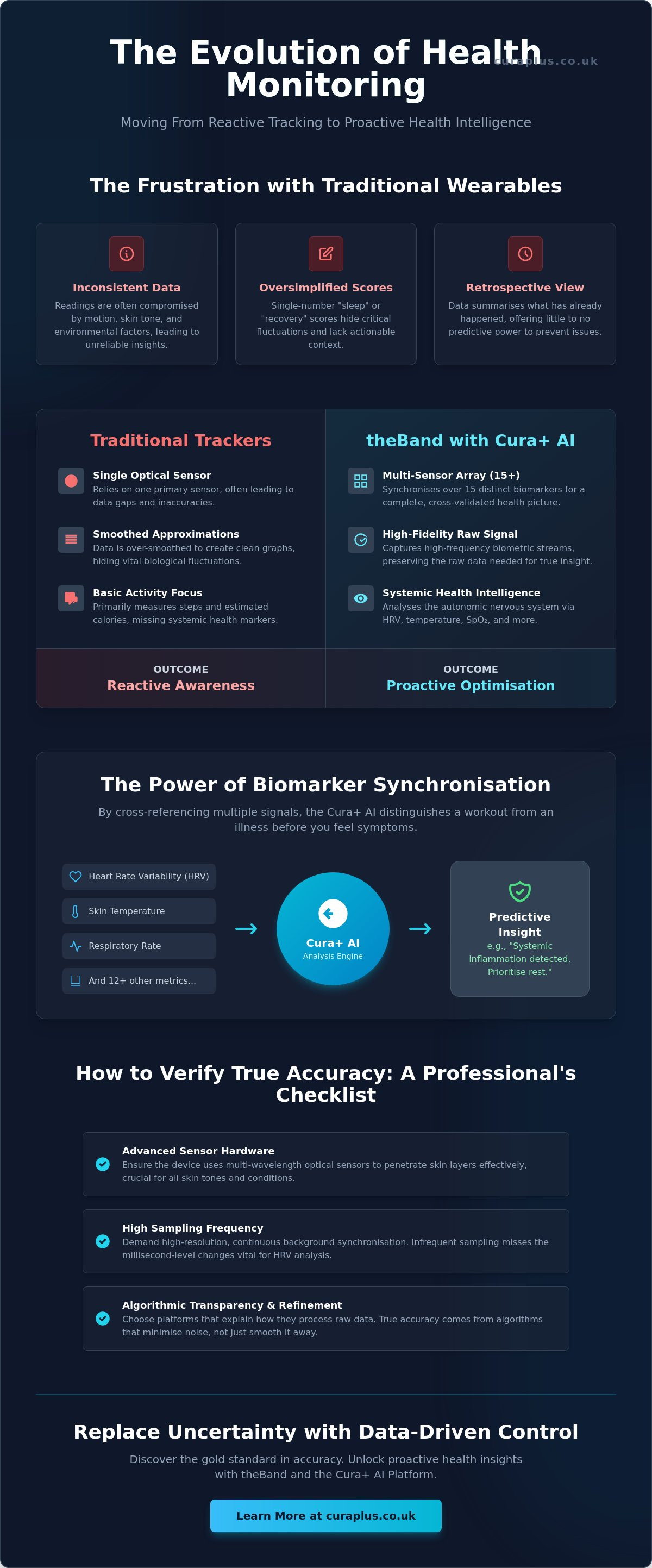
theBand by Cura+ establishes a new benchmark for data integrity by prioritising raw signal quality. Many traditional trackers over-smooth their data to create aesthetically pleasing graphs, but this process often hides critical fluctuations. theBand captures high-frequency biometric streams, ensuring that the insights provided are grounded in biological reality rather than smoothed approximations.
The Shift from Fitness Tracking to Health Intelligence
2026 marks the definitive end of approximate wellness. We've transitioned from consumer-grade gadgets to research-grade instruments that live on the body. Placement remains a vital factor in this evolution. Whilst the wrist is convenient, it's prone to "motion artefacts" that can distort readings during intense activity. The best health wearable for data accuracy must account for these variables through advanced sensor architecture. This ensures that the data you receive is actionable, professional, and entirely reliable for long-term health optimisation.
Key Metrics for Precision Monitoring
Precision monitoring focuses on the autonomic nervous system. Heart Rate Variability (HRV) serves as the primary window into your internal state, but it requires millisecond-level precision to be meaningful. Peripheral oxygen saturation and skin temperature provide additional layers of context, although they require nuanced calibration to account for environmental shifts. Biomarker synchronisation is the core of modern accuracy, where multiple data streams are aligned to create a single, high-fidelity picture of systemic health.
The Biomarker Revolution: Why 15 Sensors Beat 1
A single data point is a liability; a multi-sensor array is a narrative. Most consumer devices rely on a solitary optical sensor to track heart rate, a method frequently compromised by movement, skin temperature, or ambient light. To qualify as the best health wearable for data accuracy, a device must move beyond these isolated metrics. Relying on one sensor is like trying to understand a complex engine by looking only at the exhaust. True precision requires the simultaneous capture of multiple biomarkers to cross-validate every signal and eliminate the "noise" that plagues traditional trackers.
When temperature, heart rate variability (HRV), and blood oxygen are analysed together, the resulting data is far more robust. For instance, a spike in heart rate could indicate stress, physical exertion, or the onset of a fever. Without a concurrent reading of skin temperature and respiratory rate, the device is merely guessing. By cross-referencing signals, theBand can distinguish between a high-intensity workout and a systemic inflammatory response. This rigorous approach to wearable data quality standards ensures that every alert is grounded in clinical-grade evidence rather than algorithmic estimation.
Predictive Accuracy vs. Retrospective Data
Traditional trackers are retrospective by design. They summarise your day, telling you how many steps you took or how poorly you slept after the fact. This information is interesting but rarely actionable. The future of wellness lies in predictive accuracy. By monitoring 15+ biomarkers continuously, theBand identifies minute deviations from your unique physiological norms. It doesn't just record what happened; it provides a window into what is likely to occur, allowing you to adjust your behaviour before a trend becomes a problem.
The Science of the Cura+ AI Platform
The Cura+ AI Platform serves as the intellectual engine for this hardware. It processes raw data streams to filter out environmental interference, ensuring that your readings remain accurate even in challenging conditions. Central to this process is how the platform builds a health baseline for every individual user. Rather than comparing your data to a generic population average, the system learns your specific biological signatures. This personalised calibration allows neural networks to detect the earliest signs of viral onset or autonomic fatigue with remarkable sensitivity. Discovering your baseline is the first step toward total self-mastery within the Cura+ ecosystem.
Comparing Top Contenders: theBand vs. Traditional Trackers
Selecting the best health wearable for data accuracy requires a shift in perspective. Most consumers gravitate toward the Apple Watch Series 11 or the Samsung Galaxy Watch 8 because they excel as communication tools. However, a Systematic Review of Wearable Accuracy reveals that whilst these generalist devices provide acceptable data for the average user, they often struggle with the granular precision required for professional health monitoring. Their sensors must share battery power and processing cycles with high-resolution displays and constant app notifications, which can lead to lower sampling frequencies during critical rest periods.
In professional health contexts, the limitations of Fitbit and Whoop become apparent. Fitbit's ecosystem often prioritises simplified, gamified metrics that can obscure the raw physiological reality. Whoop, whilst popular for its screenless form factor, lacks the diverse biomarker array necessary for a truly systemic health overview. theBand by Cura+ adopts a different philosophy. By removing the screen entirely, the hardware eliminates "distraction data" and focuses its entire energy budget on high-fidelity sensor performance. This allows for a level of data integrity that traditional trackers simply cannot match.
The financial model also reflects this difference in intent. Mainstream brands often use a model where you pay for hardware and then pay again for basic data visualisations. The Cura+ AI Platform shifts this focus. You aren't just paying for access to your own numbers; you're investing in the sophisticated intelligence required to transform 15+ raw biomarkers into a coherent, predictive health strategy.
Sport-Focused vs. Health-Focused Architecture
Athletes and health optimisers require fundamentally different data sets. Standard wearables are built to track "work"—steps, laps, and calories burned. Precision health instruments are built to track "state"—autonomic balance, systemic inflammation, and baseline stability. The problem with gamified health metrics is that they encourage behaviour based on arbitrary scores rather than biological needs. The rise of predictive health wearables in the UK suggests a market that is moving away from these digital badges toward genuine, proactive wellness.
Data Privacy and Ownership in 2026
In the current landscape, the hidden cost of "free" data analysis in big-tech ecosystems is your biometric sovereignty. Many global corporations view your health data as a commodity to be harvested. Cura+ operates with a commitment to user sovereignty, ensuring your most intimate biological signals remain secure and private. British users are increasingly prioritising local, secure health tech that values data integrity as much as data security, ensuring that the journey toward self-optimisation doesn't come at the expense of personal privacy.
How to Verify Wearable Data Integrity Before You Buy
Verification is the final barrier between a mere gadget and a professional-grade health instrument. To secure the best health wearable for data accuracy, you must look beyond the marketing facade and interrogate the underlying architecture. This process requires a technical audit of the hardware and software synergy to ensure the insights you receive are grounded in reality rather than algorithmic guesswork.
Step 1: Research the sensor manufacturer and wavelength technology. Standard green-light LEDs are common but often struggle with deeper tissue penetration; red and infrared wavelengths provide superior accuracy for deeper biomarkers. Step 2: Evaluate the frequency of background data syncs. High-fidelity monitoring requires near-continuous synchronisation to capture the transient nature of autonomic nervous system shifts. Step 3: Look for clinical validation studies or white papers. Devices that have undergone independent scrutiny offer a level of reliability that unverified consumer trackers cannot match. Step 4: Assess the AI’s ability to provide "Why" and not just "What". A drop in recovery score is useless unless the platform identifies the specific physiological catalyst. Step 5: Check for integration with a personalised AI health coach. In 2026, raw data must be paired with intelligent guidance to facilitate actual transformation.
Identifying "Data Smoothing" Pitfalls
Data smoothing is a common industry practice where algorithms "fill in the gaps" between infrequent sensor samples to create "pretty" charts. Whilst these graphs look impressive, they often hide critical health anomalies and transient spikes that indicate systemic stress. Accurate readings require raw, high-resolution biometric streams. You should prioritise devices that allow for raw biometric exports, ensuring your data remains untampered and true to your unique biology. This transparency is what separates the best health wearable for data accuracy from standard fitness trackers.
The Role of Battery Life in Data Continuity
Battery life is often viewed as a convenience, but it's actually a pillar of data integrity. Short battery life leads to frequent charging cycles, creating "data gaps" that ruin the continuity required for predictive models. If your device is on a charger during a nap or a high-stress event, the AI loses the context needed for accurate forecasting. theBand achieves continuous monitoring by balancing sensor power consumption with an efficient, screenless architecture. This ensures a seamless data stream that supports the most rigorous health-optimisation strategies. Discover how theBand maintains precision through continuous wear.
Why theBand by Cura+ is the Gold Standard for Accuracy
Precision is the foundation of mastery. Whilst the market is saturated with devices that offer approximate estimations, theBand by Cura+ has been engineered to establish the definitive benchmark for the best health wearable for data accuracy. This is not merely a tracker; it's a sophisticated multi-sensor array designed to capture over 15 distinct biomarkers with meticulous precision. By synchronising high-fidelity data streams including ECG and inflammation markers, the hardware provides the rigorous input that the Cura+ AI Platform requires to generate truly proactive insights. The synergy between this physical instrument and its proprietary AI engine creates a level of biological clarity that was previously reserved for clinical environments.
Turning accurate data into life-saving foresight is the core mission of the Cura+ ecosystem. Standard wearables might notice a high heart rate during rest, but theBand identifies the specific physiological signatures of autonomic fatigue or viral onset days before physical symptoms manifest. Joining the waitlist for this next-generation technology is the first step toward mastering your biological data. It represents a shift from being a passive recipient of health information to becoming an active strategist of your own wellbeing.
Proactive Health Intelligence in Practice
The practical application of this technology is best seen in its predictive capabilities. By monitoring subtle biomarker trends, theBand can identify stress patterns before they become chronic, allowing for immediate lifestyle adjustments. Case studies in early illness detection have shown that identifying deviations in respiratory rate and skin temperature can provide a critical window for intervention. This proactive approach ensures that you are always operating from a position of knowledge rather than uncertainty. The future of personalised wellbeing depends on this ability to forecast needs rather than merely recording history.
Conclusion: Investing in Certainty
In the high-stakes journey of personal health, accuracy is the only metric that truly matters. Data that is "mostly correct" is fundamentally unreliable for long-term optimisation. theBand by Cura+ offers a unique value proposition by prioritising sensor integrity and algorithmic depth over gamified badges or social distractions. It's a professional tool for those who refuse to compromise on the quality of their health insights. As we move further into 2026, the choice is clear: continue with approximate wellness or invest in the certainty of precision engineering. Secure your future with theBand by Cura+ and begin your transition toward data-driven excellence.
Mastering Your Biological Future through Precision
The transition from fitness tracking to health intelligence marks a significant leap in how we manage our personal biology. We've explored how a multi-sensor array eliminates the noise of single-metric devices and why a screenless architecture prioritises data integrity over digital distractions. Finding the best health wearable for data accuracy is no longer about simple step counting; it's about the sophisticated synchronisation of systemic biomarkers that inform your future state.
theBand, designed and engineered in the UK, represents the pinnacle of this movement. By monitoring 15+ complex biomarkers simultaneously and utilising proprietary AI predictive alerts, it transforms raw data into a proactive health strategy. This level of clarity replaces the anxiety of the unknown with the calm control of actionable insight. You have the opportunity to move beyond retrospective summaries and embrace a future where your health is a system you fully understand and master.
Discover theBand: The UK’s Most Accurate Predictive Wearable
The journey toward self-optimisation is a high-stakes endeavour, but with the right instruments, the path becomes clear. Your biological potential is within reach.
Frequently Asked Questions
Which wearable is most accurate for heart rate variability (HRV)?
While many consumer devices estimate HRV, theBand is engineered for millisecond precision. It utilises high-frequency sampling to capture the subtle intervals between heartbeats, providing a superior resolution compared to standard trackers. This level of detail is essential for anyone using the best health wearable for data accuracy to monitor autonomic nervous system balance and recovery states.
Can a health wearable really detect illness before I feel symptoms?
Yes, predictive AI identifies physiological deviations often days before physical symptoms emerge. By monitoring your unique health baseline, the Cura+ AI Platform detects subtle shifts in heart rate variability and skin temperature. These early warnings allow you to adjust your recovery and behaviour before a viral onset or systemic stress becomes debilitating, moving you from reactive to proactive health management.
How does theBand compare to the Oura Ring for sleep accuracy?
theBand provides a more comprehensive biomarker array than the Oura Ring 4, which primarily focuses on sleep and temperature metrics. Whilst the Oura Ring is a respected tool for sleep tracking, theBand synchronises over 15 biomarkers to provide a systemic view of recovery. This multi-sensor approach ensures that sleep scores are grounded in a broader physiological context rather than isolated movement data.
Do I need a subscription for the most accurate data analysis?
Access to the Cura+ AI Platform is necessary to unlock the full depth of predictive data analysis. Whilst the hardware captures raw biological signals, the platform provides the sophisticated algorithmic interpretation required for high-stakes health optimisation. This subscription ensures your data is filtered through the latest neural networks to maintain the highest standards of precision and actionable insight.
What are the 15 biomarkers tracked by theBand?
theBand monitors a diverse array of metrics, including heart rate variability, peripheral oxygen saturation, and skin temperature. It also tracks respiratory rate, ECG patterns, and markers of systemic inflammation amongst others. This synchronised data stream allows the Cura+ AI Platform to build a high-fidelity picture of your biological state, moving far beyond the limited metrics found in standard consumer wearables.
Is my biometric data secure with Cura+?
Data sovereignty is a core pillar of the Cura+ commitment to its users. Your biometric information is encrypted and stored securely, ensuring that you maintain total ownership of your personal health narrative. We don't view your data as a commodity; instead, it's treated with the gravity and confidentiality that personal health information demands in a modern digital landscape.
How often should I calibrate my health wearable for maximum accuracy?
Calibration occurs continuously through the Cura+ AI Platform as it refines your unique health baseline. You don't need to perform manual adjustments because the system learns your specific physiological signatures over time. This ongoing calibration is what makes it the best health wearable for data accuracy, as it adapts to your changing biological state without user intervention.
Why is skin temperature a critical metric for immune health?
Skin temperature serves as a vital early indicator of the body's inflammatory response. Subtle elevations often precede a fever or other physical symptoms, signalling that the immune system is actively responding to a threat. When cross-referenced with HRV and respiratory rate, temperature data provides a powerful tool for proactive health management and early illness detection before you feel unwell.


