


What if your wearable stopped merely recording what you have already done and started predicting what your body is about to do? For many, the novelty of closing activity rings has faded into a persistent sense of data fatigue. You track your steps and monitor your heart rate, yet you still feel blindsided by sudden exhaustion or an unexpected illness. Many users are now discovering that upgrading from a basic fitness band is no longer about seeking a larger screen. It is about graduating from reactive logging to true predictive biological intelligence.
We recognise the frustration of staring at metrics that offer no clear path to action. You deserve a device that acts as a sophisticated consultant for your physiology, not a digital toy. This article explores how the transition to advanced AI-driven monitoring provides a profound window into your autonomic nervous system and recovery patterns. We will examine how theBand and the Cura+ AI platform move beyond the opaque algorithms of the past to offer actionable clarity. You will learn how to transform your wearable into a proactive early warning system that empowers your journey toward total self-optimisation.
Key Takeaways
- Understand why traditional activity metrics have reached a data ceiling and why 10,000 steps no longer correlates with comprehensive wellness.
- Discover the physiological advantages of upgrading from a basic fitness band to a sophisticated system that monitors 15+ biomarkers simultaneously.
- Learn how AI-driven predictive intelligence acts as a professional early warning system by identifying subtle shifts in your autonomic nervous system.
- Gain a structured 5-point framework for evaluating next-generation wearables, prioritising sensor depth and analytical precision over simple aesthetics.
- Explore how the transition from reactive logging to proactive health management provides the clarity needed for true biological self-optimisation.
Beyond the Step Count: Recognising the Limitations of Basic Fitness Bands
The era of the simple pedometer is ending. For years, Wearable technology has been dominated by devices that serve as reactive logs of movement. These basic fitness bands act as digital diaries; they tell you how many steps you took or how many hours you slept after the fact. Whilst useful for beginners, this approach provides a retrospective view that lacks the depth required for true biological mastery. When upgrading from a basic fitness band, you must move beyond tools that merely record movement and seek those that interpret your physiology.
Many users eventually hit what we term the 'Data Ceiling'. This is the point where hitting a target of 10,000 steps no longer correlates with meaningful improvements in wellness. Movement is only one component of a complex biological system. A basic device might show a high activity level, yet fail to recognise that your body is under significant systemic stress. This reactive tracking only captures what happened, whereas the future of health lies in proactive intelligence that anticipates what is about to occur.
The 'Data Fatigue' Phenomenon amongst Wearable Users
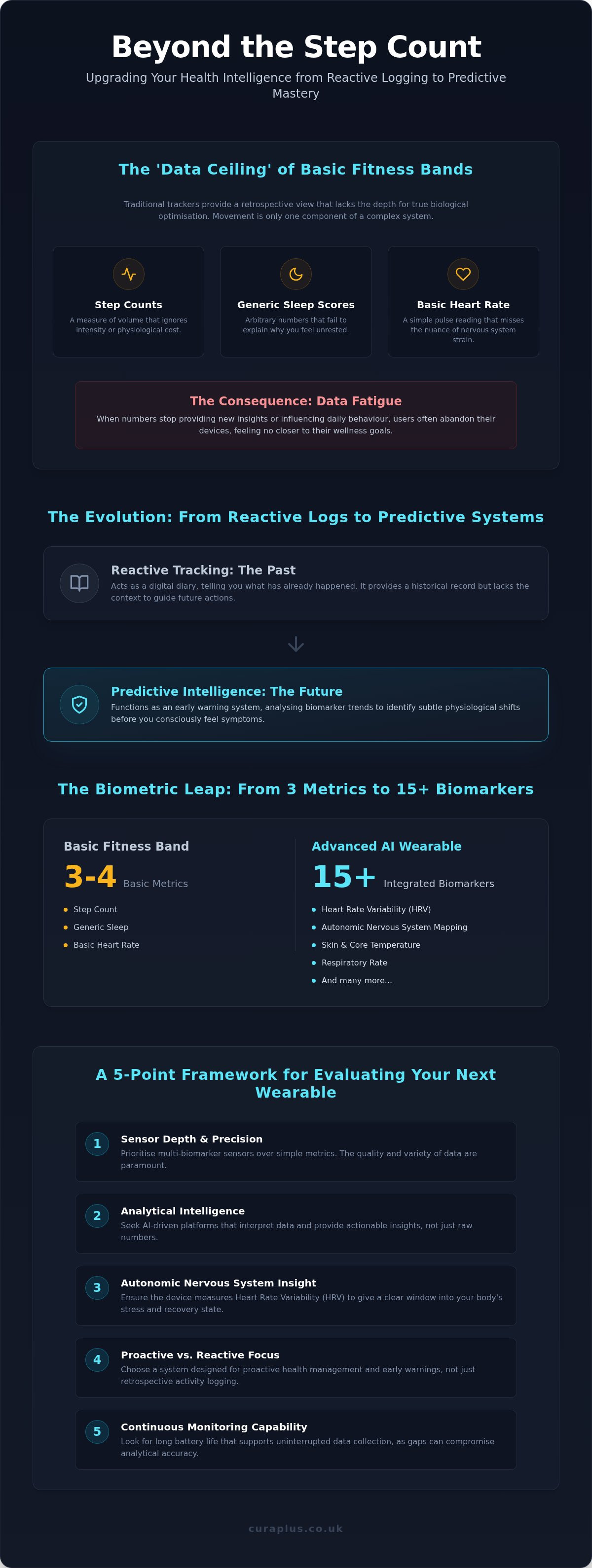
It's common for users to abandon their basic trackers within six months. This abandonment stems from data fatigue; the numbers stop providing new insights and fail to influence daily behaviour. The core issue is the reliance on vanity metrics rather than actionable biomarkers. Consider the limitations of a standard tracker:
- Step counts: A measure of volume that ignores intensity or physiological cost.
- Generic sleep scores: Arbitrary numbers that don't explain why you feel unrested.
- Heart rate: A basic pulse reading that misses the nuance of autonomic nervous system strain.
Without understanding heart rate variability or recovery patterns, a user remains blind to the internal cost of their external activity. True health intelligence requires a shift from counting to interpreting, moving from a passive record to an active consultant for the body.
Why a Better Screen Isn't a Better Health Tool
The consumer market often suggests that a smartwatch is the logical next step. However, a high-resolution screen or a library of wrist-based apps is often a distraction from health optimisation. Adding notifications and music controls does nothing to improve the quality of biological data. In many cases, these 'smart' features demand a trade-off in battery life, which compromises the continuous monitoring required for accurate health modelling. Upgrading from a basic fitness band should focus on the internal state, prioritising sensor sophistication over aesthetic gimmicks that offer little clinical value.
The Biometric Leap: Transitioning to Multi-Biomarker Intelligence
Moving beyond basic movement tracking requires a deeper engagement with the body's internal signals. This shift is defined by biometric tracking for wellness, a discipline that replaces simple step counts with a comprehensive map of biological function. Whilst entry-level devices rely on three or four basic sensors, the next generation utilises arrays capable of monitoring 15 or more integrated biomarkers. This isn't just a numerical increase; it's a fundamental change in how we perceive health. Upgrading from a basic fitness band allows you to access clinical-grade insights that were previously unavailable to the average consumer.
From Heart Rate to Autonomic Nervous System Mapping
Standard heart rate monitoring is often insufficient for high-level performance. It lacks the resolution to show how your body actually responds to stress. Heart Rate Variability (HRV) has emerged as the premier window into the autonomic nervous system, indicating whether you are in a state of sympathetic "fight or flight" or parasympathetic "rest and digest". By integrating HRV with skin temperature, sensors can detect subtle immune system responses before you feel any symptoms. This holistic view addresses many limitations of consumer wearables that fail to provide the context needed for recovery. Mapping the nervous system provides a narrative for your data, turning numbers into a strategy for resilience.
The 15+ Biomarker Standard for 2026
The standard for 2026 involves tracking a sophisticated array of metrics, including respiratory rate, blood oxygen levels, and electrodermal activity. These biomarkers provide a high-fidelity image of your physiological state. Accuracy depends heavily on high-frequency sampling; a device must capture data continuously rather than relying on occasional spot-checks. Clinical-grade precision is no longer reserved for the lab. Upgrading from a basic fitness band means demanding hardware that performs with the rigour of medical instruments. Continuous monitoring ensures that transient biological events are never missed, providing the data density required for advanced AI analysis. This level of detail is essential for anyone serious about preventative health. You can explore how theBand monitors 15+ biomarkers to provide this exact level of clarity.
Reactive Tracking vs Predictive Intelligence: The Role of AI
Data in isolation is merely a historical record. Whilst a basic band might tell you that you walked 8,000 steps yesterday, it cannot explain how those steps affected your systemic recovery. This is the difference between a digital diary and a health coach. By predictive health wearable UK standards, a device must do more than log events; it must interpret them using machine learning. Recent research into AI-integrated wearables in predictive healthcare highlights that the true value of these devices lies in their ability to detect subtle physiological shifts that escape human perception. When upgrading from a basic fitness band, you're moving from reactive tracking to a system that anticipates your needs based on your unique biological signatures.
Building Your Physiological Baseline
Most entry-level trackers rely on population averages to determine if you're "healthy." However, your "normal" is not the same as someone else's. Learning how to build a health baseline is the first step in moving away from these generic benchmarks. An advanced AI platform requires a calibration period, typically 14 to 30 days, to understand your specific circadian rhythms and resting heart rate patterns. Once this baseline is established, the system can identify minute deviations. Instead of receiving a generic notification that you slept seven hours, you receive a specific insight: your recovery is suppressed due to an elevated resting heart rate, and you should prioritise rest over high-intensity training. Generic trackers often misinterpret a late-night meal or a glass of wine as poor sleep quality without understanding the underlying metabolic stress. A personalised AI baseline filters this noise, ensuring that the guidance you receive is relevant to your current state of health.
Early Illness Detection: The Ultimate Upgrade Benefit
The most profound advantage of upgrading from a basic fitness band is the ability to detect illness before symptoms manifest. By monitoring the intersection of skin temperature, respiratory rate, and HRV, the Cura+ AI Platform identifies the subtle markers of viral onset. These "Readiness Scores" act as a dashboard for your internal capacity, preventing burnout and overtraining by flagging when your body is diverted toward immune defence. Predictive alerts are the intersection of biomarker depth and machine learning. This proactive approach transforms the wearable from a fitness accessory into a vital tool for long-term health preservation, allowing you to adjust your lifestyle before a minor issue becomes a significant setback.
A Framework for the Discerning User: Evaluating Your Next Wearable
Selecting a device for the next phase of your health journey requires a methodical approach. It's no longer sufficient to compare battery life or screen brightness. Instead, you must evaluate the utility of the data provided. When upgrading from a basic fitness band, your focus should shift from simple activity tracking to a comprehensive system that serves as a high-level consultant for your body. This transition requires a critical look at the underlying technology and the philosophy of the manufacturer.
Use this five-point framework to ensure your next device meets the demands of predictive health intelligence:
- Sensor Depth: Does the hardware support 10 or more biomarkers? Basic sensors provide a narrow view, whilst advanced arrays capture the full complexity of your physiology.
- Data Ownership: Professional users require access to raw metrics. Avoid "black box" systems that only provide a proprietary score without explaining the physiological changes behind it.
- Intelligence Layer: Ensure the platform offers proactive health management tools. This layer should translate raw metrics into actionable advice.
- Form Factor: Accuracy depends on 24/7 contact. A device must be durable and comfortable enough for continuous wear, especially during sleep.
- Analytical Rigour: The software must distinguish between temporary lifestyle noise and significant biological trends.
Assessing the Value of Health Subscriptions
The rise of subscription models in wearables often causes hesitation. However, it's vital to distinguish between paying for "premium" app features and paying for AI processing power. The Cura+ AI Platform utilises complex machine learning to model your specific biological baseline. This requires significant computational resources that a one-off hardware purchase cannot sustain. Investing in these subscriptions is a move toward preventative health. It's far more cost-effective to invest in early detection than to manage reactive treatments later. True coaching is proactive; it tells you what to do next, rather than just sending automated notifications about what you did yesterday.
Hardware Longevity and Build Quality
Medical-grade materials are essential for long-term health. Low-quality plastics can cause skin irritation during continuous wear, which compromises sensor contact and data accuracy. Your device should be an evolving tool. Future-proof firmware allows your wearable to incorporate new AI research and biomarker interpretations as they emerge. For those operating in a professional context, choosing a wearable for tracking recovery involves looking for this commitment to hardware excellence. You can discover how our technology meets these standards by exploring theBand and our AI-driven platform.
Why theBand by Cura+ is the Logical Final Upgrade
The decision to move beyond entry-level wearables is a commitment to biological excellence. In the UK, theBand by Cura+ represents the definitive conclusion to the era of reactive tracking. Whilst other devices remain tethered to the limitations of the past, our technology is engineered for the future of preventative health. Upgrading from a basic fitness band to theBand is not merely a hardware change; it is an entry into a sophisticated ecosystem of predictive intelligence. By monitoring 15+ biomarkers simultaneously, we provide a resolution of data that basic trackers simply cannot match, ensuring every physiological shift is captured and analysed with clinical rigour. This is the logical final upgrade for those who view their health as a high-stakes journey toward self-optimisation.
Sophisticated Design Meets Clinical Precision
Elite health monitoring shouldn't feel like a distraction. We've designed theBand to be a professional instrument that remains understated and elegant on the wrist. It avoids the toy-like aesthetic common amongst basic trackers, opting instead for a refined form factor that complements a professional lifestyle. This design philosophy ensures continuous, unobtrusive monitoring throughout the day and night. By prioritising high-level sensor integration over unnecessary screen notifications, we maintain the absolute integrity of your biological data. This focus on precision allows the device to function as a silent, expert consultant, providing the high-fidelity signals required for the Cura+ AI Platform to generate accurate directives. It is a tool built for the discerning user who values accuracy above all else.
Your Journey to Self-Optimisation Starts Here
The transition from simple tracking to true health mastery requires a partner that understands the complexity of the human body. Our UK-based AI platform acts as the engine of this transformation, translating raw biometric signals into clear, actionable strategies. Integrating an AI health and wellness coach into your daily routine provides the clarity needed to navigate stress, recovery, and peak performance with confidence. You no longer have to guess why you feel fatigued or when you're most productive; the data provides the answer. As we approach our pre-launch phase, we invite those ready for a more intelligent relationship with their bodies to join us. Upgrading from a basic fitness band is the first step toward a future where health is not just managed, but mastered. Secure your place at the forefront of this biological revolution.
Mastering Your Biological Future
The transition from tracking to mastering your health requires a fundamental shift in perspective. You've moved beyond the "data ceiling" of simple pedometers and recognised that true wellness isn't found in population averages. It's found in the deep, continuous monitoring of your unique physiological signatures. By upgrading from a basic fitness band, you're choosing a path of clarity over data fatigue. You're opting for a system that identifies autonomic strain and immune responses days before they impact your performance.
The future of health is predictive, personalised, and proactive. With theBand and the Cura+ AI Platform, you gain access to 15+ essential biomarkers and predictive AI alerts for early illness detection, all developed with clinical precision in the United Kingdom. This isn't just about collecting more numbers; it's about gaining a sophisticated strategist for your body. The era of reactive health is over, and the era of biological intelligence has begun.
Secure your place in the future of health—explore theBand by Cura+
Your journey toward total self-optimisation is just beginning, and the right data is your most powerful ally.
Frequently Asked Questions
What is the main difference between a basic fitness band and a predictive wearable?
The fundamental distinction lies in the shift from reactive logging to proactive interpretation. Basic bands record what has already occurred, such as steps taken or calories burned. A predictive wearable uses machine learning to anticipate future physiological states. By upgrading from a basic fitness band, you move beyond simple activity counting to a system that identifies subtle trends in your autonomic nervous system, offering a forward-looking view of your health.
Can a high-end wearable really detect if I am getting ill before I feel symptoms?
Yes, advanced wearables can identify the markers of illness up to several days before you feel symptomatic. By monitoring the intersection of skin temperature, respiratory rate, and heart rate variability, the system detects minute deviations from your established baseline. These subtle shifts often indicate that the immune system is diverting energy to fight a viral onset. This early warning allows you to prioritise recovery and adjust your schedule before the illness fully manifests.
Why is Heart Rate Variability (HRV) so important when upgrading my tracker?
Heart Rate Variability is the most significant metric for understanding your autonomic nervous system's current state. It measures the variation in time between each heartbeat, which serves as a direct indicator of stress and recovery. Whilst basic trackers focus on a simple pulse reading, HRV provides the nuance needed to determine if your body is ready for high-intensity activity or requires rest. It is the gold standard for personalising your training and recovery cycles.
Is it worth paying a monthly subscription for a health wearable?
A subscription is essential for the continuous AI processing required to model your unique biology. Unlike a one-off hardware purchase, a subscription supports the significant computational resources needed to maintain your physiological baseline and provide real-time predictive alerts. You are investing in a dynamic intelligence layer that evolves with the latest medical research, ensuring your health insights remain accurate and actionable rather than static and retrospective.
How many biomarkers should a top-tier health wearable track in 2026?
By 2026, a top-tier health wearable should track at least 15 integrated biomarkers to provide a high-fidelity image of your health. This includes metrics such as respiratory rate, blood oxygen, electrodermal activity, and skin temperature. Upgrading from a basic fitness band usually involves moving from devices that only track three or four metrics to those that offer this comprehensive biological map. More biomarkers allow the AI to filter out noise and provide more precise directives.
Will my old fitness data be compatible with a new AI-driven platform?
Most legacy data from basic trackers is incompatible with advanced AI platforms due to differences in sensor resolution and sampling frequency. AI-driven systems like Cura+ require high-density data to build an accurate physiological baseline. Whilst you can still reference your historical step counts, the AI will require a new calibration period of approximately 14 to 30 days. This ensures that the predictive alerts are based on precise, high-fidelity signals rather than lower-resolution historical logs.
Are predictive health wearables as accurate as clinical medical devices?
High-end predictive wearables utilise clinical-grade sensors that offer high levels of precision for wellness monitoring. Whilst they are not designed to provide a medical diagnosis, they are increasingly used as reliable early warning systems. The accuracy of these devices depends on continuous contact and high-frequency sampling. They serve as a sophisticated bridge between occasional medical check-ups and daily health management, providing a level of detail that was previously only available in a laboratory setting.
How does AI actually 'coach' me to better health compared to a basic app?
A basic app merely visualises data, leaving the interpretation to the user. In contrast, an AI coach synthesises multiple biomarkers to provide specific, context-aware directives. It understands that a high heart rate might be caused by stress or a late meal rather than exercise. This intelligence allows the system to offer personalised guidance, such as suggesting a specific recovery duration or identifying the optimal time for peak cognitive performance based on your current biological state.


