


What if the exhaustion you feel upon waking isn't a lack of sleep, but a silent signal that your nervous system is still trapped in a state of high alert? You've likely experienced the frustration of waking up tired despite eight hours of rest, left wondering why your body refuses to cooperate with your ambitions. Standard fitness trackers often provide contradictory data that fails to quantify the physiological impact of mental stress, whilst leaving you to guess your true readiness. Identifying a sophisticated wearable for tracking nervous system recovery is the essential first step in moving beyond guesswork and into a realm of clinical precision.
By mastering the science of autonomic nervous system (ANS) tracking, you'll transform recovery from a subjective feeling into a predictive strategy for peak health. This guide explores how decoding your body's hidden signals provides objective proof of recovery. We will examine how this data allows you to plan your daily intensity with confidence and detect early warning signs of illness or overtraining before they disrupt your progress. It's time to replace uncertainty with the clarity of physiological insight, turning your health into a system to be understood and mastered.
Key Takeaways
- Understand the delicate equilibrium between the sympathetic and parasympathetic branches to move beyond simple rest and into true physiological recovery.
- Learn why Heart Rate Variability (HRV) remains the gold standard for measuring autonomic health and how it dictates your daily performance capacity.
- Discover how to select a professional-grade wearable for tracking nervous system recovery by prioritising sensor density and clinical-grade biomarker monitoring over basic fitness metrics.
- Shift from reactive tracking to predictive intelligence by using AI to identify subtle deviations in your baseline data before symptoms of overtraining or illness emerge.
- Explore how integrating theBand with the Cura+ AI platform provides a holistic view of your health through the simultaneous monitoring of over 15 distinct biomarkers.
The Science of the Autonomic Nervous System: Why Recovery is More Than Rest
Your body's internal management system operates largely beneath the surface of conscious thought. The Autonomic Nervous System (ANS) acts as the primary control centre, orchestrating everything from heart rate to hormonal release without a single conscious command. It's a complex network that dictates how you respond to the world around you. To truly master your health, you must look beyond surface-level symptoms. Integrating a wearable for tracking nervous system recovery allows you to peer into this hidden architecture, turning biological signals into actionable intelligence.
Fight-or-Flight vs. Rest-and-Digest
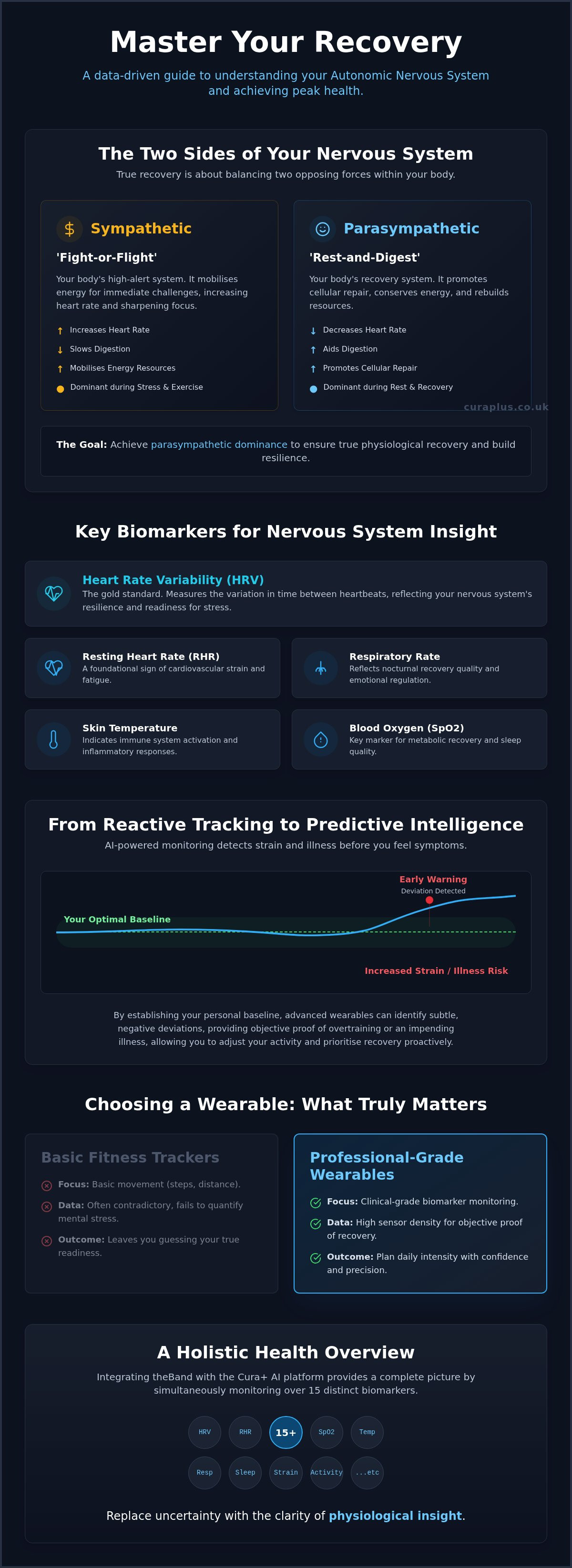
The ANS functions through two primary branches: the sympathetic and the parasympathetic. The sympathetic system is your 'fight-or-flight' mechanism, designed to mobilise energy and sharpen focus during periods of stress. In this state, your heart rate increases and digestion slows as resources are diverted to immediate survival. Conversely, the parasympathetic system initiates 'rest-and-digest' functions, which are essential for cellular repair and systemic recovery. Chronic 'high-alert' states, where the sympathetic branch remains dominant, can lead to systemic inflammation and cardiovascular strain. True recovery only occurs when the parasympathetic system successfully re-establishes control, a process that is often invisible without precise measurement.
The Concept of Physiological Resilience
Resilience isn't a static trait; it's a dynamic reflection of your ANS tone. Some individuals recover faster than others because their systems are more adept at transitioning between states of exertion and rest. Subjective feelings of tiredness often lag behind objective nervous system strain, meaning you might feel capable of a high-intensity session whilst your biomarkers signal a need for stillness. Using proactive health management tools helps you identify your current resilience level with clinical precision. This data-driven approach ensures you don't push into a deficit that leads to systemic burnout.
Over time, your nervous system can be trained to become more resilient through neuroplasticity. By monitoring your recovery patterns, you can identify specific behaviours that strengthen your parasympathetic response. This isn't just about avoiding fatigue. It's about building a body that is fundamentally more capable of handling stress. Objective data transforms recovery from a passive period of waiting into an active, strategic pursuit of peak performance. By understanding the science of your own biology, you move from reacting to symptoms to mastering your health's trajectory.
Essential Biomarkers for Tracking Nervous System Recovery
To move from abstract concepts to a data-driven strategy, you must understand the specific metrics that define your physiological state. Standard fitness devices often overlook the nuances of systemic strain, focusing instead on basic movement. A high-calibre wearable for tracking nervous system recovery provides the depth required for high-level performance management by monitoring a suite of biomarkers that reveal your body's internal load.
- Heart Rate Variability (HRV): The definitive metric for assessing the balance between your sympathetic and parasympathetic branches.
- Resting Heart Rate (RHR): A foundational indicator of cardiovascular strain and overall systemic fatigue.
- Respiratory Rate: A vital sign linked to emotional regulation and the quality of your nocturnal recovery.
- Skin Temperature: Crucial for identifying immune system activation and inflammatory responses before they become symptomatic.
- Blood Oxygen (SpO2): A key marker for metabolic recovery and the detection of potential sleep disturbances such as apnoea.
Heart Rate Variability (HRV) Explained
Many users mistake a low heart rate for a sign of total health. However, the true insight lies in the timing between those beats. Heart Rate Variability (HRV) is the millisecond-level variation between heartbeats that reflects ANS flexibility. A high HRV score suggests a resilient system ready for exertion, whilst a low score indicates a sympathetic dominance that requires rest. Interpreting these scores within the context of your daily readiness allows you to adjust your training volume with clinical precision.
Beyond the Heart: Temperature and Respiration
Nervous system health is not confined to cardiac data. Nocturnal skin temperature deviations are often the first sign of an impending immune response, allowing you to recognise viral onset before physical symptoms appear. Similarly, respiratory stability is a critical marker of deep sleep recovery stages. Adopting a comprehensive biometric tracking for wellness approach ensures you aren't relying on a single, potentially misleading data point. Integrating a professional wearable for tracking nervous system recovery into your daily routine provides the multi-sensor accuracy needed to distinguish between temporary fatigue and systemic overreaching.
By synthesising these diverse metrics, you gain a holistic view of your body's readiness. If you're seeking to move beyond basic trackers, clinical-grade biomarker monitoring provides the clarity required to master your recovery strategy.
The Predictive Power of Baseline Data: Detecting Strain Before Symptoms
Traditional fitness tracking has long been retrospective. It tells you what happened yesterday, but it rarely prepares you for tomorrow. The true power of a wearable for tracking nervous system recovery lies in its ability to shift your perspective from reactive management to predictive health intelligence. By monitoring physiological trends over time, sophisticated AI can identify subtle deviations from your norm long before you feel the physical effects. This foresight allows you to move from guessing your readiness to knowing it with absolute certainty.
One of the most compelling aspects of this technology is the 'Early Warning' window. Research into autonomic trends suggests that deviations in biomarkers can predict illness or systemic overreaching up to 72 hours before physical symptoms appear. If your heart rate variability drops whilst your nocturnal skin temperature rises, your system is likely fighting an invisible stressor. Using this data to justify a 'deload' day or increased rest isn't an admission of weakness; it's a strategic intervention that prevents injury before it occurs. It's about working with your biology rather than against it.
Building Your Unique Health Baseline
Comparing your biological data to population averages is fundamentally flawed. Your "normal" is entirely unique to your genetics, age, and lifestyle. Understanding how to build a health baseline involves a rigorous 14-day calibration period to establish your physiological fingerprint. During this phase, theBand by Cura+ utilises proprietary AI to refine this baseline continuously. This ensures that every alert is contextualised against your specific history rather than a generic template, providing the methodical reliability required for high-stakes health management.
AI and the Future of Predictive Alerts
Raw data is often overwhelming without expert interpretation. An AI health and wellness coach transforms these complex biomarkers into actionable recovery advice. Instead of merely stating you slept for seven hours, the system might observe that your nervous system remains in a sympathetic state and advise you to prioritise light activity or specific breathing exercises. This predictive analytics approach is essential for managing chronic stress patterns. It replaces the frantic energy of typical consumer marketing with a calm, collected strategy that values accuracy above all else. You are no longer just tracking your health; you are mastering a complex system with the guidance of a sophisticated digital strategist.
How to Choose and Use a Wearable for Nervous System Optimisation
Selecting a device to manage your physiology is a high-stakes decision that requires more than a cursory glance at a feature list. You aren't simply buying a gadget; you're choosing a data partner for your biological journey. To move beyond basic fitness tracking, you must prioritise sensor density. A professional-grade wearable for tracking nervous system recovery should monitor over 15 biomarkers simultaneously, providing a high-resolution view of your internal state. Devices that rely solely on movement or basic heart rate often fail to capture the nuanced signals of autonomic strain.
Prioritise raw data accuracy over aesthetic flourishes or social notifications. Whilst a sleek design is appealing, the integrity of the sensors is paramount. Clinical-grade materials ensure consistent skin contact, which is essential for precise readings of skin temperature and blood oxygen. Additionally, consider the long-term reliability of the battery. A device that requires frequent charging creates data gaps, undermining the predictive power of your health baseline. You should also evaluate the cost structure, weighing initial hardware investment against ongoing subscription fees for the AI-driven synthesis required to make sense of your data.
Selection Criteria for Advanced Users
The architecture of the software is as critical as the hardware itself. Many consumer brands operate within 'closed' ecosystems that limit your ability to export or deeply analyse your own health data. For a truly proactive approach, you need a wearable for tracking stress patterns that offers real-time alerts and high-frequency data sampling. Periodic checks are insufficient for capturing the transient spikes in sympathetic activity that define modern stress. Ensure your chosen platform utilises a dedicated AI to synthesise these multiple data points into a single, coherent readiness strategy.
Integrating Wearable Data into Daily Life
Mastering your recovery requires a shift in how you organise your morning. By reviewing your wearable for tracking recovery data immediately upon waking, you can adjust your daily intensity before the first cup of coffee. This provides 'objective permission' to rest on days when your biomarkers indicate strain, removing the guilt often associated with deloading. Beyond physical training, this intelligence helps you optimise cognitive focus and work performance. If your nervous system is resilient, it's the ideal time for deep work; if it's strained, you might prioritise restorative tasks to prevent systemic burnout.
If you're ready to transition from reactive tracking to clinical-grade health intelligence, explore theBand and the Cura+ AI platform to begin your journey toward physiological mastery.
TheBand by Cura+: Elevating Nervous System Intelligence through AI
theBand represents the zenith of modern physiological monitoring. It isn't merely a device; it's the premier predictive health wearable UK solution for those who refuse to settle for surface-level data. By monitoring over 15 biomarkers simultaneously, it provides a high-resolution map of your internal landscape. This depth of insight ensures that your wearable for tracking nervous system recovery captures the subtle interplay between your heart, lungs, and skin temperature. It's time to move beyond the limitations of generic trackers and embrace a system designed for clinical precision. This level of detail is essential for anyone who views their health as a complex, high-stakes system to be mastered rather than a series of symptoms to be managed.
Proactive Health Intelligence in Action
The Cura+ AI Platform acts as a sophisticated strategist for your body, translating raw biological data into clear, actionable intelligence. It identifies the earliest markers of viral onset by correlating subtle shifts in nocturnal skin temperature with sudden drops in HRV. This proactive intelligence allows you to adjust your behaviour up to 72 hours before you even feel unwell. Beyond simple alerts, the platform offers real-time coaching for stress regulation and sleep hygiene, providing the specific steps needed to restore parasympathetic balance. theBand was engineered in the UK to bridge the gap between medical science and consumer wellness. It's a tool for families and individuals who recognise that the future of personal health lies in predictive intelligence rather than reactive medicine. By monitoring multiple users within a household, it allows for a collective approach to wellness and resilience.
Joining the Predictive Wellness Movement
Mastering your recovery is a long-term commitment to longevity and performance. Continuous biomarker monitoring creates a rich historical record that helps you navigate the complexities of ageing and chronic stress with confidence. Getting started is a methodical and rewarding process. Once you secure theBand and activate your Cura+ AI subscription, the system begins its 14-day calibration to define your unique physiological norm. This transition from uncertainty to clarity is the ultimate form of personal empowerment. It replaces the frantic guesswork of traditional wellness with the calm control of data-driven discovery. Explore how theBand by Cura+ can redefine your recovery strategy today and turn your health into a mastered system.
Embracing the Era of Physiological Mastery
Transitioning from subjective feelings to objective data is the cornerstone of modern wellness. You've learned that true recovery requires a deep understanding of the autonomic nervous system and the high-resolution biomarkers that define it. By prioritising sensor density and establishing a unique health baseline, you move beyond basic tracking into a realm of predictive health intelligence. Integrating a professional wearable for tracking nervous system recovery isn't just about monitoring sleep; it's about gaining a strategic advantage over systemic stress and biological strain.
theBand by Cura+ provides this clinical precision, monitoring over 15 essential biomarkers whilst delivering proactive AI-driven alerts. Engineered in the United Kingdom, it serves as a sophisticated guide in your high-stakes journey toward peak health. It's time to replace uncertainty with the calm control of data-driven discovery. Discover theBand by Cura+: The Future of Predictive Health and begin your transition toward physiological mastery today. You don't have to guess your readiness when the future of wellness is already accessible through data. Your journey toward a more resilient, optimised future starts with the clarity of insight.
Frequently Asked Questions
Can a wearable really tell if my nervous system is recovered?
Yes, a sophisticated wearable for tracking nervous system recovery can objectively measure your physiological readiness by monitoring the balance between your sympathetic and parasympathetic branches. Whilst subjective feelings of tiredness are often unreliable, clinical-grade sensors capture millisecond-level changes in your heart rate variability. This data provides a clear window into your autonomic health, allowing you to distinguish between mental fatigue and actual physical strain with precision.
What is the most accurate biomarker for tracking recovery?
Heart Rate Variability (HRV) is widely considered the gold standard for assessing autonomic nervous system balance. It measures the subtle fluctuations in time between successive heartbeats, which directly reflects your system's ability to adapt to stress. When used alongside resting heart rate and skin temperature, HRV provides the most comprehensive and accurate picture of your body's current recovery state and overall systemic resilience.
How long does it take for a wearable to establish my health baseline?
It typically takes a 14-day calibration period for theBand to establish a stable and accurate health baseline. During this window, the Cura+ AI platform analyses your unique physiological patterns across various sleep cycles and activity levels. This process is essential because it ensures that future alerts are contextualised against your personal norms rather than generic population averages, providing the methodical reliability required for high-stakes health management.
Will tracking my nervous system help me avoid getting sick?
Tracking your nervous system provides an early warning window that can identify physiological strain up to 72 hours before physical symptoms appear. By monitoring deviations in skin temperature and HRV, you can detect when your immune system is mobilising against a potential threat. This foresight allows you to proactively adjust your activity and prioritise rest, which helps mitigate the severity of an illness before it fully disrupts your routine.
Do I need to wear theBand 24/7 for accurate recovery data?
For the most accurate and predictive recovery data, you should wear theBand continuously. Continuous monitoring allows the sensors to capture vital nocturnal biomarkers, such as resting heart rate and respiratory stability, which are critical for assessing deep sleep recovery. Whilst daytime data is valuable for tracking stress patterns, the most profound insights into your nervous system's restoration occur whilst you are asleep and at rest.
Is my biometric data secure with the Cura+ AI platform?
Your biometric data is treated with the highest level of security and clinical-grade privacy protocols. We recognise that personal health information is exceptionally sensitive, so the Cura+ AI platform utilises advanced encryption to ensure your data remains protected. You retain ownership of your health intelligence, whilst our systems focus on synthesising that data into actionable insights to support your long-term journey toward self-optimisation.
How does theBand differ from a standard fitness tracker or smartwatch?
theBand differs from standard trackers by monitoring over 15 distinct biomarkers with clinical precision. Most consumer smartwatches focus on basic movement and heart rate, whereas our system prioritises autonomic nervous system intelligence. The integration with the Cura+ AI platform transforms raw data into predictive alerts, moving beyond simple retrospective summaries to provide a forward-looking strategy for your personal health and recovery.
Can I use nervous system data to improve my athletic performance?
You can significantly improve athletic performance by using a wearable for tracking nervous system recovery to optimise your training intensity. By aligning your most demanding sessions with days of high physiological readiness, you ensure that your body is capable of adapting to the load. This data-driven approach prevents overtraining and injury, allowing you to maintain a more consistent and effective progression toward your performance goals.


