


What if the device designed to extend your life was simultaneously compromising your most intimate biological secrets? You likely feel the tension between the revolutionary insights of predictive health and the growing anxiety regarding who truly owns your biometric markers. It's a valid concern as the global wearable market expands toward a projected $186.14 billion by 2030. You deserve to know if your data is being sold to insurers or if it remains a private baseline for your own refinement. Understanding health data privacy wearables is no longer optional; it's the foundation of modern self-optimisation.
We agree that your biological data should belong solely to you. This guide provides the clarity you need to manage your sensitive information whilst leveraging the transformative power of predictive technology. We will explore your rights under the UK Data (Use and Access) Act 2025 and the May 2026 EUDAMED registration requirements. You will gain a robust framework for evaluating hardware like theBand and secure environments like the Cura+ AI Platform to ensure your journey toward wellness remains both visionary and secure.
Key Takeaways
- Identify why the transition from simple activity tracking to monitoring 15+ complex biomarkers necessitates a more sophisticated approach to health data privacy wearables.
- Contrast the static nature of traditional medical records with the dynamic, predictive power of digital biomarkers to better understand your body’s trajectory.
- Evaluate the security protocols required to leverage personalised AI insights without exposing your biometric markers to unauthorised third-party harvesting.
- Master the nuances of UK GDPR and the trust framework established by the Information Commissioner’s Office to confidently exercise your data rights.
- Discover how theBand and the Cura+ AI Platform integrate clinical-grade encryption to transform raw data into a secure, actionable wellness pillar.
The Evolution of Health Data Privacy in the Wearable Era
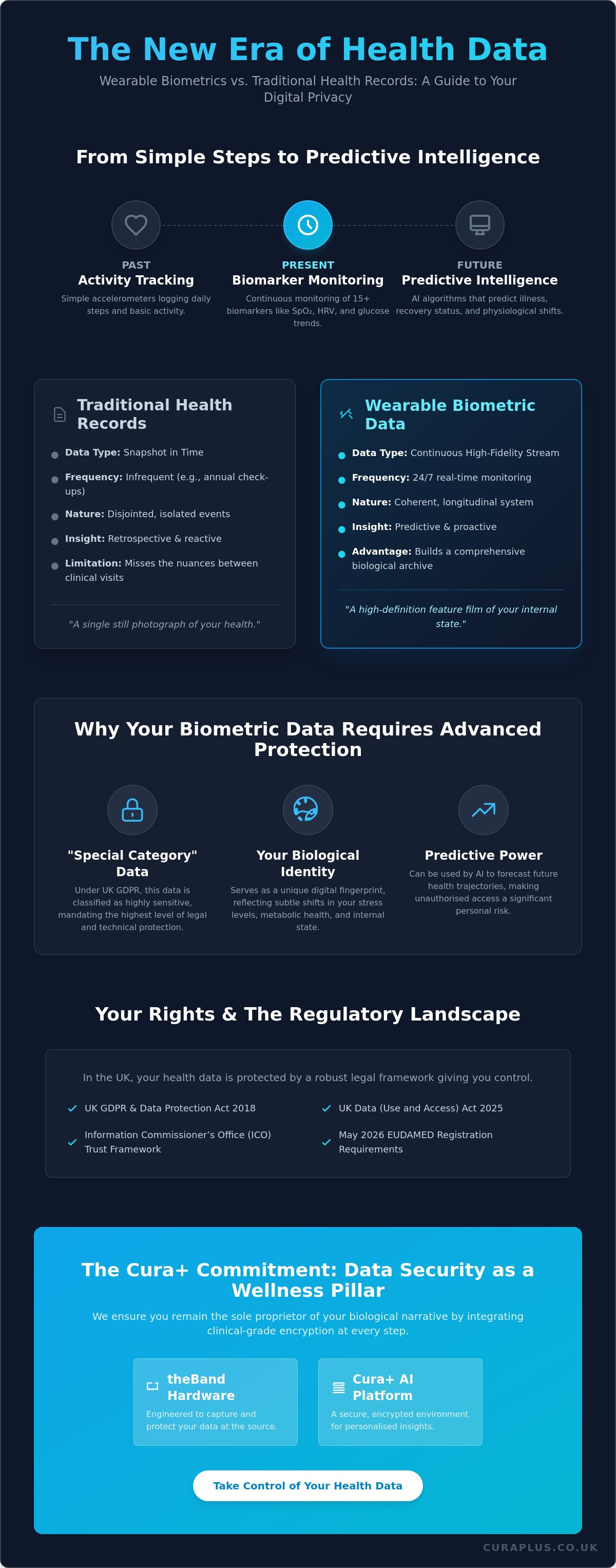
The trajectory of personal wellness has shifted from retrospective logging to real-time biological oversight. In the early days of consumer tech, a simple accelerometer tracking daily steps was the industry standard. Today, we have entered an era defined by the continuous monitoring of over 15 complex biomarkers, including blood oxygen saturation, glucose trends, and autonomic nervous system responses. This transition has fundamentally altered the requirements for The Evolution of Health Data Privacy in the Wearable Era. As these devices move from peripheral gadgets to essential health tools, the security of the information they harvest must be treated with clinical precision.
Under the UK General Data Protection Regulation (GDPR) and the Data Protection Act 2018, the raw streams produced by health data privacy wearables are classified as "special category" data. This designation reflects the high stakes involved; these are not merely numbers, but intimate reflections of your internal state. theBand was engineered to address this specific gravity. It establishes a new standard by ensuring that the user remains the sole proprietor of their biological narrative, even as the data becomes increasingly complex and predictive.
From Fitness Tracking to Predictive Intelligence
We are witnessing a move away from historical data logging toward a future of predictive intelligence. Early wearables told you how far you had walked; modern systems tell you when your body is beginning to recover or if a period of illness is imminent. This depth of insight requires a level of data density that was previously impossible. Sophisticated users now recognise that basic encryption is insufficient for protecting a 24/7 stream of their life force. They demand a system that doesn't just store data, but secures a vision of their future self through advanced algorithmic protection.
The Sensitivity of Continuous Biomarker Monitoring
Biometric markers such as heart rate variability (HRV) and skin temperature are uniquely personal, reflecting the subtle shifts in your stress levels and metabolic health. These metrics are more than just statistics; they are the foundation of your biological identity. To truly master your health, you must learn how to build a health baseline within a secure, encrypted environment. Biometric data serves as a unique digital fingerprint that remains constant even as your daily habits fluctuate. Protecting this baseline is the first step in any high-performance wellness strategy, ensuring that your most sensitive markers are never compromised.
Biometric Data vs Traditional Health Records: What is the Difference?
Traditional health records are snapshots in time. A GP appointment provides a single data point; a blood test offers an isolated chemical profile. In contrast, health data privacy wearables generate a continuous, high-fidelity stream of biological information. This dynamic data flow captures the nuance of your body's circadian rhythms and physiological stressors that a fifteen-minute consultation inevitably misses. By capturing the space between clinical visits, you transform your health from a series of disjointed events into a coherent, manageable system. It's the difference between a still photograph and a high-definition feature film of your internal state.
The gap between annual check-ups is where most physiological shifts occur. Wearable technology fills this void by providing a longitudinal view of your wellness. This constant oversight allows for the identification of trends that would otherwise remain invisible until they manifest as symptomatic issues. You aren't just collecting data; you're building a comprehensive biological archive that empowers you to make informed, data-driven decisions about your lifestyle and performance.
Defining Digital Biomarkers in 2026
Digital biomarkers represent the next evolution in preventative care. AI algorithms now interpret raw sensor data, such as peripheral oxygen saturation or sleep architecture, to predict physiological shifts before symptoms manifest. This predictive power is particularly evident when using a wearable for tracking immune health, where subtle changes in resting heart rate can signal an oncoming inflammatory response. As discussed in The Privacy Paradox: AI, Predictive Analytics, and Security, the granular nature of these streams requires unparalleled protection to prevent the commodification of your biological identity. These biomarkers are rapidly becoming the gold standard for those who view health as an asset to be optimised.
The Ownership Question: Your Body, Your Data
Who owns the digital reflection of your biology? In the UK, the distinction between a data controller and a data processor is vital. Whilst a platform might process your information, your right to data portability ensures you remain the primary stakeholder. You possess the legal authority to move your biomarkers between platforms; however, many legacy systems make this process unnecessarily opaque. Cura+ prioritises your sovereignty. By utilising theBand alongside the Cura+ AI Platform, you ensure that your data remains your property, processed with the clinical rigor you expect. It's about maintaining absolute control over your internal narrative. You can explore how theBand secures your biological identity whilst providing these elite insights.
The Privacy Paradox: AI, Predictive Analytics, and Security
The central tension in health data privacy wearables lies in the assumption that predictive accuracy requires the sacrifice of anonymity. Many believe that for AI to offer meaningful insights, it must harvest every facet of a user's identity. This is a fallacy. True intelligence in wellness technology doesn't require knowing who you are; it requires understanding how your body functions. Personalised AI focuses on refining your unique biological baseline, moving away from the "big data" harvesting models that prioritise quantity over individual security. By shifting the focus from mass data collection to specific pattern recognition, we can achieve high-level performance without compromising the individual.
A recent systematic analysis of wearable privacy policies highlighted that many manufacturers still struggle to balance algorithmic needs with user sovereignty. Whilst some platforms treat your markers as a commodity to be traded, a visionary approach views data as a private asset. Security isn't a barrier to innovation; it's the prerequisite for it. When you trust the environment in which your data resides, you're more likely to engage with the tools that drive self-optimisation. This is the foundation of a secure, data-driven lifestyle.
How AI Algorithms Predict Physiological Changes Securely
Predictive models rely on "de-identification," a process that strips personal identifiers from raw datasets before analysis. This allows the AI to learn from physiological patterns without ever linking those patterns back to a specific individual. Modern predictive health wearable UK technology increasingly utilises edge computing, where data processing occurs locally on theBand rather than in the cloud. This architecture ensures that your most sensitive markers never leave your person, providing a layer of methodical reliability that traditional cloud-based systems cannot match.
Preventing the Misuse of Health Trends
The risk of "health profiling" by third-party entities is a significant concern for the sophisticated user. Insurance companies or advertisers could, in theory, use biometric trends to adjust premiums or target vulnerabilities. To counter this, the Cura+ AI Platform maintains a strict "no-sell" policy, ensuring your biomarkers remain exclusive to your wellness journey. We view health as a complex system to be mastered, not a profile to be exploited. Our architecture generates predictive alerts by analysing patterns in encrypted data packets, ensuring that actionable insights never require the exposure of your personal identity. This methodology replaces uncertainty with clarity, allowing you to pursue excellence with absolute confidence.
Navigating UK Regulations: Your Rights and Wearable Standards
The protective framework surrounding your biological data is not merely a set of abstract guidelines; it's a rigorous legal mandate designed to ensure your digital sovereignty. In the United Kingdom, the Information Commissioner’s Office (ICO) serves as the primary guardian of these standards, overseeing how companies handle what is legally defined as "special category" data. For users of health data privacy wearables, this means that every heartbeat and sleep cycle recorded is subject to higher levels of protection than standard personal information. Understanding these rights is the first step in moving from a passive consumer to an informed architect of your own wellness.
A high-end device must embody "Privacy by Design." This principle ensures that security is not an afterthought or a secondary feature but is integrated into the very fabric of the hardware and software. When you choose an elite system, you're investing in an architecture that prioritises your safety at every touchpoint. We believe that true wellness is impossible without the peace of mind that comes from knowing your most intimate biological markers are shielded by the most stringent regulatory standards in the world.
The UK GDPR Framework for Biometrics
Under the UK GDPR, you possess the "Right to Access" your raw data at any time. This prevents manufacturers from locking your biological history behind proprietary walls, allowing you to export your markers for independent analysis or personal archiving. Equally vital is the "Right to Erasure." Should you decide to cease using a platform, the provider is legally obligated to delete your sensitive information entirely. These UK-specific protections are often far more robust than the generic international "terms of service" agreements found in mass-market devices, which may offer vague promises rather than statutory certainties.
A Consumer Checklist for Data Integrity
Before syncing any new device, you should verify the specific protocols used to transport and store your information. A sophisticated approach to data integrity includes several non-negotiable checks:
- End-to-End Encryption (E2EE): Ensure that data is encrypted from the moment it leaves theBand until it reaches the secure Cura+ AI Platform.
- Physical Storage Location: Confirm whether your data resides on UK-based servers, which are subject to local laws, or in overseas jurisdictions with potentially weaker protections.
- Policy Transparency: Assess the clarity of the privacy policy for your advanced wellness tracker to ensure there are no hidden clauses regarding third-party data sharing.
You have the power to demand total transparency from the technology you wear. By asking these questions, you ensure that your journey toward self-optimisation remains secure and private. To see how we implement these standards in practice, you can explore the Cura+ security framework and discover a more resilient approach to health tracking.
The Cura+ Commitment: Data Security as a Wellness Pillar
We believe that security is the silent architect of self-optimisation. True empowerment comes from the certainty that your biological narrative is shielded by an uncompromising framework. As we've explored throughout this guide, the landscape of health data privacy wearables is complex, yet the solution lies in a partner that views data integrity as a fundamental wellness pillar. By choosing a UK-based partner like Cura+, you ensure that your physiological insights are governed by the most stringent regulatory standards in the world, providing a level of methodical reliability that international competitors often fail to match.
The Cura+ AI Platform was designed with a layered security architecture that mirrors the complexity of the human body itself. Every data packet, from heart rate variability to metabolic trends, undergoes rigorous encryption before it even leaves your wrist. We don't just provide a device; we provide a secure ecosystem where your data is transformed into clarity without ever becoming a vulnerability. This commitment to transparency ensures that you remain the sole strategist of your own health journey, moving from uncertainty to a state of calm control.
Security Features of theBand
The sensor array within theBand utilises hardware-level encryption to secure your biomarkers at the point of collection. This ensures that even before transmission begins, your data is protected against unauthorised access. We employ secure, high-register Bluetooth protocols to facilitate the movement of data from the sensor to your mobile application, maintaining a closed loop of information. Regular firmware updates are a non-negotiable component of our security strategy; these updates ensure that your hardware evolves alongside the latest defensive technologies to maintain peak integrity at all times.
Your AI Health Coach: Intelligence without Intrusion
Our AI health and wellness coach operates on a strict "need-to-know" data basis. This means that while the algorithms provide you with elite, predictive insights, they do so without exposing your personal identity to external systems. You maintain absolute control through a transparent user dashboard, where you decide exactly who sees your health reports and how your data is utilised. We believe that privacy doesn't just protect your past; it enables a more profound health journey by allowing you to experiment and optimise with total freedom. When your data is secure, you're free to discover your true potential.
Securing Your Biological Future
The shift toward predictive intelligence necessitates a fundamental change in how you perceive your biological narrative. You've identified that digital biomarkers offer an unprecedented window into your future wellness, provided they remain under your exclusive control. Mastering health data privacy wearables is about more than just security; it's about establishing the trust required to pursue elite self-optimisation without hesitation. By leveraging the statutory protections of the UK and choosing clinical-grade hardware, you ensure that every physiological insight remains a private asset.
Cura+ facilitates this high-stakes journey through UK-based data processing and a strict adherence to "Privacy by Design" principles. Our clinical-grade biometric sensors provide the accuracy you demand within an architecture that respects your sovereignty. You now possess the framework to move beyond uncertainty and toward a state of calm, data-driven control. The future of your health is already accessible; ensure it remains yours alone.
Discover theBand: The Secure Choice for Predictive Health
Your potential for transformation is vast, and with a secure foundation, you're ready to master the complex system of your own body.
Frequently Asked Questions
Is my wearable data protected by UK GDPR?
Your biometric information is classified as "special category" data under the UK General Data Protection Regulation (GDPR). This designation mandates the highest level of legal protection, requiring explicit consent and a clear legal basis for any data processing. Because these markers are uniquely identifiable, they are subject to more stringent security requirements than standard personal data, ensuring your digital sovereignty remains intact at all times.
Can my employer or health insurer access my biometric data?
No third party, including employers or health insurers, can access your biometric stream without your explicit, granular consent. Under UK law, such data cannot be shared or sold for the purposes of adjusting premiums or monitoring workplace performance without a specific legal agreement. Cura+ maintains a strict "no-access" policy for external entities, ensuring your health trends remain a private asset for your exclusive use.
What is the difference between anonymised and pseudonymised data?
Anonymised data is information that has been permanently stripped of all identifiers, making it impossible to link the records back to you. Pseudonymised data replaces your identity with a unique "key," allowing for secure processing whilst maintaining the technical possibility of re-identification under strictly controlled circumstances. Understanding this distinction is vital for managing health data privacy wearables, as it determines how your biological markers contribute to secure research datasets.
Where is my health data physically stored when using the Cura+ platform?
Your information is physically stored on secure, UK-based servers that comply with the most rigorous data sovereignty laws. By maintaining a local data residency, we ensure that your biomarkers are never subject to the weaker privacy frameworks of overseas jurisdictions. This physical proximity provides an additional layer of methodical reliability, ensuring that your data remains governed by the Information Commissioner’s Office (ICO) standards and UK statutory requirements.
How does theBand protect against potential data breaches?
theBand utilises hardware-level encryption within the sensor array to secure your data at the moment of collection. This is followed by secure, high-register Bluetooth transmission to the Cura+ AI Platform, ensuring end-to-end protection for every biological packet. We also implement regular firmware updates to address evolving threats, creating a resilient defensive perimeter that guards against unauthorised access and maintains the clinical integrity of your sensitive biological stream.
Can I delete all my health data if I decide to stop using the device?
You possess the absolute "Right to Erasure" under UK GDPR, allowing you to request the permanent deletion of your entire biological archive at any time. Once this request is processed, all records of your biomarkers, trends, and predictive insights are purged from the Cura+ AI Platform. This ensures that you aren't just a user, but the ultimate proprietor of your biological narrative, with the power to end the data stream at your discretion.
Does Cura+ sell my health information to third-party companies?
Cura+ operates under a strict "no-sell" policy, meaning your personal biomarkers and health trends are never commodified or shared with advertisers. We believe that health data is a complex system to be understood and mastered, not a product to be traded. Your relationship with the Cura+ AI Platform is built on a foundation of mutual trust and a shared commitment to your personal self-optimisation and long-term wellness.
What should I look for in a wearable privacy policy before purchasing?
Prioritise transparency regarding data residency and the specific protocols used for end-to-end encryption. You should verify whether the manufacturer explicitly categorises biometric markers as special category data and check for clear clauses regarding third-party sharing. A robust policy for health data privacy wearables will be written with clinical precision, avoiding vague terminology in favour of statutory certainties and clear, actionable user rights that put you in control.


