


What if the "low" score flashing on your wearable isn't a sign of failure, but a sophisticated early warning system from your autonomic nervous system? You've likely felt that familiar spike of anxiety whilst scrolling through your morning data, wondering why your numbers have suddenly plummeted. It's common to feel overwhelmed by the sheer volume of data, especially when trying to understand what causes low heart rate variability UK residents are seeing on their trackers in 2026. We understand that without context, these numbers often create more questions than they answer.
This article promises to demystify the physiological and lifestyle factors driving low HRV, helping you move from reactive worry to proactive management. We'll examine the specific biological triggers for these shifts and explain how to differentiate between temporary fatigue and chronic systemic load. You'll learn how to leverage high-fidelity tools like theBand and the Cura+ AI Platform to transform raw metrics into a personalised roadmap for long-term resilience and health mastery.
Key Takeaways
- Understand HRV as the precise millisecond-level variation between heartbeats, reflecting the dynamic equilibrium between your sympathetic and parasympathetic systems.
- Identify what causes low heart rate variability UK individuals often encounter, from acute physiological load to chronic psychological stress and disrupted circadian rhythms.
- Learn to differentiate between a temporary dip in systemic recovery and a persistent baseline shift that signals a more significant health trend.
- Discover how to implement strategic interventions, such as resonance frequency breathing, to actively stimulate your parasympathetic nervous system and improve resilience.
- Explore how theBand and the Cura+ AI Platform utilise predictive intelligence to filter biometric noise and deliver clear, actionable insights for systemic self-optimisation.
Understanding Heart Rate Variability: The Autonomic Balance
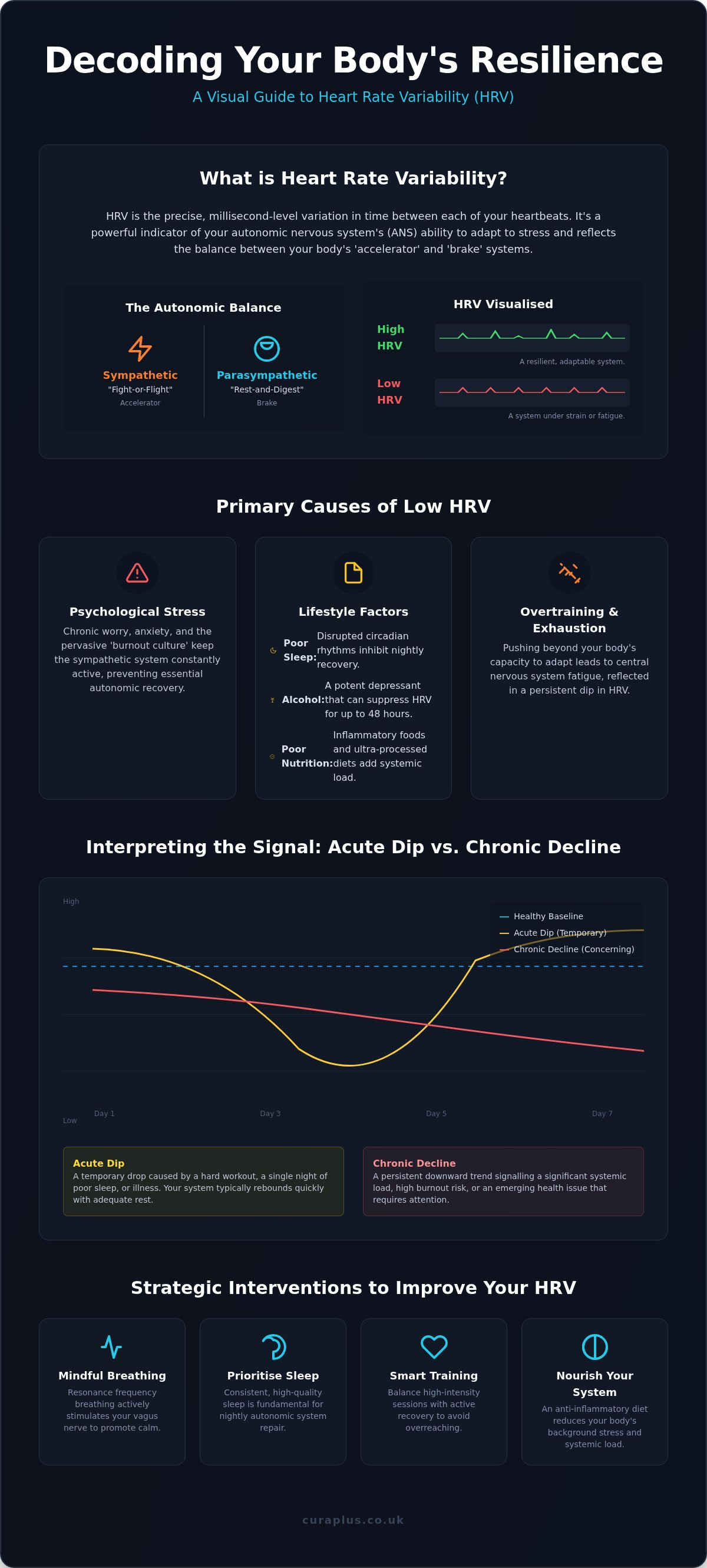
The human heart is not a metronome. Whilst we often perceive our pulse as a steady, rhythmic beat, the reality is far more complex and informative. To gain a foundational grip on What is Heart Rate Variability (HRV)?, we must look at the millisecond-level variation between consecutive heartbeats. This variability is a direct reflection of your autonomic nervous system (ANS) and its constant effort to maintain internal equilibrium. A high degree of variation suggests a resilient, responsive system. Conversely, a heart that beats with rigid regularity often signals an ANS under significant strain.
This internal state is governed by a perpetual tug-of-war between two distinct branches. The sympathetic nervous system acts as your body's accelerator, preparing you for "fight-or-flight" by increasing heart rate and alertness. Its counterpart, the parasympathetic nervous system, serves as the "rest-and-digest" mechanism, promoting recovery and calm. When these two systems are in balance, your HRV remains high. Identifying what causes low heart rate variability UK high-performers often report usually begins with identifying an overactive sympathetic drive. The ultimate goal is physiological flexibility; the ability of your system to pivot between intense focus and deep recovery with effortless precision.
The Role of the Vagus Nerve
The vagus nerve is the primary conduit of the parasympathetic system, acting as a biological brake for the heart. High-frequency HRV readings are often used as a proxy for "vagal tone", which measures how effectively this nerve can slow the heart down after a stressor. Amongst modern UK professionals, chronic stress frequently leads to poor vagal tone. This results in a persistent state of sympathetic dominance, where the body forgets how to downregulate, leading to the suppressed HRV patterns that precede burnout and systemic fatigue.
HRV vs. Heart Rate: Clearing the Confusion
It's vital to distinguish between beats-per-minute (BPM) and R-R intervals, which are the specific time gaps between heartbeats. A standard heart rate monitor provides an average of these beats, but it ignores the microscopic variations that reveal your true recovery status. Paradoxically, an athlete might exhibit a low resting heart rate whilst simultaneously showing low HRV. This often occurs during periods of overtraining, where the heart is slow due to fatigue but lacks the variability of a healthy system. Mastering biometric tracking for wellness requires a dual-lens approach. You must monitor both BPM and HRV simultaneously to understand whether a low pulse indicates peak fitness or a system that's simply running out of steam.
Primary Causes of Low HRV: From Lifestyle to Physiology
Low heart rate variability is rarely the result of a single event. It is more often the cumulative expression of systemic load. In our high-pressure environment, identifying what causes low heart rate variability UK high-achievers face requires a look at both obvious stressors and subtle physiological shifts. Psychological stress and the pervasive "burnout culture" remain dominant factors. When your mind perceives a constant threat, your sympathetic nervous system stays locked in an active state. This chronic activation prevents the autonomic recovery necessary to maintain a healthy, variable heartbeat.
Lifestyle choices play an equally critical role. Disrupted circadian rhythms and poor sleep hygiene prevent the parasympathetic system from performing its nightly maintenance. Alcohol is a particularly potent depressant here. Even a single glass of wine can suppress your HRV for up to 48 hours, as your body prioritises metabolising toxins over systemic repair. There are many Factors Influencing Heart Rate Variability, including the inflammatory load created by ultra-processed diets and sedentary behaviour. These factors create a background "noise" of inflammation that forces your heart into a rigid, metronomic rhythm.
Overtraining and Physical Exhaustion
Physical exertion is beneficial, yet there is a fine line between growth and "overreaching". When you push beyond your body's capacity to adapt, the central nervous system enters a state of fatigue that manifests as a persistent dip in HRV. Using a wearable for tracking recovery allows you to identify this phase before it leads to injury. It provides the data necessary to swap a high-intensity session for active rest, preserving your long-term performance trajectory.
Subclinical Illness and Immune Response
One of the most visionary applications of HRV data is its predictive power. A sudden, unexplained drop in HRV often precedes visible symptoms of illness, such as a cough or fever, by 24 to 72 hours. This occurs because the immune system requires significant metabolic energy to activate against a viral threat, long before you "feel" sick. By utilising a wearable for tracking immune health, you can detect these early warnings. Monitoring these trends through the Cura+ AI Platform ensures you can adjust your schedule and prioritise rest before a subclinical threat becomes a full-scale health setback.
Acute vs. Chronic Low HRV: Interpreting the Signal
A single low HRV reading is rarely a cause for alarm. It is merely a snapshot of your body's current state. Acute low HRV represents a temporary dip in your autonomic resources. This occurs following specific events like an intensive HIIT session, a late-night flight, or even a particularly rich meal. In these instances, your system is simply diverting resources to repair and digestion. The number should rebound within 24 to 48 hours as you return to equilibrium.
Chronic low HRV is a different signal entirely. This refers to a persistent downward shift in your baseline over weeks or months. It suggests that your system is no longer recovering fully between stressors. When investigating what causes low heart rate variability UK residents often find that chronic suppression is a lead indicator of long-term psychological strain or emerging systemic health issues. Comparing your data to a global average is scientifically flawed; HRV is as unique as a fingerprint. A "low" score for a marathon runner might be a "high" score for a sedentary executive. The only valid comparison is your own historical data.
The Cura+ philosophy centres on this personalised approach. We don't care where you sit on a bell curve of the general population. We care where you sit relative to your peak self. This shift in perspective replaces the anxiety of "low" numbers with the clarity of trend analysis.
The Power of Predictive Baselining
Meaningful insight requires context. AI-driven algorithms now establish a personalised "normal" range for your unique physiology, filtering out the daily noise to reveal the underlying trend. Learning how to build a health baseline is the first step in moving from data collection to predictive wellness. For the highest accuracy, we prioritise data captured during deep sleep, amongst periods of minimal external interference. This ensures that the Cura+ AI Platform can detect subtle deviations that might otherwise go unnoticed, turning raw numbers into an early warning system for your systemic resilience.
When Low HRV Becomes a Clinical Concern
Whilst wearables offer unparalleled proactive intelligence, they are not a substitute for clinical diagnosis. Certain red flags indicate that a low HRV trend requires medical attention. If you experience persistent low readings accompanied by heart palpitations, unexplained shortness of breath, or fainting, you should consult a UK GP. Chronic low HRV is sometimes linked to cardiovascular conditions such as atrial fibrillation, which affects approximately 2% of the UK adult population according to current health statistics. Use your data to facilitate informed conversations with healthcare professionals rather than attempting to self-diagnose complex medical conditions. Your wearable is a sophisticated guide, not a medical practitioner.
Strategic Interventions: Improving Your HRV Baseline
Improving your HRV baseline is not about a single "hack". It's about a methodical refinement of your systemic environment. Whilst we've established what causes low heart rate variability UK high-performers often face, the focus must now shift to active restoration. The most effective interventions are those that align your daily habits with your biological requirements. Sleep consistency is your primary leverage point. By going to bed and waking up at the same time every day, you anchor your circadian rhythm, allowing the parasympathetic system to initiate repair with predictable precision.
In addition to sleep, you can utilise specific physiological triggers to stimulate the vagus nerve. Resonance frequency breathing, which involves taking exactly six breaths per minute, synchronises your heart rate with your respiration to create a state of autonomic coherence. Cold exposure is another powerful tool. Short bursts of cold water during a contrast shower act as a controlled hormetic stressor. This trains your system to recover faster from external pressure, building the systemic resilience needed to navigate a high-stakes professional life.
Adopting a "recovery-first" mindset is essential for long-term health mastery. Instead of pushing through periods of suppressed variability, use a wearable for tracking stress patterns to time your most demanding tasks. This data-driven approach ensures you only engage in high-intensity work when your system has the biological bandwidth to handle the load. To begin your journey towards data-driven resilience, explore the Cura+ ecosystem today and gain the clarity your body deserves.
Mind-Body Techniques for Vagal Stimulation
Meditation is more than a relaxation tool. It has a measurable impact on the structural integrity of the brain's stress-response centres. Consistent practice strengthens the "vagal brake", allowing for faster downregulation after a stressful event. Social connection is equally vital. UK office culture can often lead to isolation, yet strong social bonds and "positive affect" are biological requirements for high HRV. Utilising UK-based resources like the Headspace app or local mindfulness workshops can provide the structure needed to maintain these habits.
Nutritional and Lifestyle Refinements
Hydration and electrolyte balance are fundamental to cardiac stability. Without adequate magnesium and potassium, your heart's electrical signalling becomes less efficient, often leading to the rigid rhythms associated with low HRV. Your evening routine also dictates your recovery potential. Late-night meals, common in UK social habits, force the body to focus on digestion whilst you sleep, which prevents deep nocturnal recovery. Reducing blue light exposure from screens in the evening further supports the natural parasympathetic shift, ensuring your body is prepared for a restorative night.
Predictive Intelligence: How theBand Decodes HRV Trends
Understanding what causes low heart rate variability UK high-performers experience is merely the initial step in a much larger journey toward systemic mastery. Raw data, whilst useful, often lacks the necessary context to drive meaningful change. This is where theBand transcends the capabilities of standard fitness trackers. By monitoring over 15 biomarkers simultaneously, theBand provides a high-fidelity, holistic view of your physiological state. It doesn't just record a number; it decodes the complex biological narrative occurring beneath the surface.
The Cura+ AI Platform serves as the sophisticated engine behind this data. It is specifically engineered to filter out the "noise" of daily life, such as minor environmental fluctuations or temporary movement artefacts, to reveal the true signal of your autonomic health. This leads to the activation of our Predictive Alert system. This visionary technology identifies subtle physiological shifts up to three days before they manifest as physical symptoms. This allows you to pivot from reactive management to the use of elite proactive health management tools, ensuring that a dip in HRV becomes a strategic data point rather than a health setback.
AI-Driven Health Coaching
The platform functions as a digital consultant for your body's complex systems. Rather than providing generic advice, the Cura+ AI Platform delivers personalised recommendations based on your unique HRV trends and historical baselines. If the data suggests a persistent downward trend in your autonomic recovery, the system might suggest specific adjustments to your sleep architecture or breathing protocols. This is the future of personalised wellness. It is a world where empirical data replaces guesswork, and every decision you make is backed by clinical-grade intelligence.
The Cura+ Commitment to Excellence
At Cura+, our mission is defined by a blend of clinical precision and aspirational empowerment. We believe that health is not merely the absence of illness, but a complex system to be understood and mastered. We've moved beyond simply identifying what causes low heart rate variability UK residents face; we've created a pathway for you to master your biological potential. Our commitment is to provide you with the clarity and control needed to navigate your high-stakes journey with absolute confidence.
The future of predictive health is no longer a distant concept; it is accessible today. By integrating sophisticated technology with methodical reliability, we empower you to take ownership of your systemic resilience. Don't leave your wellness to chance. Join the pre-launch today to secure your place in the future of predictive health and transform your biometric data into actionable intelligence.
Mastering Your Autonomic Intelligence
Identifying what causes low heart rate variability UK high-performers encounter is the first step toward reclaiming control over your physiological narrative. You've learned that HRV is a sophisticated reflection of your autonomic balance, influenced by everything from psychological stress to circadian alignment. By distinguishing between temporary acute dips and persistent chronic shifts, you can move away from data-driven anxiety and toward strategic self-optimisation. The future of wellness lies in understanding these signals before they escalate into systemic fatigue.
True health mastery requires more than raw data; it demands actionable intelligence. theBand provides total physiological clarity by monitoring over 15 biomarkers simultaneously, whilst the Cura+ AI Platform delivers predictive alerts to detect illness before symptoms even appear. This system is designed specifically for those who value scientific rigor and elite performance. Discover theBand: Your Partner in Predictive Health Intelligence and begin your transition from reactive management to proactive excellence. The tools for your biological future are already within reach. You have the potential to transform your health from a series of symptoms into a mastered, high-performance system.
Frequently Asked Questions
Is a low HRV always a bad sign for my health?
Low HRV isn't inherently a negative sign, but it is a significant biological signal. An acute drop often indicates that your body is currently managing a heavy load, such as a demanding workday or an intensive training session. It shows your sympathetic nervous system is dominant, which is necessary for performance. The concern only arises when your score fails to rebound, suggesting your system isn't adapting to stress.
Can I improve my heart rate variability naturally through lifestyle changes?
You can absolutely improve your HRV naturally by focusing on autonomic balance. Consistent sleep patterns, resonance frequency breathing, and moderate aerobic exercise are the most effective levers for strengthening your parasympathetic "brake". By understanding what causes low heart rate variability UK professionals often experience, you can tailor your recovery to counteract specific environmental stressors like long commutes or sedentary office hours.
How long does it take to see an improvement in my HRV baseline?
You should expect to see meaningful shifts in your HRV baseline over a period of four to eight weeks. Whilst acute changes happen daily, the baseline is a moving average that reflects long-term systemic adaptation. Consistent adherence to recovery protocols is vital. If you stay disciplined with your sleep and stress management, your "normal" range will gradually climb as your physiological resilience increases.
What is a 'good' HRV score for someone in the UK?
There is no single "good" score because HRV is highly individual. A score of 40 might be peak performance for one person but a sign of exhaustion for another. You must ignore global averages and focus on your own historical data. A healthy score is simply one that stays within or slightly above your established personal baseline without frequent, unexplained drops.
Does age affect heart rate variability readings?
Age is one of the most significant non-lifestyle factors that influence your readings. HRV naturally declines as we age, reflecting a gradual reduction in the flexibility of the autonomic nervous system. Because of this, it's even more important to compare your data against your own age-matched history rather than a younger demographic. Maintaining a high level of cardiovascular fitness can help slow this natural decline.
Why does alcohol have such a dramatic impact on my HRV score?
Alcohol is a potent physiological stressor that forces the body into a state of sympathetic dominance. It increases your resting heart rate and reduces the intervals between beats as your system prioritises detoxification over restorative processes. Even small amounts can suppress your HRV for 48 hours. This makes it a primary factor in what causes low heart rate variability UK residents see after social events.
Can stress at work cause my HRV to drop significantly?
Psychological stress at work can trigger a drop in HRV just as effectively as physical exhaustion. Your body doesn't distinguish between a looming deadline and a physical threat; both activate the "fight-or-flight" response. If you're constantly in a high-pressure environment, your parasympathetic system never gets the chance to engage. This leads to a chronically suppressed score and an increased risk of systemic burnout.
Should I see a doctor if my wearable shows a consistently low HRV?
You should consult a medical professional if a consistently low HRV is accompanied by physical symptoms. Whilst wearables provide excellent proactive intelligence, they aren't diagnostic tools. If you experience heart palpitations, dizziness, or unusual shortness of breath alongside low readings, seek advice from a UK GP. They can investigate whether the data reflects a lifestyle issue or an underlying cardiovascular condition like atrial fibrillation.


