


Why is your Heart Rate Variability reading 40ms whilst your training partner's is 80ms? It is a question that fuels unnecessary anxiety for many health-conscious Britons who feel their data is shouting at them in a language they don't quite understand. You've likely felt the frustration of a low score appearing on your screen without a clear explanation of why your body is under stress. Understanding how AI interprets HRV for health predictions UK is the essential shift from mere tracking to true physiological mastery.
We agree that a number without context is just noise. This guide provides the clarity you've been seeking by defining what a good HRV score looks like for your specific age and fitness level. You'll learn how to establish a personal baseline that respects your unique biology rather than chasing an arbitrary average. We'll also explore how sophisticated tools like theBand and the Cura+ platform use this data as an elite early warning system, allowing you to predict illness and refine your recovery before symptoms ever manifest. It's time to replace uncertainty with the calm control of data-driven insight.
Key Takeaways
- Understand why Heart Rate Variability is the definitive metric for assessing your autonomic nervous system's resilience and its capacity for recovery.
- Learn to identify your personal baseline rather than relying on generic averages, as your unique biology determines what constitutes a healthy score.
- Gain insight into how AI interprets HRV for health predictions UK, transforming raw data into actionable intelligence for long-term wellness.
- Discover how to use HRV fluctuations as a predictive tool; it's often the first sign that your body is fighting an infection before you feel any symptoms.
- Examine the specific lifestyle factors, from British work-life balance to alcohol consumption, that directly influence your heart's ability to manage stress.
Understanding Heart Rate Variability (HRV) in the UK Context
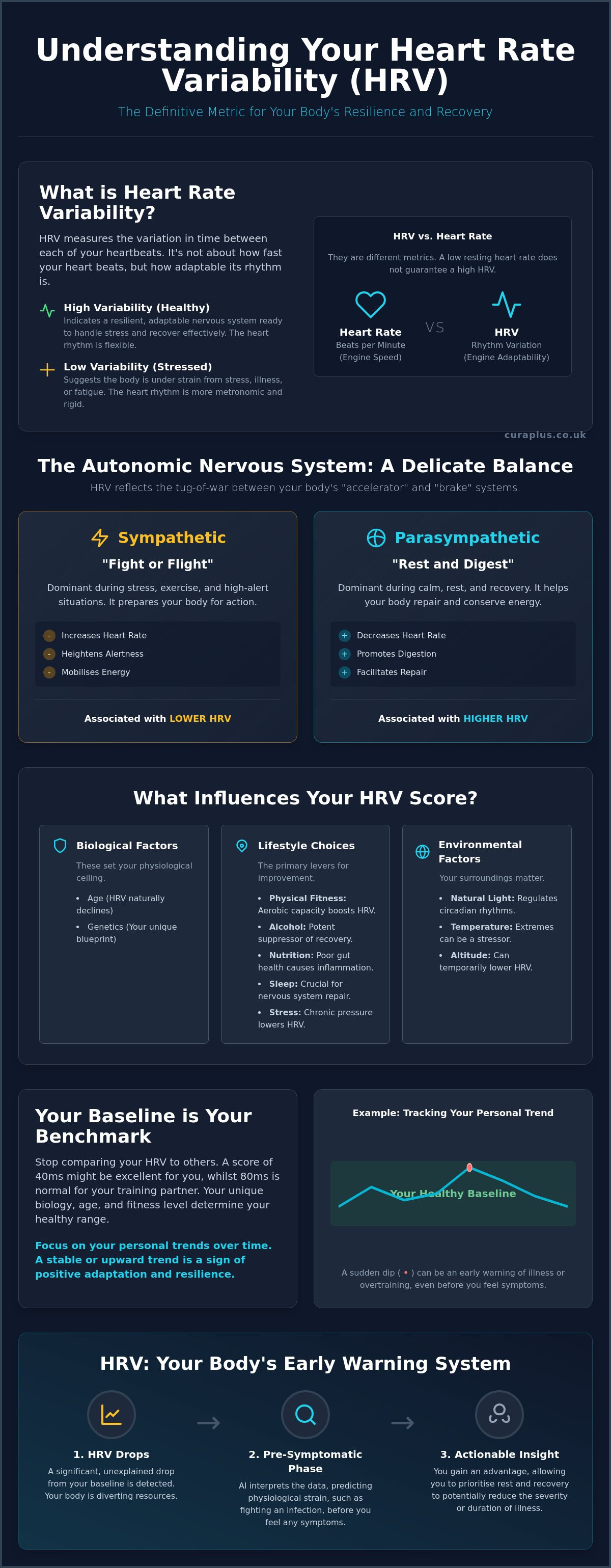
Heart rate variability is not a measurement of your pulse's speed, but rather a window into your nervous system's internal rhythm. Technically defined as the variation in time between consecutive heartbeats, these millisecond differences are known as R-R intervals. Whilst a steady, metronomic beat might sound ideal, a healthy heart is actually one that is constantly reacting to its environment. In 2026, Heart Rate Variability (HRV) has become the definitive gold standard for British health-tech users who value precision over generalisations. It represents the delicate tug-of-war between the two branches of your Autonomic Nervous System (ANS): the sympathetic branch, which drives your fight or flight response, and the parasympathetic branch, which governs rest and recovery.
The UK is witnessing a significant cultural shift in how professionals manage their wellbeing. We're seeing a move away from reactive GP visits toward proactive, data-led monitoring. High-performing individuals amongst the British workforce no longer wait for symptoms to appear before taking action. Instead, they utilise sophisticated platforms to gain an advantage. Understanding how AI interprets HRV for health predictions UK is the cornerstone of this evolution, as it allows users to spot physiological strain long before it manifests as burnout or illness. It's about moving from guesswork to a state of calm, informed control.
The Biology of Resilience
A high HRV score indicates a flexible, resilient nervous system that can pivot between high-stakes pressure and deep recovery with ease. It suggests your parasympathetic system is active, allowing your body to repair itself efficiently. Conversely, a consistently low HRV suggests your body is trapped in a sympathetic-dominant state. This chronic fight or flight behaviour pattern is common in high-pressure environments, where the ability to regulate emotions and maintain cognitive clarity is often compromised. Resilience is not about avoiding stress; it's about how quickly your system returns to its baseline after the challenge has passed.
HRV vs. Heart Rate: Clearing the Confusion
It's a common misconception that a low resting heart rate automatically guarantees a high HRV. Whilst they often correlate, they measure entirely different aspects of cardiac health. Heart rate measures the number of beats per minute, essentially the "speed" of your engine. HRV measures the complexity and adaptability of the rhythm itself. You can have a slow heart rate whilst your system remains dangerously rigid and stressed. Stress and HRV variability share an inverse relationship; as physiological or psychological pressure increases, the intervals between your heartbeats become more uniform and less varied.
The Biological Drivers: What Influences Your HRV Score?
Your HRV is not a static number. It is a dynamic reflection of your biological age and genetic blueprint. These non-negotiable factors set what we call your physiological ceiling. Whilst you cannot change your genetics, understanding HRV metrics and norms allows you to benchmark your performance against peers in your age bracket. As we age, our autonomic flexibility naturally declines; however, a fit 50-year-old may often present a superior profile to a sedentary 30-year-old. This is where physical fitness becomes the primary lever for improvement. High aerobic capacity correlates strongly with higher baseline scores, as a conditioned heart requires less effort to maintain homeostasis.
Lifestyle choices play a decisive role in daily fluctuations. For the UK professional, the impact of a late-night meal or a glass of wine after a particularly demanding workday cannot be understated. Alcohol is a potent suppressor of the parasympathetic system, often muting recovery for up to 48 hours. Chronic low-grade inflammation is another silent driver that suppresses your score. Often triggered by poor gut health or undiagnosed sensitivities, this inflammation keeps the body in a state of constant, subtle alarm. This is precisely how AI interprets HRV for health predictions UK; it identifies these minute, persistent suppressions that the human eye might dismiss as simple tiredness.
Environmental and Circadian Factors
The UK workforce faces unique environmental challenges, particularly during the shorter British winter days. A lack of natural light exposure disrupts circadian rhythms, leading to irregular sleep patterns and lowered autonomic tone. Seasonal Affective Disorder (SAD) isn't just a mood issue; it's a physiological one that manifests in your biometric data. Temperature regulation whilst sleeping is also critical for recovery. If your bedroom is too warm, your heart must work harder to cool the body, which directly lowers your overnight HRV. Monitoring these trends with a precision biomarker tool can help you adjust your environment for peak performance.
Psychological Stress and HRV
Not all stress is detrimental. Eustress, or beneficial stress, such as a challenging workout or an exciting project, can actually strengthen your system. Distress is the enemy. It is the chronic, grinding pressure that leads to mental fatigue. Your data will often reveal this fatigue before you feel consciously exhausted. By using a wearable for tracking stress patterns, you can distinguish between a productive push and a dangerous overextension. This level of physiological intelligence ensures that you manage your energy with the same rigour you apply to your professional commitments.
Defining a 'Good' HRV Score: Why Your Baseline Matters Most
Comparing your HRV score to a partner or a peer is a common mistake that often leads to unnecessary anxiety. It is a scientifically flawed approach because it ignores the intricate nuances of your unique physiology and genetic ceiling. Whilst general averages provide a useful framework, your "good" score is entirely dependent on your own historical data. The 2026 HRV Age-Bracket Reference Chart serves as a compass for the UK population, but it is your personal baseline that acts as the true north for your health journey. Understanding how AI interprets HRV for health predictions UK involves moving beyond these generic charts to identify what is normal for you, specifically.
The Cura+ AI Platform eliminates the guesswork by calculating your personal baseline through a rigorous 14-day calibration period. During this time, the system learns the subtle rhythms of your autonomic nervous system, filtering out the "noise" of daily life to establish a stable reference point. Recent breakthroughs in AI for predictive health at Imperial College London demonstrate that machine learning can detect cardiac anomalies and systemic shifts long before they are visible to the human eye. By anchoring your data to a personalised baseline, you transform raw numbers into a sophisticated early warning system.
HRV Age Charts: What is Normal for You?
According to the latest 2026 clinical consensus, typical ranges for the UK population reflect a natural decline in autonomic flexibility as we age. Individuals in their 20s generally see scores between 55 and 105ms, whilst those in their 40s typically range from 35 to 75ms. By the time we reach our 60s, a normal range often sits between 20 and 45ms. Elite athletes and those with exceptional aerobic conditioning often sit two standard deviations above these means. If your score sits outside the average for your age, it isn't necessarily a cause for alarm; it simply highlights the importance of tracking your own trends rather than chasing a collective mean.
Building and Protecting Your Baseline
Establishing a reliable baseline requires methodological precision and consistency. Snapshot readings taken at irregular intervals are often influenced by temporary stressors, making them unreliable for long-term health predictions. This is why theBand by Cura+ prioritises continuous monitoring, capturing the full spectrum of your physiological behaviour throughout the day and night. To ensure the integrity of your data, you must follow a structured approach on how to build a health baseline. Consistency in device placement and measurement conditions ensures your data remains a high-fidelity asset, providing the clarity needed for true self-optimisation.
Interpreting Fluctuations: What Your Data Reveals About Your Health
Heart rate variability is a living conversation between your heart and your brain. It's never static, but certain shifts demand your immediate attention. A sudden 20% decline from your established baseline is more than a mere fluctuation; it's a physiological red flag. Whilst a single glass of wine can suppress your parasympathetic recovery for up to 48 hours, a persistent drop often points toward deeper systemic challenges. These might include overtraining syndrome, where high-intensity exercise becomes counter-productive, or the early stages of a pathogenic challenge. Even an unexpected spike, known as the rebound effect, can be misleading. This often indicates parasympathetic overreaching, a state where the body is desperately forcing recovery after extreme exhaustion.
Meticulous observation of these patterns is how AI interprets HRV for health predictions UK. The Cura+ platform doesn't simply view a low number in isolation. Instead, it cross-references the shift against 15+ other biomarkers to determine if you're facing a temporary training plateau or a genuine health risk. This level of analysis transforms raw data into a sophisticated strategy for self-optimisation.
Predictive Illness Detection
The true power of HRV lies in its ability to detect the immune system's response before you feel the first symptoms. Your autonomic nervous system reacts to the internal stress of a viral onset long before your body temperature rises or a cough develops. In clinical case studies, we've observed distinct viral signatures in biometric data up to 72 hours before a fever begins. By utilising biometric tracking for wellness, you can pivot your schedule and prioritise rest, potentially shortening the duration of an illness before it takes hold. To secure your own physiological early warning system, explore the capabilities of theBand.
Long-term Trends vs. Daily Noise
It's vital that you don't panic over a single low score. Daily noise is an inevitable part of biological tracking; it can be caused by anything from a late-night meal to a stressful commute. To gain clarity, you must focus on the 7-day rolling average. This metric provides the necessary context to distinguish between an acute stressor and a chronic downward drift. Consider these three key indicators of your long-term health trend:
- Stable Baselines: Indicate a well-recovered system capable of handling high-pressure environments.
- Downward Drifts: Suggest chronic stress, lack of sleep, or declining cardiovascular health that warrants a lifestyle adjustment.
- Consistent Volatility: Often points toward irregular lifestyle habits, such as inconsistent sleep or poor nutritional timing.
By identifying these drifts early, you can make the precise lifestyle adjustments needed to maintain your homeostatic balance and avoid the cycle of burnout.
Beyond Tracking: Using theBand by Cura+ for Predictive Intelligence
Traditional wearables often leave users with a collection of graphs and no clear direction. They provide the "what" but fail to address the "why" or the "what next". theBand by Cura+ represents a paradigm shift in this space. By integrating 15+ biomarkers, including SpO2 and Skin Temperature, it moves beyond the limitations of isolated metrics. This comprehensive data set allows the Cura+ AI Platform to filter out environmental noise, providing a level of clarity that was previously reserved for clinical settings. It's the transition from asking "What is my score?" to understanding exactly what actions you should take today to protect your long-term vitality.
The sophistication of how AI interprets HRV for health predictions UK lies in its ability to synthesise multiple streams of biological data simultaneously. When a drop in HRV is accompanied by a subtle rise in skin temperature, the AI recognises this as a specific immune signature. This is the essence of a predictive health wearable UK users can trust. It doesn't just track your state; it anticipates your needs, offering a visionary approach to wellness that prioritises prevention over cure.
The Power of Multi-Biomarker Analysis
HRV alone is a powerful indicator, but when paired with skin temperature and oxygen saturation, it becomes the ultimate early-warning system. This multi-layered analysis allows the Cura+ AI to provide personalised coaching that adapts to your unique physiological responses. If your data indicates a systemic strain, the platform provides actionable insights tailored to your recovery needs. As a UK-based health technology specialist, we adhere to the highest data security standards, ensuring your biological information remains private and secure. Our support system is anchored in British clinical consensus, providing a reliable partnership in your journey toward self-optimisation.
Taking the Next Step in Your Health Journey
Whether you're a high-performer looking for a competitive edge or a family focused on proactive wellness, continuous monitoring is the key to unlocking true physiological intelligence. theBand provides the high-fidelity data required to master your health as a complex system. We invite you to join the pre-launch waitlist and be amongst the first to experience this level of insight. It's time to move beyond reactive medicine and embrace a strategy built on accuracy and methodical reliability. Join the revolution in the future of personal health and take command of your biological destiny today.
Mastering Your Physiological Intelligence
The journey toward self-optimisation begins with moving beyond generic health averages. You've seen that a "good" HRV score isn't a fixed target found amongst your peers, but a stable personal baseline that reflects your body's unique resilience. By understanding how AI interprets HRV for health predictions UK, you transition from passive tracking to active, data-driven foresight. This shift replaces the anxiety of low readings with the calm clarity of actionable insight.
This level of precision is the core of our mission. theBand monitors 15+ critical biomarkers simultaneously, whilst the Cura+ AI Platform delivers predictive alerts that can identify potential illness before physical symptoms even appear. Designed and engineered in the UK, this technology provides the sophisticated framework you need to manage your wellness as a complex, high-performance system. It's time to replace uncertainty with the quiet excitement of discovery. We invite you to Discover theBand: The Future of Predictive Health Intelligence and begin your transformation today. Your potential is already visible in your data; we are here to help you unlock it.
Frequently Asked Questions
Is an HRV score of 50 good for a 40-year-old in the UK?
A score of 50 ms is considered a healthy reading for a 40-year-old, as it sits comfortably within the typical UK normative range of 35 to 75 ms. However, you must view this number through the lens of your personal baseline. If your typical reading is 70 ms, a sudden shift to 50 ms suggests your body is struggling to recover from a recent stressor or sub-clinical illness.
Why is my HRV so low even though I exercise regularly?
A low HRV despite frequent exercise often indicates that your body is in a state of functional overreaching. Whilst aerobic activity eventually raises your baseline, the immediate aftermath of a session keeps your sympathetic nervous system active. This is precisely how AI interprets HRV for health predictions UK, as it identifies when your training volume has exceeded your system's current capacity for repair and recovery.
Can caffeine or supplements artificially inflate my HRV score?
Caffeine is a stimulant that typically suppresses HRV by activating your fight or flight response, whilst certain supplements like Magnesium can support higher scores by promoting parasympathetic tone. These substances don't "artificially" change the score; they represent real chemical shifts in your autonomic state. Tracking these variables allows you to see exactly how your nutritional choices influence your heart's ability to manage stress.
How long does it take to see a significant improvement in my HRV baseline?
Meaningful improvements in your HRV baseline typically manifest over a period of 4 to 12 weeks. Biological adaptations, such as increased stroke volume or improved autonomic balance, require consistent lifestyle interventions to take root. You might see daily fluctuations sooner, but a stable upward trend in your 7-day rolling average is the true indicator that your system is becoming more resilient and flexible.
What is the best time of day to measure HRV for accuracy?
The most accurate window for measurement is during deep sleep or immediately upon waking, before the demands of the day intervene. Measuring at these times ensures that external variables like morning coffee or work-related thoughts don't skew the data. theBand by Cura+ prioritises continuous overnight monitoring, providing a high-fidelity dataset that captures your system in its most rested and honest state.
Does a high HRV always mean I am perfectly healthy?
A high HRV is usually a positive sign of resilience, but a sudden, unexplained spike can actually indicate parasympathetic overreaching. This occurs when the body is so exhausted that it forces an extreme recovery response to maintain homeostasis. True health is marked by a stable baseline that reacts appropriately to challenges rather than an isolated high number that sits outside your normal physiological range.
How does theBand by Cura+ compare to other UK fitness trackers for HRV accuracy?
theBand by Cura+ distinguishes itself through multi-biomarker integration and clinical-grade sensor precision. Unlike many trackers that provide a single recovery percentage, our system cross-references HRV with 15+ other metrics like skin temperature and SpO2. This holistic approach allows our AI to provide predictive alerts for illness detection that generic trackers often miss, all backed by UK-based data security and engineering.
Can HRV help me manage my work-related stress and anxiety?
HRV is an invaluable tool for managing work-related anxiety because it provides an objective measurement of your internal stress levels. By monitoring your data, you can identify the subtle signs of burnout before they become debilitating. This physiological intelligence allows you to implement targeted recovery strategies, such as breathwork or workload adjustments, ensuring you remain in a state of calm, productive control throughout the week.


