


What if the most sophisticated diagnostic tool you ever owned wasn't located in a hospital, but was actually your own biological data? Most people wait for a physical symptom to appear before they seek medical advice; yet by that point, the underlying issue has often been developing for months. Learning how to build a health baseline transforms your approach from reactive guesswork to predictive precision. It's about moving beyond generic "normal" ranges to identify your unique, personal physiological signature.
It's understandable to feel frustrated by the limitations of the traditional GP model or the endless stream of contradictory wellness advice. You shouldn't have to live with the quiet anxiety of hidden health issues that a standard ten-minute appointment might miss. We'll show you how to establish a sophisticated physiological baseline to detect illness early and optimise your long-term health with clinical clarity. This is about replacing uncertainty with the calm control of data-driven insight.
In this guide, we'll outline a clear framework for continuous monitoring through theBand and the Cura+ AI Platform. You'll learn how to distinguish between temporary biological noise and the actual signals that demand action. We're moving toward a future where health is a complex system to be mastered, and that journey begins with your first data point.
Key Takeaways
- Understand why traditional annual check-ups provide an insufficient snapshot and how to transition toward a model of continuous, dynamic health intelligence.
- Discover exactly how to build a health baseline by identifying the specific biomarkers and autonomic nervous system metrics that constitute your unique biological signature.
- Learn the 14-day protocol for standardising your environment to eliminate biological noise and establish a valid foundation for your physiological norms.
- Develop the ability to distinguish between healthy natural fluctuations and the critical early-warning signals that indicate a departure from your personal baseline.
- Explore how theBand and Cura+ AI Platform automate the monitoring of over 15 biomarkers to maintain a predictive and evolving map of your long-term wellness.
Redefining the Health Baseline: From Static Snapshots to Dynamic Intelligence
A health baseline is not a static number on a medical chart. It is the unique biological normal of your body, a complex signature written across your cardiovascular, metabolic, and neurological systems. Most people only interact with their health data when something feels wrong. However, true mastery of your well-being requires viewing your body as a continuous experiment. In this context, your baseline serves as the essential control group, the reference point against which all future changes are measured. Without this foundation, it's nearly impossible to distinguish a minor fluctuation from a critical warning sign.
The traditional annual GP check-up is a low-resolution snapshot in a world that requires high-definition video. Measuring blood pressure once every twelve months provides a single data point that can be skewed by stress, caffeine, or the white coat effect of being in a clinic. This reactive model is designed to wait for pathology to manifest before offering an intervention. Transitioning to proactive health intelligence means moving away from these isolated snapshots toward a stream of data that captures your body's behaviour in the real world. This shift replaces the uncertainty of the traditional model with the calm control of predictive data.
The Flaw of Averages in Modern Healthcare
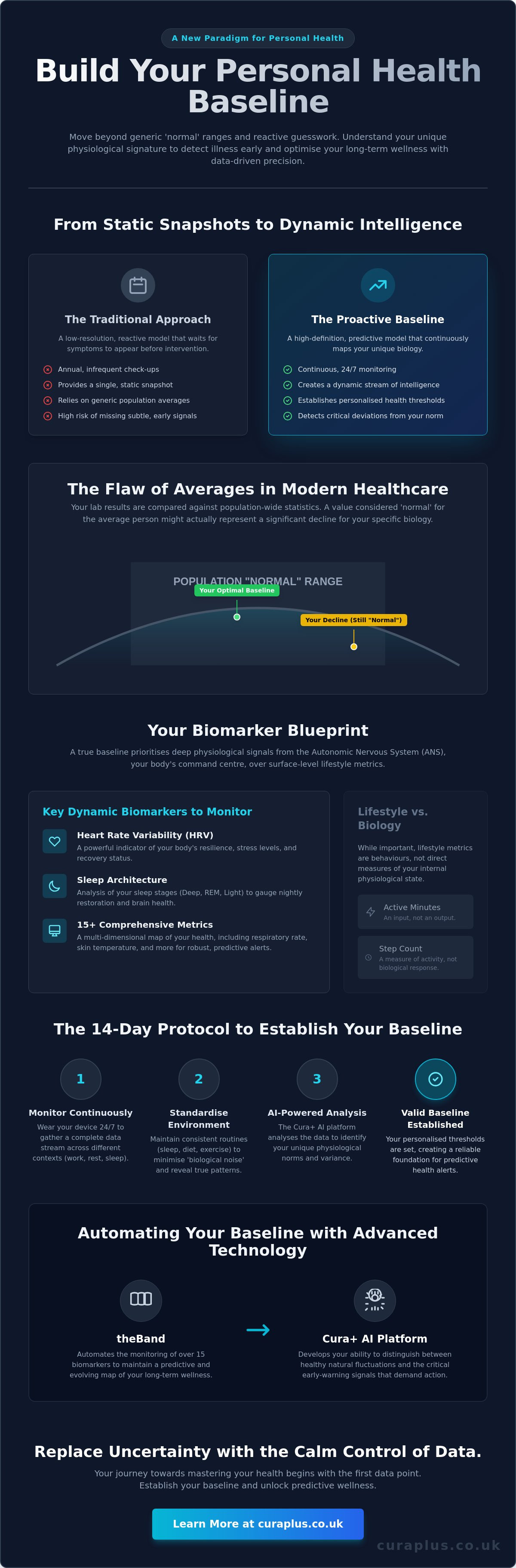
When you receive lab results, your numbers are typically compared against population-wide statistics. These ranges are designed to catch acute illness, not to identify your personal optimum. A value that is considered normal for the average person might actually represent a significant decline for your specific biology. Understanding a Biomarker (medicine) requires deep context. By learning how to build a health baseline tailored to your specific biology, you establish personalised thresholds. This ensures that your health strategy is based on your unique variance rather than a generic population average.
Static vs. Dynamic Baselines
Static baselines involve measurements that change slowly, such as height, weight, or quarterly blood panels. Whilst these are useful, they lack the granularity needed for sophisticated predictive alerts. Dynamic baselines, however, track metrics that fluctuate constantly, such as heart rate variability (HRV) and sleep architecture. These provide a real-time view of your Autonomic Nervous System. By using advanced tools like theBand and the Cura+ AI Platform, you can monitor these shifts automatically. This continuous flow of data is the only way to detect the subtle deviations that precede illness, allowing for a level of precision that static measurements simply cannot match.
The Biomarker Blueprint: Essential Metrics for a Comprehensive Baseline
Building a resilient biological profile requires a shift in focus from surface-level activity to deep physiological signals. Many individuals confuse lifestyle metrics, such as daily step counts or active minutes, with true health indicators. Whilst movement is vital, it is a behaviour rather than a biological response. To understand how to build a health baseline that offers predictive value, we must prioritise biomarkers that reflect the state of the Autonomic Nervous System (ANS). The ANS acts as the body's internal command centre, regulating everything from heart rhythm to immune readiness. By monitoring 15 or more distinct biomarkers simultaneously, you create a multi-dimensional map that is far more resistant to statistical outliers than a single blood pressure reading.
This comprehensive approach is supported by research from organisations like the National Institute of Environmental Health Sciences, which highlights how biomarkers serve as critical early warning systems for systemic stress. When these metrics are tracked in aggregate, they reveal the subtle interplay between your environment and your biology. This is the foundation of predictive wellness. It is not about reaching a generic goal. It is about establishing your unique "control" state.
Cardiovascular and Autonomic Indicators
Heart Rate Variability (HRV) stands as the gold standard for assessing your body's ability to oscillate between stress and recovery. High variability generally indicates a robust, adaptable nervous system, whilst a significant drop often precedes physical or mental exhaustion. Your Resting Heart Rate (RHR) provides the necessary context for this, establishing your true "at rest" signature. Additionally, monitoring your respiratory rate is essential. Subtle increases in breaths-per-minute, even by just one or two, are often the first physiological signals of an impending immune response. These shifts frequently occur long before you feel symptomatic.
Metabolic and Circadian Biomarkers
Your circadian rhythm dictates the timing of nearly every biological process. Establishing a baseline for skin temperature allows you to track the minute shifts that often precede viral onset or hormonal changes. Similarly, sleep architecture-the distribution of REM, Light, and Deep sleep-reveals the quality of your neurological repair and metabolic health. Oxygen Saturation (SpO2) completes this picture by monitoring your respiratory efficiency as a constant. When considering how to build a health baseline, these metabolic markers provide the necessary depth to detect subtle systemic changes. You can explore how theBand captures these metrics to provide a seamless, data-driven view of your internal landscape.
A Step-by-Step Guide to Establishing Your Physiological Norms
Establishing a valid physiological baseline is a methodical process that demands consistency. To understand how to build a health baseline, you must commit to a minimum 14-day observation window. This timeframe is essential to capture the natural variance of your biology whilst filtering out temporary anomalies. According to Stanford Medicine on health baselines, this initial data set serves as the critical starting point for achieving future health goals and preventative care. By standardising your environment during this phase, you reduce biological noise and ensure the signals you capture are authentic representations of your internal state.
Consistency is the foundation of accuracy. This is particularly true during the sleep cycle, where the most profound physiological recovery occurs. Monitoring external variables such as alcohol consumption, intense exercise, and travel is vital. These factors are not part of your true baseline; they are stressors that cause temporary deviations. Recording these events allows you to contextualise your data, ensuring that a late-night glass of wine isn't mistaken for a systemic health decline.
Phase 1: The Raw Data Collection
During the first seven days of monitoring, resist the urge to optimise your behaviour. If you typically drink three cups of coffee or sleep six hours, continue to do so. Changing your habits now will create a false baseline that does not reflect your actual "normal". Ensure that theBand is positioned securely and consistently each night to maintain high-fidelity sensor contact. This phase is about gathering raw, unvarnished data. You must identify and exclude "outlier" days, such as those following a long-haul flight or an acute injury, to prevent them from skewing your eventual average.
Phase 2: Establishing the Range
Once you have collected 14 days of high-quality data, you can begin to calculate your unique health signature. This involves determining the mean and standard deviation for each of your key biomarkers. Your baseline is not a single point; it is a dynamic range with defined upper and lower bounds. If your resting heart rate typically sits between 54 and 58 beats per minute, a shift to 64 is a meaningful signal, even if it remains within the generic population average. The Cura+ AI Platform automates this complex analysis, refining your range as you age or improve your physical condition. This ensures your understanding of how to build a health baseline evolves alongside your biology, maintaining its predictive power over the long term.
Interpreting Variance: Distinguishing Natural Fluctuations from Early Warning Signs
Biological systems are inherently volatile. A common misconception in wellness is that "normal" health looks like a flat line on a graph. In reality, a lack of variability is often a sign of physiological frailty or extreme fatigue. When you understand how to build a health baseline, you learn to embrace this volatility rather than fear it. The objective is to distinguish "biological noise"-the harmless fluctuations caused by a heavy meal or a warm bedroom-from a "meaningful signal" that indicates a genuine shift in your internal state. This clarity allows you to move through your day with a sense of calm control, grounded in data rather than anxiety.
One of the most powerful applications of a sophisticated baseline is the detection of viral onset before physical symptoms appear. Your body often initiates an immune response hours or even days before you feel a scratchy throat or a headache. By monitoring your established physiological norms, you can spot the subtle "pre-symptomatic" signature of illness. This predictive intelligence transforms your relationship with your body. You're no longer reacting to a crisis; you're managing a system with foresight. Recognising the difference between the physiological signature of acute recovery after a hard workout and the slow, grinding decline of chronic stress is what separates elite self-optimisation from generic health tracking.
The Anatomy of a Health Alert
A single data point rarely tells the whole story. A health alert becomes critical when three or more biomarkers deviate from your baseline simultaneously. For instance, a sudden drop in Heart Rate Variability (HRV) combined with a rise in nocturnal skin temperature and an increased respiratory rate is a classic "Red Flag" for immune challenge. The Cura+ AI Platform excels here, utilising advanced algorithms to filter out irrelevant data spikes. It ensures that a one-off "bad night" doesn't trigger a false alarm, providing you with high-fidelity insights that demand actual attention.
When to Take Action
Determining your personal "Red Flag" thresholds is essential for practical health management. If your biomarkers stay within one standard deviation of your mean, you're likely experiencing normal variance. However, a move beyond two standard deviations suggests a systemic shift. You can use these deviations to adjust your daily schedule with precision. If your recovery scores are significantly suppressed, it's a signal to swap a high-intensity training session for active recovery or to delegate high-stress work tasks. You can start automating your health intelligence with theBand to ensure you never miss a critical signal. This data-driven approach ensures that your lifestyle choices are always in sync with your biological reality.
Automating Your Baseline with theBand by Cura+
Manual health diaries and subjective activity logs are relics of a less precise era. True predictive wellness requires a system that operates silently in the background, capturing data with clinical-grade accuracy whilst you sleep, work, and move. This is the essence of how to build a health baseline that offers genuine utility. By integrating theBand with the Cura+ AI Platform, you transition from the burden of data collection into the clarity of proactive health intelligence. You no longer need to guess whether a fluctuation is a cause for concern. The system masters your unique biological signature and provides the context required to understand every shift.
theBand functions as a high-level consultant for the human body rather than a simple tracker. It doesn't just count steps; it monitors the complex interplay of your internal systems to ensure your baseline remains a living, breathing map of your health. This is a visionary approach to wellness that replaces reactive medicine with a data-driven strategy for self-optimisation. It allows you to view your health as a complex system to be mastered rather than a series of symptoms to be managed, positioning you ahead of the curve in personal health management.
Continuous Monitoring Without the Complexity
The traditional difficulty in how to build a health baseline has always been the manual effort required to maintain it. Advanced sensors in theBand eliminate this friction by automatically capturing over 15 biomarkers with clinical-grade precision. This includes the high-fidelity tracking of heart rate variability and skin temperature, metrics that are notoriously difficult to measure accurately with standard consumer hardware. By removing the need for manual diaries, theBand ensures your baseline is built on a foundation of objective, untainted data. Real-time alerts notify you the moment your physiology deviates from your personal norms, allowing for immediate lifestyle adjustments before a minor issue escalates.
Personalised Coaching via AI
Raw data is merely noise without a sophisticated layer of interpretation. The Cura+ AI Platform processes your continuous stream of information to identify the subtle trends that a human observer might miss. It interprets your baseline to provide bespoke wellness recommendations that are entirely unique to your biology. Whether it's suggesting an earlier bedtime based on respiratory rate trends or advising a reduction in training intensity due to suppressed HRV, the platform bridges the gap between tracking and taking meaningful action. This is the future of personalised health, where your baseline informs every decision you make.
Order theBand today to begin building your biological blueprint and secure the peace of mind that comes with elite health intelligence.
Mastering Your Biological Future
Transitioning from a reactive medical model to a proactive, data-driven lifestyle is the most significant investment you can make in your longevity. You've learned that a true baseline is not a static number but a dynamic range that reflects your body's unique resilience. By following a structured 14-day protocol and prioritising high-fidelity biomarkers like HRV and skin temperature, you gain the ability to spot systemic shifts long before they manifest as physical symptoms. Understanding how to build a health baseline is the essential first step toward replacing medical uncertainty with the calm control of personal insight.
To further enhance this proactive approach, individuals can utilise services like iscript.care to access medically-supervised treatments for hormonal health and weight management, tailored to their specific biological data.
The journey toward self-optimisation no longer requires manual diaries or subjective guesswork. With clinical precision sensor technology and AI-driven predictive health alerts, you can now monitor over 15 physiological biomarkers automatically. This level of sophisticated intelligence ensures that your daily decisions are always grounded in biological reality. It's time to move beyond the "flaw of averages" and claim mastery over your unique health signature. The tools to decode your body's silent signals are now within your reach.
Begin building your predictive health baseline with theBand and transform the way you understand your body. The future of your wellness is no longer a mystery; it's a data set waiting to be mastered.
Frequently Asked Questions
What is a health baseline and why is it important?
A health baseline is your personal biological signature, representing the "control group" of your unique physiological systems. It's critical because it allows you to move beyond generic population averages to identify what "normal" looks like for your specific body. By understanding how to build a health baseline, you create a reference point that makes even the most subtle deviations visible, transforming your health management from reactive symptom-chasing to proactive, data-driven intelligence.
How long does it take to build an accurate health baseline?
Establishing a valid physiological baseline requires a minimum observation window of 14 consecutive days. This timeframe is necessary to capture the natural fluctuations of your biology, such as the impact of your weekly work cycle and recovery patterns. Whilst shorter periods might offer a snapshot, two weeks provide the statistical depth needed to filter out temporary biological noise and establish the true upper and lower bounds of your unique health signature.
Which biomarkers are the most important for a baseline?
The most resilient baselines prioritise biomarkers that reflect the state of the Autonomic Nervous System and circadian biology. Key metrics include Heart Rate Variability (HRV), Resting Heart Rate, respiratory rate, and nocturnal skin temperature. Tracking sleep architecture is also essential. By monitoring 15 or more of these biomarkers simultaneously, theBand provides a multi-dimensional view of your internal landscape that is far more accurate than tracking a single metric in isolation.
Can a fitness tracker build a health baseline for me?
Standard fitness trackers often lack the sensor precision and analytical depth required for a sophisticated baseline. Most consumer devices focus on lifestyle metrics like steps, which don't reflect internal physiological states. To truly understand how to build a health baseline, you need clinical-grade sensors and an AI platform like Cura+. This combination automates the complex task of distinguishing between harmless fluctuations and meaningful signals that require action.
What should I do if my data deviates from my baseline?
If your data deviates from your established norms, the first step is to contextualise the shift by looking for external stressors. Factors such as alcohol consumption, intense physical exertion, or acute psychological stress can cause temporary spikes. If three or more biomarkers deviate simultaneously without an obvious cause, it's a signal to prioritise recovery. You should adjust your schedule to allow for increased rest whilst monitoring the data for a return to your mean.
How often should I update or reset my health baseline?
Your baseline should be a dynamic entity that evolves as your body changes over time. Whilst the Cura+ AI Platform refines your baseline continuously, a manual reset may be necessary after significant life events, such as recovering from a major illness or achieving a substantial shift in physical fitness. This ensures your predictive alerts remain accurate and relevant to your current biological reality rather than comparing you to a past version of yourself.
Can a health baseline help detect illness like flu or COVID-19 early?
Yes, a sophisticated baseline can often detect the physiological signature of viral onset before physical symptoms manifest. Subtle increases in respiratory rate and nocturnal skin temperature, combined with a decline in HRV, frequently precede the "feeling" of being unwell by several hours or days. This early warning intelligence allows you to initiate rest and recovery protocols sooner, potentially reducing the severity and duration of the impending illness.
If you are concerned about specific bacterial infections while monitoring your health, you can discover mrsatest.co.uk for convenient at-home screening kits.
Is my biometric data secure when building a baseline with AI?
Data security is a foundational pillar of building a personal health baseline. The Cura+ AI Platform utilises robust encryption and strict access controls to ensure your biometric information remains private and secure. We align with modern data protection standards to provide a secure environment for your biological data. This commitment to privacy allows you to focus on the discovery and optimisation of your health without concerns about unauthorised data exposure.


