


What if the feeling of being "burnt out" wasn't a vague psychological state, but a measurable biological metric you could track from your living room? You likely recognise the exhaustion that lingers after a demanding week, yet standard fitness trackers often fail to capture the true nuance of your internal strain. It's frustrating to feel entirely depleted whilst your wearable suggests you're perfectly recovered. Understanding how to measure stress levels at home UK requires moving past these generic estimations and into the realm of precise, clinical-grade biomarkers.
You deserve a framework that replaces uncertainty with actionable data. This guide will show you how to transcend subjective questionnaires and use advanced tools to objectively quantify your physiological stress response before it leads to a physical breakdown. We'll explore the critical distinction between heart rate and heart rate variability (HRV), the utility of at-home cortisol kits, and how sophisticated systems like theBand and the Cura+ AI Platform provide the clarity you need to master your health.
Key Takeaways
- Shift your perspective from subjective feelings to heart rate variability (HRV), the primary metric for quantifying your autonomic nervous system's resilience.
- Master a precise, five-step framework on how to measure stress levels at home UK by establishing a physiological baseline during your typical weekly routine.
- Identify the subtle differences between beneficial acute stress and debilitating chronic strain whilst learning to mitigate the "White Coat Effect" during home assessments.
- Explore how the integration of AI-driven platforms like Cura+ provides the predictive intelligence required to detect biological shifts before they lead to burnout.
- Understand the synergy between validated psychological scales and high-fidelity biometrics to create a comprehensive, data-led narrative of your personal health.
Understanding Stress Measurement: Subjective vs Objective Methods
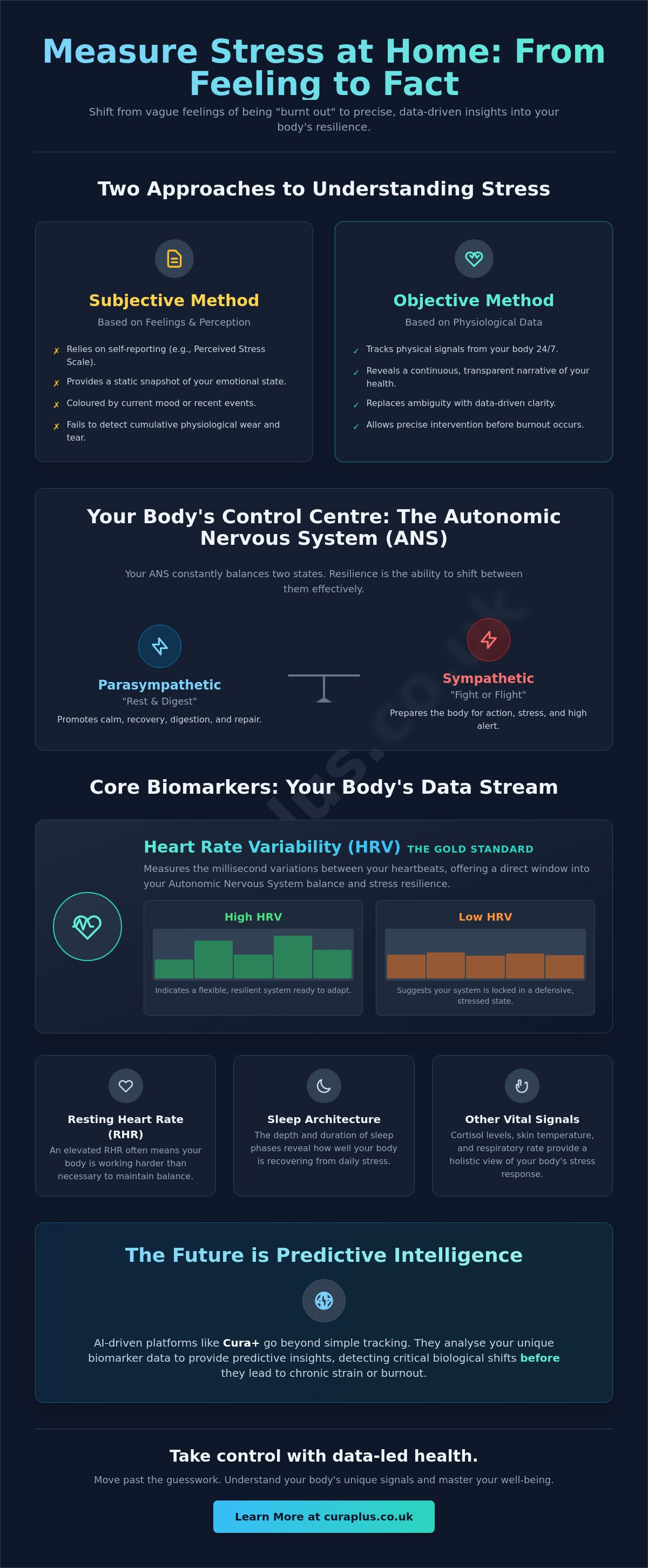
Stress isn't merely a transient emotional state or a simple lack of resilience. It's a sophisticated, systemic physiological response orchestrated by the Autonomic Nervous System (ANS). This system serves as your body's internal control centre, balancing the "fight or flight" sympathetic response with the "rest and digest" parasympathetic state. For many high-performers in the UK, the constant pressure to deliver results whilst maintaining personal equilibrium leads to a state of chronic activation. Learning how to measure stress levels at home UK has become a vital necessity for preventative health. By moving beyond intuition, you can identify the exact moment your body begins to overcompensate for environmental demands.
The Role of the Perceived Stress Scale (PSS)
The Perceived Stress Scale (PSS) is a 10-item instrument used extensively to gauge how individuals appraise the situations in their lives. It asks you to reflect on the past month, determining the extent to which you felt your life was unpredictable or overwhelming. Whilst it's a respected tool for assessing psychological stress, it possesses inherent limitations. It provides a static snapshot of your emotional state rather than a continuous stream of data. Because it relies on self-reporting, the results are often coloured by your current mood or recent events. It identifies emotional overload with precision, but it frequently fails to detect the cumulative physiological wear and tear that leads to long-term health complications.
The Shift Towards Physiological Biomarkers
Objective measurement represents the next evolution in personal wellness. It involves the systematic tracking of physical signals that your body emits when under strain. These biomarkers provide a transparent, 24/7 narrative of your internal health, revealing truths that your conscious mind might overlook. When you understand how to measure stress levels at home UK through a biological lens, you gain access to a refined set of data points:
- Heart Rate Variability (HRV): This measures the millisecond variations between your heartbeats, serving as the gold standard for assessing ANS balance.
- Resting Heart Rate (RHR): An elevated RHR often indicates that your body is working harder than necessary to maintain homeostasis.
- Sleep Architecture: Analysing the depth and duration of your recovery phases reveals how well your body is processing the previous day's stressors.
These metrics offer a level of clinical precision that was previously only available in a laboratory setting. By monitoring these signals, you replace the ambiguity of "feeling burnt out" with the clarity of data-driven insights. This shift allows you to master your health as a complex system, ensuring that you can intervene with precision before acute stress transforms into chronic illness.
Core Biomarkers for Monitoring Stress Levels at Home
To truly master your physiological narrative, you must look beneath the surface of subjective feelings. Whilst traditional advice focuses on identifying symptoms like tension or irritability, these are trailing indicators. By the time you feel a tension headache, your body has likely been in a state of sympathetic dominance for hours, if not days. A more sophisticated approach to how to measure stress levels at home UK involves monitoring the delicate interplay of over 15 distinct biomarkers. This holistic view ensures that you aren't just reacting to symptoms, but proactively managing your internal equilibrium through high-fidelity data.
Heart Rate Variability (HRV): The Gold Standard
Heart Rate Variability (HRV) stands as the definitive metric for stress resilience. It measures the millisecond differences between successive heartbeats, providing a direct window into your Autonomic Nervous System. A high HRV suggests a robust, flexible system capable of transitioning between the "fight or flight" sympathetic state and the "rest and digest" parasympathetic state. Conversely, a suppressed HRV indicates that your system is locked in a defensive posture. Utilising a sophisticated device to measure HRV allows you to track these subtle shifts in real-time, providing the clarity needed to adjust your workload before fatigue sets in.
Other signals provide essential context to your HRV readings. During periods of elevated cortisol, your skin temperature may fluctuate and your respiratory rate often increases as the body prepares for perceived threats. These are not isolated events; they are part of a coordinated biological response. By tracking these variables in tandem, you gain a comprehensive understanding of how to measure stress levels at home UK with clinical accuracy. This level of insight transforms health from a series of symptoms into a manageable, data-driven system.
Sleep Architecture and Stress Recovery
Stress is a primary disruptor of sleep architecture. It frequently truncates REM and Deep Sleep cycles, leaving the body physically and cognitively unrecovered. If you consistently wake up feeling "tired" despite a full night's rest, your internal data is signaling a failure in recovery. This lack of restorative sleep creates a negative feedback loop, further depleting your stress resilience for the upcoming day. Monitoring these cycles allows you to see how your "readiness" score fluctuates based on the previous day's demands.
Mastering these complex data points requires a platform that can synthesise information into actionable insights. You can begin your journey toward total self-optimisation by exploring the Cura+ AI Platform, which serves as a partner in your quest for biological clarity.
How to Measure Stress Levels at Home: A 5-Step Guide
Quantifying your physiological strain requires more than a casual glance at a heart rate monitor. It demands a structured protocol that integrates biological data with environmental context. To master how to measure stress levels at home UK, you must adopt a methodical approach that prioritises longitudinal trends over isolated events. This five-step framework transforms raw data into a strategic roadmap for your wellness.
- Step 1: Establish your baseline. Spend seven days monitoring your vitals during a standard, non-crisis week to determine your unique physiological "normal".
- Step 2: Integrate subjective and objective data. Use validated tools like the Perceived Stress Scale (PSS) alongside real-time biometrics to see where your perception aligns with your biology.
- Step 3: Prioritise trends. Focus on 7-day rolling averages to avoid "data anxiety" caused by natural daily fluctuations.
- Step 4: Correlate with lifestyle. Use a journal to identify how specific behaviours, such as late-night emails or caffeine intake, impact your recovery metrics.
- Step 5: Act on readiness. Review your morning recovery scores to determine whether to push for peak performance or prioritise active rest.
Establishing Your Health Baseline
Your body is an individual system with its own set of biological "norms". Comparing your HRV or resting heart rate to a generic population average is often misleading and counterproductive. Instead, you must define a baseline that reflects your specific physiological capacity during periods of relative stability. Understanding how to build a health baseline is the foundation of proactive care, allowing you to detect the earliest deviations from your optimal state.
Correlating Data with Daily Behaviour
Data gains its true power when it's contextualised through your daily habits. Maintaining a "stress diary" alongside your wearable data allows you to spot patterns that might otherwise remain hidden. You may discover that a second afternoon espresso causes a significant drop in your overnight HRV, or that late-working sessions correlate with fragmented sleep architecture. This process also reveals "silent stressors". These factors, such as poor indoor air quality or the early stages of a viral onset, often impact your biomarkers before you feel any physical symptoms. By identifying these triggers, you can refine how to measure stress levels at home UK and take control of your biological destiny. It's about replacing guesswork with the quiet excitement of data-driven discovery.
Common Pitfalls in At-Home Stress Testing
Quantifying your physiological strain requires a level of detachment from immediate data. Even when you've mastered how to measure stress levels at home UK, the psychological act of testing can occasionally skew your results. This is a domestic version of the "White Coat Effect," where the subtle anxiety of potentially seeing a "poor" score triggers the very sympathetic response you're trying to measure. Precision is only possible when you view each data point as a single tile in a much larger mosaic. A solitary "low" HRV score or a morning of elevated resting heart rate isn't a signal of impending failure. It's simply a piece of information that requires context to become meaningful.
Acute vs Chronic Stress Signals
A frequent error in home assessment is the failure to distinguish between different types of biological strain. Acute stress is a temporary spike in activation, such as the physiological rush before a major presentation or the physical load of a high-intensity workout. This state is often beneficial, as it sharpens focus and drives performance. Your body should recover from these events with efficiency, returning to its baseline within hours. Chronic stress, however, manifests as a sustained "low" in your recovery biomarkers that persists over days or weeks. This is the state where your internal systems fail to "reset," leading to systemic exhaustion and long-term health complications. By focusing on longitudinal trends, you can identify exactly when a healthy challenge has transformed into a harmful burden.
The Accuracy Gap in Consumer Wearables
The disparity between casual activity trackers and clinical-grade monitoring systems is significant. Many basic wearables rely on simplified algorithms that struggle to differentiate between physical movement and psychological strain. For example, a standard tracker might interpret a high heart rate during a stressful meeting as a "cardio workout" because it lacks the multi-sensor depth to correlate heart rate with skin temperature or respiratory patterns. Achieving a refined understanding of how to measure stress levels at home UK necessitates tools designed for biological precision rather than just step counting. True physiological mastery requires a system that can filter out the "noise" of daily life to focus on the genuine signals of your autonomic nervous system.
To bridge this accuracy gap and access professional-level insights, you can explore the Cura+ AI Platform to transform your raw data into a strategic health asset. Precision is the difference between an educated guess and a visionary strategy for your wellness.
The Future of Stress Management: AI and Predictive Intelligence
The landscape of personal health is undergoing a fundamental shift. We are moving away from retrospective analysis toward a state of Predictive Health Intelligence. This evolution represents the pinnacle of how to measure stress levels at home UK, as it allows for the detection of subtle biomarker shifts that human observation inevitably misses. Whilst you might feel resilient on a Tuesday morning, your internal data might reveal a declining HRV and rising skin temperature that suggest a systemic vulnerability. AI-driven systems process these high-fidelity signals in real-time, providing the foresight required to intervene before your performance suffers. It's the difference between managing a crisis and preventing one entirely.
The true power of this technology lies in its ability to provide real-time alerts. Imagine a system that suggests a "rest day" or a period of active recovery hours before you consciously feel the weight of burnout. This isn't just about tracking data; it's about creating a dynamic, responsive relationship with your own biology. By utilising advanced algorithms, you can filter out the environmental noise to focus on the genuine signals of your autonomic nervous system. This sophisticated approach ensures that your health strategy is always one step ahead of your demands.
How AI Coaches Transform Data into Action
Interpreting the interplay between 15+ distinct biomarkers is an intricate task that requires clinical-grade precision. An AI health and wellness coach serves as a sophisticated guide through this complexity. Instead of generic lifestyle advice that ignores your unique context, you receive personalised recommendations rooted in your specific biological narrative. theBand by Cura+ monitors these variables simultaneously, ensuring that every insight is grounded in high-fidelity data. This level of refinement allows the system to interpret how your sleep architecture, respiratory rate, and heart rate variability converge to define your current state of readiness.
Moving from Reactive to Proactive Wellness
The journey toward self-optimisation is a transition from reactive management to proactive mastery. Traditionally, high-performers waited until they felt the physical symptoms of exhaustion before seeking a solution. Now, you can move from "feeling stressed" to "knowing you are stressed" and, ultimately, to "preventing stress" before it manifests. Mastering how to measure stress levels at home UK is no longer about responding to a breakdown; it's about maintaining a visionary strategy for your long-term health. By combining data with high-quality wellness support from Artemis Curated, you have the opportunity to replace uncertainty with clarity and take total control of your biological narrative.
The future of wellness isn't a distant concept; it's a data-driven reality available to you now. Discover how theBand by Cura+ can revolutionise your stress management and empower you to reach your peak potential through the power of predictive intelligence.
Mastering Your Physiological Narrative
The transition from subjective feelings to objective data represents a fundamental shift in personal health management. By prioritising high-fidelity biomarkers like heart rate variability over vague intuition, you gain the clarity needed to navigate high-pressure environments with clinical precision. You've learned that establishing a unique baseline is essential, as it allows you to detect the earliest signals of systemic strain before they manifest as physical exhaustion. Mastering how to measure stress levels at home UK is no longer a matter of guesswork; it's a strategic process of biological discovery.
True resilience requires a system that moves beyond reactive monitoring into the realm of predictive intelligence. theBand by Cura+ is designed to meet rigorous British healthcare standards, monitoring over 15 vital biomarkers simultaneously to provide a comprehensive view of your internal state. With AI-driven predictive health alerts, you can receive actionable insights that allow you to adjust your lifestyle before burnout occurs. Discover the future of stress intelligence with theBand by Cura+ and transform your health into a managed, high-performance system. You possess the tools to replace uncertainty with data-led confidence and take command of your wellness journey today.
Frequently Asked Questions
Can I accurately measure my stress levels at home without a doctor?
You can objectively monitor your physiological response to pressure using advanced tools, though these are not a substitute for clinical medical diagnosis. By focusing on how to measure stress levels at home UK through high-fidelity sensors, you gain a transparent view of your autonomic nervous system's current state. This data-driven approach allows for proactive health management and a deeper understanding of your body's unique resilience patterns.
What is the best biomarker to track for chronic stress?
Heart Rate Variability (HRV) is the definitive biomarker for assessing chronic stress resilience. Whilst cortisol provides a snapshot of hormonal activity at a single point in time, HRV offers a continuous narrative of your body's ability to recover from systemic strain. A sustained decline in your HRV baseline over several days typically indicates that your system is struggling to return to a restorative parasympathetic state.
How does Heart Rate Variability (HRV) relate to my stress levels?
HRV reflects the delicate balance between your sympathetic and parasympathetic nervous systems. When your body is under significant stress, your heartbeats become more rhythmic and less variable, resulting in a lower HRV score. A higher variability suggests a robust and flexible system that is prepared to handle new challenges whilst maintaining the internal equilibrium necessary for peak performance and long-term health.
Is there a difference between a stress test and an anxiety test?
There is a significant distinction between these two assessments. A stress test typically measures your body's physiological response to external demands through objective biomarkers like heart rate or skin temperature. An anxiety test is often a psychological assessment focused on your internal feelings of apprehension or worry. Whilst they are related, stress is a systemic biological reaction whilst anxiety is primarily a psychological state.
Can a wearable device really predict when I am going to be stressed?
Sophisticated wearables equipped with predictive intelligence can identify subtle shifts in your biomarkers before you consciously feel the effects of strain. By analysing trends in 15+ metrics, systems like theBand can detect a declining recovery baseline and issue proactive alerts. This foresight allows you to adjust your schedule or prioritise rest before a physical or cognitive breakdown occurs, replacing reactive management with visionary control.
What should I do if my at-home stress measurements are consistently high?
Consistently high readings suggest that your body is locked in a state of chronic sympathetic activation. You should review your daily habits, such as sleep architecture and caffeine intake, to identify potential triggers. Many individuals explore natural wellness options from CBD Health Collection to assist with their relaxation and recovery protocols. If these metrics don't improve after lifestyle adjustments, it's advisable to consult a healthcare professional to check for underlying conditions. These tools provide clarity but don't replace professional medical advice for persistent health issues.
How often should I monitor my stress biomarkers?
Continuous monitoring is the most effective way to understand how to measure stress levels at home UK with accuracy. Single measurements are easily skewed by temporary factors like a heavy meal or a brief argument. By tracking your data 24/7, you can establish a reliable 7-day rolling average that reveals the true state of your long-term health and resilience rather than just a snapshot of a single moment.
Does skin temperature change when I am stressed?
Skin temperature often fluctuates during periods of acute stress as your body redistributes blood flow to vital organs. This is part of the coordinated "fight or flight" response managed by your autonomic nervous system. Monitoring these subtle thermal shifts alongside other vitals provides a more comprehensive picture of your physiological strain, allowing for a more refined interpretation of your body's complex internal narrative.


