


What if you could identify a developing viral infection or a physiological imbalance three days before you felt a single symptom? For too long, we've been trapped in a cycle of reactive medicine, waiting for illness to announce itself before we take action. You likely feel the frustration of information overload from standard trackers that offer plenty of data but very little actionable insight. It's exhausting to sift through heart rate numbers whilst searching for the right preventative health tools for home that actually provide a clear understanding of your long-term vitality.
This guide will empower you to transition from mere symptom tracking to proactive health optimisation using the most sophisticated technology available in 2026. We'll outline a clear framework for home monitoring that replaces guesswork with clinical precision. By the end of this article, you'll understand how tools like theBand and the Cura+ AI Platform provide early warning systems for your biology. We'll explore the shift toward data-driven peace of mind, ensuring you have the clarity needed to master your health as a complex, high-performance system.
Key Takeaways
- Learn how to transition from reactive symptom management to predictive intelligence that identifies physiological shifts before they manifest as illness.
- Identify the essential categories of preventative health tools for home, focusing on the distinction between consumer-grade devices and high-fidelity monitoring systems available in the UK.
- Explore how AI-driven algorithms decode your unique biological norms to provide actionable insights into your Autonomic Nervous System and overall vitality.
- Develop a structured implementation strategy for home health monitoring, starting with a personal goal audit and the integration of multi-biomarker wearables like theBand.
The Evolution of Home Health: From Reactive Kits to Predictive Intelligence
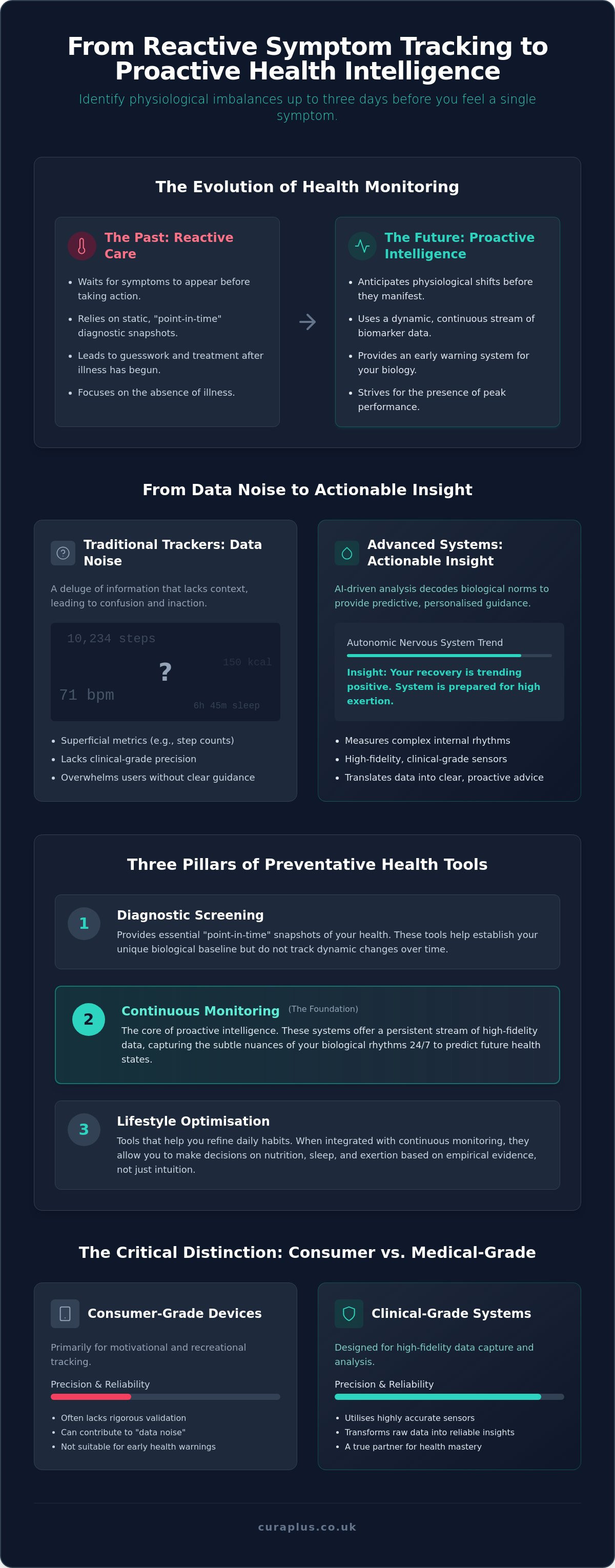
We've moved past the era of waiting for symptoms to appear before seeking intervention. Historically, home medical kits were designed for reaction. A thermometer only confirms a fever once it's already present. Today, preventative health tools for home are defined as integrated systems that anticipate physiological shifts before they manifest as physical distress. This evolution represents a fundamental shift in how we perceive our biological data, moving from static measurements to a dynamic, living narrative of our health.
Traditional tools were essentially diagnostic snapshots. Modern proactive intelligence systems, however, operate as continuous surveillance for the body. This approach aligns with the broader medical principle of prophylaxis, which focuses on the active prevention of disease rather than its subsequent treatment. By monitoring subtle fluctuations in biomarkers, these systems provide a window into the body's future state. It's the difference between looking in a rear-view mirror and having a high-definition map of the road ahead.
In 2026, the UK market has pivoted sharply toward self-optimisation and longevity. We no longer settle for the mere absence of illness; we strive for the presence of peak performance. This cultural shift has led to the rise of "physiological intelligence" as the new gold standard. It's a framework where your data isn't just stored; it's interpreted to create a refined, individualised map of your health trajectory. This intelligence allows for a level of calm control that was previously only available in clinical settings.
Why Traditional Fitness Trackers Often Fall Short
Most fitness trackers provide a deluge of information that lacks context. Counting steps or measuring basic heart rate is insufficient for true health mastery. This creates "data noise", where users are overwhelmed by numbers but lack actionable insights. Without clinical-grade precision and sophisticated analysis, these metrics remain superficial. True preventative intelligence requires more than just monitoring movement; it requires the measurement of complex internal rhythms that signal a change in your biological baseline.
The Rise of Predictive Health in the UK
The NHS "digital-first" initiative has fundamentally changed the landscape of home monitoring. By encouraging citizens to take ownership of their physiological data, the focus has shifted from clinical visits to continuous home-based oversight. AI now enables us to move beyond simple questions like "What is my heart rate?" to more complex inquiries like "Am I becoming ill?". Predictive health is the use of historical biomarker trends to forecast future wellness states. This transition ensures that preventative health tools for home serve as an early warning system, replacing uncertainty with data-driven confidence.
Essential Categories of Preventative Health Tools for the Modern Home
Selecting the right preventative health tools for home requires a structured approach to classification. We can broadly categorise these technologies into three pillars: diagnostic screening, continuous monitoring, and lifestyle optimisation. Diagnostic tools provide essential "point-in-time" snapshots, whilst lifestyle optimisation systems refine your daily habits. However, it's the continuous monitoring segment that serves as the foundation for proactive intelligence, offering a persistent stream of data that captures the nuances of your biological rhythms.
In the UK, the distinction between "medical-grade" and "consumer-grade" labels is a critical factor for the discerning user. Whilst the regulatory environment is evolving to allow more flexibility for low-risk wellness products, the quest for precision remains paramount. A device that carries clinical-grade sensors provides a level of rigour that basic fitness trackers cannot match. This accuracy is what transforms a simple gadget into a reliable partner for health mastery. Implementing biometric tracking for wellness into your daily routine ensures that decisions regarding nutrition, sleep, and exertion are based on empirical evidence rather than subjective intuition.
Interoperability is the final piece of the puzzle. Fragmented data is the enemy of clarity. To avoid a disjointed ecosystem where your smart scales don't communicate with your wearable, you must choose tools designed for integration. A unified data environment allows for a holistic interpretation of your health. To truly unify these disparate data points, a centralised platform like the Cura+ AI Platform acts as the master interpreter for your biological signals, turning raw numbers into a coherent strategy for longevity.
Continuous Biomarker Monitoring Systems
Modern wearables have progressed far beyond simple activity tracking. High-fidelity systems now monitor over 15 biomarkers simultaneously, providing an unprecedented view of internal physiological states. By tracking metrics such as blood oxygen, skin temperature, and heart rate variability in real-time, these devices identify deviations from your unique baseline. This shift aligns with broader trends in Emerging Wearable Health Technologies that are redefining the boundaries of remote care. theBand by Cura+ leads this category, utilising multi-sensor integration to offer a comprehensive physiological profile that traditional screen-based trackers often miss.
At-Home Diagnostic and Screening Kits
Whilst wearables provide the "flow" of data, diagnostic kits provide the "depth". Finger-prick blood tests allow for the regular monitoring of cholesterol, vitamin D levels, and hormonal balances without a clinical visit. Similarly, smart scales have evolved to measure visceral fat and metabolic age, offering insights into your internal composition. These tools complement continuous wearables by providing the biochemical context that sensors alone might overlook. Together, they form a complete preventative health tools for home ecosystem, ensuring no aspect of your vitality is left to chance.
Beyond Heart Rate: The Role of AI and Multi-Biomarker Monitoring
The true power of modern preventative health tools for home doesn't lie in the collection of data, but in its sophisticated interpretation. Whilst first-generation wearables merely reported heart rate, today's AI-driven systems focus on identifying subtle "deviations from the norm" within your unique biological profile. Every individual possesses a distinct physiological baseline; what is normal for one person may signal the onset of illness for another. By utilising machine learning, these platforms learn your personal patterns over time, allowing them to detect microscopic shifts that would be invisible to the human eye or basic tracking software.
Central to this intelligence is the monitoring of the Autonomic Nervous System (ANS). Your ANS serves as the command centre for your body's unconscious functions, regulating everything from digestion to your fight-or-flight response. When your system is under strain, the ANS is the first to react. By tracking heart rate variability (HRV) and skin temperature, you gain a transparent view into your body's resilience. These specific metrics are vital for tracking immune health, as a rise in nocturnal skin temperature often precedes a fever by several days. This foresight transforms your health strategy from a series of reactions into a masterclass in proactive oversight.
There is a fundamental difference between a standard "notification" and a "predictive alert". A notification tells you what is happening now; a predictive alert tells you what is likely to happen in the near future. This shift in communication style allows you to adjust your behaviour before a physiological decline occurs, ensuring you remain in a state of peak optimisation rather than recovering from a setback.
The Power of 15+ Integrated Biomarkers
The synergy between multiple metrics provides a holistic clarity that single-metric tracking cannot achieve. When AI synthesises data from blood oxygen, HRV, and respiratory rate simultaneously, it creates a comprehensive picture of your internal state. Research indicates that this multi-biomarker approach can identify viral onset up to 72 hours before physical symptoms actually appear. Multi-sensor data synthesis enables the creation of a high-fidelity digital twin that reflects the user's live physiological state with clinical accuracy. This digital representation allows the system to simulate responses and predict outcomes with remarkable precision.
Predictive Alerts: Preventing Burnout and Illness
Managing mental and physical exhaustion requires more than just willpower; it requires data. Utilising wearables for tracking stress patterns allows you to visualise the impact of your environment on your nervous system. The system identifies when your stress levels are consistently high and your recovery is inadequate, issuing a warning to rest before your body forces you to do so through illness or burnout. This is the essence of proactive intelligence. It replaces the traditional model of reactive medicine with a sophisticated, data-driven shield, ensuring that preventative health tools for home act as a constant guardian of your long-term vitality.
Implementing a Proactive Health Strategy at Home
Owning the right hardware is merely the first stage of your journey toward physiological mastery. To truly harness preventative health tools for home, you need a structured methodology for integration into your daily life. Begin by auditing your primary health objectives. Are you focused on long-term longevity, peak athletic performance, or the early detection of viral illness? Defining these goals allows you to filter your biological data through the correct lens, ensuring every insight serves a specific purpose.
Once your objectives are clear, the next step involves the acquisition of a high-fidelity wearable like theBand. This is not about simple step tracking; it's about establishing a persistent, clinical-grade link with your biology. For the first 14 to 30 days, your primary task is consistency. Wear the device religiously, ensuring it is charged and positioned correctly every night. This initial period is crucial for AI calibration, as it allows the system to understand your unique physiological signatures and rhythmic patterns.
A common mistake amongst new users is obsessing over daily fluctuations. Your heart rate variability or sleep score will naturally vary based on a myriad of factors, from a late-night meal to a stressful meeting. Instead, shift your focus to weekly trends. Are your biomarkers trending upward over a seven-day period, or is there a persistent decline in your recovery scores? This macro-view provides the clarity needed to make meaningful lifestyle adjustments without falling into the "anxiety loop" of over-analysing minor, transient data points.
Building Your Personal Health Baseline
Establishing a baseline is the most critical phase of your strategy. You can find more detail in our guide on how to build a health baseline. It's essential to remember that your "normal" is entirely distinct from population averages. Clinical standards provide a broad range, but your personal optimal state is a moving target that only consistent, high-fidelity monitoring can define. Consistency in wearable placement and charging habits ensures the data remains untainted by external variables.
Turning Data into Action with AI Coaching
Data without interpretation is just noise. This is where an AI health and wellness coach becomes indispensable to your routine. Rather than trying to decode complex graphs yourself, the AI provides direct, actionable insights that simplify decision-making. You might receive a prompt to increase magnesium intake based on specific recovery patterns or a suggestion to go to bed 30 minutes earlier to counteract a rising stress trend. This proactive guidance ensures your data leads to tangible transformation rather than just information overload. To begin your journey toward data-driven wellness, explore the full capabilities of the Cura+ AI Platform today.
theBand by Cura+: The Pinnacle of Home Preventative Technology
For those who view their biology as a complex system to be mastered, theBand represents the ultimate evolution in preventative health tools for home. Unlike standard consumer smartwatches that often prioritise social media notifications and app ecosystems, theBand is a dedicated instrument of physiological intelligence. It's engineered specifically for individuals who demand clinical accuracy and proactive insights over superficial metrics. By focusing exclusively on high-fidelity data collection, it provides a level of clarity that general-purpose wearables simply cannot replicate.
At the core of this system is a UK-based AI platform that monitors over 15 biomarkers simultaneously. This isn't just about recording data; it's about the continuous refinement of your personal health model. We operate on a subscription-based model because proactive health isn't a one-off purchase. It's a commitment to continuous intelligence. This ensures your AI coach is always updated with the latest predictive algorithms, evolving alongside your body's changing needs. We invite you to join our pre-launch phase to secure early access to the leading predictive health wearable UK has to offer.
Sophisticated Design Meets Clinical Precision
The aesthetic of theBand is visionary yet understated. It's designed to be worn 24/7 without the intrusive glow of a screen or the constant vibration of digital alerts. This screen-free design ensures that your focus remains on your well-being, not your inbox. Beneath the sleek exterior lies a sophisticated sensor array that maintains rigorous accuracy during both peak athletic exertion and deep REM sleep. It's a professional tool for a high-stakes journey, providing the methodical reliability required for true self-optimisation.
Securing Your Physiological Future
In an era of increasing digital vulnerability, we treat your biological data with the gravity it deserves. Your information is encrypted and secured using the highest standards, ensuring you remain the sole owner of your longitudinal health history. Owning this data over months and years allows you to see the true trajectory of your vitality. It's an investment in your future self. Don't wait for your body to signal a crisis before you take control. Sign up for our pre-launch today and lead the shift toward a more intelligent, proactive way of living.
Mastering Your Biological Narrative
The transition from reactive symptom management to proactive health optimisation is no longer a distant vision; it's a present reality. By integrating preventative health tools for home into your daily routine, you move beyond the limitations of standard fitness trackers. You've learned that true mastery requires a high-fidelity baseline and the ability to decode the Autonomic Nervous System's subtle signals. This shift ensures you remain ahead of the curve, identifying physiological deviations before they impact your performance or well-being.
The future of wellness belongs to those who value clinical precision and data-driven clarity. With the ability to monitor 15+ biomarkers simultaneously and receive predictive AI alerts, you can finally replace uncertainty with calm control. This UK-based technology represents the pinnacle of physiological intelligence, offering a sophisticated guide for your long-term vitality. It's an opportunity to own your longitudinal data and use it to refine every aspect of your existence.
Secure your place for theBand pre-launch and embrace the future of proactive health.
It's time to stop reacting to illness and start orchestrating your peak health. Your journey toward total biological clarity begins today.
Frequently Asked Questions
What are the best preventative health tools for home use in 2026?
The most effective preventative health tools for home are integrated systems that combine multi-biomarker wearables with AI-driven analytics. Whilst basic trackers focus on activity, professional-grade systems like theBand monitor internal physiological shifts to provide predictive insights. High-fidelity smart scales and at-home diagnostic kits for hormonal or metabolic screening also serve as essential components of a comprehensive home health ecosystem.
Can a wearable device really detect illness before I feel sick?
Yes, sophisticated wearables can identify the onset of illness up to 72 hours before physical symptoms manifest. This is achieved by detecting subtle deviations in your baseline heart rate variability and nocturnal skin temperature. By identifying these microscopic shifts in your Autonomic Nervous System, the system provides a predictive alert that allows you to prioritise rest and recovery before a full infection takes hold.
How does an AI health coach differ from a standard fitness app?
An AI health coach provides synthesis and interpretation whilst standard apps merely collect raw data points. Instead of presenting you with a list of steps or heart rate numbers, an AI platform like Cura+ decodes what that data means for your unique biology. It offers specific, actionable guidance on nutrition, sleep, and exertion, effectively acting as a high-level consultant for your body's complex systems.
Is my data secure when using AI-driven health monitors?
Professional health technology platforms utilise advanced encryption and secure cloud architectures to protect your physiological narrative. Your longitudinal health data is a highly sensitive asset; therefore, reputable providers ensure that you remain the sole owner of your information. This commitment to privacy allows you to build a detailed biological history over several years without compromising your personal security or anonymity.
What biomarkers should I be tracking for proactive health management?
Proactive health management requires tracking a broad array of biomarkers, including heart rate variability, blood oxygen saturation, and respiratory rate. Monitoring skin temperature and sleep architecture is also vital for understanding immune resilience and recovery. High-fidelity preventative health tools for home track 15 or more of these metrics simultaneously to create a high-fidelity digital twin of your internal state.
Do I need a medical degree to understand the data from these tools?
No, you don't need clinical training because the AI platform handles the complex interpretation for you. The software translates technical terminology into clear, manageable insights that anyone can apply to their lifestyle. This approach replaces the confusion of raw data with the quiet excitement of discovery, allowing you to master your health with confidence and precision.
How much does a professional-grade preventative health system cost in the UK?
Investment levels for home health systems vary depending on the sophistication of the sensor array and the depth of the AI analytics provided. Most advanced systems now utilise a model that includes an initial hardware investment followed by a subscription for continuous intelligence. This structure ensures your predictive algorithms remain updated with the latest clinical research and technological refinements for long-term accuracy.
Can these tools replace regular check-ups with my GP?
No, home health tools are designed to complement, not replace, professional medical consultations. These systems serve as a sophisticated early warning system and a tool for lifestyle optimisation rather than a platform for clinical diagnosis. By providing your GP with accurate longitudinal data from your home monitoring, you can have more informed and effective discussions during your scheduled medical appointments.


