


What if your body could alert you to a developing illness days before you felt a single symptom? For many, health remains a frustrating black box, only addressed when something goes wrong and we're forced into brief, reactive appointments. Having proactive vs reactive healthcare explained reveals that the traditional model is often a game of catch-up. It's a system where 90% of healthcare spending is directed toward chronic conditions that might have been mitigated with earlier insight. You likely feel that your current approach is missing the nuance of your unique biology, leaving you to wonder which metrics actually define your well-being.
This article provides the clarity you need to move beyond managing symptoms and start mastering your wellness. You'll learn how predictive AI and biomarker tracking shift the focus from emergency repairs to informed, daily optimisation. We'll explore a framework for using real-time data to anticipate health changes, giving you the confidence to choose a proactive strategy that secures your future vitality. By the end, you'll understand how to transform data into a sophisticated guide for your high-stakes journey toward self-optimisation.
Key Takeaways
- Having proactive vs reactive healthcare explained reveals why the traditional "break-fix" model is insufficient for those pursuing modern longevity and peak performance.
- Understand how to interpret your body's data as a complex system rather than a series of isolated symptoms that only appear once internal stress has reached a critical point.
- Explore the role of continuous monitoring in establishing a precise biological baseline, using 15+ biomarkers to gain superior clarity and control.
- Learn how predictive AI transforms historical trends into actionable foresight, allowing you to intercept potential health issues before they manifest.
- Discover how to leverage tools like theBand and the Cura+ platform to transition from a passive patient to an active strategist focused on biological optimisation.
Defining the Spectrum: Reactive, Preventative, and Proactive Healthcare
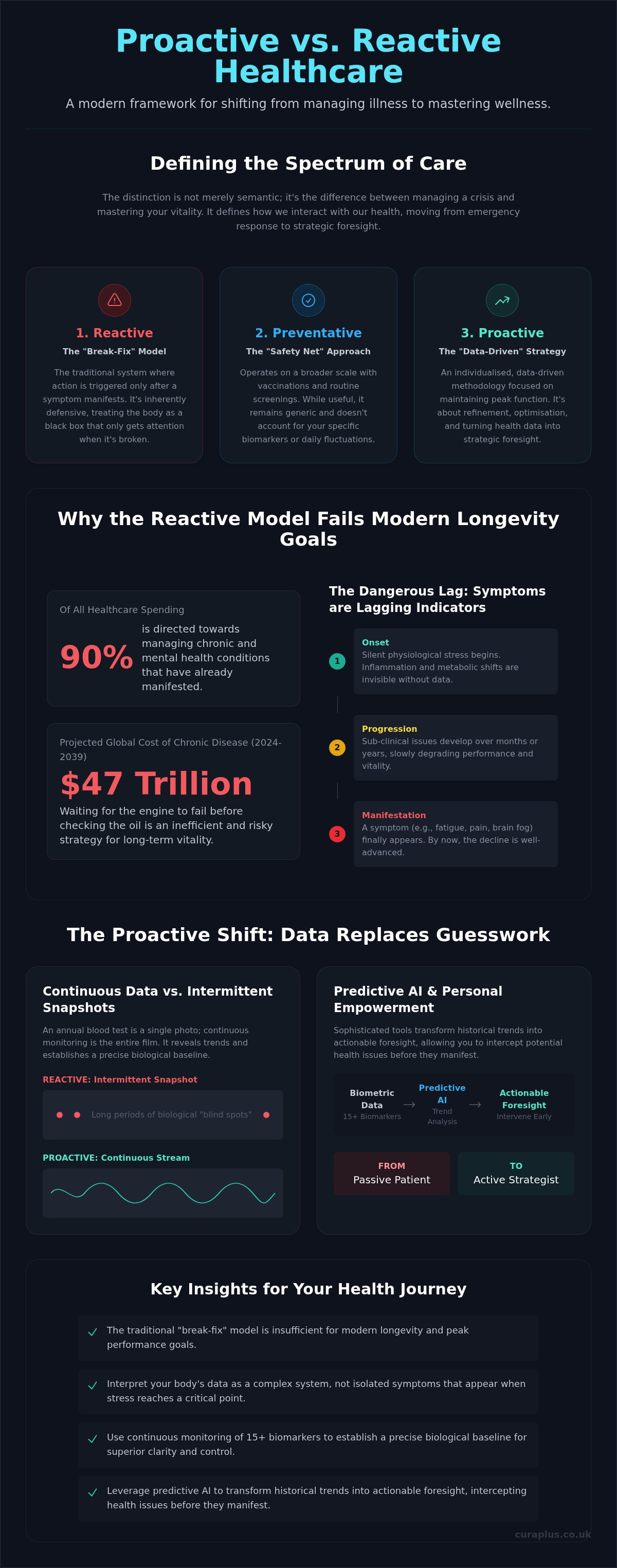
Understanding the nuances of modern medical care requires a clear framework. Having proactive vs reactive healthcare explained is the first step toward reclaiming authority over your biological future. Most people exist in a state of passive observation, waiting for the body to signal distress before seeking assistance. This spectrum defines how we interact with our health, moving from emergency response to strategic foresight. The distinction is not merely semantic; it's the difference between managing a crisis and mastering your vitality.
- Reactive Healthcare: This is the traditional "break-fix" model. It's the system we've used for decades: you feel a pain, you book an appointment, and a clinician attempts to resolve the symptom. It's inherently defensive.
- Preventative Healthcare: Preventive healthcare operates on a broader scale. It includes vaccinations and routine screenings designed for the general population. It's a "safety net" approach, yet it remains generic. It doesn't account for your specific biomarkers or daily fluctuations.
- Proactive Healthcare: This is an individualised, data-driven methodology focused on maintaining peak function whilst you're healthy. It's about refinement rather than just repair.
The "Wait and See" Trap of Reactive Care
The fundamental flaw of reactive care is its reliance on "feeling sick" as the primary trigger for action. By the time a symptom manifests, the underlying physiological decline is often well-advanced. These sub-clinical issues are silent thieves of longevity. Traditional GP appointments are often too brief to catch these subtle shifts, focusing instead on the most pressing complaint. This approach creates a dangerous lag between the onset of a problem and its resolution. It treats the body as a black box that only deserves attention when it's broken.
The Shift Toward Personalised Proactivity
True proactivity is not a one-off event like an annual physical; it's a continuous behaviour. It requires a fundamental shift in how you perceive your body. Instead of a series of symptoms to be managed, your body is a complex system of data points waiting to be decoded. Utilising sophisticated proactive health management tools allows you to monitor these shifts in real-time. This empowerment turns the individual into the lead strategist of their own health journey. It replaces uncertainty with clinical precision and calm control.
Why the Reactive Model is Failing Modern Longevity Goals
The traditional medical infrastructure was designed for a different era. It excelled at managing acute infections and traumatic injuries, where a clear event triggered a clinical response. However, modern health challenges are predominantly chronic and metabolic. In 2025, U.S. healthcare spending increased by 7.3%, reaching a staggering $5.7 trillion, yet 90% of these expenditures are directed towards managing chronic and mental health conditions that have already manifested. When we have proactive vs reactive healthcare explained in the context of longevity, it becomes clear that waiting for symptoms is a strategy of diminishing returns.
Symptoms are lagging indicators. By the time you feel fatigue, joint pain, or cognitive fog, your body has likely been under significant physiological stress for months or even years. This break-fix mentality ignores the gradual decline that precedes a diagnosis. Chronic diseases are projected to cost as much as $47 trillion globally between 2024 and 2039. Relying on a reactive model means you are essentially waiting for the engine to fail before checking the oil. It's an inefficient use of resources and a risk to your long-term vitality.
The Physiological Blind Spot
Many life-altering conditions begin with silent inflammation or subtle metabolic shifts that don't register on a standard diagnostic scale. The most dangerous misconception in modern wellness is the belief that "if I feel fine, I am healthy." Feeling fine is not a clinical metric; it is merely the absence of acute distress. Sophisticated biometric tracking for wellness illuminates these hidden trends, allowing you to see what you cannot feel. It replaces the anxiety of the unknown with the clarity of data-driven insight.
The Problem with Intermittent Data
A single annual blood test is a snapshot, not a strategy. Your biology is dynamic, fluctuating based on sleep, stress, and nutrition. A "normal" result at the doctor’s surgery might actually mask a downward trend when compared to your unique personal baseline. Moving from snapshots to a continuous cinematic view helps make the benefits of having proactive vs reactive healthcare explained tangible in your daily life. This shift towards predictive intelligence in healthcare is already being adopted by leading institutions to evaluate and govern patient outcomes more effectively.
Without access to your own continuous data, you're forced to outsource your intuition to a system that only recognises you when you're broken. Reclaiming this narrative starts with understanding your unique biological rhythm. If you're ready to move beyond the limitations of the reactive model, exploring a data-driven wellness strategy is the essential next step in your optimisation journey.
The Role of Continuous Data in Proactive Health Management
Continuous monitoring is the catalyst for a fundamental shift in biological management. Whilst the reactive model relies on infrequent snapshots, a proactive strategy demands a cinematic view of your internal state. Having proactive vs reactive healthcare explained through the lens of data reveals that true wellness is found in the nuances of your daily fluctuations. By tracking 15+ biomarkers simultaneously, you gain the ability to see the "big picture" of your health, identifying how sleep, nutrition, and exertion interact within your unique system.
This high-definition clarity allows for the detection of subtle deviations from your established norms. Instead of waiting for a clinical event, real-time alerts prompt immediate lifestyle adjustments. Whether it's increasing hydration, prioritising rest, or modifying a workout, these micro-interventions prevent minor stressors from escalating into systemic issues. It marks the transition from being a passive patient to becoming the "CEO of your own health," where every decision is backed by physiological evidence rather than intuition.
Biomarkers as Early Warning Signals
Specific biomarkers act as the body’s early warning system. Utilising a wearable for tracking immune health can reveal a viral onset days before you feel "under the weather." Subtle rises in skin temperature or a sudden drop in Heart Rate Variability (HRV) are often the first signs that the body is diverting resources to fight an infection. Similarly, using a wearable for tracking stress patterns allows you to intercept physiological strain before it manifests as chronic burnout. These metrics provide a window into your autonomic nervous system, offering a level of insight that was previously reserved for clinical settings.
Building Your Personal Biological Baseline
The most critical component of proactive care is your personal baseline. Population "normal" ranges are often too broad to be useful for individual optimisation. A reading that is considered healthy for the average person might actually be a significant deviation for you. Learning how to build a health baseline requires precision technology that captures your unique physiological signature over time. Once this baseline is established, your data becomes a sophisticated guide, allowing you to recognise when you are operating at peak performance and when your system requires intervention. This personalised approach ensures that your health strategy is as unique as your DNA.
Predictive Intelligence: The Next Frontier Beyond Proactive Care
Whilst proactive care represents a significant leap forward, predictive intelligence is the true horizon of human wellness. Having proactive vs reactive healthcare explained often highlights the importance of early action, but prediction introduces the critical element of foresight. It's the difference between knowing you are currently under stress and knowing that your specific physiological trajectory will lead to illness in forty-eight hours. Machine learning algorithms interrogate your data to identify non-linear patterns that the human eye, and even traditional clinical models, frequently overlook. For those committed to biohacking and high-level performance, this foresight is the ultimate competitive advantage.
Predictive health moves beyond the "what" and "how" to answer the "when." By synthesising data from 15+ distinct biomarkers, AI can detect the subtle, cascading effects of physiological strain before they reach a threshold of dysfunction. This allows for a level of refinement that reactive medicine simply cannot match. You are no longer managing a body that has already failed; you are optimising a system to ensure it never does. This is the quiet excitement of discovery, where uncertainty is replaced by the calm control of data-driven certainty.
From Monitoring to Anticipating
The transition from monitoring to anticipating is driven by the Cura+ AI health and wellness coach. This platform does not merely store data; it learns your unique biological habits to provide increasingly accurate forecasts over time. By analysing historical trends alongside real-time inputs, it generates sophisticated readiness scores. These scores are essential when evaluating wearables for tracking recovery, as they dictate whether your body is prepared for high-intensity exertion or requires restorative rest. This level of precision eliminates the guesswork that often plagues standard fitness tracking, ensuring every action is purposeful.
The Future of Personal Health in 2026
Looking toward the future of personal health in 2026, we see a world where generic medical advice is replaced by hyper-individualised intelligence. The empowerment of having a clinical-grade laboratory on your wrist cannot be overstated. It transforms you from a consumer of healthcare into a master of your own biology. As AI continues to refine its predictive capabilities, the concept of "waiting for a diagnosis" will become obsolete for those who prioritise physiological excellence. You deserve a health strategy as sophisticated as the body it protects.
If you are ready to stop reacting to your health and start predicting it, explore the Cura+ AI platform today to secure your biological future.
Empowering Your Future with theBand by Cura+
The theoretical framework of having proactive vs reactive healthcare explained is only as powerful as the tools you use to implement it. For those seeking to master their biology, theBand by Cura+ represents the ultimate convergence of sophisticated hardware and artificial intelligence. It's the predictive health wearable UK users have been waiting for, designed to bridge the gap between abstract data and actionable wellness. Whilst standard trackers offer glimpses into your activity levels, theBand interrogates over 15 distinct biomarkers to provide a comprehensive map of your internal landscape.
Raw data, however, requires a translator. The Cura+ AI Platform serves as your personal biological strategist, processing complex physiological inputs into clear, coached insights. It doesn't just tell you that your heart rate is elevated; it explains what that elevation means for your immune readiness and metabolic health. By joining our pre-launch phase, you aren't just purchasing a device. You're securing your place in a new era of predictive wellness where uncertainty is replaced by clinical-grade clarity.
Clinical Precision Meets Personalised Coaching
Precision is the cornerstone of the Cura+ experience. TheBand utilizes medical-grade sensors to monitor fluctuations that are invisible to the naked eye, ensuring your biological baseline is established with absolute accuracy. This level of detail supports a longevity-focused lifestyle by identifying the micro-trends that lead to macro-health outcomes. Our subscription model ensures that your monitoring is continuous, providing the peace of mind that comes from knowing your system is being guarded by the world's most advanced predictive algorithms. It's a sophisticated partnership between technology and your unique physiology.
Taking the First Step Toward Predictive Intelligence
Having proactive vs reactive healthcare explained reveals a simple truth: the most effective way to manage an illness is to prevent it from ever occurring. The transition from a reactive "break-fix" mentality to a predictive strategy is the most significant investment you can make in your future self. It's time to stop reacting to the symptoms of yesterday and start predicting the vitality of tomorrow. Every data point is an opportunity for optimisation, and every alert is a chance to intercept decline before it manifests. You have the power to transform your health from a mystery into a mastered system. Your journey toward biological excellence begins with a single, data-driven decision. Discover theBand and join the Cura+ mission today to reclaim authority over your health.
Mastering Your Biological Future
Transitioning from a reactive medical model to predictive intelligence is a fundamental reclamation of your health narrative. Having proactive vs reactive healthcare explained reveals that true wellness is found in the space between feeling 'fine' and the onset of clinical symptoms. By replacing generic population averages with your unique biological baseline, you move beyond the uncertainty of the 'break-fix' approach. You're no longer a passive recipient of care but a lead strategist who uses continuous data to secure long-term vitality and peak performance.
TheBand by Cura+ provides the sophisticated oversight your biology requires to thrive. By monitoring 15+ biomarkers in real-time and delivering AI-driven predictive alerts, this UK-based clinical-grade technology empowers you to act whilst others merely wait. It's time to stop managing illness and start mastering wellness. Secure your future with theBand by Cura+ and begin your journey toward biological excellence today. You have the intelligence to transform your potential into a permanent state of high-level vitality.
Frequently Asked Questions
What is the main difference between proactive and reactive healthcare?
Reactive healthcare is triggered by the onset of symptoms, whilst proactive care is driven by continuous data to maintain peak function. Having proactive vs reactive healthcare explained clarifies that the reactive model is defensive, responding only after a biological system fails. Proactive care is an offensive strategy, utilising real-time insights to optimise your health before any dysfunction occurs.
Is proactive healthcare the same as preventative medicine?
Proactive care is highly individualised, whereas preventative medicine typically focuses on broad, population-level measures. Preventative medicine includes generic interventions like vaccinations and routine screenings intended for the general public. Proactive care uses your specific biomarkers to guide daily decisions, making it a personalised strategy for self-optimisation rather than a one-size-fits-all safety net.
How do wearables help with proactive health management?
Wearables provide the continuous data stream necessary to move beyond intermittent medical snapshots. Sophisticated devices like theBand monitor 15+ biomarkers in real-time, capturing your physiological state during your actual daily life. This constant visibility allows for the detection of subtle shifts that an annual physical or a single blood test would likely miss.
Can proactive healthcare really detect illness before symptoms appear?
Yes, physiological changes often precede physical symptoms by several days. Subtle rises in skin temperature or significant decreases in Heart Rate Variability (HRV) can signal an immune response before you feel "under the weather." Detecting these early markers allows for immediate lifestyle adjustments, such as increased rest or hydration, that may mitigate the severity of a developing illness.
Why is a "biological baseline" important for proactive care?
A biological baseline is your unique physiological signature, serving as the personal reference point against which all future data is measured. Without a baseline, it's difficult to determine if a specific metric represents a healthy fluctuation or a genuine warning sign. Proactive care relies on these personalised norms rather than broad population averages that may not apply to your unique biology.
What biomarkers are most important for tracking proactively?
Critical biomarkers for proactive tracking include Heart Rate Variability (HRV), resting heart rate, skin temperature, and respiratory rate. Monitoring 15+ biomarkers simultaneously provides a multi-dimensional view of your internal health. This complexity is essential for understanding how different systems, such as your nervous and cardiovascular systems, are interacting under various levels of stress.
How does AI improve the accuracy of proactive health monitoring?
AI identifies non-linear patterns and complex correlations that are invisible to the human eye or traditional diagnostic tools. By interrogating vast amounts of historical and real-time data, machine learning algorithms can forecast future health states with clinical precision. This predictive intelligence transforms raw metrics into actionable foresight, allowing you to anticipate physiological changes rather than simply monitoring them.
Is proactive healthcare more expensive than reactive care in the long run?
Proactive care is significantly more cost-effective when considering the long-term economic and personal burden of chronic disease. Treating established conditions currently accounts for 90% of annual healthcare expenditures, which reached $5.7 trillion in 2025. Investing in continuous monitoring reduces the likelihood of expensive emergency interventions and the high cost of lost productivity associated with chronic illness.


