


What if the reason you wake up exhausted has nothing to do with how long you slept, but rather the invisible architecture of your night? It's a common frustration for many in the UK. You've likely looked at your phone's health app only to find a sea of conflicting data that doesn't match your physical state. You've probably questioned whether a wrist-based sensor can truly capture the nuance of your human biology. Choosing a high-precision wearable for tracking sleep stages is no longer about counting hours of shut-eye. It's about securing clinical-grade accuracy to transform raw data into a strategic advantage for your health.
It's frustrating to see a 'perfect' sleep score when your body feels depleted and on the verge of burnout. You deserve a clear, sophisticated window into your autonomic nervous system that replaces guesswork with absolute precision. In this guide, you'll learn how to decode your unique sleep architecture, from REM cycles to deep restorative phases, whilst identifying the technology that offers the highest level of reliability. We'll explore how to leverage tools like theBand and the Cura+ AI Platform to organise your recovery and predict physiological strain, ensuring you remain in total control of your personal wellness journey.
Key Takeaways
- Understand the biological necessity of each sleep phase. Learn how your body prioritises physical cellular repair during deep sleep and cognitive consolidation during REM cycles.
- Evaluate the technical efficacy of actigraphy and photoplethysmography sensors. This ensures you choose a wearable for tracking sleep stages that delivers clinical-grade accuracy.
- Identify how external variables like alcohol or late-night habits disrupt your autonomic nervous system whilst comparing nightly data against your personalised baseline.
- Transition from basic monitoring to advanced health intelligence. Use theBand and the Cura+ AI Platform to track over 15 biomarkers for a holistic view of your systemic wellbeing.
Understanding Sleep Stages and Why Wearable Tracking Matters
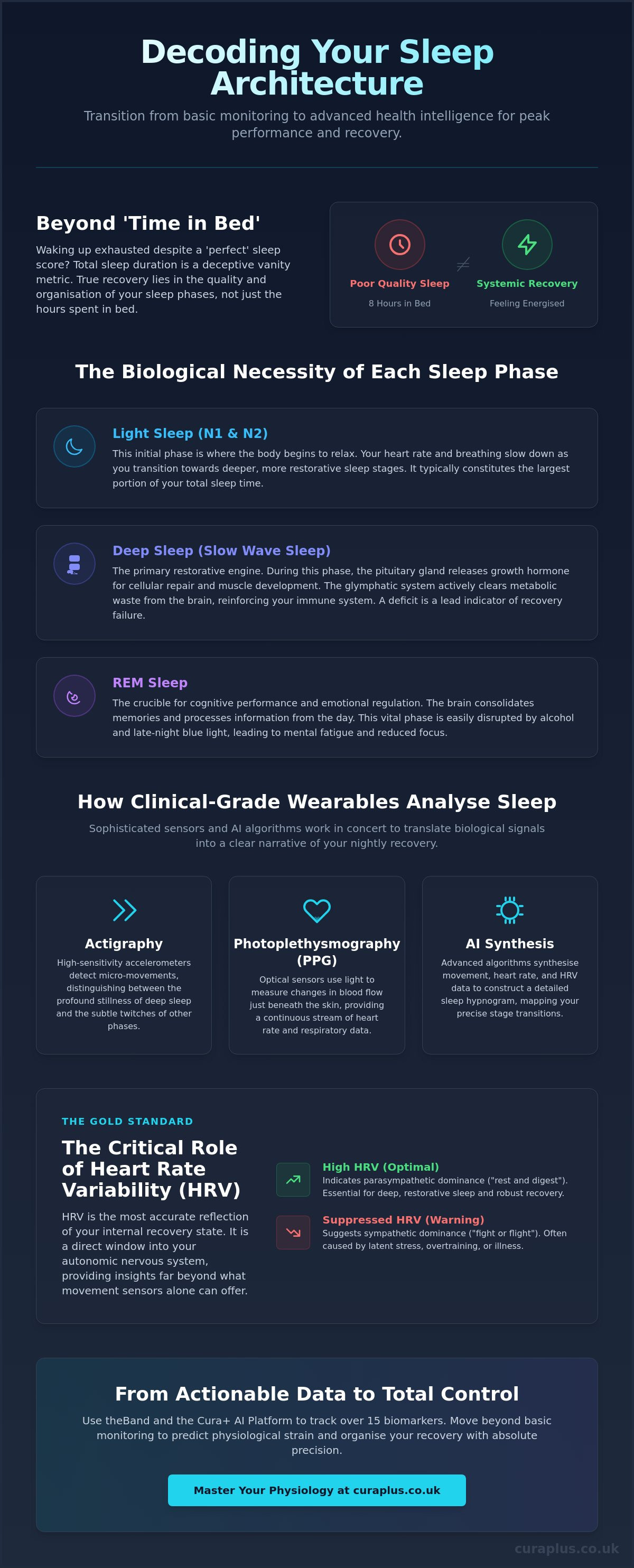
Sleep is not a monolithic block of downtime; it is a sophisticated sequence of biological transitions. Whilst many focus on total duration, "Time in Bed" remains a deceptive vanity metric that fails to reflect systemic health. True self-mastery requires a granular analysis of your sleep architecture, the structural organisation of your night across four distinct phases: Awake, Light (N1 and N2), Deep, and REM. Understanding Sleep Stages allows you to view your rest as a proactive health biomarker rather than a passive necessity. By utilising a high-precision wearable for tracking sleep stages, you can transform invisible biological processes into actionable data points that inform your daily performance.
The Role of Deep Sleep in Physical Recovery
Deep sleep, or Slow Wave Sleep (SWS), serves as the body’s primary restorative engine. During this phase, your blood pressure drops and your breathing slows, allowing the pituitary gland to release essential growth hormones for tissue repair and muscle development. It is also the window where the glymphatic system becomes most active, clearing metabolic waste from the brain. Consistent deep sleep is the cornerstone of immune resilience. If your wearable for tracking sleep stages reveals a persistent deficit in this phase, it serves as a lead indicator of recovery failure. You can identify these physiological gaps long before they manifest as physical illness or chronic fatigue, allowing for immediate lifestyle adjustments through the Cura+ AI Platform.
REM Sleep and Cognitive Performance
Rapid Eye Movement (REM) sleep is the crucible of cognitive processing and emotional regulation. It is during this stage that the brain consolidates memories and synthesises the day’s information, turning raw experience into long-term knowledge. Modern lifestyle factors frequently sabotage this vital phase. Consuming alcohol or exposure to late-night blue light can disproportionately suppress REM cycles, leaving you feeling mentally sluggish despite a full night’s rest. Monitoring REM patterns provides a sophisticated early warning system for mental burnout. A sudden decline in REM duration often correlates with decreased focus and heightened emotional reactivity. By tracking these fluctuations with theBand, you gain the clarity needed to protect your cognitive performance and maintain a sharp, strategic edge in your daily life.
How Wearables Track Sleep Stages: The Science of Sensors
Modern technology has successfully bridged the gap between laboratory polysomnography and daily life. A high-calibre wearable for tracking sleep stages utilises a sophisticated suite of sensors to monitor physiological shifts that occur whilst you rest. At the foundation lies actigraphy. High-sensitivity accelerometers detect micro-movements, distinguishing between the profound stillness of deep sleep and the subtle muscle twitches often associated with REM cycles. However, movement alone is an incomplete metric. To achieve a comprehensive understanding of How Wearables Track Sleep, devices must integrate optical sensors that peer beneath the skin.
Photoplethysmography (PPG) uses light to measure blood flow, providing a continuous stream of heart rate data. The real complexity begins when this raw sensor data meets artificial intelligence. Advanced algorithms, such as those within the Cura+ AI Platform, synthesise movement, heart rate, and respiratory patterns to construct a sleep hypnogram. This digital map provides a granular breakdown of your transitions between stages, offering a level of insight that was once reserved for clinical environments. By integrating these disparate data streams, the technology translates biological noise into a clear narrative of your nightly recovery.
The Critical Importance of HRV in Sleep Analysis
Heart Rate Variability (HRV) is the variation in time between consecutive heartbeats. It's not merely a measure of cardiovascular fitness; it's a window into your autonomic nervous system. High HRV indicates a dominant parasympathetic state, which is essential for deep, restorative sleep. Conversely, a suppressed HRV suggests sympathetic dominance, often caused by latent stress or overtraining. High-end devices now treat HRV as the gold standard for stage classification, as it provides a far more accurate reflection of internal recovery than movement alone. It is the primary metric for those seeking to master their physiological state.
Beyond Movement: Respiratory and Temperature Tracking
Sophisticated devices go beyond basic pulse monitoring to include respiratory rate and skin temperature. Your breathing patterns change significantly during the night. It becomes remarkably steady during deep sleep whilst becoming irregular or rapid during REM. Skin temperature fluctuations are equally telling, often signalling hormonal shifts or the onset of viral illness before physical symptoms appear. By monitoring over 15 distinct biomarkers, theBand provides a holistic view that ensures your data is both accurate and predictive. This multi-sensor approach allows a wearable for tracking sleep stages to detect subtle biological deviations that simpler trackers would overlook.
Evaluating Accuracy: What to Look for in a Sleep Tracking Wearable
Precision is the ultimate differentiator. Whilst entry-level trackers provide a basic overview of your night, they often lack the sensor density required for clinical-grade insights. You must distinguish between consumer-grade fitness trackers and advanced health intelligence devices. The gold standard for validation remains Polysomnography (PSG). Whilst no consumer device perfectly replicates a clinical lab study, the gap is narrowing significantly. A 2024 Harvard Medical School study revealed that Fitbit's sleep stage tracking was approximately 10% less accurate than ring-based alternatives. This discrepancy often stems from the form factor. Rings and dedicated bands, such as theBand, provide more consistent skin contact and less movement interference than traditional watches.
The market in 2026 is also defined by how you access your data. Modern health tech has shifted toward a "Subscription vs Ownership" model. For instance, the Oura Ring Gen 4 requires a monthly membership fee of £5.99 to unlock full functionality. Similarly, the Whoop 5.0 is bundled with a yearly membership. When choosing a wearable for tracking sleep stages, you must decide if you prefer an upfront investment or a recurring service model. Your choice should reflect a commitment to long-term health mastery rather than a temporary curiosity. Precision is the priority.
Data Integrity and Sampling Frequency
Accuracy depends on how frequently a device samples your physiological signals. REM detection requires high-frequency monitoring to capture subtle shifts in heart rate variability. Many budget wearables utilise "data smoothing" to preserve battery. This process averages out heart rate fluctuations, which effectively masks the vital transitions between sleep phases. You should seek devices that offer raw data transparency. Understanding the unfiltered reality of your biology is the only way to ensure your health strategy is based on fact rather than algorithmic guesswork.
Battery Life vs. Continuous Monitoring
A wearable is only effective if it's actually worn. If a device requires daily charging, it creates significant gaps in your longitudinal data. This is particularly detrimental if you're forced to charge the unit overnight. Reliable health management requires "always-on" monitoring to establish a stable baseline. You should evaluate battery claims against the intensity of the sensors. High-performance systems, integrated with the Cura+ AI Platform, maintain continuous monitoring for several days. This ensures that every restorative moment is captured, providing a complete picture of your systemic recovery.
How to Use Sleep Data to Optimise Your Health and Recovery
Data is only as valuable as the decisions it informs. Comparing your sleep stages to population averages is a fundamental error in health management; your biology is a unique system with its own requirements. A high-precision wearable for tracking sleep stages is a tool for active intervention rather than passive observation. By establishing a personalised baseline, you shift from reacting to fatigue to proactively managing your vitality. This allows you to interpret your morning readiness score as a strategic directive for the day ahead.
Your sleep architecture serves as a lead indicator for physical and mental strain. When your wearable for tracking sleep stages indicates a sustained drop in deep sleep, your body is signalling a recovery deficit. This data should dictate your physical output. If your restorative phases are suppressed, it's wiser to opt for active recovery or mobility work rather than a high-intensity training session. Over time, spotting these subtle shifts allows you to predict illness or burnout before physical symptoms manifest. This level of foresight is the hallmark of sophisticated health mastery.
Step 1: Establishing Your Health Baseline
To unlock true predictive power, you must first define your "normal". We recommend wearing your device for a period of 14 to 21 days to capture a statistically significant physiological norm. This duration accounts for weekly stressors and environmental changes, providing the Cura+ AI Platform with the data necessary to identify meaningful deviations. For a deeper exploration of this protocol, read our guide on How to Build a Health Baseline: A Definitive Guide to Predictive Wellness. Once this foundation is set, the system uses AI to provide personalised coaching that anticipates your body's needs whilst you focus on performance.
Step 2: Correlating Behaviour with Sleep Architecture
Your evening habits directly dictate the quality of your rest. Use your data to conduct targeted mini-experiments, such as eliminating digital screen exposure 60 minutes before bed. You'll likely observe a measurable increase in REM latency and duration. Perhaps most striking is the "alcohol effect". Even a single evening drink can cause a total collapse of REM sleep, visible on your dashboard as a fragmented, shallow cycle. By visualising these correlations, you can organise your week to ensure peak cognitive performance when it matters most. Secure your health intelligence today by integrating theBand and the Cura+ AI Platform into your daily routine.
The Future of Sleep Intelligence: theBand by Cura+
The evolution of health technology has reached a pivotal junction where passive monitoring is replaced by proactive intelligence. Whilst the previous decade focused on simply recording data, the next era is defined by the ability to anticipate physiological needs. Choosing a wearable for tracking sleep stages in 2026 requires a shift in perspective. You're no longer just looking for a device to tell you how you slept; you're seeking a partner that understands your systemic health. theBand represents this shift by monitoring over 15 distinct biomarkers, providing a holistic view that extends far beyond traditional sleep architecture.
This sophisticated ecosystem operates on a Direct Hardware and SaaS model. This ensures that your health insights are never static. As the Cura+ AI Platform evolves, your device becomes more intelligent, refining its understanding of your unique biology with every passing night. It's a commitment to continuous self-optimisation. By integrating high-fidelity sensors with cloud-based analytics, theBand transforms into a high-level consultant for your body, offering clarity where there was once only uncertainty.
Predictive Alerts: Turning Sleep Data into Action
The true power of this technology lies in its predictive capacity. Subtle deviations in your sleep stages, combined with minute fluctuations in skin temperature, often signal a viral onset or systemic strain days before physical symptoms emerge. Your AI health and wellness coach synthesises these signals in real-time. It provides specific, actionable guidance to mitigate risks. For those prioritising longevity and biohacking, this wearable for tracking sleep stages becomes an indispensable tool for maintaining peak performance and avoiding unnecessary downtime.
Joining the New Era of Proactive Wellness
Moving beyond basic fitness trackers is a choice to value accuracy over novelty. It's time to stop wondering why you feel depleted and start knowing exactly what your body requires for total restoration. The transition from reactive management to proactive wellness is both an intellectual and practical journey toward excellence. You have the opportunity to master your health as a complex, understandable system. Explore theBand by Cura+ and secure your proactive health future to unlock the next level of your human potential.
Master Your Recovery Architecture
Mastering your sleep is no longer a matter of chance; it's a deliberate act of biological management. By integrating a high-precision wearable for tracking sleep stages into your daily routine, you move beyond basic metrics to uncover the subtle signatures of your autonomic nervous system. You've seen how clinical-grade accuracy and high-frequency sampling distinguish visionary technology from mere consumer novelties. This clarity allows you to predict physiological strain and optimise your performance with surgical precision. It's time to replace morning guesswork with a data-driven strategy that prioritises long-term vitality.
theBand by Cura+ is engineered for 24/7 proactive wellness. It monitors over 15 vital biomarkers to deliver AI-driven predictive health alerts, ensuring you're informed of systemic shifts before symptoms even arise. You deserve a partner that views health as a complex system to be mastered rather than a series of symptoms to be managed. The future of your wellbeing is already accessible through data; it's time to claim it.
Join the waitlist for theBand by Cura+ and redefine your health intelligence.
Frequently Asked Questions
Is a wearable for tracking sleep stages as accurate as a clinical sleep study?
Consumer wearables cannot perfectly replicate the gold-standard results of laboratory polysomnography, which measures brainwaves directly via EEG. However, they've become remarkably sophisticated proxies for clinical studies. A high-calibre wearable for tracking sleep stages provides the distinct advantage of longitudinal data, capturing your biological patterns over weeks and months rather than a single, often stressful night in a lab. This long-term perspective is frequently more valuable for identifying systemic health trends and recovery deficits.
Can a sleep tracker tell the difference between REM and Deep sleep accurately?
Modern sensors distinguish between these phases by synthesising heart rate variability, respiratory rate, and micro-movements. Deep sleep is characterised by a remarkably steady pulse and slow, rhythmic breathing, whilst REM sleep involves irregular respiration and varied heart rates. The Cura+ AI Platform processes these disparate signals to categorise your sleep architecture with high precision. Whilst no wrist or finger-based device is infallible, the technology is now sufficiently advanced to provide a reliable map of your nightly cognitive and physical restoration.
Why does my wearable show different sleep stages than my partner's device?
Discrepancies between devices occur because every manufacturer utilises unique sensor hardware and proprietary algorithms to interpret raw biological data. Variations in sampling frequency and the sensitivity of accelerometers mean that two different brands will rarely produce identical results, even if worn by the same person. This is why you should focus on your personal baseline within a single ecosystem. Comparing your data to a partner’s device is less productive than tracking your own physiological deviations over time.
How much Deep sleep do I actually need per night according to age?
Sleep requirements are highly individual, but most healthy adults should aim for deep sleep to comprise approximately 15 to 25 per cent of their total rest. Younger individuals typically experience higher volumes of slow-wave sleep to support growth and development, whilst older adults may see a natural, gradual decline in this restorative phase. Rather than chasing a rigid age-based figure, use your data to identify your unique "normal". Focus on how fluctuations in your deep sleep duration correlate with your daily cognitive clarity and physical readiness.
Can tracking sleep stages help detect early signs of illness or flu?
Subtle shifts in your sleep architecture often serve as a lead indicator of an impending immune response. A sudden, unexplained reduction in deep sleep, often accompanied by an elevated resting heart rate and increased skin temperature, can signal that your body is fighting a latent infection. theBand and the Cura+ AI Platform are designed to identify these physiological anomalies. By receiving predictive alerts before physical symptoms manifest, you can adjust your behaviour and prioritise recovery to mitigate the severity of the illness.
Should I wear my sleep tracker on my wrist, finger, or bicep for best results?
Placement significantly impacts data integrity, with fingers and biceps generally offering superior sensor contact compared to the wrist. Finger-based devices are particularly effective because the digital arteries are more accessible for PPG sensors, allowing for cleaner heart rate variability readings. A dedicated wearable for tracking sleep stages, such as theBand, is engineered to maintain consistent skin contact throughout the night. This reduces the "noise" caused by movement, ensuring the raw data remains high-fidelity and actionable for your health strategy.
Does wearing a tracker at night interfere with sleep quality due to blue light or EMF?
High-performance wearables are designed with "stealth" modes to ensure they don't disrupt your circadian rhythm or sleep hygiene. These devices typically disable visible light sensors during rest and utilise ultra-low-energy Bluetooth protocols to minimise EMF exposure. The biological benefit of gaining clarity into your recovery far outweighs the negligible electronic output of modern health tech. Ensuring your device is optimised for night use allows you to gather vital data whilst maintaining a pristine, dark, and restorative sleep environment.
What should I do if my wearable shows I am getting zero REM sleep?
If your data indicates a total absence of REM, first ensure the device fit is secure and the sensors are clean to rule out a technical recording error. If the fit is correct, consider if recent lifestyle choices like alcohol consumption or specific medications are chemically suppressing your REM cycles. However, if you feel mentally sharp despite the low reading, it may indicate that the algorithm is under-counting your cycles. Persistent anomalies should be reviewed against your long-term trends within the Cura+ AI Platform to determine if a recalibration is necessary.


