


What if your body could communicate a brewing infection days before you felt the first sign of fatigue or a scratchy throat? For many high-performers, falling ill feels like an unpredictable ambush that disrupts both professional momentum and personal discipline. You've likely experienced the frustration of a planned week collapsing, or perhaps you've felt sceptical of standard fitness trackers that offer plenty of data but very little clarity whilst you're trying to stay ahead of a busy schedule.
Understanding exactly what biomarkers predict illness allows you to shift from reactive symptom management to proactive physiological mastery. You'll discover the specific biological signals that forecast health shifts before they manifest, ensuring you maintain peak wellness through every season. This guide examines the most critical predictive markers, such as heart rate variability and respiratory rate, and demonstrates how advanced tools like theBand and Cura+ AI Platform provide the clinical precision needed to intervene early. We'll move beyond the noise of basic biometrics to provide a clear, data-driven strategy for self-optimisation.
Key Takeaways
- Transition from reactive medicine to predictive intelligence by understanding how quantifiable biological signals provide a window into your future health status.
- Learn exactly what biomarkers predict illness by monitoring subtle shifts in Heart Rate Variability (HRV) and Resting Heart Rate (RHR) before physical symptoms emerge.
- Establish a personalised physiological baseline to distinguish between normal variance and genuine health warnings, ensuring you respond only to significant data deviations.
- Implement immediate recovery protocols, including optimised sleep hygiene and nutritional adjustments, the moment your AI-driven data signals an impending immune challenge.
- Discover how theBand and Cura+ AI Platform integrate 15+ biomarkers to provide a cohesive, sophisticated narrative of your body's internal state.
Understanding Biomarkers in the Era of Predictive Healthcare
A biomarker is an objective, quantifiable characteristic of a biological process. Historically, these indicators were captured through static measurements, such as a blood pressure reading at a local surgery or a fasting glucose test in a laboratory. However, as we move into 2026, the paradigm is shifting towards 'Predictive Intelligence'. This evolution represents a move away from reactive medicine, where we treat problems after they arise, and towards a visionary model of health where data allows us to anticipate and prevent illness before it takes hold.
Whilst traditional clinical biomarkers provide a necessary snapshot in time, they often lack the context of your daily life. Modern digital biomarkers, tracked continuously by sophisticated wearables, offer a high-definition narrative of your physiological state. The true power of this era lies in the synthesis of multiple data streams. Rather than viewing heart rate or sleep duration in isolation, AI-driven platforms now analyse how these variables interact. This multi-variate approach addresses a significant gap in standard health tracking by detecting subtle deviations that a single data point would inevitably miss. This is Physiological Intelligence: the ability to use continuous data as a tool for proactive self-regulation and mastery over your own body.
The Difference Between Symptoms and Biomarkers
Symptoms are lagging indicators. By the time you experience a persistent headache, a fever, or muscle aches, your body's inflammatory response is already well established. Biomarkers, conversely, function as leading indicators. They reveal internal physiological strain long before you feel 'sick'. When asking what biomarkers predict illness, we must focus on the data that precedes the physical sensation. Continuous monitoring captures the quiet onset of inflammation, allowing you to identify what biomarkers predict illness in your specific body. This early visibility provides a critical window for intervention, such as increasing recovery time or adjusting your nutritional intake before your immune system becomes overwhelmed.
Why 2026 is the Turning Point for Personal Health
The landscape of wellness is undergoing a sophisticated transformation. AI is finally making complex biometric data accessible to the individual, turning raw numbers into clear, actionable insights without the need for constant clinical consultation. The UK is currently at the forefront of this shift, leading the future of personal health through innovation in wearable technology and data science. There is a growing movement amongst high-performers to move beyond basic step counting and instead master their biological narrative. This elite approach views health as a complex system to be understood and optimised, replacing the uncertainty of 'feeling fine' with the calm control of data-backed clarity.
The Core Biomarkers That Predict Impending Illness
Identifying what biomarkers predict illness is not a matter of finding a single magic number. Instead, it involves observing the subtle, multi-variate shifts in your body’s internal environment that occur long before a physical symptom manifests. Scientific literature on predictive healthcare biomarkers confirms that these indicators provide a window into systemic health that traditional periodic check-ups cannot match. By monitoring specific metrics continuously, you gain a high-fidelity view of your body's defensive state.
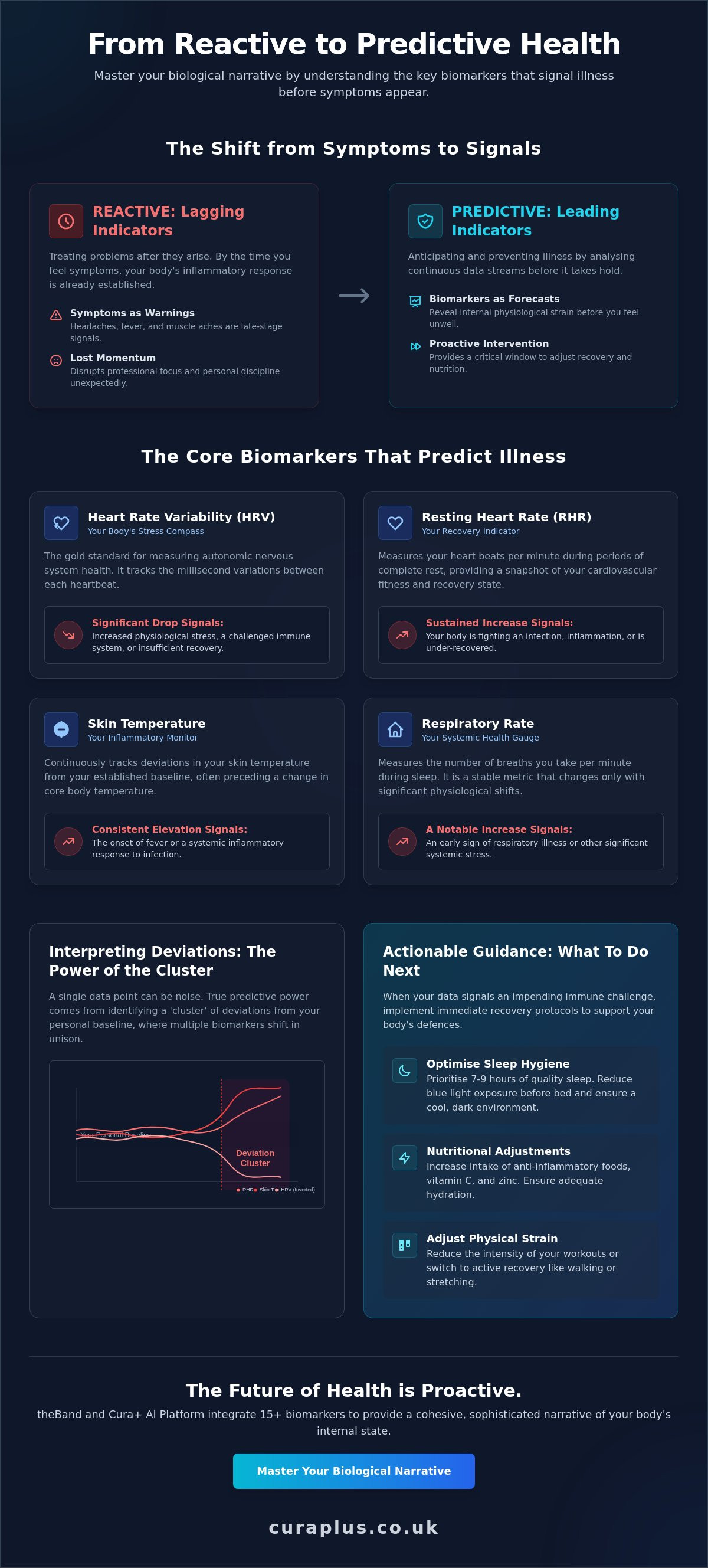
Whilst several indicators contribute to this picture, four primary metrics stand out as the most reliable predictors of acute illness. These include Heart Rate Variability (HRV), Resting Heart Rate (RHR), Skin Temperature, and Respiratory Rate. When these signals deviate from your established baseline in unison, it creates a "cluster" of data that serves as a definitive warning. Understanding these signals is the first step toward achieving true physiological mastery.
Heart Rate Variability (HRV): Your Stress Compass
Heart Rate Variability is the gold standard for measuring autonomic nervous system health. It tracks the millisecond variations between each heartbeat, reflecting the balance between your sympathetic (fight or flight) and parasympathetic (rest and digest) systems. A sudden, significant drop in HRV signals that your body is under stress and is prioritising immune defence over recovery. This often happens 48 hours before you feel the first symptoms of a virus. Utilising a wearable for tracking stress patterns is essential for early detection, as it allows you to see the parasympathetic nervous system retreating whilst you still feel physically capable. When your HRV plunges, it's a clear signal to scale back intensity and prioritise rest.
Skin Temperature and Immune Readiness
Your body is a master of thermoregulation. Even before a full-blown fever develops, your internal temperature begins to fluctuate as the immune system activates. Research suggests that a deviation as small as 0.5°C from your personalised nightly average can predict an impending fever up to 24 hours in advance. It’s important to distinguish between environmental temperature changes, such as a warm bedroom, and true internal inflammatory responses. theBand monitors these subtle shifts whilst you sleep, providing a controlled environment for data collection that ensures maximum accuracy. By integrating integrated health intelligence into your routine, you can distinguish between a restless night and a genuine immune challenge.
Secondary metrics such as Resting Heart Rate (RHR) and Blood Oxygen (SpO2) levels provide additional context. A spike in RHR of 10% or more over your baseline often correlates with the body working harder to fight off infection. Similarly, an increased respiratory rate can indicate that your metabolic demand has risen due to illness. When these metrics are synthesised through the Cura+ AI Platform, they move from being isolated numbers to a predictive narrative of your health.
How to Interpret Deviations from Your Physiological Baseline
Data is only as valuable as the context in which it exists. Whilst standard fitness trackers often compare your stats to broad population averages, true physiological intelligence relies on the 'N-of-1' philosophy. This principle dictates that your own historical data is the only benchmark that truly matters. When considering what biomarkers predict illness, a single bad night's sleep is not a crisis; it's a data point. The challenge lies in distinguishing between the expected 'noise' of a busy life and the genuine signals of physiological distress.
For high-performers, population averages are often misleading. An athlete’s resting heart rate might be 45 beats per minute, whilst the national average sits closer to 70. If that athlete’s rate climbs to 55, they are under significant strain, even though they still appear 'healthier' than the average person. Mastery over your health requires moving beyond these generic charts and focusing on your unique physiological signature.
Establishing Your Personal 'Normal'
Building an accurate baseline is the first step in mastering your health narrative. We recommend a 14-day period of consistent monitoring whilst you are in a state of relative wellness to define your unique ranges. Learning how to build a health baseline requires discipline, but it provides the Cura+ AI Platform with the necessary data to filter out your unique signature. This process allows the AI to understand your 'normal variance', ensuring you aren't alerted to minor fluctuations caused by a late dinner or an extra espresso.
To achieve clinical clarity, we employ the 'Rule of Three'. A deviation in a single metric is rarely a cause for alarm. However, when three specific markers trend negatively at once, intervention becomes mandatory. Look for this trifecta:
- HRV Drop: A 20% or greater decrease from your 7-day rolling average.
- RHR Spike: An increase of 5 to 10 beats per minute above your resting norm.
- Sleep Quality Decline: A significant reduction in restorative REM or Deep Sleep cycles.
When these three signals align, your body is no longer just tired. It's actively redirecting resources to fight a perceived threat.
Spotting the 'Pre-Symptomatic' Window
There is a critical 12 to 48 hour window where your data shifts before physical symptoms like a cough or fever arrive. This is the pre-symptomatic phase. Understanding what biomarkers predict illness during this time allows you to differentiate between overtraining and impending sickness. Overtraining usually manifests as a slow, gradual decline in HRV over several days. In contrast, illness often presents as a sharp, sudden crash in multiple metrics simultaneously. By identifying this window early, you can adjust your behaviour and potentially lessen the severity of the illness before it takes hold.
Actionable Guidance: What to Do When Your Data Signals Illness
Knowledge of what biomarkers predict illness is only as powerful as the protocol you implement once the data shifts. When your physiological dashboard signals a multi-variate deviation, such as the 'Rule of Three' discussed previously, the objective must immediately transition from peak performance to active preservation. You shouldn't wait for physical symptoms to manifest before taking action. Instead, use this 'pre-symptomatic' window to redirect your body's resources toward its internal defence systems with clinical decisiveness.
Prioritising immediate rest is the most effective intervention. Sleep is the primary theatre for immune function and cellular repair. Simultaneously, you must adjust your nutritional intake and hydration levels whilst your body is in this high-alert state. Increasing water intake and focusing on anti-inflammatory micronutrients provide the raw materials your immune system requires to combat a brewing infection. Reducing both physical and cognitive load is equally vital. Every watt of energy spent on a strenuous workout or an intense work meeting is energy stolen from your physiological repair processes.
The Proactive Recovery Protocol
Implementing a structured recovery strategy can significantly shorten the duration of an illness. Choosing the right wearable for tracking recovery allows you to time your return to activity with clinical precision. Pushing through a biomarker dip is a common mistake that often leads to prolonged illness or total burnout. During this phase, focus on increasing REM sleep and managing cortisol through deliberate breathwork. These actions lower systemic stress, allowing your heart rate variability to recover more efficiently. If you want to master your internal state, you can explore theBand and Cura+ AI Platform to begin your journey toward predictive wellness.
When to Seek Professional Medical Advice
It's essential to distinguish between predictive wellness alerts and clinical diagnostic data. Whilst theBand provides high-fidelity insights into what biomarkers predict illness, it is not a substitute for a medical diagnosis. However, having a recorded history of your immune health trends is invaluable when consulting a GP. Presenting clear, longitudinal data of heart rate spikes or HRV crashes can facilitate a faster, more accurate diagnosis. This evidence-based approach transforms you from a passive patient into an informed partner in your own healthcare journey.
theBand by Cura+: Mastering Your Biological Narrative
The pursuit of peak wellness requires more than just awareness; it demands a sophisticated instrument capable of translating the body’s complex signals into clear, actionable intelligence. Whilst previous sections have detailed what biomarkers predict illness, theBand serves as the essential bridge between raw data and proactive mastery. It is engineered to be the most advanced wellness tracker available in 2026, offering a level of depth that basic consumer wearables simply cannot replicate.
At its core, theBand synthesises over 15 distinct biomarkers through the Cura+ AI Platform. This multi-variate approach addresses the critical gap in modern health tracking by analysing how different systems interact in real-time. By monitoring the intersection of heart rate variability, oxygen saturation, and peripheral skin temperature, the system identifies the subtle patterns that indicate a brewing infection or systemic fatigue. This solves the problem of alarm fatigue through sophisticated 'Alert Logic'. Instead of notifying you of every minor fluctuation, the platform only intervenes when significant, clustered deviations occur, ensuring you remain focused on your performance whilst the AI manages the complexity of your biological narrative.
Precision Engineering for Predictive Insight
Our multi-sensor array is designed to capture clinical-grade data directly from the wrist, providing a continuous stream of high-fidelity information. The Cura+ AI then transforms these raw numbers into 'Personalised Health Coaching', offering specific recommendations based on your unique physiological signature. This isn't generic advice; it's a data-driven strategy tailored to your body's current state. For those who value clarity amongst the inherent complexity of biology, theBand provides the definitive answer to what biomarkers predict illness within their own unique system. It replaces uncertainty with a visionary level of control.
Your Journey to Physiological Mastery
Getting started is a seamless process. Once you secure your device, the Cura+ app guides you through the 14-day baseline period, allowing the AI to learn your specific patterns and normal variances. Our subscription model ensures your platform evolves alongside your body’s changing needs, providing deeper insights and more refined predictive capabilities as your data history grows. This is an invitation to move beyond reactive health management and step into an elite future where your wellness is predictable, measurable, and mastered.
Join the pre-launch for theBand today and secure your place at the forefront of the predictive healthcare revolution. It's time to start predicting your health rather than just reacting to it.
Mastering Your Health Through Predictive Intelligence
The transition from reactive symptom management to predictive physiological intelligence represents a fundamental shift in how we approach human wellness. By understanding what biomarkers predict illness, you've moved beyond the limitations of standard fitness tracking into a territory of clinical-grade clarity. We've established that identifying subtle deviations in metrics like Heart Rate Variability and skin temperature, when synchronised against a personalised baseline, provides the foresight needed to intervene before an illness takes hold.
This data-driven approach replaces the anxiety of the unknown with the calm control of actionable insight. You now possess the framework to interpret your body's internal narrative with sophisticated precision. To take the next step in your health journey, secure your pre-launch access to theBand and start monitoring your biomarkers. With the ability to track 15+ essential biomarkers and receive AI-driven predictive alerts backed by clinical-grade sensor precision, you're not just watching your health; you're mastering it. The future of your wellness is already accessible through your data. It's time to lead it with confidence.
Frequently Asked Questions
Can a wearable really predict if I'm getting a cold or flu?
Yes, sophisticated wearables identify illness by detecting physiological deviations before you feel physically unwell. By monitoring what biomarkers predict illness, such as respiratory rate and heart rate variability, theBand identifies immune system activation up to 48 hours before symptoms like a cough or fever manifest. This provides a critical window for proactive intervention and rest.
Which biomarker is the most accurate for predicting illness?
Heart Rate Variability (HRV) is the gold standard for predicting autonomic nervous system strain. Whilst other indicators like skin temperature provide essential context, HRV serves as the primary compass for your body's balance between stress and recovery. When synthesised through the Cura+ AI Platform, it becomes the most reliable leading indicator of an impending health shift.
How much does my HRV need to drop before I should be concerned?
A decrease of 20% or more from your 7-day rolling average is typically a significant signal of physiological distress. Minor daily fluctuations are expected, but a sudden plunge suggests your body is redirecting resources toward immune defence. You should view this as a mandatory prompt to scale back physical intensity and prioritise restorative sleep.
Is skin temperature the same as having a fever?
Skin temperature measures peripheral heat trends rather than core body temperature. Whilst a core fever is a clinical symptom of established illness, subtle shifts in skin temperature of just 0.5°C often precede a fever by 24 hours. theBand tracks these changes whilst you sleep to ensure environmental factors don't distort the predictive accuracy of your data.
How long does it take to establish a reliable health baseline?
It takes 14 days of consistent data collection to establish a reliable physiological baseline. This period allows the Cura+ AI to understand your unique signature and filter out your normal variance. Once this baseline is set, the system can accurately identify what biomarkers predict illness specifically for your unique body and lifestyle.
Can theBand distinguish between stress from work and stress from a virus?
The system distinguishes between different stress types by analysing multi-variate data clusters. Work stress typically impacts HRV without significantly altering skin temperature or respiratory rate. Conversely, a viral challenge often triggers a simultaneous shift in multiple markers, including a spike in resting heart rate and an increase in overnight temperature.
Do I need to wear theBand 24/7 for the predictive alerts to work?
Continuous 24/7 wear is recommended for maximum precision, but overnight monitoring is the most vital component. During sleep, your body is in a controlled state, which allows theBand to capture clinical-grade data without the noise of daily movement. This ensures the predictive alerts remain accurate and provide the clarity needed for self-optimisation.
What should I do if my biomarkers look 'bad' but I feel perfectly fine?
Treat 'bad' biomarkers as a leading indicator and immediately enter a proactive recovery phase. Feeling fine often means you're in the pre-symptomatic window where the immune system is already responding but symptoms haven't arrived. Increasing hydration and reducing cognitive load during this period can often lessen the severity of the impending illness.


