


What if your body could signal an impending illness forty-eight hours before you felt the first symptom? For many, the frustration of reactive healthcare is a constant burden. You've likely sought a reliable wearable for tracking immune health only to find yourself overwhelmed by raw data that lacks actionable context. It's exhausting to manage your wellbeing through guesswork, whilst feeling vaguely fatigued and lacking the clarity to understand what your system is actually fighting.
You don't have to wait for a fever to take control of your health. By leveraging theBand and the Cura+ AI Platform, you can transform biometric signals into a predictive shield. This guide details how to synthesise complex sensor data to detect subtle physiological deviations before they manifest as illness. We'll explore the link between modern sensors and immune response, the necessity of establishing a personalised, data-driven "normal," and the precise methods for identifying early viral onset through sophisticated AI analysis.
Key Takeaways
- Transition from reactive symptom management to a proactive wellness model by monitoring continuous physiological indicators of inflammation and infection.
- Identify the critical significance of Heart Rate Variability (HRV) and resting heart rate spikes as primary early warning signals of autonomic nervous system stress.
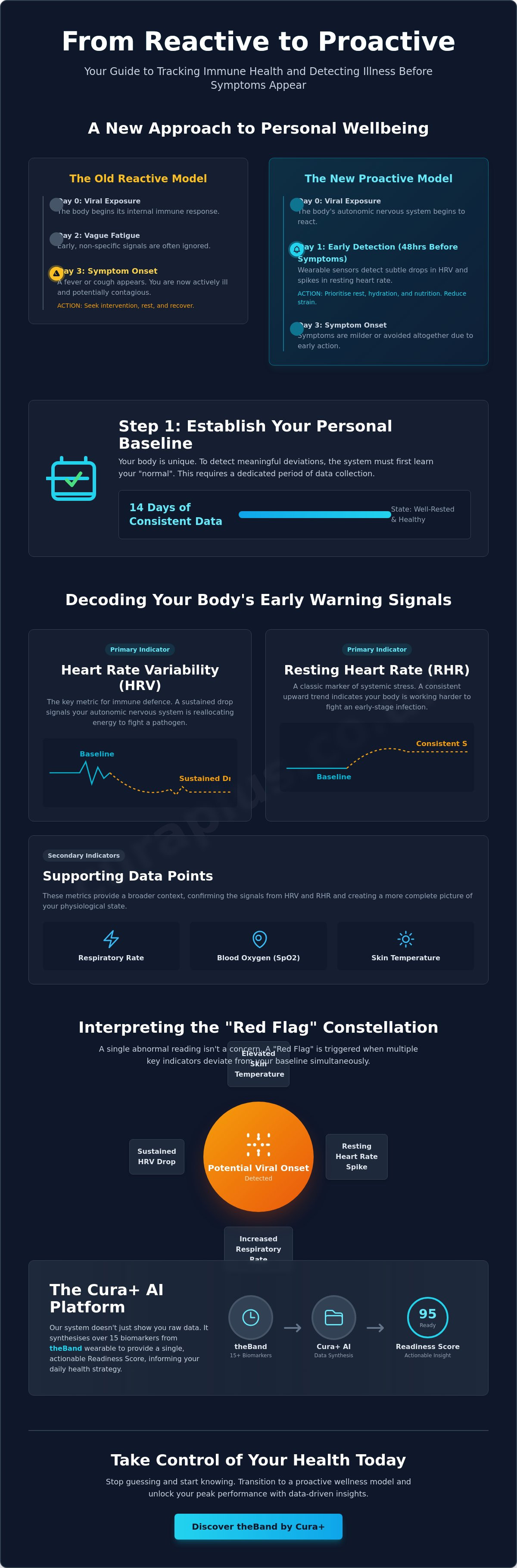
- Learn the protocol for establishing a precise physiological baseline through fourteen days of consistent data collection whilst in an optimal, well-rested state.
- Discover how to interpret the "Red Flag" constellation using a wearable for tracking immune health to detect potential viral onset before physical symptoms manifest.
- Understand how theBand and Cura+ AI Platform synthesise over fifteen biomarkers to provide a comprehensive readiness score that informs your daily health strategy.
Understanding Immune Health Tracking via Wearable Technology
Immune health tracking represents a paradigm shift in how we perceive personal wellbeing. It's the continuous monitoring of physiological indicators, such as inflammation or latent infection, long before they reach a clinical threshold. Traditionally, healthcare has been reactive. We wait for a cough or a fever before seeking intervention. However, utilising a sophisticated wearable for tracking immune health allows us to move toward a proactive model. This approach relies on "digital biomarkers," which are non-invasive data points harvested from sensors to provide a clear window into the internal state of the body. These devices don't offer a clinical diagnosis. Instead, they serve as biological alerts, prompting you to investigate further or adjust your lifestyle before a minor deviation becomes a major setback.
The Difference Between Fitness Tracking and Immune Monitoring
Many consumers mistake basic activity monitors for comprehensive health tools. Whilst step counts and calorie tracking are useful for weight management, they're insufficient for assessing the complexities of the immune system. True immune monitoring requires high-frequency sampling and multi-sensor arrays capable of detecting subtle shifts in heart rate variability and skin temperature. The evolution of wearable technology has introduced medical-grade precision into consumer hardware. This precision allows for the interrogation of internal biological systems rather than just external movement. It's the difference between counting how many miles you've walked and understanding how your body is recovering at a cellular level. High-resolution data ensures that the insights you receive are based on biological reality, not just generalisations.
Why Proactive Healthcare Matters in 2026
In the UK, the demand for personal health autonomy has reached an all-time high. People are no longer content with being passive recipients of care. They want to be active participants. Early detection of physiological stress doesn't just reduce recovery time; it prevents community spread by allowing individuals to self-isolate before they become contagious. There's also a clear economic advantage to this strategy. Maintaining a constant state of "readiness" ensures you remain productive and focused, avoiding the burnout and prolonged absences associated with ignored health signals. By 2026, the shift toward decentralised, data-driven wellness became the standard for those seeking peak performance. Choosing a wearable for tracking immune health is no longer a luxury. It's a fundamental component of a modern, responsible health strategy.
The Core Biomarkers: What Your Body Signals to the Sensors
Your body is constantly communicating its internal state through a series of complex biological signals. When using a wearable for tracking immune health, the goal is to translate these signals into actionable insights. Sensors don't just track movement; they monitor the delicate balance of the autonomic nervous system and the metabolic demands of an active immune response. By observing how these metrics shift in relation to each other, we can gain a high-resolution view of our systemic resilience. It's a process of decoding the body's early warning system before physical symptoms even begin to surface.
HRV: The Window into Your Immune Defence
Heart Rate Variability (HRV) is the variation in time between consecutive heartbeats. It's a critical metric. It reflects the real-time balance between your sympathetic (fight or flight) and parasympathetic (rest and digest) nervous systems. A sudden, sustained drop in HRV often precedes physical symptoms of illness by several days. This happens because the autonomic nervous system begins reallocating energy to the immune response long before you feel unwell. When the body detects a pathogen, it prioritises internal defence over external performance, leading to a noticeable shift in your baseline HRV levels.
Resting heart rate (RHR) serves as a secondary, yet equally vital, indicator. A spike in RHR, particularly when combined with low HRV, is a classic marker of systemic stress. Whilst a single night of poor sleep might cause a minor fluctuation, a consistent upward trend often signals that the body is fighting an early-stage infection. Similarly, monitoring respiratory rate and blood oxygen (SpO2) levels provides a broader context. Although these are secondary indicators, they offer essential data when interpreting deviations and alerts that might otherwise seem vague or confusing. For those seeking the highest level of precision, exploring advanced biosensing platforms can offer deeper clarity into these complex interactions.
Skin Temperature and Respiratory Rate
Sensors are now capable of detecting micro-fluctuations in skin temperature during the night, often picking up changes as small as 0.1 degrees Celsius. These subtle rises are frequently a precursor to fever or systemic inflammation. There's also a strong correlation between an increased respiratory rate and the body's inflammatory state. If your breaths per minute rise above your established average, it's a signal that your system is working harder to maintain homeostasis. Consistency in measurement is paramount here. A single data point is just a snapshot; a wearable for tracking immune health provides the cinematic view necessary to spot trends that indicate a significant shift in your biological readiness.
How to Establish and Maintain Your Personal Immune Baseline
Data without context is merely noise. To transform a wearable for tracking immune health into a predictive tool, you must first define what "normal" looks like for your unique physiology. This process, known as calibration, requires a disciplined approach to data collection. You cannot detect a deviation if you haven't established the steady state from which that deviation occurs. It's a methodical journey from raw numbers to personalised intelligence. Precision is the prerequisite for insight. By establishing a firm foundation, you empower the Cura+ AI Platform to distinguish between daily fluctuations and significant biological shifts.
The Importance of 24/7 Data Collection
Precision begins with consistency. You must wear your device 24/7 for at least 14 days to capture a statistically significant initial dataset. Whilst daytime metrics provide value, nocturnal data is often the most accurate for immune tracking. During sleep, the body is free from the "noise" of external stressors like caffeine, work-related anxiety, or physical exertion. This allows the sensors to capture your true resting state without interference. Learning how to build a health baseline during this period ensures that the AI can accurately calculate your specific ranges for HRV, RHR, and skin temperature.
It's vital to calibrate only whilst you are feeling optimal and well-rested. If you begin your tracking journey during a period of illness or extreme fatigue, your baseline will be skewed, rendering future alerts less reliable. The goal is to capture the signature of your body in its most resilient state. Once this foundation is laid, the system can begin to recognise the subtle patterns that suggest your system is under duress. This isn't just about collecting data; it's about defining the parameters of your personal excellence.
Normalising Your Data Against Lifestyle Factors
Your biology doesn't exist in a vacuum. Lifestyle factors such as alcohol consumption, intense exercise, or international travel can mimic the physiological signals of an impending illness. For instance, a high resting heart rate following a celebratory evening might look like a viral onset to a basic algorithm. However, by using "tags" or journals within the Cura+ app, you provide the necessary context to refine AI accuracy. Distinguishing between a "hangover" and a genuine immune challenge is essential for maintaining trust in your data. It ensures that when an alert does trigger, it carries the weight of clinical-grade relevance.
Sleep deprivation also has a profound impact on immune biomarkers, often causing a sharp drop in HRV and a rise in systemic stress. By noting these occurrences, you help the system understand that the deviation is lifestyle-induced rather than a biological threat. This collaborative process between user input and machine learning creates a refined, high-fidelity model of your health. It moves you beyond generic alerts toward a sophisticated understanding of your body's complex internal dynamics. You aren't just monitoring symptoms; you are mastering a complex system.
Recognising Early Warning Signs: Interpreting Deviations and Alerts
Identifying the onset of physiological stress requires more than just glancing at a single number. When you use a wearable for tracking immune health, the real value lies in the "Red Flag" constellation. This is a specific, synchronised shift where your resting heart rate (RHR) climbs, your heart rate variability (HRV) drops significantly, and your nocturnal skin temperature rises above your established baseline. Individually, these changes might be anecdotal. Collectively, they represent a systemic alert that your immune system is actively engaging a threat. Research suggests these deviations often manifest 24 to 48 hours before physical symptoms like a sore throat or fatigue become apparent. This window of opportunity is where proactive health management is won or lost.
The Cura+ AI Platform synthesises these divergent data points into a single, intuitive Readiness or Immune Score. This isn't a mere average of your steps and sleep. It's a high-level analysis of your biological resilience. If your score plummets whilst your skin temperature rises, the system identifies a high probability of viral onset. Once this deviation is detected, the immediate course of action is clear. Prioritise hydration, increase your sleep duration, and consider rapid testing. By intervening during this pre-symptomatic phase, you give your body the resources it needs to potentially shorten the duration of an illness or even prevent it from fully taking hold. You can optimise your proactive response by following the platform's real-time recommendations.
Pattern Recognition vs. Single Outliers
One restless night does not constitute a health crisis. AI-driven health tracking excels at distinguishing between a single outlier and a sustained trend. A poor night's sleep caused by late-night caffeine might lower your HRV for a few hours, but it won't typically trigger a systemic immune alert. The predictive power of a wearable for tracking immune health comes from monitoring trends across multiple days. The platform looks for sustained deviations that suggest a deeper biological shift rather than a temporary lifestyle fluctuation. It's the difference between a passing cloud and a gathering storm. This methodical approach ensures that the alerts you receive are credible and worthy of action.
From Data to Action: Personalised Health Coaching
Data is only powerful when it leads to a change in behaviour. This is the role of an AI health and wellness coach, which translates complex biomarkers into specific lifestyle adjustments. Instead of wondering if you should push through a workout whilst feeling "off," you have hard data providing the "permission to rest." There is a profound psychological benefit to this clarity. It replaces the guilt of inactivity with the strategic confidence of recovery. The platform might suggest a lower-intensity routine or an earlier bedtime based on your current immune stress, ensuring your daily choices align with your long-term health objectives. It's a partnership between human intuition and machine intelligence.
Elevating Proactive Care with theBand by Cura+
Whilst generic fitness rings and watches offer a glimpse into your daily activity, they often fall short of providing the high-fidelity insights required for true immune monitoring. theBand by Cura+ represents a significant advancement in this field, establishing itself as a predictive health wearable UK leader. It's engineered specifically to serve as a sophisticated wearable for tracking immune health, moving beyond surface-level metrics to interrogate the body's internal state. By tracking over 15 biomarkers, theBand provides a level of detail that far exceeds standard consumer hardware. This depth of data is essential for the predictive modelling discussed in previous sections, ensuring that your biological alerts are based on clinical-grade precision rather than algorithmic guesswork.
The mission of Cura+ is to democratise predictive health, making the future of wellness accessible today. We view health not as a series of symptoms to be managed, but as a complex system to be mastered. theBand is the physical manifestation of this philosophy, acting as a high-level consultant for your body. It replaces uncertainty with clarity, providing you with the data-driven confidence to make informed decisions about your recovery and readiness. This proactive approach is the cornerstone of modern self-optimisation, allowing you to maintain peak performance whilst others are sidelined by reactive care.
Unrivalled Sensor Depth and Accuracy
theBand incorporates a multi-sensor array designed to capture the subtle physiological shifts that precede illness. These sensors focus on the "Red Flag" constellation mentioned earlier, monitoring skin temperature micro-fluctuations and high-resolution heart rate variability with exceptional accuracy. Achieving this level of precision in a wearable format required rigorous engineering, yet the device remains optimised for continuous 24/7 wear. Its ergonomic design ensures that data collection remains uninterrupted, even during sleep, which we've identified as the most critical window for immune tracking. You don't have to sacrifice comfort for clinical-grade insight.
Joining the Cura+ Ecosystem
The hardware is only one half of the solution. theBand connects seamlessly to the Cura+ AI Platform, where your raw data is transformed into personalised health intelligence. This ecosystem is built with a steadfast commitment to data privacy and security, specifically tailored for our UK users. We believe that predictive health should be accessible and transparent, not buried behind opaque systems. Our platform ensures that you remain the sole owner of your biological narrative. We're currently in a pre-launch phase, offering exclusive access to those ready to lead the shift toward proactive wellness. To secure your place at the forefront of the health revolution, invite you to join the pre-launch phase at curaplus.co.uk.
Master Your Biological Narrative
The transition from reactive symptom management to proactive wellness isn't just a technological shift; it's a fundamental change in how you relate to your body. By understanding the subtle interplay between HRV, resting heart rate, and skin temperature, you move beyond guesswork. A high-fidelity wearable for tracking immune health provides the cinematic view necessary to spot trends that indicate a significant shift in your biological readiness. This level of insight allows you to intervene during the pre-symptomatic phase, giving your system the resources it needs to maintain homeostasis.
theBand by Cura+ represents the pinnacle of this data-driven strategy. Designed and developed in the UK, it monitors over 15 complex biomarkers and utilises AI-driven predictive alerts to offer unprecedented clarity. You don't have to wait for the onset of fatigue to prioritise your recovery. Discover the future of proactive health with theBand by Cura+ and transform your health into a masterable system. Your journey toward self-optimisation begins with the decision to replace uncertainty with insight. Embrace the confidence of knowing your body's internal state with absolute precision.
Frequently Asked Questions
Can a wearable really detect COVID-19 or the flu before symptoms start?
Wearables can identify the physiological deviations associated with viral onset up to 48 hours before physical symptoms manifest. Whilst they don't provide a clinical medical diagnosis of a specific virus, they detect the systemic stress caused by an infection. This early warning allows for earlier self-isolation and testing before you feel noticeably unwell.
How accurate are wearables for tracking immune health compared to blood tests?
A wearable for tracking immune health offers continuous longitudinal data, whilst blood tests provide a single, high-precision snapshot in time. Wearables excel at identifying subtle deviations from your personal baseline over weeks and months. Blood tests remain necessary for clinical diagnosis and specific cellular analysis, making them complementary rather than interchangeable tools.
Which biomarkers are most important for monitoring my immune system?
Heart Rate Variability (HRV), resting heart rate (RHR), and nocturnal skin temperature are the most critical biomarkers for immune monitoring. A decrease in HRV combined with a spike in RHR and skin temperature often signals an active immune response. Using a wearable for tracking immune health to monitor these in tandem provides the most reliable predictive alert.
Do I need to wear my health tracker at night for immune monitoring?
Yes, wearing your device at night is essential because nocturnal data is free from the physiological noise of daytime activities. During sleep, your body is in a controlled state, allowing sensors to capture your true resting baseline without interference from caffeine or stress. This is when subtle immune signals are most visible to the AI.
Can stress levels affect my immune health data on a wearable?
Psychological and physical stress directly impact your immune health data by activating the sympathetic nervous system. High stress levels will lower your HRV and raise your resting heart rate, occasionally mimicking the signals of an impending illness. Using the tagging feature in the Cura+ app helps the AI distinguish between lifestyle-induced deviations and genuine viral onset.
Is theBand by Cura+ a medical device?
theBand by Cura+ is a sophisticated wellness and predictive health tool, not a regulated medical device. It's designed to provide biological alerts and personal insights rather than a clinical medical diagnosis. You should always consult a healthcare professional for medical concerns or if you require a formal diagnosis for specific symptoms.
How long does it take for the AI to learn my health baseline?
It typically takes 14 days of consistent, 24/7 wear for the Cura+ AI Platform to establish a statistically significant health baseline. During this calibration period, the system learns your unique physiological signatures. This ensures that future alerts are based on your personal normal rather than generic population averages, increasing the accuracy of every insight.
What should I do if my wearable sends me an immune health alert?
If you receive an immune health alert, you should immediately prioritise rest and hydration whilst monitoring for emerging symptoms. Consider reducing your physical activity and increasing sleep duration to support your body's defence mechanisms. It's also a prudent time to conduct a rapid test or seek professional medical advice if you begin to feel unwell.


