


With the healthcare wearable market projected to reach $186.14 billion by 2030, it is striking that many still rely on caffeine and guesswork for managing energy levels throughout the day. You have likely experienced the frustration of following generic "eat better, sleep more" advice only to find your focus collapsing by 3 pm. It is difficult to maintain peak performance when you are reacting to exhaustion rather than proactively regulating your internal systems. You deserve a strategy that respects the complexity of your biology.
This guide moves beyond basic lifestyle tips to introduce a sophisticated, biomarker-driven approach to daily vitality. You will learn how to transition from being a passenger in your own body to becoming a strategist who understands their physiological triggers. By utilising theBand and the Cura+ AI platform, you can identify the subtle shifts in your autonomic nervous system that precede a crash. We will provide the framework you need to achieve consistent, high-level energy from 7 am until 10 pm through precise data and predictive intelligence.
Key Takeaways
- Discover how to transition from reactive fatigue management to proactive regulation of your autonomic nervous system.
- Master a data-driven protocol for managing energy levels throughout the day by establishing baseline metrics like HRV and resting heart rate.
- Identify the "Energy Blindness" trap and learn how to recognise physiological triggers before they lead to a total loss of focus.
- Align your most demanding tasks with your biological peaks through precise circadian synchronisation and biometric pacing.
- Utilise predictive health intelligence to identify subtle shifts in your metabolic state before they manifest as physical exhaustion.
What is Physiological Energy Management in 2026?
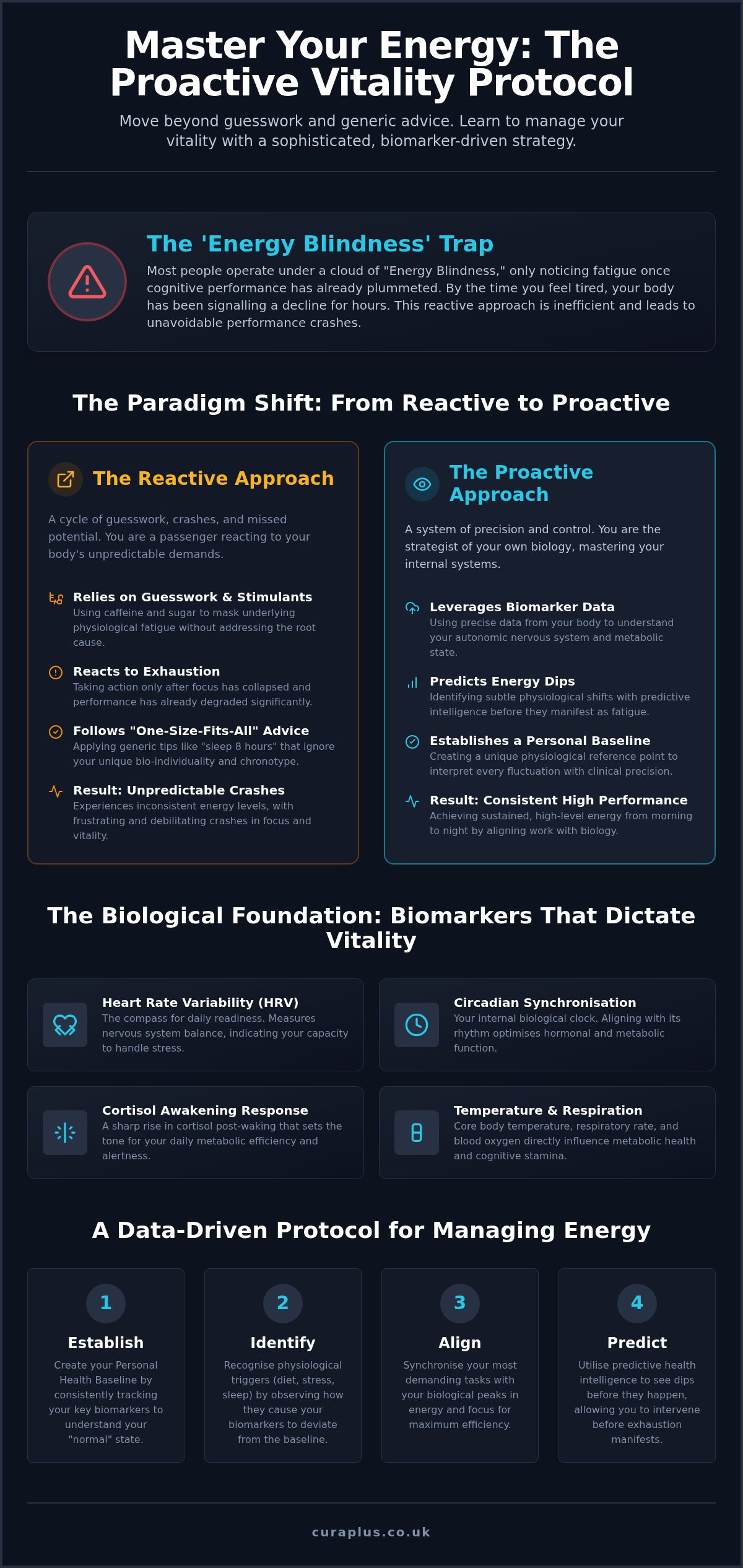
In 2026, the concept of vitality has shifted from a subjective feeling to a measurable data point. Managing energy levels throughout the day is no longer a matter of discipline; it is the active regulation of your autonomic nervous system (ANS) and metabolic state. Most people operate under a cloud of "Energy Blindness," only noticing fatigue once their cognitive performance has already plummeted. This reactive approach is inefficient. By the time you feel tired, your body has been struggling to maintain homeostasis for hours. Predictive Health Intelligence allows us to see these dips before they happen, transforming health from a series of managed symptoms into a mastered system.
We are moving away from the era of traditional self-help and into a period where data provides the clarity we once sought through guesswork. Establishing a Personal Health Baseline is the non-negotiable foundation of this new era. It acts as a reference point, allowing you to interpret every fluctuation in your physiology with clinical precision. This shift in perspective is the first step toward reclaiming your daily performance from the whims of unpredictable crashes.
The Difference Between Tiredness and Physiological Fatigue
Acute tiredness is a temporary signal that your body requires rest after exertion. Physiological fatigue, however, is a deeper systemic depletion that persists even after sleep. Your body signals this energy drain through subtle biomarker shifts long before your brain perceives a lack of focus. This is why building a health baseline is essential. Without a clear understanding of your "normal" state, you cannot accurately distinguish between a minor lull and a significant physiological crash.
When you monitor your baseline, you begin to see patterns that were previously invisible. You might notice that a specific dietary choice leads to a suppressed Heart Rate Variability (HRV) the following afternoon. This insight allows you to intervene before the fatigue becomes debilitating. By tracking these metrics, you learn to read the body's early warning signs, effectively managing energy levels throughout the day with the foresight of a strategist.
Why Generic Advice Fails the Individual
Generic advice often fails because it ignores the nuances of your internal clock. Whilst standard guidelines suggest eight hours of sleep, they often overlook the influence of The Biological Foundation: Biomarkers That Dictate Your Vitality. Your specific chronotype and genetic predispositions dictate when your metabolic energy peaks and troughs. Bio-individuality is the unique physiological blueprint that determines how your specific body metabolises energy and responds to external stressors.
Relying on "one-size-fits-all" nutrition or sleep cycles is like using a map of London to navigate Manchester; the principles are similar, but the details will lead you astray. For instance, a morning person's peak cortisol window differs significantly from that of a night owl. Attempting to force your body into a rhythm that contradicts its genetic programming creates unnecessary physiological stress, which directly saps your daily vitality and leads to the very crashes you are trying to avoid.
The Biological Foundation: Biomarkers That Dictate Your Vitality
To master the art of managing energy levels throughout the day, you must first decode the silent language of biomarkers. Your vitality is not a random occurrence. It's the result of complex interactions between your hormonal rhythms, metabolic rate, and nervous system state. A critical component of this is the Cortisol Awakening Response. This sharp rise in cortisol levels within the first 45 minutes of waking sets the tone for your metabolic efficiency. If this response is blunted, you start the day in a deficit, regardless of how much caffeine you consume.
Beyond hormones, core body temperature and skin temperature serve as essential indicators of metabolic health. A slight dip in core temperature typically precedes sleep, whilst a steady rise fuels daytime alertness. Similarly, your respiratory rate and blood oxygenation levels directly influence cognitive stamina. When oxygen saturation remains optimal, your brain maintains the high-level focus required for complex problem-solving. Whilst many seek to boost your energy naturally through diet, these biological foundations remain the primary drivers of your daily capacity.
HRV: The Compass for Daily Readiness
Heart Rate Variability (HRV) is perhaps the most significant metric for anyone serious about self-optimisation. It measures the variation in time between each heartbeat, serving as a real-time proxy for your autonomic nervous system balance. A high HRV indicates a body that is resilient and ready for high-energy output. Conversely, a low reading suggests your system is stuck in a "fight-or-flight" state, making it an ideal wearable for tracking stress patterns and preventing burnout. Sustaining vitality requires a meticulous balance between physiological demand and recovery.
Sleep Architecture and Energy Restoration
True restoration isn't found in the duration of sleep, but in its architecture. Tracking REM and deep sleep stages provides insight into how effectively your body repairs tissues and consolidates cognitive resources. theBand by Cura+ monitors over 15 biomarkers to help you track recovery with clinical accuracy. When sleep stages are fragmented, you accumulate a "sleep debt" that impairs glucose sensitivity the following day. This impairment makes you more susceptible to afternoon slumps and erratic hunger, undermining your efforts at consistent performance. Understanding these data points is the only way to ensure your energy remains stable from dawn until dusk. You can explore our predictive health platform to begin your journey into physiological intelligence.
Reactive vs. Proactive Energy Management: A Comparison
Most individuals manage their vitality like a fire station; they only respond when there is an emergency. This reactive approach, often termed the "Caffeine Cycle," relies on external stimulants to mask internal signals of depletion. Proactive management, or Biometric Pacing, represents a paradigm shift. It utilises real-time data to adjust your cognitive and physical load before your system reaches a breaking point. When you are managing energy levels throughout the day reactively, you are essentially borrowing from tomorrow's reserves to pay for today's demands. This creates a cycle of metabolic stress that eventually leads to burnout and a measurable decline in executive function.
Consider the ubiquitous "afternoon slump." Whilst common wisdom blames a heavy lunch or a lack of sugar, it is frequently a predictable circadian dip. In a reactive model, you might reach for a refined carbohydrate snack or another espresso. In a proactive model, your data would have signalled a rise in skin temperature and a slight drop in Heart Rate Variability (HRV) an hour earlier. Predictive alerts allow you to implement a short recovery protocol, such as a focused breathing session or a brief period of non-sleep deep rest, before the crash occurs. This foresight preserves your metabolic flexibility and ensures your focus remains sharp until the evening.
The Caffeine Trap: Borrowing Energy from Tomorrow
Caffeine is a chemical loan, not a source of fuel. It functions by blocking adenosine receptors in the brain. Adenosine is a neurotransmitter that accumulates whilst you are awake, creating "sleep pressure" that signals the need for rest. By masking this signal, caffeine allows you to feel alert while your physiological debt continues to climb. The half-life of caffeine in the average healthy adult is approximately five to six hours. Without data-driven timing, late-afternoon consumption leads to sleep fragmentation, which impairs your glucose sensitivity and HRV the following morning. Using precise monitoring allows you to time your intake for maximum cognitive benefit without sabotaging your next day's baseline.
Predictive Intelligence: The Future of High Performance
The transition from feeling tired to knowing your limits is enabled by sophisticated algorithms. Modern AI health and wellness coaches process vast arrays of historical and real-time biomarkers to forecast your capacity. This intelligence moves beyond simple tracking; it provides a strategic map for your day. Instead of wondering why you feel depleted at 4 pm, you can see the trajectory of your energy hours in advance. Managing energy levels throughout the day becomes a precise exercise in physiological intelligence, allowing you to allocate your most precious resource, your attention, with clinical accuracy.
A Data-Driven Protocol for Managing Energy Levels
Mastering the art of managing energy levels throughout the day requires a transition from intuition to a structured, data-led protocol. Your biology operates on a predictable schedule, yet it's influenced by real-time stressors that generic advice simply cannot account for. By following a systematic framework, you can synchronise your output with your internal capacity, ensuring that your cognitive resources are utilised with maximum efficiency. This protocol is designed to protect your metabolic flexibility whilst minimising the physiological cost of high performance.
Morning: Setting the Physiological Tone
Your day begins with the establishment of a baseline. Within 30 minutes of waking, exposure to natural light serves as a critical circadian anchor, triggering the suppression of melatonin and the release of cortisol. Simultaneously, you should consult your Readiness Score; this metric, derived from your nocturnal Heart Rate Variability (HRV) and Resting Heart Rate (RHR), dictates the appropriate intensity for your day's schedule. Hydration with electrolytes is equally vital, as it supports the cellular transport of energy and prevents the early-morning cognitive fog often mistaken for a lack of caffeine.
Alignment is the second step. High-focus tasks should be synchronised with your biological peak, typically occurring in the late morning when your core temperature is rising. By reserving your most demanding cognitive work for these windows, you leverage your natural rhythm rather than fighting against it. Simultaneously, nutritional pacing ensures that you don't sabotage this focus with glucose volatility. By prioritising low-glycaemic fuel, you avoid the insulin spikes that lead to subsequent energy crashes.
Afternoon: Navigating the Post-Prandial Dip
The post-prandial dip is a biological reality, but it doesn't have to be a productivity killer. When you feel your focus wavering, a 10-minute Non-Sleep Deep Rest (NSDR) session can effectively reset your autonomic nervous system, shifting you from a sympathetic to a parasympathetic state. If energy remains low, check these three specific biomarkers:
- Heart Rate Variability (HRV): A sudden drop suggests your system is over-taxed.
- Skin Temperature: An elevated reading may indicate an inflammatory response or metabolic stress.
- Respiratory Rate: Higher rates often signal an unconscious stress response that drains energy.
Movement snacks, such as a five-minute walk or brief calisthenics, further boost mitochondrial function, providing a natural surge in vitality without the need for sugar. Finally, the evening must be dedicated to down-regulation. Protecting your next day's potential involves reducing blue light exposure and lowering your core body temperature, ensuring you enter the deep sleep stages necessary for full restoration. Managing energy levels throughout the day is a continuous cycle of measurement and adjustment. To begin implementing this protocol with clinical precision, explore theBand by Cura+ and gain real-time insights into your physiological state.
Mastering Your Vitality with theBand by Cura+
The transition from managing symptoms to mastering a system requires more than just intent; it requires the right infrastructure. theBand stands as the ultimate predictive health wearable in the UK, designed to provide the high-fidelity data necessary for true physiological intelligence. Whilst consumer-grade gadgets often focus on historical activity, this platform prioritises future capacity. By monitoring 15+ biomarkers in real-time, theBand offers a 360-degree view of your internal state, allowing you to "see" your energy levels before you feel them. This level of insight is the difference between guessing your limits and knowing them with clinical certainty.
The true power of this system lies in the Cura+ AI platform. Raw data is often overwhelming, but our AI acts as a personal strategist for your daily vitality. It synthesises complex metrics, such as autonomic nervous system (ANS) strain and metabolic readiness, into actionable coaching. This predictive intelligence ensures you are managing energy levels throughout the day with a level of precision previously reserved for elite athletes. Additionally, the system excels at tracking immune health. By detecting subtle deviations in skin temperature and resting heart rate, the platform can alert you to sub-clinical illness, preventing the hidden energy loss that often precedes physical symptoms.
Beyond Fitness Tracking: This is Physiological Intelligence
theBand is not a step counter; it is a sophisticated health consultant for the human body. It is built for high-performers who view their health as their most valuable asset. The platform provides an exclusive ecosystem where data becomes clarity and clarity becomes performance. We are currently inviting individuals who share our commitment to excellence to join our pre-launch phase. This is your opportunity to gain early access to a technology that is redefining the boundaries of personal wellness and self-optimisation.
Your Journey to Unshakeable Energy
Managing energy levels throughout the day is a skill that can be mastered once you replace uncertainty with accuracy. We have moved beyond the era of reactive fixes and entered the age of proactive regulation. You don't have to accept afternoon crashes or morning fog as inevitable. With the right data and a sophisticated plan, you can maintain consistent, high-level vitality from dawn until dusk. The future of your health is no longer a mystery to be solved, but a system to be mastered. Discover theBand and the future of personal health today.
Reclaiming Your Biological Potential
The journey from reactive exhaustion to proactive vitality requires a fundamental shift in how you perceive your body's signals. You have seen that energy isn't a static resource but a complex system influenced by heart rate variability, metabolic temperature, and circadian alignment. By moving beyond generic advice and embracing physiological intelligence, you gain the clarity needed for managing energy levels throughout the day with clinical precision.
This transition is made possible through the integration of sophisticated technology and biological data. theBand provides a comprehensive view of your health by monitoring 15+ vital biomarkers in real-time. When paired with our AI-driven predictive health intelligence, this British-engineered technology transforms raw data into a strategic roadmap for your performance. You no longer have to wonder why your focus fluctuates whilst others seem to thrive; you'll have the insights to master it.
Secure your path to peak performance with theBand by Cura+
The future of your vitality is accessible through data. Embrace the opportunity to understand your body's unique rhythm and achieve a state of unshakeable, consistent energy.
Frequently Asked Questions
How can I stop feeling tired in the afternoon without more caffeine?
You can mitigate afternoon fatigue by utilising Non-Sleep Deep Rest (NSDR) or strategic biometric pacing rather than relying on stimulants. These techniques reset your autonomic nervous system, shifting you from a stressed sympathetic state to a restorative parasympathetic one. By identifying the specific physiological triggers of your slump, you can implement movement snacks or hydration protocols that address the root cause of the dip. This approach ensures you're effectively managing energy levels throughout the day without sabotaging your nocturnal sleep architecture.
What are the best biomarkers to track for daily energy levels?
The most critical biomarkers for assessing vitality include Heart Rate Variability (HRV), core body temperature, and skin temperature. HRV provides a direct window into your nervous system readiness, whilst temperature fluctuations signal shifts in your metabolic rate. Additionally, monitoring your respiratory rate and blood oxygenation levels helps identify when your cognitive stamina is beginning to wane. Tracking these metrics allows for a sophisticated understanding of your body's internal state beyond subjective feelings of tiredness.
Can a wearable device really help me manage my energy?
A sophisticated wearable device facilitates the transition from reactive guesswork to proactive physiological management. By providing a continuous stream of data, tools like theBand allow you to visualise your internal reserves in real-time. This visibility enables you to adjust your workload based on your actual biological capacity rather than an arbitrary schedule. Managing energy levels throughout the day becomes a precise science when you have access to predictive health intelligence that's able to forecast crashes before they occur.
What is the role of HRV in managing daily fatigue?
Heart Rate Variability (HRV) serves as the primary indicator of your autonomic nervous system's balance and resilience. A high HRV suggests that your body is well-recovered and capable of handling significant cognitive or physical demands. Conversely, a suppressed HRV often precedes feelings of exhaustion, signalling that your system is overtaxed. By monitoring this metric, you can strategically time your most intensive tasks for periods of high readiness, thereby avoiding the onset of chronic fatigue.
How does sleep quality affect my energy levels 24 hours later?
Sleep quality, specifically the architecture of REM and Deep Sleep stages, dictates your metabolic efficiency and hormonal balance the following day. Poor restoration leads to impaired glucose sensitivity and a blunted cortisol awakening response, making you more susceptible to energy crashes. This physiological debt accumulates, affecting your focus and resilience long after you've woken up. Tracking these stages ensures you understand the restorative value of your rest rather than just its duration.
Is there a way to predict an energy crash before it happens?
Predicting a crash is possible through the analysis of subtle biomarker trends, such as a rising skin temperature combined with a declining HRV. These physiological shifts often occur up to an hour before you consciously perceive fatigue. AI-driven platforms, such as Cura+, utilise historical data to recognise these patterns and issue predictive alerts. This foresight allows you to intervene with a recovery protocol, effectively preventing the crash and maintaining your cognitive performance.
How do I build a personal health baseline for energy tracking?
Building a personal health baseline requires the consistent measurement of your metrics upon waking, specifically your resting heart rate and HRV. By recording these values over several weeks, you establish a statistical "normal" that reflects your unique physiology. This baseline acts as a reference point, allowing you to identify when external stressors or lifestyle choices are causing a deviation. Without this foundation, it's impossible to accurately interpret the significance of daily biomarker fluctuations.
What is the difference between a fitness tracker and a predictive health wearable?
Traditional fitness trackers primarily record historical activity data, such as steps taken or calories burned, offering a retrospective view of your health. In contrast, a predictive health wearable like theBand monitors 15+ biomarkers to forecast your future capacity and readiness. These sophisticated tools use AI to provide actionable coaching based on your real-time physiological state. This shift from measurement to intelligence allows you to manage your health as a complex, masterable system.


