


What if the sudden exhaustion you feel on a Friday evening was actually visible in your biology as early as Tuesday morning? It is a common experience to believe you are managing well, only to find your performance plummeting without warning. You might be conflating physical fitness with true physiological readiness, whilst relying on vague metrics that fail to offer a clear path forward. This article demonstrates how to move beyond basic data to truly master your body's unique signals. By utilising a sophisticated wearable for tracking stress patterns, you can transition from reactive management to proactive biological leadership.
We will examine how theBand and the Cura+ AI Platform allow you to identify these hidden trends; decode the link between your lifestyle choices and systemic strain; and develop a personalised regulation strategy that keeps you ahead of the curve. You will discover how to predict the onset of physiological strain before it manifests as a problem, ensuring your path to self-optimisation remains clear and controlled. By the end of this guide, you will understand how to transform raw biometric data into a predictive map of your nervous system's behaviour.
Key Takeaways
- Understand why a static stress score is often a lagging indicator and how to instead decode the dynamic behaviour of your autonomic nervous system.
- Master the use of Heart Rate Variability (HRV) to identify the precise balance between your sympathetic "fight or flight" response and parasympathetic recovery.
- Discover the methodology for establishing a 14-day baseline with a wearable for tracking stress patterns to distinguish meaningful physiological trends from daily anomalies.
- Transition from insight to action by utilising real-time readiness data to trigger micro-recoveries and optimise your physical exertion levels.
- Explore how theBand and the Cura+ AI Platform leverage a high-fidelity 15-biomarker array to deliver proactive, predictive health intelligence.
Beyond the "Stress Score": Understanding Physiological Stress Patterns
Physiological stress is far more than a subjective sensation or a fleeting mental state. It is a quantifiable deviation within the autonomic nervous system (ANS); a departure from the steady baseline of homeostasis. Whilst many people equate stress with a feeling of being "overwhelmed," your biology begins to register strain long before your mind acknowledges it. Most consumer devices simplify this complexity into a single, arbitrary "stress score." Whilst these numbers are accessible, they are frequently lagging indicators. They tell you that you were stressed an hour ago, rather than alerting you to the subtle shifts currently unfolding in your biology.
To master your health, you must look beyond these scores and understand your "Stress Architecture." This is the unique, rhythmic way your body responds to internal and external pressure. Some individuals experience sharp, aggressive spikes in physiological strain that dissipate quickly, whilst others endure a slow, creeping elevation that persists for days. It is vital to distinguish between acute stress, which is a necessary catalyst for growth and focus, and chronic patterns that indicate systemic depletion. A sophisticated wearable for tracking stress patterns identifies these nuances, providing a level of granularity that standard trackers simply cannot match.
Why Subjective Feeling Often Fails Us
Many high-performers suffer from what we call "burnout lag." This is the phenomenon where you feel mentally alert whilst your internal biomarkers are in a state of freefall. Adrenaline is a powerful mask. It sustains you through a demanding workday, concealing the physiological strain until you finally stop and the "crash" occurs. To bridge this gap between perception and reality, a predictive health wearable UK becomes an essential tool for objective clarity. Understanding what are wearable technologies can do beyond simple activity monitoring is the first step toward true physiological intelligence. By the time you "feel" stressed, the biological pattern is already well-established.
The Anatomy of a Stress Pattern
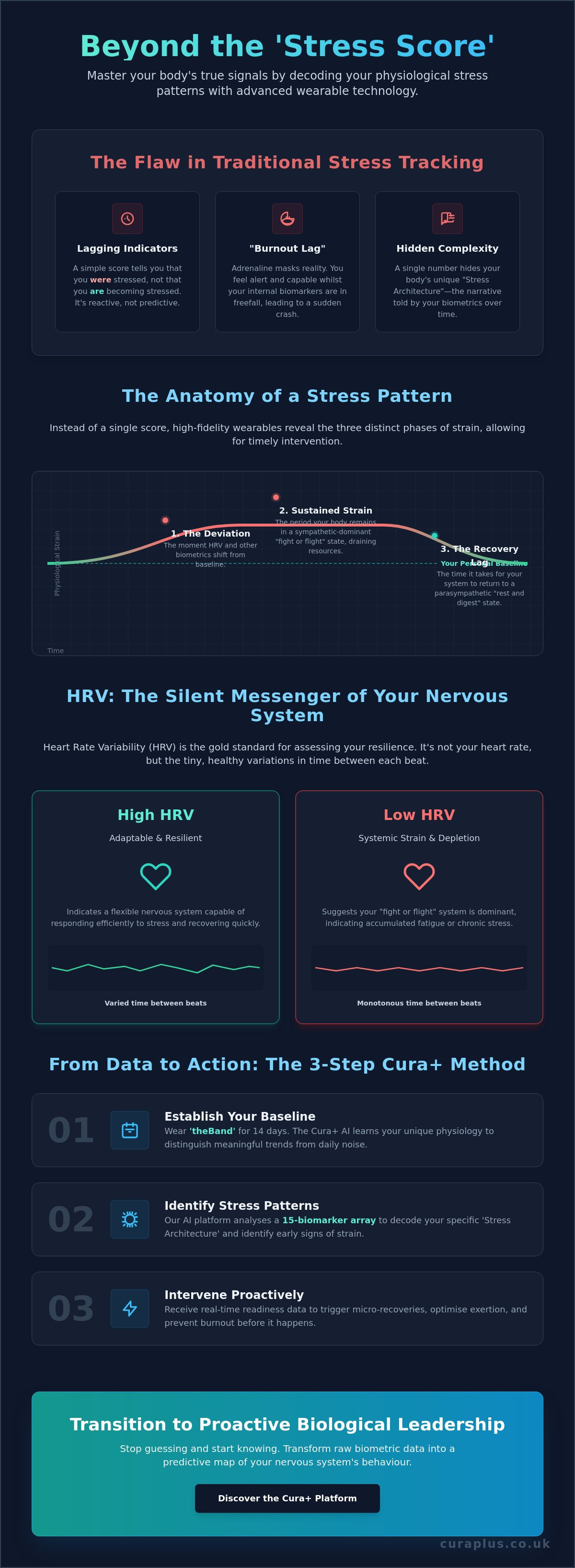
A pattern is not a single data point; it is a narrative told through biometrics. When using a high-fidelity wearable for tracking stress patterns, you can identify three distinct phases of strain:
- The Deviation: The initial moment your biometrics, such as Heart Rate Variability (HRV), begin to shift away from your established baseline.
- The Sustained Strain: The duration your body remains in a sympathetic-dominant state, indicating that your resources are being actively drained.
- The Recovery Lag: The period it takes for your system to return to its parasympathetic, or "rest and digest," baseline after the stressor has passed.
Standard consumer dashboards often hide these phases behind oversimplified graphics. However, by analysing the raw data through the Cura+ AI Platform, you can see the precise moment your recovery begins to falter. This level of insight allows you to intervene before a single day of high pressure turns into a week of chronic exhaustion.
The Biometrics of Burnout: How Wearables Measure Internal Strain
True physiological intelligence requires a departure from surface-level metrics. It demands an understanding of the intricate dialogue between your sympathetic and parasympathetic nervous systems. The former, often described as the "fight or flight" mechanism, prepares your body for action, whilst the latter governs "rest and digest" functions. A high-calibre wearable for tracking stress patterns monitors this delicate equilibrium to identify when your system is tilting toward chronic depletion. It's not just about tracking; it's about interpreting the body's internal symphony.
HRV: The Silent Messenger of the Nervous System
Heart Rate Variability (HRV) is not a measure of how fast your heart beats, but rather the millisecond variation between those beats. It serves as the gold standard for assessing autonomic health and systemic resilience. When your HRV is high, it indicates a flexible, responsive nervous system capable of adapting to environmental demands. Resilience is measurable. Conversely, a consistently low HRV suggests that your body is trapped in a sympathetic-dominant state, unable to transition into recovery. By observing these fluctuations, you can pinpoint exactly when your internal resources are being compromised.
Secondary Biomarkers: Validating the Stress Response
Whilst HRV is the primary window into the autonomic nervous system, it does not exist in a vacuum. High-fidelity tracking requires a multi-sensor approach to distinguish emotional stress from physical illness or environmental heat. For instance, tracking immune health through biometric data often reveals significant overlaps with stress patterns. A rising resting heart rate (RHR) combined with a spike in skin temperature might indicate your body is fighting an infection rather than reacting to a professional deadline. Context is everything.
theBand utilises a comprehensive array of 15+ biomarkers to filter this "noise" and provide an accurate reflection of your physiological state. This includes monitoring respiratory rate and electrodermal activity to validate the findings from your HRV data. This multi-layered verification ensures that the insights you receive are both precise and actionable. If you're ready to master your body's unique signals, exploring the capabilities of advanced physiological intelligence platforms is the logical next step. By integrating these data points, you move beyond guesswork and into a state of calm, data-driven control.
Step-by-Step: How to Use a Wearable to Identify Your Stress Patterns
Identifying your biological breaking point requires more than a casual glance at a dashboard. It demands a structured approach to data collection and a commitment to objective observation. To truly benefit from a wearable for tracking stress patterns, you must first move beyond the novelty of the numbers and begin to see the narrative they form over time. This process begins with the most critical step in any scientific endeavour: establishing a control.
Establishing Your Physiological Baseline
You cannot identify a deviation if you don't know what "normal" looks like for your specific biology. We recommend a minimum of 14 days of continuous data collection before you draw any significant conclusions. This window accounts for the natural variability of a standard work week and the subtle shifts in your circadian rhythm. Learning how to build a health baseline is the foundation of predictive wellness. To ensure high-fidelity insights, 24/7 wear-time is non-negotiable. Whilst you may be tempted to remove theBand during rest, the data gathered during sleep is often the most revealing. The Cura+ AI Platform automates this calibration, continuously refining your baseline as your fitness and health evolve.
Once your baseline is secure, you can begin to analyse your "Recovery Slope." This is the speed at which your parasympathetic system re-engages after a high-pressure event. A healthy system bounces back quickly. A compromised system lingers in a state of "Ghost Stress," where your biometrics remain elevated even whilst you are sitting on the sofa or lying in bed. These hidden stressors, often triggered by late-night blue light exposure or residual caffeine, are the primary drivers of long-term burnout. A wearable for tracking stress patterns makes these invisible drains visible.
Decoding the Daily Rhythm
Contextualising your data is where raw numbers become intelligence. By tagging real-world events such as high-stakes meetings, intense exercise, or alcohol consumption, you create a map of your "Stress Architecture." You might discover that your "midday slump" isn't a lack of caffeine; it is often a state of cognitive overload where your HRV has plummeted due to back-to-back tasks. This objective clarity allows you to adjust your schedule based on biological reality rather than sheer willpower. Use this weekly checklist to audit your results:
- Identify the Peak: At what time of day does your sympathetic activation consistently reach its zenith?
- Measure the Lag: How many hours pass between your final work task and your first parasympathetic recovery signal?
- Audit the "Ghost": Are there spikes in your strain data during periods of supposed rest or sleep?
- Correlate the Choices: Did specific dietary habits, such as late-night meals, flatten your recovery curve overnight?
Using these metrics transforms the device from a passive monitor into a strategic consultant. You aren't just watching your stress; you are mastering the complex system that produces it. This mastery often extends to your physical surroundings, where choosing precision-fit solutions like Carcarpit for your vehicle can help maintain the sense of order and control necessary for sustained performance.
From Insight to Intervention: Regulating Your Stress Response with Data
Data is only as valuable as the decisions it informs. If your wearable for tracking stress patterns indicates a state of high sympathetic arousal, continuing with high-intensity tasks is a choice to ignore biological reality. Intervention is the bridge between mere awareness and true mastery. It involves using real-time alerts to interrupt the accumulation of strain before it reaches a threshold of exhaustion. By the time you notice physical symptoms, the pattern is already entrenched; the goal is to intervene whilst the deviation is still subtle.
The Power of Micro-Recoveries
Cumulative stress is usually the result of small, unchecked deviations throughout the day. By implementing "micro-recoveries," you can prevent these minor spikes from coalescing into a systemic crash. These aren't long breaks. Instead, they're precision interventions designed to signal safety to the brain. Contrast this with the common habit of "passive recovery," such as scrolling through a phone, which often increases cognitive load and further depletes your resources. Active recovery, such as structured breathing or a brief walk, provides the nervous system with the specific input it needs to re-engage the parasympathetic branch. You might also discover Lockpick Pros to explore how tactile, precision-based hobbies can help recalibrate your focus. Investing just 120 seconds in deliberate physiological regulation can successfully recalibrate your autonomic nervous system.
Predictive Scheduling: Working with Your Biology
The most sophisticated application of biometric data is the "Proactive Pivot." This involves adjusting your professional or physical schedule based on your current "Readiness" score. If your data predicts an upcoming crash, pushing through a high-stakes meeting or an intense gym session is counter-productive. This is "Biological Load Balancing." By matching the intensity of your tasks to your current resilience level, you ensure that you're working with your biology rather than against it. Utilising an advanced wellness tracker allows you to see these windows of opportunity and vulnerability days in advance.
Long-term optimisation requires observing which lifestyle habits actually move the needle on your baseline HRV. You might find that consistent morning sunlight or earlier meal times have a more profound impact on your stress architecture than generic wellness advice suggests. Mastery is an iterative process. If you're ready to implement these high-level strategies, you can optimise your physiological performance with theBand today. By turning insights into interventions, you transform your health from a series of symptoms into a managed, high-performance system.
Proactive Intelligence: Why theBand is the Ultimate Wearable for Stress Pattern Recognition
The transition from tracking data to mastering biology requires a tool of unmatched sophistication. Whilst standard fitness trackers offer a glimpse into activity levels, theBand is engineered to provide a comprehensive map of your physiological state. It utilises a high-fidelity 15-biomarker sensor array that captures the subtle nuances of your autonomic nervous system. This is the definitive wearable for tracking stress patterns for those who view health as a complex, high-stakes system to be understood and optimised rather than merely monitored. It provides the granularity required to see the invisible trends that dictate your daily performance.
AI-Driven Predictive Alerts
Most consumer devices operate on a reactive model; they inform you of your stress levels only after the physiological event has occurred. The Cura+ AI Platform disrupts this cycle by providing true "Health Intelligence." Instead of a generic notification stating that you are currently stressed, the system delivers predictive alerts. It might signal that your resilience is dropping 48 hours before you feel the symptoms of exhaustion. By learning your unique biological "signature," the platform identifies the specific patterns that precede a crash. This allows you to take preemptive action whilst you still have the resources to do so, effectively changing your trajectory before strain becomes burnout.
Sophisticated Design for the Modern Professional
Precision does not have to come at the expense of aesthetics. theBand reflects a blend of clinical precision and aspirational empowerment, designed to be worn seamlessly in professional environments. It is a statement of commitment to excellence. The value of theBand extends through the Cura+ subscription, which ensures your data undergoes continuous, AI-driven refinement. As your biology changes, the algorithms evolve with you, providing increasingly accurate insights into your personal stress architecture. This is not just a device; it is a partnership in your journey toward self-optimisation.
Personalised health coaching further bridges the gap between raw data and actionable strategy. Interpreting complex stress patterns requires a level of nuance that generic apps cannot provide. With theBand and the Cura+ AI Platform, you gain access to the tools and intelligence needed to secure your biological peak. The future of proactive wellness is no longer a distant concept. Join the pre-launch today to claim your place at the forefront of physiological intelligence and master your body's unique signals.
Mastering Your Biological Narrative
Mastering your body's stress architecture is the ultimate competitive advantage. You have moved beyond the simplicity of lagging scores to understand the rhythmic behaviour of your autonomic nervous system. By leveraging a sophisticated wearable for tracking stress patterns, you can now identify subtle deviations before they manifest as systemic burnout. You possess the framework to transform raw biometric data into a proactive strategy for both recovery and high-level performance. True physiological intelligence is about replacing reactive management with predictive control.
theBand represents the definitive pinnacle of this technological evolution. Designed and engineered in the UK, it monitors over 15 biomarkers with clinical-grade precision to provide a granular view of your internal state. When paired with the Cura+ AI Platform, you receive proprietary predictive alerts that allow you to intervene whilst your resilience remains high. Secure your future health: Explore theBand by Cura+. The path from biological uncertainty to data-driven clarity is now accessible. It's time to lead your biology with the visionary confidence it deserves.
Frequently Asked Questions
Can a wearable actually detect emotional stress versus physical stress?
A sophisticated wearable for tracking stress patterns distinguishes between these states by correlating biometric spikes with physical activity data. Emotional stress often triggers a sympathetic nervous system response, such as a drop in HRV or a rise in skin temperature, without the corresponding movement detected by accelerometers. This allows the Cura+ AI Platform to identify when your biology is reacting to a high-stakes meeting rather than a brisk walk.
How long does it take for a wearable to learn my stress patterns?
Establishing a reliable biological baseline requires 14 days of continuous data collection. This two-week window allows the system to account for your unique circadian rhythms and the natural variability of your work week. During this period, theBand identifies your specific "normal" range, ensuring that future alerts are based on genuine physiological deviations rather than daily anomalies.
Why does my stress score stay high even when I am relaxing?
A high stress score during periods of perceived rest often indicates a "recovery lag" in your autonomic nervous system. Your body may still be processing residual adrenaline or dealing with "ghost stressors" such as late-night blue light exposure or systemic inflammation. If your parasympathetic system fails to re-engage promptly, your biometrics will reflect a state of sustained strain despite your lack of activity.
Is HRV the only metric I should care about for stress tracking?
Whilst HRV is the gold standard for assessing nervous system resilience, it's not the only metric that matters for high-fidelity tracking. Truly understanding your stress architecture requires a multidimensional view that includes resting heart rate, respiratory rate, and skin temperature. theBand monitors over 15 biomarkers to provide a comprehensive narrative, ensuring that your health intelligence is never based on a single, isolated data point.
Can tracking stress patterns help prevent burnout before it happens?
Proactive tracking identifies the subtle biological shifts that precede physical exhaustion, allowing for intervention during the "deviation" phase. By observing a downward trend in your readiness scores over several days, you can implement micro-recoveries or adjust your schedule before a crash occurs. This predictive approach transforms your health management from a reactive struggle into a controlled, data-driven strategy.
How accurate are the sensors in theBand compared to clinical equipment?
theBand is engineered with a 15-biomarker sensor array to provide high-fidelity data that rivals the granularity of clinical monitoring. Whilst it's a general wellness tool, it filters out environmental noise and movement artefacts to ensure your physiological map is as precise as possible. This level of detail is essential for those who view their health as a high-performance system to be mastered.
Do I need to wear the device at night to get accurate stress data?
Continuous 24/7 wear is vital because your most significant recovery data is gathered whilst you sleep. Overnight biometrics provide the clearest view of your parasympathetic activation and systemic repair processes. Without this data, the Cura+ AI Platform cannot accurately calculate your daily readiness or identify the long-term patterns that dictate your overall resilience.
What is the difference between a fitness tracker and a predictive health wearable?
Fitness trackers are primarily historical tools that record what has already happened, such as steps taken or calories burned. In contrast, a predictive wearable for tracking stress patterns focuses on your future capacity. By utilising the Cura+ AI Platform, theBand moves beyond simple tracking to forecast your biological breaking point, providing the intelligence you need to stay ahead of your body's demands.


