


Most health tracking today is a post-mortem of what's already happened rather than a forecast of what's to come. You've likely felt the frustration of staring at a screen full of steps and sleep cycles, wondering why you still feel exhausted or how to catch a viral onset before it sidelines your week. It's unsettling to feel that your biology is a black box. You deserve clarity. You're looking for a continuous health monitoring device UK residents can rely on to turn silent physiological trends into clear, actionable intelligence.
We're entering an era where wellness is no longer reactive; it's predictive. This guide explores how the latest advancements in 2026, including theBand and the Cura+ AI Platform, allow you to establish a precise baseline of your physiological resilience. You'll learn how to move beyond basic wearables to achieve early detection of illness and receive personalised coaching based on your unique biology. We'll examine the shifting regulatory landscape and the sophisticated technology that transforms complex biomarkers into a strategic map for your long-term health.
Key Takeaways
- Understand the transition from reactive symptom management to predictive health intelligence through real-time physiological tracking.
- Discover how monitoring over 15 distinct biomarkers, such as Heart Rate Variability (HRV) and skin temperature, facilitates the early detection of viral onset.
- Learn to distinguish between historical "activity-first" data and the "biology-first" insights provided by a sophisticated continuous health monitoring device UK residents use to forecast wellness trends.
- Master a structured approach to home health by establishing a 14-day physiological baseline to identify specific biological weak points.
- Explore how theBand and the Cura+ AI Platform integrate high-precision sensors with predictive alerts to refine your long-term health strategy.
The Evolution of Continuous Health Monitoring Devices for Home Use
The foundation of this movement is the autonomic nervous system (ANS). As the body's primary early warning centre, the ANS regulates involuntary functions such as heart rate and temperature long before physical sensations reach our conscious awareness. By monitoring the ANS through a Remote patient monitoring (RPM) framework adapted for wellness, individuals can identify subtle deviations in their baseline. This allows for a level of self-optimisation that was previously reserved for elite athletes or clinical environments.
Why Basic Wearables are Falling Behind in 2026
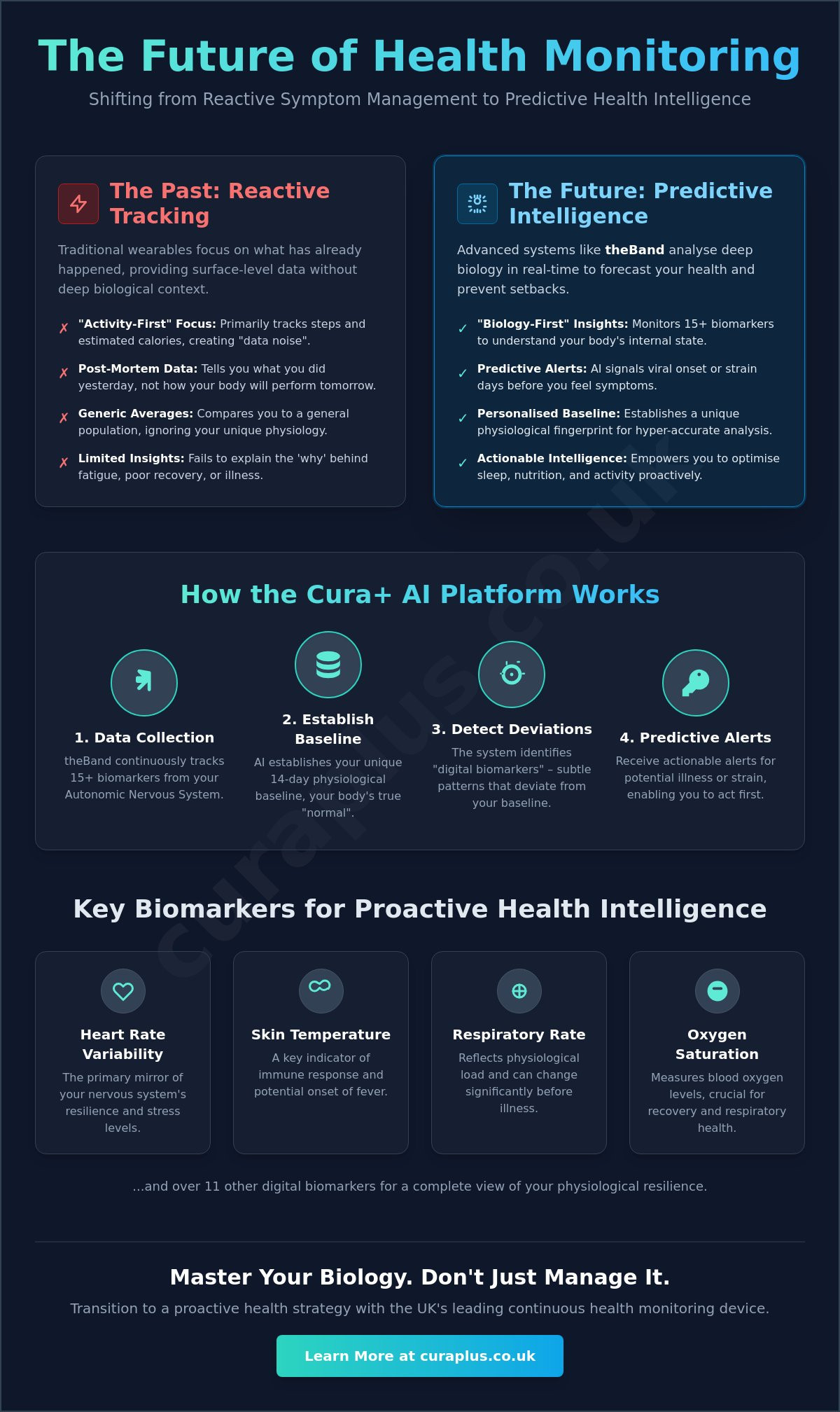
Traditional fitness trackers served their purpose by encouraging movement, yet they've become insufficient for high-level wellness. Simple step counts and estimated calorie burns often create "data noise" where users possess plenty of numbers but no actionable insights. Knowing you walked 10,000 steps doesn't explain why your recovery is stalling or why your sleep quality has plummeted. This transition is a core component of the future of personal health. We've moved beyond observing behaviour to analysing deep-tissue biology. Advanced devices like theBand prioritise multi-sensor biomarker monitoring over basic activity tracking, replacing uncertainty with empirical clarity.
The Role of AI in Home Prevention Strategies
The Cura+ AI Platform transforms raw data into strategic intelligence by identifying "digital biomarkers". These are sophisticated patterns in heart rate variability, skin temperature, and respiratory rate that serve as a 2026 standard for home care. AI algorithms establish a personalised health baseline unique to your physiology; they don't compare you to a generic average. When your data drifts from this baseline, the system issues predictive alerts. These notifications can signal a viral onset or physiological strain days before you feel unwell. It's a proactive shield that empowers you to adjust your lifestyle, sleep, or nutrition before a minor shift becomes a major setback.
Understanding the Biomarkers That Power Proactive Health Intelligence
Mastering your health requires more than a superficial glance at your heart rate. A high-performance continuous health monitoring device UK users trust must synthesise a vast array of physiological data points to create a coherent picture of wellness. True predictive power comes from monitoring 15+ biomarkers simultaneously. This holistic approach ensures that a shift in one area, such as respiratory rate, is contextualised by another, like oxygen saturation. By engaging in biometric tracking for wellness, you transition from guessing how you feel to knowing exactly how your body is performing at a cellular level.
The science of "readiness" is distinct from simple fatigue. You might feel tired but possess high physiological readiness, or feel energetic whilst your biomarkers signal a deep need for rest. Distinguishing between these states is the hallmark of sophisticated health optimisation. It allows you to push when your body is capable and recover when your systems are strained, preventing the burnout that often follows reactive habits.
Heart Rate Variability (HRV): The Mirror of Your Nervous System
Heart Rate Variability (HRV) serves as the primary mirror of your autonomic nervous system. It's the measurement of the variation in time between consecutive heartbeats. Contrary to intuition, a heart that beats with metronomic regularity is often a sign of high stress. High HRV indicates a resilient, well-recovered system capable of adapting to environmental demands with ease. Sudden, sustained drops in HRV often predict impending immune challenges or psychological strain days before they manifest as physical symptoms. Monitoring this metric provides a clear window into your body's hidden stress levels.
Skin Temperature and Immune Response Monitoring
Minor fluctuations in skin temperature are critical indicators of physiological strain that often go unnoticed. Whilst a fever is an obvious sign of illness, subtle nocturnal temperature trends can identify the incubation period of common viruses. Recent UK research on wearable sensors for health monitoring highlights how continuous data can detect clinical deterioration significantly earlier than intermittent manual checks. Using a wearable for tracking immune health allows you to observe these patterns in real-time. If you're ready to transform these complex data points into a clear strategy for excellence, you can view theBand's predictive sensor technology to begin your journey toward predictive health.
Comparing Traditional Fitness Trackers with Predictive Health Wearables
The distinction between a standard fitness tracker and a high-performance continuous health monitoring device UK professionals utilise lies in the fundamental objective of the data. Fitness trackers are inherently "activity-first" devices. They focus on external metrics like steps taken, floors climbed, and estimated calories burned. Whilst useful for general motivation, these metrics are purely historical. They tell you what you did, but they offer no insight into the biological cost of those actions. In contrast, predictive wearables are "biology-first" tools. They prioritise internal physiological states, analysing how your unique system is coping with the demands of your lifestyle.
High-level wellness optimisation requires clinical-grade sensor accuracy that exceeds the capabilities of mass-market activity bands. This standard of precision is essential when tracking subtle fluctuations in vital signs that signal health deterioration. For context, the NICE guidance on wireless vital signs monitoring highlights the value of advanced systems that provide continuous data for better outcomes. At home, this translates to sensors that can detect minute shifts in heart rate variability or blood oxygen levels with the same rigour found in medical environments. To maintain this level of precision, many systems employ a subscription model. This ensures that the Cura+ AI Platform receives constant software refinements and algorithm updates, keeping your health intelligence at the cutting edge.
Historical vs. Predictive Data Architectures
Reviewing yesterday’s step count doesn't help you avoid tomorrow’s burnout. Historical data architectures are retrospective; they document the past without influencing the future. Predictive architectures, however, focus on physiological "readiness". This metric calculates your body's capacity to handle physical or mental stress on any given day. By understanding your readiness, you can make informed decisions about whether to undertake a high-intensity session or prioritise deep recovery. You can explore these differences further in our advanced wellness tracker comparison framework, which details how predictive intelligence transforms daily decision-making.
The Necessity of AI-Driven Health Coaching
Raw biometric data is often a source of confusion rather than clarity. For the average user, seeing a sudden dip in SpO2 or a rise in resting heart rate can cause unnecessary anxiety without proper context. AI acts as a sophisticated guide, translating complex biological signals into clear, actionable instructions. It's the difference between seeing a number and receiving a directive to "prioritise rest tonight." This empowerment is visionary. It allows you to intervene before you even feel tired, catching the earliest signs of strain and adjusting your behaviour to maintain peak performance. It replaces data noise with a clear, strategic map for your wellness journey.
How to Organise Your Home Health Monitoring Strategy
- Step 1: Establish a personalised health baseline over a consistent 14-day period to understand your unique physiological "normal".
- Step 2: Identify your primary health "weak points" through biomarker trend analysis, such as identifying if your recovery typically stalls after specific stressors.
- Step 3: Integrate data-driven habits, such as adjusting your evening routine, based on real-time physiological alerts from your AI platform.
- Step 4: Use a wearable for tracking recovery to adjust daily exertion levels, ensuring you don't overtrain during periods of low resilience.
- Step 5: Review long-term trends monthly to detect subtle physiological shifts that may indicate gradual changes in your metabolic or cardiovascular health.
This systematic progression ensures that you aren't just collecting numbers. You're building a strategic map for your wellness. To begin this journey with precision, you can optimise your health strategy with theBand and the Cura+ AI Platform today.
Setting Your Personalised Health Baseline
Your data is only meaningful when compared to your unique biological signature. Comparing your resting heart rate or HRV to a generic population average often leads to incorrect conclusions because every individual possesses a distinct physiological range. A baseline is the statistical average of your biomarkers during periods of health. Establishing this requires two weeks of consistent wear to account for natural fluctuations in sleep and activity. You can follow our detailed guide on how to build a health baseline to ensure your data foundation is scientifically sound. Once this baseline is set, any deviation becomes a clear signal for action.
Habit Formation Based on Real-Time Bio-Feedback
The centre of behavioural health lies in using data to drive better lifestyle choices. Real-time bio-feedback allows you to see the immediate impact of your decisions on your nervous system. Using "Zoned" notifications helps you manage daily stress levels effectively by alerting you when your physiological strain exceeds your current capacity. If you receive a "Red" readiness score, it's a clear directive to change your physical behaviour for that day. This might mean swapping a high-intensity workout for a restorative walk or prioritising an earlier sleep schedule. These micro-adjustments prevent the cumulative fatigue that leads to burnout, keeping you within your optimal performance zone.
theBand by Cura+: The Pinnacle of At-Home Preventative Technology
theBand represents the ultimate evolution of the continuous health monitoring device UK innovators have developed for 2026. It is a multi-sensor wearable engineered specifically to facilitate predictive intelligence rather than simple activity logging. Whilst the market is saturated with devices that count steps, theBand focuses on the internal landscape. It monitors over 15 distinct biomarkers with clinical-grade precision. This includes essential metrics such as respiratory rate, heart rate variability, and blood oxygen levels (SpO2). These data points are not just numbers; they are the early warning signals of your body's immune and stress responses.
This hardware serves as the gateway to the Cura+ AI Platform. Together, they create a closed-loop system of personalised wellness coaching. Our commitment to data-driven excellence in the UK market is reflected in our pre-launch exclusivity programme. This ensures that early adopters receive the highest level of support as they transition to a proactive health model. We prioritise accuracy above all else, providing a tool that meets the rigorous demands of those who view health as a complex system to be mastered.
Sophisticated Sensors for Simple Physiological Insights
The power of theBand is found in its invisible operation. Its sensors deliver clinical precision whilst maintaining a minimalist, lightweight design that is comfortable for 24-hour wear. It monitors the autonomic nervous system continuously, requiring no manual input or user intervention to capture high-fidelity data. We have intentionally avoided the distractions of short-term gamification, such as badges or digital trophies. Instead, theBand is dedicated to identifying long-term health trends and subtle physiological shifts. This focus on stability and accuracy ensures that your health strategy is built on a foundation of empirical truth rather than fleeting motivation.
The Cura+ AI Advantage for Proactive Living
The AI health and wellness coach is the engine that drives the Cura+ advantage. It translates complex biological signals into actionable intelligence that you can apply immediately. If the system detects a deviation from your baseline that suggests an impending viral onset, it provides a real-time alert. This allows you to manage physiological strain before symptoms ever appear. It is a sophisticated guide for proactive living, replacing the anxiety of the unknown with the confidence of data. We invite you to join the future of proactive health management and experience the clarity that comes from true biological insight.
Mastering Your Biological Future
The transition from observing past activity to predicting future wellness is the most significant shift in personal health today. You've seen how establishing a 14-day baseline and focusing on the autonomic nervous system provides a level of clarity that basic step counters cannot match. By choosing a sophisticated continuous health monitoring device UK residents can finally replace biological uncertainty with empirical evidence. This isn't just about collecting data; it's about having the confidence to make informed decisions before your body demands them through illness or exhaustion.
theBand by Cura+ is engineered to lead this transformation. With UK-based clinical-grade sensor technology monitoring 15+ critical biomarkers, it provides the high-fidelity intelligence your body deserves. When combined with the Cura+ AI Platform for predictive alerts, you gain a strategic partner that understands your unique physiology. Your journey toward self-optimisation is no longer a solo endeavour. Discover the future of proactive wellness with theBand by Cura+ and take command of your resilience today. The future of your health is already within reach.
Frequently Asked Questions
What are the best preventative health tools for home use in the UK?
The most effective preventative health tools are those that prioritise continuous physiological monitoring over intermittent snapshots. In the UK, high-performance options like theBand offer clinical-grade sensors that track 15+ biomarkers. These tools are designed to move beyond simple step counting, providing a comprehensive view of your biological resilience and allowing you to identify subtle shifts in your wellness before they manifest as physical symptoms.
Can a continuous health monitoring device really predict when I am going to get sick?
Yes, a continuous health monitoring device UK residents use can identify the incubation period of common viruses by detecting deviations from your personalised baseline. When your heart rate variability drops or your skin temperature rises slightly above your statistical average, the Cura+ AI Platform issues a predictive alert. This allows you to intervene with rest or nutrition days before you feel the first signs of physical discomfort.
How does heart rate variability (HRV) help in preventing illness at home?
Heart rate variability (HRV) serves as a sensitive early warning system by reflecting the state of your autonomic nervous system. A resilient body typically shows high variability between beats; a sudden, sustained decrease often indicates that your system is under significant stress or fighting an infection. Monitoring HRV at home allows you to adjust your exertion levels in real-time, preventing minor physiological strain from developing into a major health setback.
What is the difference between a standard fitness tracker and a predictive health wearable?
Standard fitness trackers focus on historical activity data, such as steps and calories, whilst predictive health wearables prioritise real-time biological states. A fitness tracker tells you what you did yesterday; a predictive tool like theBand tells you what your body is capable of today. This biology-first approach uses AI to interpret biomarkers, providing a readiness score that guides your daily decisions rather than just recording your past movements.
Is my biometric data secure when using AI-driven health monitoring tools?
Your biometric data is protected under the rigorous standards of UK GDPR and the Data Protection Act. When using AI-driven platforms like Cura+, your physiological information is encrypted and handled with the highest level of security. We view health data as a private, high-stakes asset; therefore, our systems are engineered to ensure that your biological insights remain under your control whilst providing the clarity needed for self-optimisation.
How long does it take to establish a reliable health baseline at home?
It takes exactly 14 days of consistent wear to establish a reliable physiological baseline for your unique biology. This two-week period allows the Cura+ AI Platform to account for natural fluctuations in your sleep, activity, and stress levels. Once this statistical normal is defined, the system can accurately detect even minute deviations, ensuring that every alert you receive is based on your specific biological signature rather than a generic average.
Do I need a medical background to understand the data from theBand?
You don't need any medical or technical expertise to benefit from the data provided by theBand. The Cura+ AI Platform acts as a sophisticated health consultant, translating complex biometric signals into simple, actionable coaching. Instead of presenting you with raw numbers that are difficult to interpret, the system provides clear directives, such as suggesting an earlier sleep schedule or a day of restorative recovery based on your current readiness.
Can preventative health tools help with long-term stress management?
Preventative health tools are exceptionally effective for long-term stress management because they identify physiological strain before it becomes chronic. By monitoring biomarkers like HRV and respiratory rate, you can see the immediate impact of psychological stress on your body. This visibility allows you to implement Zoned notifications and breathing protocols, helping you master your nervous system and build a baseline of resilience that protects your long-term wellness.


