


What if your body could send you a notification about an impending illness or burnout days before you felt the first hint of fatigue? For years, biometric tracking for wellness has focused on the retrospective, offering a digital diary of steps taken and hours slept. Whilst these metrics provide a baseline, they often leave users with a sense of data fatigue, providing numbers that lack the necessary context to drive real change. It's time to move beyond the passive record and embrace a system that anticipates your physiological needs.
You likely understand the frustration of seeing a declining readiness score without knowing exactly how to reverse the trend. We've reached a pivotal shift where sophisticated technology allows us to transition from simple observation to proactive, predictive health mastery. This guide will clarify which biomarkers truly influence your longevity and how to detect subtle physiological shifts before they manifest as physical symptoms. You'll learn how to leverage theBand and the Cura+ AI Platform to build a personalised health strategy that replaces guesswork with clinical precision, ensuring you remain in total control of your biological trajectory.
Key Takeaways
- Understand the evolution from retrospective data collection to predictive foresight through advanced biometric tracking for wellness.
- Identify the 15+ essential biomarkers required to construct a comprehensive, multi-sensor view of your internal physiological state.
- Learn how the Cura+ AI Platform decodes subtle data patterns to identify early signs of burnout or illness before they manifest physically.
- Discover the methodology for establishing a personalised health baseline to replace misleading population-wide averages with precise individual data.
- Master the integration of high-level signals, such as autonomic nervous system tone, to achieve a state of proactive physiological optimisation.
The Evolution of Biometric Tracking: From Fitness to Predictive Foresight
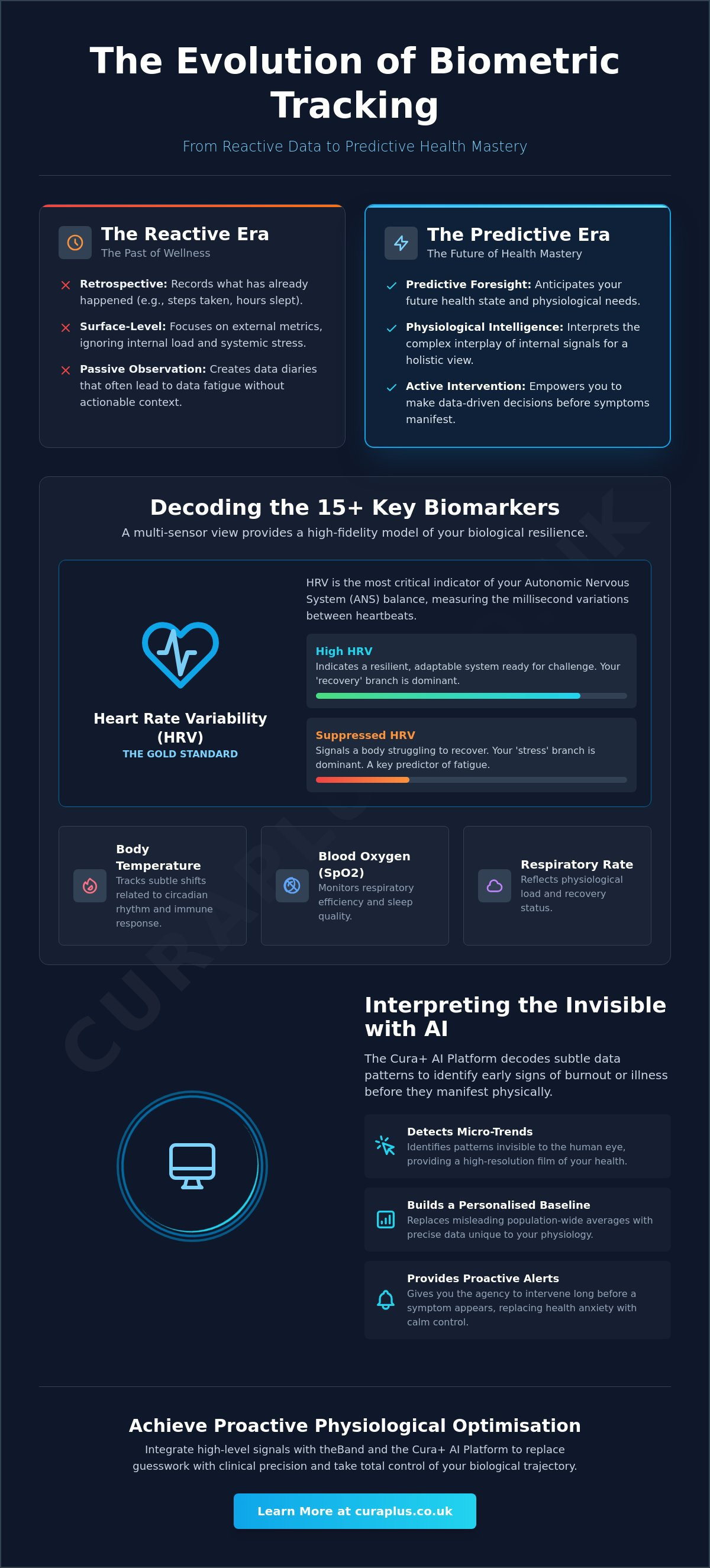
Biometric tracking for wellness is defined as the continuous, high-fidelity monitoring of physiological signals to optimise human performance and health. We have moved beyond the "Reactive Era" of wellness. In this previous phase, technology primarily recorded what had already happened: how many steps you walked, how many calories you burned, or how many miles you cycled. Whilst useful for general activity, these metrics are historical and surface-level. We are now entering the "Predictive Era", where the focus shifts from external movement to internal systems. Advanced systems don't just record history; they anticipate your future health state.
This transition is rooted in the Quantified Self movement, which popularised the idea of using data to understand our own biology. However, the modern gold standard is no longer just quantity; it's "physiological intelligence". This is the ability to interpret the complex interplay of internal signals to maintain a state of total mastery over one's wellbeing. It's a move from passive observation to active, data-driven intervention.
Why Step-Counting is No Longer Enough
Traditional trackers focus on external metrics like distance and calories, yet these numbers offer a shallow perspective on health. A high-performer might walk 10,000 steps whilst their body is in a state of extreme systemic stress. Conversely, a day of low activity might be exactly what the nervous system requires for recovery. The limitation of external metrics is that they ignore the "internal load". By monitoring internal systems directly, we gain insight into how the body actually responds to stress, regardless of the physical effort exerted. High-performers are increasingly abandoning simple activity logs in favour of systemic monitoring that prioritises internal stability over arbitrary movement goals.
The Shift Toward Proactive Health Management
Proactive health management is the practice of identifying physiological trends before they manifest as clinical problems. The traditional medical model relies on annual check-ups, which are merely snapshots in time. These infrequent data points often fail to capture the subtle, incremental shifts that signal the onset of burnout or metabolic dysfunction. Continuous biometric tracking for wellness provides a high-resolution film of your health rather than a set of blurry photographs. This constant stream of data allows for the detection of patterns that would be invisible to the naked eye. Replacing the anxiety of health uncertainty with data-driven clarity creates a sense of calm control. When you can see a trend developing, you possess the agency to intervene long before a symptom appears.
The Science of the System: Decoding the 15+ Key Biomarkers
Achieving total physiological mastery requires a shift from isolated data points to unified, multi-sensor integration. Tracking a single metric, such as resting heart rate, provides an incomplete picture of your internal state. It's akin to assessing a complex machine by observing a single gear. To gain a holistic view, biometric tracking for wellness in 2026 utilises a suite of sensors that monitor over 15 distinct biomarkers simultaneously. This synchronised approach allows for the detection of nuances amongst various data streams that a single-sensor device would inevitably miss. By cross-referencing heart rate with respiratory data and temperature, the system builds a high-fidelity model of your biological resilience.
The Gold Standard: Heart Rate Variability (HRV)
Heart Rate Variability (HRV) stands as the most critical indicator of your autonomic nervous system (ANS) balance. It measures the millisecond variations between consecutive heartbeats, reflecting the tug-of-war between your sympathetic (stress) and parasympathetic (recovery) branches. A high HRV suggests a resilient system ready for challenge, whilst a suppressed HRV indicates a body struggling to recover. Understanding these trends is essential for preventing overtraining and chronic fatigue. If you're looking to refine your data collection, you should consult our guide on how to choose the best device to measure HRV to ensure you're capturing clinical-grade data.
Core Physiological Indicators: Temperature, Oxygen, and Beyond
Beyond the heart, your skin temperature and blood oxygen levels (SpO2) act as early warning systems for systemic shifts. Fluctuations in nocturnal skin temperature often precede the physical symptoms of an immune response by 24 to 48 hours. Similarly, monitoring SpO2 and respiratory rate provides insight into your cardiovascular efficiency and metabolic health. As noted in recent analysis of Biometrics in Employee Wellness, the ability to track these progress markers is fundamental to encouraging proactive rather than reactive care. When these metrics intersect, they form a "readiness" score that dictates whether you should push your limits or prioritise deep restoration.
Sleep Architecture and Recovery
True recovery isn't determined by the time spent in bed, but by the quality of your sleep architecture. Biometric tracking for wellness must distinguish between light, deep, and REM sleep stages to accurately assess physical and cognitive repair. Deep sleep is the primary driver for tissue growth and immune function, whilst REM sleep facilitates emotional processing and memory consolidation. For those seeking to optimise their rest, choosing a wearable for tracking sleep stages is a vital step in moving beyond basic movement detection toward genuine recovery analysis. These insights ensure that your sleep is working for you, not just passing the time.
The precision of these sensors is what separates a toy from a professional health tool. In 2026, the gap between clinical equipment and wearable technology has effectively closed, allowing you to access laboratory-level insights from your wrist. To begin your journey toward data-driven health, explore the sophisticated capabilities of the Cura+ ecosystem today.
Interpreting the Invisible: How AI Identifies Early Physiological Shifts
Raw data is merely noise without the lens of intelligent interpretation. In the context of biometric tracking for wellness, a static heart rate or a single sleep score offers little more than a historical record. The true power of modern technology lies in the Cura+ AI Platform, which identifies subtle patterns amongst multiple biomarkers that the human eye would naturally miss. By analysing the correlation between disparate signals, AI creates "digital biomarkers", which are predictive signatures that can forecast future health states before they manifest as tangible symptoms.
This shift toward physiological intelligence replaces the burden of manual tracking with automated, high-fidelity coaching. Instead of wondering why you feel lethargic, the system provides a data-driven narrative, explaining the precise biological shifts occurring within your body. It acts as a sophisticated guide, offering real-time adjustments to your lifestyle based on your unique internal load rather than generic population averages. This ensures that every recommendation is grounded in your current biological reality.
Detecting Viral Onset and Immune Response
One of the most profound applications of predictive AI is its ability to flag an impending illness long before you reach for a thermometer. The system establishes your unique "immune baseline" by monitoring nocturnal skin temperature and HRV trends over time. A simultaneous rise in temperature and a sharp decline in HRV often signals that your immune system is mobilising to fight a pathogen. By tracking immune health proactively, users can identify these anomalies up to 48 hours before symptoms appear. This early warning allows for immediate intervention, such as increased hydration and rest, potentially mitigating the severity of the illness before it takes hold.
Stress Patterns and Mental Resilience
Biometrics provide an objective window into the physical impact of psychological stress, bridging the gap between mind and body. Whilst we often perceive stress as a purely mental phenomenon, its signature is etched into our physiology through suppressed HRV and elevated resting heart rates. Utilising Biometrics for Mental Wellness allows individuals to differentiate between acute stressors, which can be productive, and chronic stress, which leads to systemic depletion. By establishing a "stress baseline", the Cura+ AI Platform identifies when your nervous system remains in a state of high alert for too long. Understanding these wearable for tracking stress patterns empowers you to implement recovery protocols before mental strain translates into physical burnout. This clarity transforms health from a series of symptoms to be managed into a complex system to be understood and mastered.
Practical Implementation: Establishing a Baseline for Long-Term Health
Your "Health Baseline" is your unique physiological signature. It represents the standard operating range of your body across multiple biomarkers. Many individuals fall into the trap of comparing their data to general population averages, which is often misleading. What is considered a "normal" resting heart rate or HRV for the average person may be a sign of acute distress for you. Biometric tracking for wellness is most effective when it focuses on deviations from your personal norm rather than external benchmarks.
To establish a statistically significant baseline, consistency is paramount. A period of 14 to 21 days of continuous data collection is typically required to calibrate the system to your lifestyle. During this window, data integrity relies on wearing your device through both sleep and daily activity. Without this unbroken stream of information, the AI cannot accurately distinguish between a true physiological shift and a simple gap in measurement.
Steps to Building Your Physiological Profile
Constructing a high-resolution profile requires more than just wearing a device; it demands an organised approach to data collection. Follow these essential steps to ensure accuracy:
- Continuous Calibration: Wear your device 24/7 during the initial 21-day period to capture the full spectrum of your circadian rhythms.
- Contextual Tagging: Use the platform to tag lifestyle events such as alcohol consumption, intense exercise, or travel. This helps the AI correlate specific behaviours with physiological responses.
- Trend Analysis: Resist the urge to react to daily fluctuations. Focus on weekly and monthly trends to identify genuine progress or decline.
For a more detailed breakdown of this process, consult our definitive guide to building a health baseline.
Recognising and Acting on Deviations
Once your baseline is set, the system will flag deviations that fall outside your standard range. It's vital to distinguish between a "red flag" and a normal daily fluctuation. A single night of poor sleep might cause a minor dip in HRV, but a sustained three-day decline whilst resting heart rate rises is a clear signal for intervention. In such cases, a "wait and watch" approach is often less effective than proactive lifestyle adjustments. You might choose to reduce training intensity or prioritise earlier sleep to allow your system to recover. This level of biometric tracking for wellness ensures you're always one step ahead of your body's needs.
Ready to start your calibration? Order theBand and begin building your physiological profile today.
The Pinnacle of Personalised Health: Integrating theBand by Cura+
The transition from passive data collection to proactive health mastery requires hardware that matches the sophistication of the underlying science. Whilst the previous sections have detailed the importance of baselines and AI interpretation, these concepts remain theoretical without a high-fidelity input source. Biometric tracking for wellness reaches its zenith with theBand, a device engineered to function as a continuous physiological laboratory on your wrist. It represents the shift from consumer-grade gadgets to professional-grade intelligence tools, providing the raw data necessary for the Cura+ AI Platform to deliver its predictive insights.
Precision is not a luxury; it is a necessity for those committed to elite-level self-optimisation. theBand monitors over 15 distinct biomarkers, including high-resolution signals like autonomic nervous system (ANS) tone, which serves as a real-time barometer for your internal stress and recovery balance. By integrating this hardware with the Cura+ AI Platform, you gain access to a seamless ecosystem that provides real-time alerts and actionable guidance. This is the essential tool for individuals who view their health as a complex system to be understood, refined, and mastered.
Precision Engineering for Clinical Accuracy
The foundation of theBand is its sophisticated sensor array, which has been developed with a focus on clinical precision and data integrity. British engineering ensures that every component is optimised for accuracy, even in challenging conditions. The hardware is designed for 24/7 comfort, which is vital for maintaining the data continuity required to establish a reliable health baseline. Unlike trackers that feel intrusive or require frequent removal, theBand's ergonomic profile ensures it remains a constant companion. This persistent monitoring allows for the capture of nocturnal data and daily fluctuations without interruption, ensuring that your physiological profile is never incomplete.
Your AI Health Consultant
The true power of theBand is realised when it communicates with the Cura+ AI Platform. This isn't just an app; it's a digital health consultant that evolves as it learns your specific biological responses to stress, nutrition, and rest. The system provides personalised coaching that moves beyond generic advice, offering predictive alerts that notify you of impending physiological shifts. If your ANS tone suggests a state of overreach, the platform doesn't just show you a graph; it provides a strategy to restore balance. This intelligence ensures that your wellness journey is no longer a matter of guesswork but a methodical progression toward your peak potential.
The future of your health is no longer a mystery to be solved. It's a system to be mastered through clarity and insight. Take the definitive step toward total physiological control and secure your future health with theBand by Cura+.
Mastering Your Physiological Future
The transition from reactive step-counting to sophisticated biometric tracking for wellness marks a definitive era of human optimisation. By moving beyond population averages and establishing your unique physiological baseline, you replace health uncertainty with clinical clarity. You now understand that the secret to longevity isn't just collecting data, but interpreting the subtle shifts amongst your internal systems before they manifest as physical symptoms. Precision is no longer a luxury; it is a prerequisite for excellence.
With theBand, you can monitor over 15 essential biomarkers with clinical precision, whilst the Cura+ AI Platform provides the predictive health alerts necessary for early illness detection and proactive recovery. This system is designed for those who refuse to leave their wellbeing to chance. It's time to embrace a personalised strategy that treats your body as the complex, intelligent system it is. Discover the future of predictive health with theBand by Cura+. Your journey toward total physiological mastery is just beginning, and the data is ready to lead the way.
Frequently Asked Questions
What is the difference between biometric tracking and standard fitness tracking?
Biometric tracking focuses on internal physiological systems, whereas standard fitness tracking prioritises external activity metrics. Whilst a fitness tracker counts steps or miles, biometric tracking for wellness monitors the body's internal load and autonomic nervous system state. This shift allows for a deeper understanding of biological resilience and systemic health rather than just physical output or calorie expenditure.
Can biometric tracking for wellness really predict when I am going to get sick?
Advanced systems can identify physiological signatures that precede physical symptoms by up to 48 hours. By monitoring nocturnal skin temperature and Heart Rate Variability (HRV), the Cura+ AI Platform detects subtle immune responses before you feel unwell. This early foresight enables proactive intervention, such as increasing rest or hydration, to potentially mitigate the impact of a viral onset before it takes hold.
Which biomarkers are the most important for daily wellness monitoring?
Heart Rate Variability (HRV), resting heart rate, and nocturnal skin temperature are the most critical metrics for daily monitoring. These biomarkers provide a real-time window into your nervous system balance and immune health. When tracked alongside blood oxygen levels and respiratory rate, they form a comprehensive picture of your body's readiness to handle stress or its requirement for deep restoration.
How accurate are modern wearable biometric sensors compared to clinical equipment?
Modern wearable sensors in 2026 have effectively closed the gap with traditional clinical equipment for the purpose of continuous health monitoring. theBand utilises high-fidelity sensors that provide medical-grade data in a comfortable, wearable format. Whilst a clinical setting is necessary for formal diagnosis, these wearables offer the advantage of 24/7 data continuity, which is often more valuable for identifying long-term physiological trends.
Is my biometric data secure and private when using an AI health platform?
Your data is protected by stringent privacy regulations, including the latest 2026 updates to consumer data protection acts. The Cura+ AI Platform employs sophisticated encryption and adheres to regional standards such as the CPRA and the Indiana Consumer Data Protection Act. We prioritise transparency and consent, ensuring that your sensitive biological information remains secure and under your personal control at all times.
How long does it take to see meaningful trends in my biometric data?
It typically takes 14 to 21 days to establish a statistically significant health baseline. This initial period allows the AI to calibrate to your unique physiological signature and understand your standard operating range. Once this baseline is established, the system can accurately identify subtle deviations that signal meaningful shifts in your wellness, allowing for precise, data-driven adjustments to your lifestyle.
Do I need to be an athlete to benefit from biometric tracking?
You don't need to be an athlete to benefit from biometric tracking for wellness as the system is designed for anyone committed to long-term health. Whether you are managing a high-pressure career or seeking to improve your sleep quality, these insights provide the clarity needed to master your biology. Understanding your internal load is as valuable for preventing burnout in the boardroom as it is for training.
Can biometrics help me manage stress and burnout more effectively?
Biometrics offer an objective measurement of psychological stress by tracking its physical impact on your nervous system. By monitoring your stress baseline through HRV and heart rate trends, you can identify when your body remains in a sympathetic state for too long. This allows you to implement recovery protocols before chronic stress translates into physical exhaustion, replacing health uncertainty with calm, data-driven control.


