


What if the subtle fluctuations in your morning pulse were not mere data noise, but a sophisticated early warning system for your entire physiology? You have likely experienced the frustration of generic health advice that classifies any pulse between 60 and 100 beats per minute as acceptable, whilst leaving you to navigate the anxiety of daily variations alone. It's common to feel that your wearable provides plenty of data but very little actionable clarity regarding your actual readiness or recovery.
This article will empower you to interpret what resting heart rate trends mean UK wide for your unique biological profile, transforming a simple metric into a tool for elite performance and proactive health. You will discover how to move beyond basic tracking to achieve a refined cardiac baseline that predicts illness before symptoms even manifest. We shall explore the science of autonomic optimisation and how theBand, powered by the Cura+ AI Platform, provides the predictive intelligence required to master your health with clinical precision and visionary confidence.
Key Takeaways
- Distinguish between standard NHS reference ranges and the elite longevity range of 48 to 60 bpm to establish a high-performance cardiovascular baseline.
- Understand the physiological mechanisms of stroke volume and Vagus nerve regulation to reduce the mechanical strain on your cardiac system.
- Learn exactly what resting heart rate trends mean UK residents can use to detect physiological stress or viral onset up to 48 hours before physical symptoms manifest.
- Implement strategic Zone 2 cardiovascular training and electrolyte-optimised hydration protocols to systematically lower your resting heart rate.
- Master predictive health management by synchronising theBand with the Cura+ AI Platform to monitor 15+ critical biomarkers for a holistic view of your internal state.
Understanding Resting Heart Rate as a Vital Health Biomarker
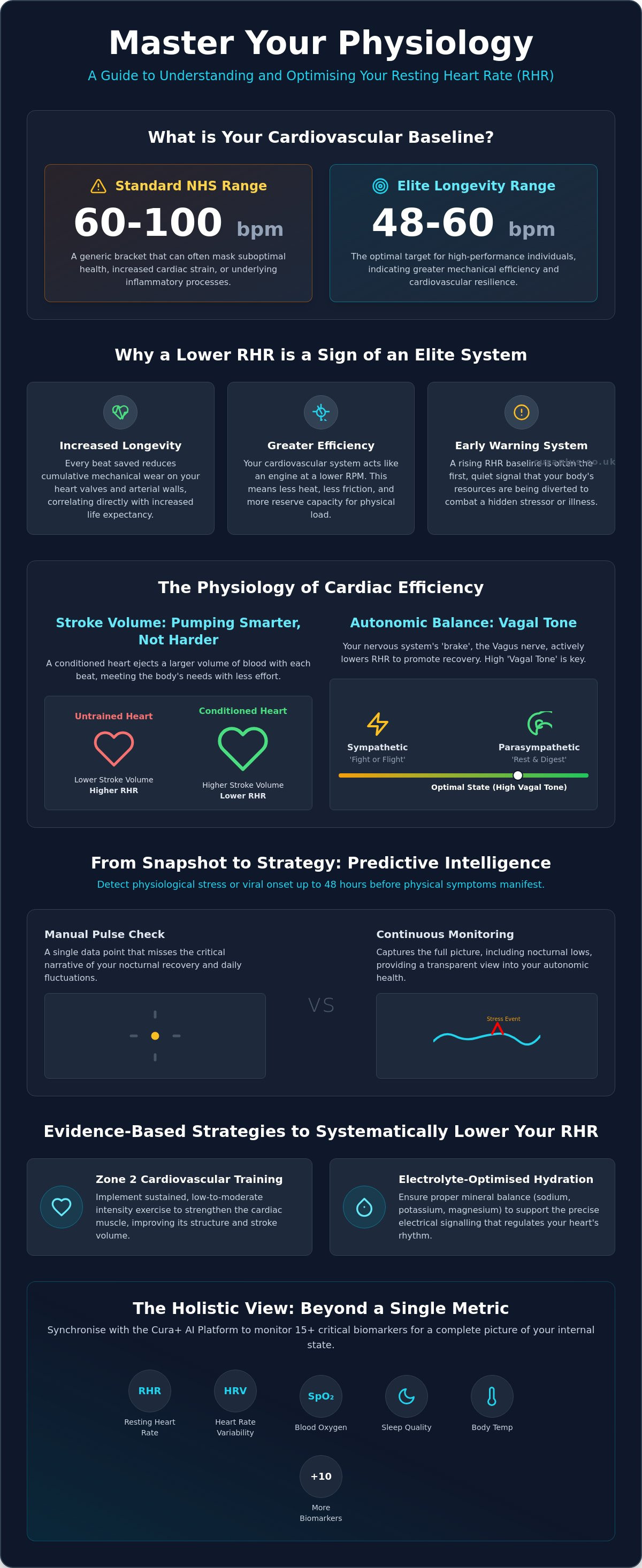
Your heart is a precision instrument. Its baseline rhythm, or Resting heart rate, serves as the ultimate diagnostic for cardiovascular efficiency. Whilst the NHS suggests a normal range of 60 to 100 beats per minute (bpm), this generic bracket often masks suboptimal health. For those pursuing peak longevity, an optimal range typically sits between 48 and 60 bpm. A heart that beats less frequently whilst at rest is a heart that operates with greater mechanical efficiency. High RHR values often signal systemic stress, poor recovery, or underlying inflammatory processes. To truly grasp what resting heart rate trends mean UK health enthusiasts must look beyond the surface of a single number. This commitment to biometric tracking for wellness represents the new foundation for modern, data-driven living.
Why RHR Trends Matter for Longevity in 2026
A lower RHR isn't just a badge of fitness; it correlates directly with increased life expectancy. Every beat saved is a reduction in cumulative mechanical wear on your heart valves and arterial walls. Think of your cardiovascular system as an engine idling at a lower RPM. There's less heat, less friction, and significantly more reserve capacity for when the body is under load. Establishing a clear health baseline allows you to see if your system is thriving or merely surviving. In 2026, we view RHR as a leading indicator of all-cause mortality. It's the quiet signal that speaks volumes about your biological age versus your chronological one. When your baseline begins to creep upwards without an obvious cause, it's often the first sign that your body's internal resources are being diverted to combat a hidden stressor.
The Shift from Pulse Checks to Cardiac Intelligence
Manual pulse checks are mere snapshots. They miss the complex narrative of your physiology. Your heart follows a strict diurnal rhythm, dipping to its lowest point during deep sleep to facilitate cellular repair and hormonal regulation. This process is governed by the autonomic nervous system, specifically the delicate balance between the sympathetic "fight or flight" and the parasympathetic "rest and digest" branches. Relying on a single morning measurement is insufficient for true health insight. True cardiac intelligence requires continuous monitoring to capture these nocturnal lows and daily fluctuations. It's the only way to transform raw data into a predictive health strategy. By observing how your heart behaves whilst you sleep, you gain a transparent view into your autonomic health that no manual check can provide.
The Physiology of a Lower Heart Rate: Strengthening the Cardiac System
A lower resting pulse is the hallmark of a structurally superior heart. This efficiency is primarily driven by stroke volume, which is the volume of blood the heart ejects with each individual contraction. When the cardiac muscle is conditioned, the left ventricle becomes more elastic and powerful, allowing it to move a greater quantity of oxygenated blood without increasing the frequency of beats. This structural advantage means your system achieves its metabolic requirements with less effort. If you learn to measure your heart rate with precision, you can track this physiological progress over months of training.
The relationship between resting heart rate and Heart Rate Variability (HRV) is equally fundamental to your health. Whilst RHR represents the speed of the heart, HRV measures the millisecond variations between those beats. A low RHR paired with high HRV indicates a robust, resilient autonomic nervous system. Conversely, chronic stress locks the body into a sympathetic state. This "fight or flight" dominance keeps the baseline pulse elevated and the heart's rhythm rigid, signalling that the body is struggling to find a state of true recovery. It isn't just about how fast the heart beats, but how well it responds to the commands of your nervous system.
Autonomic Nervous System and Vagal Tone
The autonomic nervous system functions like a sophisticated dual-control system. The sympathetic branch acts as the accelerator, whilst the parasympathetic branch, led by the Vagus nerve, serves as the brake. When you are in a state of deep rest, the Vagus nerve releases acetylcholine to signal the sinoatrial node to slow down. Vagal Tone is the measure of the Vagus nerve's activity in regulating the heart's rhythm, where higher tone correlates with a lower resting heart rate and enhanced recovery. Developing high vagal tone is essential for shifting the body out of a state of constant alert and into a restorative phase.
Cardiac Remodelling Through Aerobic Efficiency
Consistent, low-intensity aerobic work triggers eccentric hypertrophy of the left ventricle. This is a positive form of cardiac remodelling where the heart chamber expands to hold more blood. The result is a system that delivers more oxygen per beat, reducing the total daily workload on the cardiac muscle. Understanding what resting heart rate trends mean UK athletes and wellness seekers can use to gauge their cardiovascular age is vital for long-term health. Monitoring these structural shifts requires a predictive health wearable UK users can rely on for clinical-grade accuracy. It's the only way to ensure your training is actually improving your heart's internal architecture.
For those ready to master their internal biology, theBand provides the continuous data stream necessary to visualise these physiological transformations in real-time.
Evidence-Based Lifestyle Strategies to Reduce Your RHR
Achieving a refined cardiac baseline requires more than intent; it demands a strategic application of physiological principles. To move from a standard normal adult heart rate toward an elite longevity range, you must prioritise Zone 2 cardiovascular training. This low-intensity, steady-state exercise is the gold standard for mitochondrial health and fat oxidation. Aiming for 150 minutes weekly allows your heart to undergo the positive remodelling discussed earlier without triggering excessive cortisol. Consistency in this zone builds the aerobic foundation necessary to lower your daily beats per minute systematically. Understanding what resting heart rate trends mean UK wellness seekers can achieve is the first step toward mastering your internal environment.
Hydration and electrolyte balance play a frequently overlooked role in cardiac efficiency. When your blood volume drops due to dehydration, your heart must beat faster to maintain blood pressure and oxygen delivery. Similarly, alcohol consumption acts as a significant physiological disruptor. Even a single moderate drink can spike your RHR for up to 48 hours, as the body works to metabolise toxins and manage the resulting systemic inflammation. Sleep hygiene is the final pillar of this foundation. Your heart requires a consistent nocturnal window to reach its minimum beat frequency, a period essential for deep cellular recovery and autonomic recalibration.
The 12-Week Cardiac Optimisation Protocol
Systemic change takes time. A progressive 12-week programme should combine steady-state cardio with resonance frequency breathing to strengthen the Vagal brake. Consistency outweighs intensity; a daily 20-minute walk is often more effective for RHR reduction than a sporadic high-intensity workout. Incorporating an evening routine that includes dim lights and magnesium supplementation can help your heart reach its nocturnal minimum earlier in the sleep cycle. This deliberate approach ensures your cardiac system remains in a restorative state for the maximum duration possible.
Nutritional and Environmental Factors
Specific micronutrients are vital for the electrical stability of the heart. Magnesium and Omega-3 fatty acids support the sinoatrial node and reduce the likelihood of palpitations or erratic rhythms. Environmental stressors also dictate your cardiac rhythm. Regular thermal therapy, such as sauna sessions or controlled cold exposure, trains your heart to remain resilient under pressure. By tracking stress patterns, you can identify which environmental triggers are causing unnecessary spikes in your baseline. This proactive intelligence allows you to curate a lifestyle that supports, rather than strains, your cardiovascular health.
Monitoring Trends: Moving from Manual Checks to Predictive Intelligence
Traditional health monitoring has long relied on the manual spot-check. Whilst finding your pulse at the wrist provides a momentary data point, it fails to capture the dynamic narrative of your cardiovascular health. A single measurement is easily skewed by recent caffeine intake, emotional stress, or even your posture. To truly understand what resting heart rate trends mean UK health pioneers must shift their focus toward continuous, high-fidelity data. This transition from reactive checking to predictive intelligence allows you to see the subtle shifts that occur whilst you are stationary or asleep, providing a transparent view of your systemic recovery that manual methods simply cannot replicate.
Nocturnal resting heart rate is the most authentic measure of your internal state. During deep sleep, the influence of external variables is minimised, leaving only the pure signal of your autonomic nervous system. AI-driven biomarker analysis now allows us to filter out the "noise" of daily life, identifying true biological trends amongst thousands of data points. This level of cardiac intelligence transforms your wearable from a passive tracker into an active consultant. It enables you to distinguish between a temporary spike caused by a late meal and a sustained trend that requires a strategic adjustment to your training or recovery protocol.
Detecting Illness Before Symptoms Appear
Your heart rate is a sensitive barometer for immune activity. When your body identifies a viral or bacterial threat, it initiates a metabolic surge to fuel the production of white blood cells and antibodies. This increased energy demand forces the heart to beat faster, even whilst you rest. By tracking immune health through these subtle RHR elevations, you can often detect an oncoming illness up to 48 hours before physical symptoms like a cough or fever emerge. A sustained elevation in nocturnal resting heart rate above your personal baseline often indicates the early metabolic demands of an immune response before physical symptoms manifest.
The Role of AI in Personalised Health Alerts
Generic wearables often rely on static thresholds that trigger alerts only when a heart rate exceeds a pre-set limit. In contrast, sophisticated AI platforms learn your unique physiological signature. They recognise that a resting rate of 65 bpm might be normal for one individual but a signal of extreme fatigue for another. These algorithms provide context-aware notifications that distinguish between healthy fluctuations and genuine anomalies. High-precision sensors are vital here; without medical-grade accuracy, the AI cannot provide the reliable insights necessary for proactive health management. It is the difference between receiving a notification that your heart rate is "high" and receiving a predictive alert that your system requires immediate rest.
Experience the future of personal health by integrating theBand and the Cura+ AI Platform into your daily optimisation strategy.
Optimising Cardiac Health with theBand by Cura+
Mastering your physiology requires more than intent; it demands the right instrumentation. theBand by Cura+ is the definitive tool for proactive health management, designed for those who refuse to settle for generic wellness advice. By monitoring 15+ biomarkers simultaneously, including heart rate variability and blood oxygen levels, it provides a holistic view of your cardiac health that was previously reserved for clinical environments. This isn't just about collecting data. The Cura+ AI Platform transforms your raw resting heart rate metrics into sophisticated coaching insights, allowing you to understand exactly what resting heart rate trends mean UK wide for your specific biological age and performance goals.
Positioning yourself at the forefront of health technology means moving beyond the limitations of standard fitness trackers. theBand acts as an essential partner in your journey toward self-optimisation, providing the clarity needed to make high-stakes decisions about your training and lifestyle. Whether you are aiming for an elite longevity range or simply seeking to master your internal biology, the integration of high-precision sensors with predictive intelligence ensures you are never navigating your health in the dark. It's a visionary approach to wellness that replaces uncertainty with data-driven confidence.
Continuous Monitoring for Real-Time Insights
Precision is nothing without consistency. theBand features a sophisticated multi-sensor array designed for 24/7 use, ensuring every beat is captured with medical-grade accuracy whilst you work, train, and sleep. The platform seamlessly integrates your RHR with sleep architecture and activity data to provide a 360-degree view of your systemic state. For the dedicated athlete or professional, tracking recovery becomes an automated process that prevents overtraining and identifies when your body is primed for peak output. This continuous stream of intelligence allows you to adjust your behaviour in real-time, ensuring your cardiac system remains in an optimal state of balance.
Join the Future of Predictive Healthcare
The era of reactive medicine is ending. By embracing predictive intelligence, you gain the peace of mind that comes from knowing your system is being monitored by the most advanced algorithms available in the UK. You no longer have to wonder if a fluctuation in your pulse is a cause for concern; the Cura+ AI Platform provides the context and clarity required to understand your unique cardiac narrative. It's time to move beyond basic step counting and enter the world of high-performance biological mastery. Secure your future and take total control of your cardiovascular destiny today. Pre-order theBand by Cura+ and secure your health intelligence platform to begin your journey toward elite cardiac intelligence.
Master Your Biological Narrative
We've moved beyond the era of static pulse checks and generic health advice. Understanding what resting heart rate trends mean UK wide involves more than just counting beats; it's about interpreting the sophisticated dialogue between your heart and your autonomic nervous system. By prioritising Zone 2 training and adopting precise recovery protocols, you can systematically refine your cardiovascular efficiency and protect your long-term vitality. The transition from reactive tracking to predictive intelligence is the foundation of modern longevity.
theBand provides the clinical-grade accuracy required for this level of mastery. With advanced sensors monitoring 15+ critical biomarkers, the Cura+ AI Platform delivers predictive health alerts that identify physiological shifts up to 48 hours before they manifest as symptoms. This is a visionary leap in personal wellness that replaces uncertainty with data-driven clarity. Optimise your cardiac health with theBand by Cura+ and transform your biological data into your most powerful asset. Your journey toward peak performance starts with the intelligence to act before the need arises.
Frequently Asked Questions
What is a good resting heart rate for my age in the UK?
Whilst the NHS defines a normal adult range as 60 to 100 beats per minute, high-performance longevity standards suggest an optimal range of 48 to 60 bpm. Age does influence this, as maximum heart rate declines over time, but your resting baseline remains a primary indicator of cardiovascular efficiency. Focusing on what resting heart rate trends mean UK residents can achieve through conditioning is more valuable than adhering to broad, age-based averages.
How long does it take to lower my resting heart rate through exercise?
Structural cardiac adaptations typically manifest within four to twelve weeks of consistent Zone 2 aerobic training. During this period, the heart's stroke volume increases, allowing it to pump more blood with fewer beats. You might notice initial improvements in recovery time within just a few weeks, but permanent reductions in your baseline RHR require sustained commitment to eccentric hypertrophy of the left ventricle.
Can stress alone cause a permanently high resting heart rate?
Chronic psychological stress can lead to sustained sympathetic nervous system dominance, effectively keeping your heart in a "fight or flight" state. This prevents the Vagus nerve from applying its physiological brake, resulting in an elevated baseline that persists even during sleep. Whilst the heart muscle itself isn't damaged immediately, the lack of parasympathetic recovery can lead to long-term systemic fatigue and reduced heart rate variability.
Is a resting heart rate of 50 bpm too low for a non-athlete?
A resting heart rate of 50 bpm, known as bradycardia, is generally considered safe if you don't experience symptoms like dizziness, fatigue, or fainting. Whilst often associated with elite athletes, some individuals naturally possess high vagal tone or structural efficiency. However, if such a low rate is a sudden departure from your established baseline, it warrants a professional consultation to rule out underlying conduction issues.
How does alcohol consumption affect my resting heart rate trends?
Alcohol acts as a potent systemic stressor that can elevate your resting heart rate for up to 48 hours after consumption. The metabolic strain of processing ethanol, combined with dehydration and disrupted sleep architecture, prevents the heart from reaching its nocturnal minimum. Tracking what resting heart rate trends mean UK wide for social drinkers often reveals a significant recovery debt that lingers long after the immediate effects of the alcohol have worn off.
Can a wearable device really predict if I am getting ill?
High-precision wearables can identify the metabolic surge associated with early immune activation, often detecting illness 48 hours before physical symptoms appear. When your body identifies a pathogen, your heart rate rises to support the increased energy demands of your immune response. theBand utilises AI-driven biomarker analysis to distinguish these meaningful deviations from daily noise, providing a predictive window for proactive rest.
When should I see a doctor about my resting heart rate trends?
You should seek medical advice if your resting heart rate is consistently above 100 bpm or if a low rate is accompanied by chest pain, shortness of breath, or palpitations. Rapid changes to your established baseline that don't correlate with lifestyle shifts like exercise or stress also require investigation. Professional guidance ensures that any potential arrhythmias or underlying conditions are identified with clinical certainty.
Does caffeine have a long-term impact on my baseline heart rate?
Caffeine primarily causes acute, short-term spikes in heart rate rather than a permanent shift in your baseline. However, chronic over-consumption can lead to adrenal fatigue and disrupted sleep, which indirectly elevates your RHR over time. If you rely on stimulants to mask poor recovery, your baseline data may become obscured, making it difficult to identify genuine physiological trends or early signs of systemic stress.


