


The standard fitness tracker was never designed for the complexities of a chronic condition; in fact, its insistence on 'hitting your steps' often fuels the destructive boom-and-bust cycles that define autoimmune life. You likely know the exhaustion of manual symptom logging, only to find the data remains a fragmented puzzle when a flare finally hits. It's frustrating to feel that your technology prioritises calories over the vital biomarkers that actually dictate your quality of life. Finding a specialised wearable for tracking autoimmune symptoms UK patients can rely on has historically meant compromising between athletic gadgets and clinical machinery.
We are entering a new era where clinical precision meets personal empowerment. This guide explores how the integration of advanced biomarker monitoring and predictive AI is transforming autoimmune management from reactive guesswork into proactive intelligence. You'll discover how tools like theBand and the Cura+ AI Platform allow you to identify physiological warning signs before symptoms manifest, whilst clarifying the precise relationship between your daily behaviours and systemic inflammation. We will examine the transition from generic fitness data to a sophisticated, data-driven strategy that allows you to master your health rather than simply managing your symptoms.
Key Takeaways
- Understand why traditional fitness metrics often fail those with chronic illness by misinterpreting inflammatory stress as physical exertion.
- Learn how monitoring 15+ distinct biomarkers, such as skin temperature and respiratory rate, creates a multi-dimensional map of your immune health.
- Discover why a specialised wearable for tracking autoimmune symptoms UK residents use for predictive intelligence is more reliable than manual symptom logging.
- Master the methodology for establishing a personalised health baseline to distinguish between normal biological variance and the onset of a flare-up.
- Explore how theBand and the Cura+ AI Platform synthesise complex data into clear, actionable insights for superior health mastery.
The Limitation of Traditional Fitness Trackers for Autoimmune Conditions
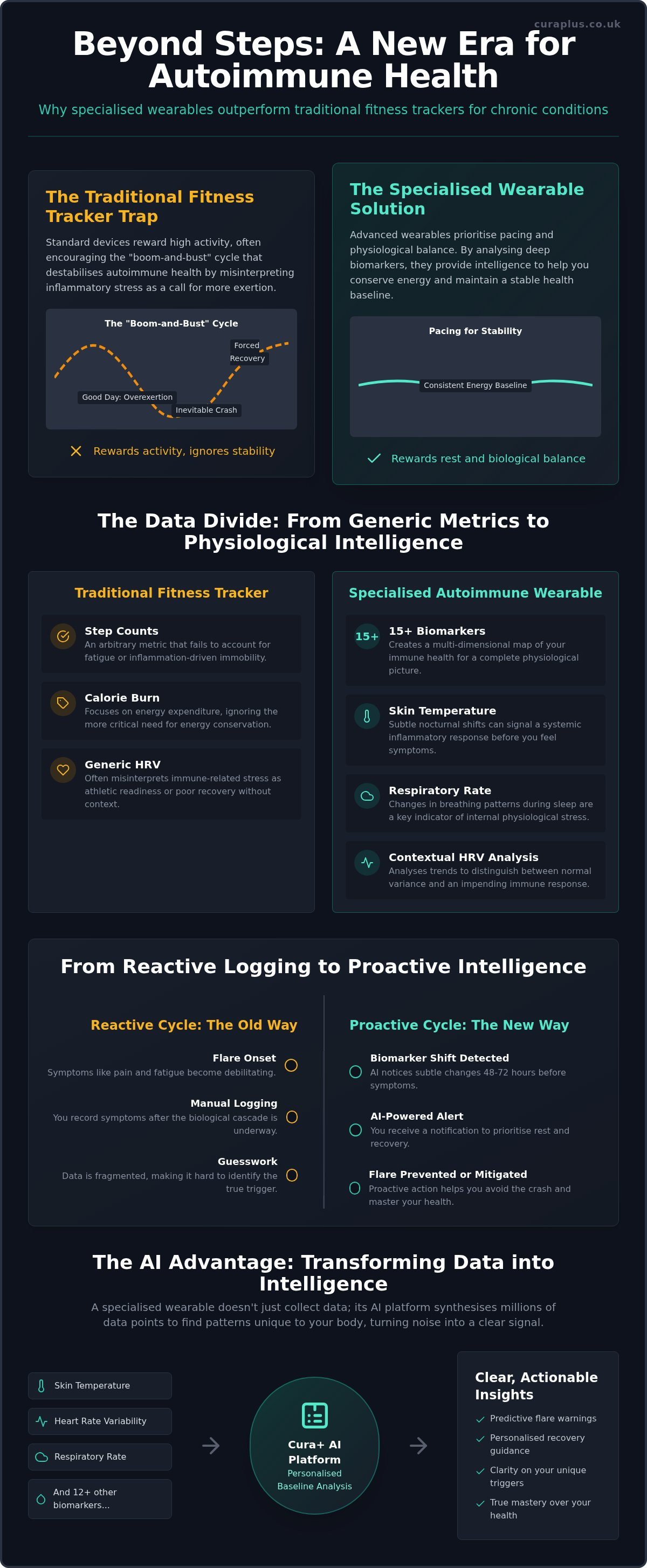
The standard consumer fitness tracker is built on a fundamental misunderstanding of the autoimmune body. Most devices are engineered for the "healthy" user whose primary goal is physical exertion and caloric deficit. For those seeking a wearable for tracking autoimmune symptoms UK markets offer, this athletic bias is not just unhelpful; it's potentially damaging. When a device nudges you to "close your rings" whilst your body is fighting a systemic inflammatory surge, it ignores the biological reality of fatigue and prioritises arbitrary movement over actual wellness.
This discrepancy is most evident in the "Heart Rate Variability (HRV) Paradox". In elite sports, a high HRV usually indicates readiness for strain. However, in the context of chronic illness, an unusually high or low HRV can signal an overactive immune response or autonomic dysfunction. Traditional trackers often miss these nuances, providing reactive data that merely records a flare once the exhaustion has already set in. Proactive monitoring requires a shift in focus toward biomarkers that generic sensors ignore, such as subtle nocturnal skin temperature shifts and changes in respiratory rate, which often precede a symptomatic flare by 48 to 72 hours.
Why Step Counts and Calories Miss the Mark
The "boom-and-bust" cycle is the primary enemy of autoimmune stability. Traditional wearables exacerbate this by rewarding high activity levels, often leading users to overexert themselves on "good" days, which inevitably triggers a multi-day crash. There's a profound psychological weight to constantly "failing" fitness goals that were never designed for a body in crisis. A sophisticated wearable technology solution must instead prioritise pacing and recovery, rewarding the user for the discipline of rest rather than the frequency of steps. It's about mastering the art of energy conservation, not just burning it.
The Need for Clinical Precision in Daily Monitoring
Consumer-grade sensors are often sufficient for counting steps, but they lack the high-fidelity resolution required for autoimmune intelligence. We must move beyond "fitness data" toward "physiological intelligence", where every data point is viewed as a signal of systemic health. Precision is non-negotiable when tracking the 15+ biomarkers necessary to map an individual's unique baseline. In the context of UK healthcare standards, proactive health intelligence is defined as the continuous, data-driven anticipation of physiological shifts to prevent symptomatic flares before they occur.
Biomarker Tracking: The Science of Predictive Symptom Management
Traditional symptom management is fundamentally retrospective. By the time you record a flare in a journal, the biological cascade is already well underway. Shifting to a wearable for tracking autoimmune symptoms UK patients use for predictive intelligence changes the narrative. By monitoring 15+ biomarkers simultaneously, we move from observing symptoms to observing the immune system's precursors. This transition allows for a level of clarity that manual logging simply cannot match. For a deeper technical exploration, consult our guide on biometric tracking for wellness.
Skin temperature and respiratory rate are particularly revealing indicators of internal stress. A subtle, sustained rise in nocturnal skin temperature often signals a systemic inflammatory response before joint pain or fatigue becomes debilitating. AI algorithms process these deviations from your unique baseline, identifying patterns that are invisible to the naked eye. This multi-dimensional view is essential; no single metric tells the full story of your immune health. It's the synthesis of these data points that transforms raw numbers into actionable intelligence.
The Role of HRV in Autonomic Nervous System Balance
Heart Rate Variability (HRV) serves as a primary indicator of your body's stress and recovery state. It measures the variation in time between each heartbeat, reflecting the balance between your sympathetic and parasympathetic nervous systems. A declining HRV trend over several days is a significant warning sign; it often precedes an autoimmune flare by 24 to 48 hours. When you observe this downward trend, it's a signal to prioritise aggressive recovery protocols. Interpreting this data requires context; a single low reading might just be a poor night's sleep, but a consistent trend indicates your body is struggling to maintain homeostasis.
Beyond the Surface: Monitoring 15+ Vital Signs
True predictive power comes from the synthesis of multiple data points. Metrics such as blood oxygen saturation, sleep architecture, and resting heart rate interlock to create a "digital twin" of your physiological state. Sleep architecture provides a window into your body's repair mechanisms; when inflammation rises, deep sleep often decreases, even if total sleep duration remains unchanged. Research into wearables for remote monitoring highlights how continuous, 24/7 data collection is vital for accuracy. This level of insight is why choosing a specialised wearable for tracking autoimmune symptoms UK users can trust is a strategic decision for long-term health. Tools like theBand integrate with the Cura+ AI Platform to provide real-time insights that help you regain the control that chronic illness often takes away.
Manual Logs vs. AI-Driven Wearables: A Comparison Framework
The transition from manual journals to AI-driven systems represents a fundamental shift in how we understand chronic illness. Whilst analogue logs have served as a baseline for decades, they are inherently limited by the human element. A wearable for tracking autoimmune symptoms UK users can integrate into their daily lives removes the burden of constant self-observation. Objective sensor data provides an unblinking account of your physiology, capturing the subtle fluctuations that occur whilst you sleep, work, or rest. This creates a continuous stream of evidence that manual entries, which are often subjective and retrospective, simply cannot replicate.
User fatigue is a significant barrier to effective symptom tracking. It's common for individuals to stop logging during the very moments they are experiencing a flare, as the cognitive load of manual entry becomes too high. This results in critical data gaps at the most vital times. In contrast, an AI-driven wearable maintains its vigilance regardless of your energy levels. By utilising AI-assisted biomarker detection, these devices can identify complex correlations that remain invisible to the human eye. For instance, an algorithm might detect a relationship between local air quality fluctuations and a decline in your sleep efficiency, providing a level of environmental insight that a paper journal never could.
Overcoming the Subjectivity of Manual Journals
Memory bias is a persistent challenge in autoimmune care. When asked to recall the severity of a symptom from three weeks ago, our brains often reshape the memory based on how we feel in the present moment. Having a record of hard data allows you to present a clear, chronological narrative to medical professionals in the UK. This transition to objective metrics is why high-fidelity data is the favourite tool of modern rheumatologists seeking to optimise treatment plans. It replaces "I think I felt worse" with "My HRV dropped by 15% whilst my resting heart rate increased."
AI Analysis: Finding the Signal in the Noise
The true power of modern technology lies in the processing of information. An AI health and wellness coach processes thousands of distinct data points every hour, searching for the "signal" of an impending flare amongst the "noise" of daily life. This capability enables predictive alerts, which are fundamentally different from simple notifications. Whilst a notification might tell you that your heart rate is high, a predictive alert synthesises multiple biomarkers to warn you that your body is entering a state of high inflammatory risk. This allows for immediate lifestyle adjustments, such as increasing rest or refining your nutrition, before the physical symptoms fully manifest.
Building a Personal Baseline for Autoimmune Wellness
In the context of autoimmune management, the term "normal" is often a misnomer. Clinical averages based on healthy populations rarely apply to a body experiencing chronic inflammation. To achieve true physiological intelligence, you must first define your own unique baseline. This is where a specialised wearable for tracking autoimmune symptoms UK residents use for long-term health mastery becomes indispensable. By understanding how to build a health baseline, you transition from comparing yourself to others to comparing yourself against your own optimal state.
A baseline is not a static number; it is a dynamic range of 15+ biomarkers that reflects your body's equilibrium. When your device detects a deviation from this range, it provides an early warning system that precedes physical discomfort. This allows you to make informed decisions about your daily activity levels, ensuring you don't overextend your biological resources during a period of vulnerability. It's about moving away from "boom-and-bust" cycles and toward a steady, data-driven state of wellness.
The Calibration Phase: Teaching the AI Your Body
The first two weeks of wearing theBand are critical. This 14-day calibration period allows the Cura+ AI Platform to map your circadian rhythms, heart rate patterns, and respiratory fluctuations. During this phase, maintaining your usual behaviour is essential. The AI needs to see your typical "good" and "bad" days to learn the difference between a deliberate workout and a physiological stress event triggered by an immune response. This methodical learning process ensures that the alerts you receive are accurate and tailored specifically to your biology, providing a reliable foundation for future health decisions.
Responding to Deviations: Practical Pacing Strategies
Once your baseline is established, theBand acts as a sophisticated guide for energy budgeting. When the device signals that your biomarkers are trending outside your healthy range, it's a prompt for "aggressive rest." This isn't just about taking it easy; it's a strategic intervention to prevent a full-scale flare. By using metrics like "PacePoints," you can budget your energy throughout the day with clinical precision. If your biomarkers suggest a high inflammatory load, you can proactively reduce your commitments, effectively flattening the curve of a potential flare. Explore how theBand provides the precision needed for effective pacing.
theBand by Cura+: Transforming Data into Autoimmune Intelligence
theBand represents the culmination of years of physiological research and AI refinement. It stands as the definitive wearable for tracking autoimmune symptoms UK patients can use to reclaim their autonomy. By synthesising 15+ distinct biomarkers in real-time, this system moves beyond the limitations of manual logging and generic fitness data. The synergy between the high-fidelity hardware and the Cura+ AI Platform creates a continuous feedback loop of health intelligence, allowing you to anticipate flares before they disrupt your life.
Predictive alerts offer a profound shift in the emotional landscape of chronic illness. For many, the constant unpredictability of autoimmune conditions is a primary source of anxiety, affecting not just the individual but their families as well. Having access to data-driven warnings provides a sense of calm control. It allows you to plan social engagements and professional commitments with a new level of confidence. Joining our pre-launch phase is the first step toward this proactive future; it's an invitation to be at the forefront of the medicalisation of consumer wearables.
Designed for Elegance and Clinical Utility
Discreet and sophisticated, theBand is engineered for 24/7 wear. Its aesthetic is suitable for professional settings and social events alike, ensuring that your health monitoring remains a private, seamless part of your lifestyle. We've prioritised medical-grade sensors to guarantee the superior accuracy required for autoimmune tracking; consumer-grade alternatives simply don't provide the resolution needed for clinical-level insights. To support this ongoing journey, our recurring subscription model ensures you always have access to the latest AI updates and health coaching. This ensures your data remains relevant as new patterns in your biology are discovered over time.
Your Partner in Longevity and Flare Prevention
Living with an autoimmune condition shouldn't mean settling for a life defined by limitations. theBand is designed to help you achieve your biological peak by providing the clarity needed to master your internal systems. It's about transforming a complex array of symptoms into a manageable health narrative. By utilising predictive health wearable UK technology, you can transition from reactive symptom management to a strategy of total health mastery. Explore theBand and secure your proactive health future.
Mastering Your Health Narrative Through Data
The transition from reactive symptom logging to proactive predictive intelligence marks a fundamental shift in autoimmune care. By moving beyond the limitations of generic fitness trackers and prioritising the monitoring of 15+ distinct biomarkers, you gain the clarity needed to anticipate flares before they manifest. Establishing a personal baseline allows for a level of precision that population averages simply cannot provide. As UK-based AI health pioneers, we've designed a discreet, 24/7 wearable for tracking autoimmune symptoms UK residents can rely on for daily health mastery.
The future of your wellness is no longer a matter of guesswork; it's a data-driven strategy built on clinical accuracy and sophisticated AI analysis. theBand provides the high-fidelity resolution required to identify subtle physiological shifts, ensuring you remain in control of your journey toward self-optimisation. Secure your position for theBand launch and transform your health intelligence. You possess the tools to move from uncertainty to clarity, and the journey toward your biological peak begins today.
Frequently Asked Questions
Can a wearable actually predict an autoimmune flare-up?
A wearable can identify the physiological precursors to a flare-up by detecting subtle deviations in your unique baseline. Whilst it doesn't offer a clinical diagnosis, theBand monitors shifts in heart rate variability and nocturnal skin temperature that often precede physical symptoms. This data-driven approach allows you to implement recovery strategies before a full-scale flare manifests, moving your health management from reactive guesswork to proactive intelligence.
How is theBand different from a standard smartwatch or fitness tracker?
Unlike standard smartwatches that prioritise step counts and calories, theBand is a specialised wearable for tracking autoimmune symptoms UK patients use for clinical-grade precision. It monitors 15+ biomarkers simultaneously, including respiratory rate and sleep architecture, providing high-fidelity data that generic fitness trackers ignore. The integration with the Cura+ AI platform ensures that these metrics are synthesised into actionable health intelligence rather than just raw activity numbers.
Which biomarkers are most important for tracking autoimmune conditions?
Heart rate variability (HRV) and nocturnal skin temperature are the most critical biomarkers for anticipating inflammatory events. HRV reflects autonomic nervous system balance, whilst skin temperature shifts can signal systemic stress or impending inflammation. Other vital metrics include respiratory rate, blood oxygen levels, and deep sleep duration. Monitoring these interlocked vitals provides a multi-dimensional view of your immune system's current state and overall resilience.
Is my health data secure on the Cura+ AI platform?
We prioritise data security with the same rigour we apply to biological accuracy. The Cura+ AI platform utilises advanced encryption and complies with UK data protection regulations to ensure your personal health metrics remain private and secure. Your data is used exclusively to refine your personal health baseline and provide tailored alerts. We view your information as a vital asset in your high-stakes journey toward self-optimisation.
Do I need a medical referral to use a health wearable in the UK?
You don't require a medical referral to purchase or use theBand in the United Kingdom. It is designed as a sophisticated health optimisation tool rather than a clinical diagnostic device. However, the data it provides is of such high quality that many users find it helpful to discuss their trends with their healthcare providers. Always ensure your device meets relevant UK standards for wellness technology and data privacy.
How long does it take to establish a reliable health baseline?
Establishing a reliable health baseline requires a 14-day calibration period. During this initial two-week phase, the Cura+ AI learns your body's unique circadian rhythms and physiological norms. It's essential to maintain your typical behaviours during this time so the system can accurately distinguish between standard daily variance and the subtle deviations that might signal an impending autoimmune flare-up or a period of systemic stress.
Can I share my wearable data with my GP or rheumatologist?
Yes, sharing your objective biomarker data can significantly enhance your consultations with a GP or rheumatologist. Providing a chronological record of HRV trends and sleep architecture replaces subjective memory with hard evidence. This clarity helps medical professionals understand your condition's trajectory between appointments. Using a wearable for tracking autoimmune symptoms UK clinicians can review allows for more informed discussions regarding your long-term treatment and lifestyle management.
What happens if the wearable detects a significant change in my biomarkers?
If the system detects a significant deviation from your baseline, it triggers a predictive alert through the Cura+ AI platform. This notification isn't a cause for alarm but a signal for strategic intervention. You'll receive actionable coaching insights, such as suggestions for increased rest or refined pacing strategies. These alerts empower you to make real-time adjustments to your daily schedule, effectively mitigating the impact of a potential flare before it escalates.


