


What if the most sophisticated piece of technology you own isn't your smartphone, but the biological system you inhabit? For many, the current reality of wellness is a cluttered dashboard of heart rate variability and sleep scores that offer more confusion than clarity. You've likely felt the weight of data fatigue, staring at charts whilst wondering how to extract actionable insights from health data that actually move the needle on your longevity.
It's frustrating to possess a wealth of biometric information yet still feel anxious about a sudden dip in energy or a potential illness. We understand that metrics are only valuable when they lead to mastery. In this guide, you'll discover how to transform raw biometric signals into a precise, life-changing framework for long-term health optimisation. We'll examine the shift from retrospective tracking to predictive intelligence, showing you how theBand and the Cura+ AI Platform provide the early warnings and personalised adjustments necessary to stay ahead of the curve.
Key Takeaways
- Identify the "Actionability Gap" to distinguish between retrospective metrics and the prescriptive intelligence required for genuine physiological transformation.
- Discover how to extract actionable insights from health data by synthesising 15+ key biomarkers into a high-fidelity map of your internal biology.
- Understand why clinical-grade predictive intelligence is essential for moving beyond the surface-level gamification found in standard consumer wearables.
- Master a structured 5-step framework for implementing precise micro-adjustments based on your body's daily signals and scientific evidence.
- Explore how the integration of advanced hardware and AI-driven coaching creates a predictive engine for proactive illness prevention and health optimisation.
Beyond the Numbers: Defining Actionable Insights from Health Data
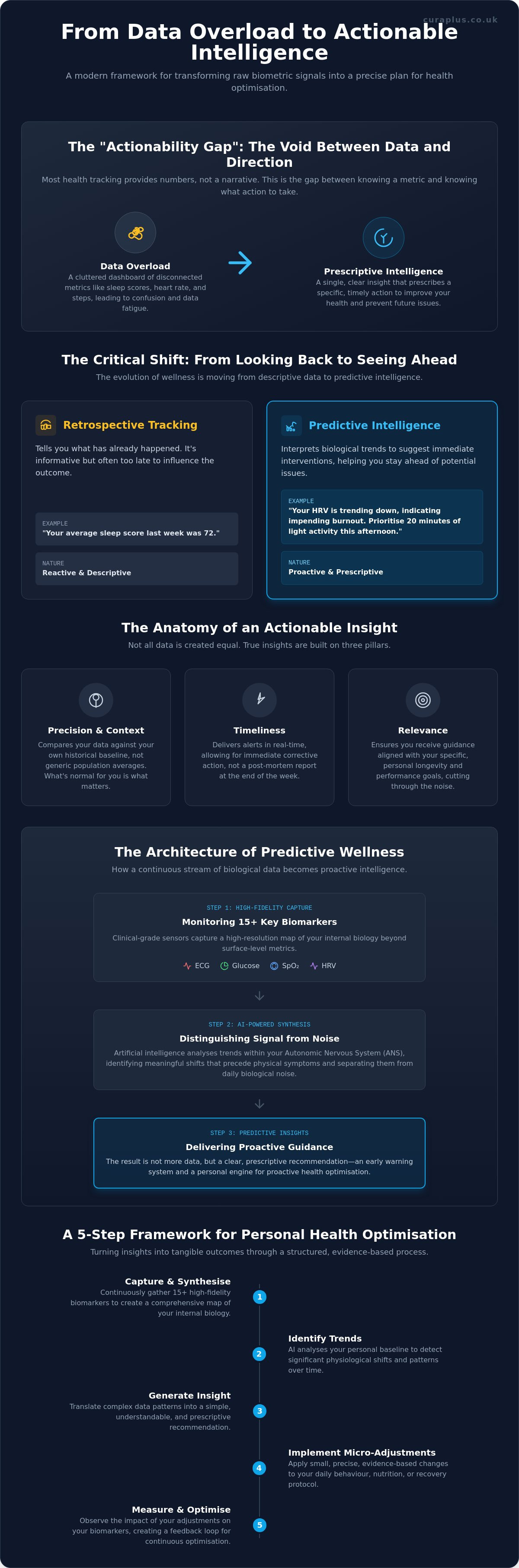
Data is ubiquitous; clarity remains rare. For years, the wellness industry has focused on the accumulation of metrics, yet we've reached a saturation point where more data no longer equates to better health. This phenomenon has created what we define as the "Actionability Gap." It's the psychological and practical void between knowing a specific biometric value and understanding exactly which behaviour to change to improve it. True actionable insights from health data don't just describe your current state; they prescribe your next move.
In the evolving landscape of 2026, the standard for personal wellness has shifted from descriptive tracking to predictive intelligence. Descriptive data tells you what happened, such as how many calories you burned yesterday. Whilst this is informative, it's retrospective and often too late to influence outcomes. Prescriptive insights, powered by sophisticated Health care analytics, interpret your biological trends to suggest immediate interventions. Instead of simply reporting a low sleep score, a predictive system identifies the physiological markers of impending burnout and advises a specific recovery protocol before your performance suffers.
Artificial intelligence serves as the essential filter in this process. Your body produces an immense amount of biological noise daily. AI distinguishes between a temporary spike in heart rate due to a morning coffee and a sustained elevation that signals systemic inflammation. By isolating significant trends from statistical noise, technology transforms a chaotic dashboard into a streamlined path toward optimisation.
The Anatomy of an Actionable Insight
Precision requires context. A resting heart rate of 60 bpm might indicate peak cardiovascular fitness for a sedentary individual, yet for an elite endurance athlete, it could signal significant overtraining or illness. Actionable intelligence relies on contextualisation, comparing your data against your own historical baseline rather than generic population averages. Timeliness is equally critical. A retrospective report delivered at the end of the week is a post-mortem; a real-time alert regarding a blood glucose spike allows for immediate corrective action, such as a brief walk to stabilise your levels. Finally, relevance ensures you aren't buried under notifications that don't align with your specific longevity goals.
Why Raw Data Often Fails the User
The industry faces a persistent challenge: data fatigue. Statistics suggest a significant percentage of users abandon traditional wearables within 90 days because the devices provide numbers without narrative. Most consumer-grade trackers lack the clinical-grade precision required to offer meaningful guidance, often gamifying movement whilst ignoring deeper metabolic signals. When you view biomarkers in isolation, such as looking at step counts without considering heart rate variability or oxygen saturation, you risk misinterpreting your body's needs. True actionable insights from health data require a holistic perspective where every signal is understood as part of a complex, interconnected system.
The Architecture of Predictive Wellness: How Data Becomes Intelligence
Transforming a stream of numbers into actionable insights from health data requires more than a simple sensor. It demands a sophisticated engine capable of high-fidelity capture and real-time synthesis. In the current landscape, a predictive health wearable UK acts as this essential engine, serving as a continuous bridge between your internal biology and your conscious decisions. By monitoring over 15 distinct biomarkers, such as continuous glucose, ECG, and blood oxygen saturation, these devices move beyond the reactive model of healthcare. They identify physiological signatures that precede physical symptoms, allowing for a proactive stance against illness and fatigue.
The primary source for this intelligence is the Autonomic Nervous System (ANS). Your ANS is the command centre for your body's stress and recovery responses, often reacting to internal shifts hours or even days before you feel "unwell." By prioritising ANS signals like Heart Rate Variability (HRV), the system identifies subtle metabolic shifts that standard trackers overlook. This transition from monitoring surface-level metrics to deep physiological signatures is what separates clinical-grade intelligence from mere gamification. Much like the Health Information Exchange infrastructure facilitates seamless data sharing in clinical settings, a predictive wearable creates a unified internal map of your health, ensuring no signal is interpreted in a vacuum.
Establishing Your Physiological Baseline
A metric is meaningless without a point of reference. Your "unique normal" is the foundation of predictive wellness; it's the statistical baseline of your body in a state of equilibrium. You can learn how to build a health baseline through consistent, high-fidelity monitoring over a period of 14 to 21 days. Once this baseline is established, the focus shifts from absolute numbers to deviations. A resting heart rate that is five beats per minute above your personal average is a significant warning sign, even if it falls within the "normal" range for the general population. This personalised context is the catalyst for generating actionable insights from health data that are truly relevant to your biology.
The Role of Multi-Sensor Integration
Reliability in health tracking stems from cross-referencing biomarkers. When the Cura+ AI Platform detects a drop in HRV, it doesn't immediately alert you to stress; instead, it looks for corroborating evidence. It checks for a rise in skin temperature and a dip in blood oxygen levels. If all three markers deviate simultaneously, the system identifies a likely immune response. This multi-sensor approach eliminates the false positives that lead to data anxiety, providing you with a clear, confident directive for your day. If you're ready to move beyond the noise of traditional trackers, exploring a data-driven approach can provide the clarity your health journey deserves.
Deciphering the Signal: Why Most Wearables Provide Noise, Not Clarity
"Why is my current smartwatch not enough?" This is the most common question we encounter when discussing the evolution of biometric tracking. The answer lies in the fundamental distinction between a consumer gadget and a clinical-grade instrument. Most commercial devices are designed for mass-market appeal, prioritising gamification over deep physiological understanding. Whilst closing "activity rings" or earning digital badges can encourage movement, these features often lack the fidelity required to generate actionable insights from health data. A fitness tracker acts as a diary of where you've been; a future of personal health device serves as a diagnostic engine for where you're going.
One of the most critical technical differences is the data sampling rate. To preserve battery life, many smartwatches only measure heart rate or oxygen saturation every few minutes. This low-frequency approach captures mere snapshots, providing a fragmented view of your biology. To detect the subtle flickers of a nervous system under strain, you need high-frequency monitoring that captures data points multiple times per second. Without this resolution, the most important biological signals are lost amongst the noise of daily life. Precision requires a continuous, high-fidelity stream of information to identify the metabolic shifts that actually matter.
The Actionability Gap in Commercial Wearables
Sleep scores are a prime example of the actionability gap. Being told you had a "62/100" sleep score upon waking is merely descriptive. It's a post-mortem of a night you can't change. It doesn't tell you how to fix the underlying issue. True intelligence would correlate that score with your evening meal time, alcohol consumption, or room temperature to provide a specific directive for the following night. Similarly, generic "Move" reminders are often counterproductive. If your body is currently fighting a viral load or recovering from intense strain, a command to stand up and exercise ignores your physiological readiness. High-register precision tools respect these nuances, offering guidance that aligns with your body's current capacity.
Predictive Alerts vs. Passive Monitoring
Passive monitoring records history. Predictive alerts write the future. By utilising a wearable for tracking stress patterns, you can identify the precise moment your autonomic nervous system begins to deviate from its baseline. This allows the Cura+ AI Platform to flag a potential viral onset or a burnout event up to 48 hours before you feel a single physical symptom. We're moving away from the retrospective question of "What happened?" and toward the proactive certainty of "What is about to happen?" This shift transforms actionable insights from health data from a luxury into a fundamental tool for maintaining peak performance and long-term wellness.
Turning Insights into Outcomes: A Framework for Personal Health Optimisation
Possessing a high-fidelity data stream is only the first stage of the journey. To achieve genuine physiological transformation, you must move from observation to execution. Transforming these signals into actionable insights from health data requires a methodical framework designed to filter out the trivial and highlight the vital. We utilise a "Micro-Adjustment" strategy; this involves making small, evidence-based changes to your daily behaviour that compound into significant long-term gains. This structured approach replaces the anxiety of the unknown with a sense of calm control. Decisions are no longer guesses. They are strategic responses to your body's internal requirements.
Step 1: Metric Identification and Baseline Comparison
The process begins by identifying which specific biomarker is currently trending away from your established norm. You must determine if this shift is acute, such as a single night of poor sleep, or chronic, indicating a sustained downward trend in your recovery capacity. A baseline is a dynamic physiological signature that represents your body's unique state of equilibrium over time. By comparing today's data against this signature, you can immediately spot deviations that require attention before they manifest as physical symptoms or performance plateaus.
Step 2: Environmental and Behavioural Correlation
Once a deviation is identified, the next step is to uncover the "why." You must cross-reference your biometric data with recent lifestyle factors. Did you consume alcohol or a late meal? Have you recently travelled across time zones or increased your training volume? Using the Cura+ dashboard, you can visualise these correlations effortlessly, seeing exactly how specific triggers impact your physiology. This step is essential for identifying the root cause of a shift rather than merely reacting to the symptom. Understanding these patterns allows you to predict how future choices will influence your health trajectory.
Step 3: Execute Targeted Intervention
Action must be precise to be effective. If your Heart Rate Variability (HRV) is significantly suppressed, the most impactful intervention might be a dedicated breathwork session, an earlier bedtime, or a reduction in exercise intensity for the day. Conversely, if you observe an elevated skin temperature, your protocol should pivot toward aggressive hydration and immune system support. The key is to execute one single, high-impact action rather than attempting multiple vague lifestyle changes. By focusing on actionable insights from health data, you eliminate the friction of decision fatigue and ensure your energy is directed where it is most needed. If you are ready to master your body's unique signals, you can begin your optimisation journey with Cura+ to turn raw data into a definitive plan of action.
theBand by Cura+: Your Personal Engine for Proactive Health Intelligence
The transition from tracking to transformation requires a hardware solution capable of clinical-grade precision. theBand by Cura+ is engineered to be that solution, acting as a high-fidelity gateway to your internal biology. Whilst standard wearables offer a fragmented glimpse into your activity, theBand provides a comprehensive map by monitoring over 15 key biomarkers simultaneously. This continuous stream of data is then processed by the Cura+ AI Platform, which serves as a sophisticated consultant for your body. It doesn't just present you with numbers; it synthesises actionable insights from health data into what we call "Health Coaching" moments.
This platform represents a visionary shift in personal wellness. It acts as a strategist that is always present, anticipating your body's needs before they become demands. We've built this system with an unwavering commitment to data privacy, adhering to the highest British clinical standards. Your biological information is treated with the gravity it deserves, ensuring that your journey toward self-optimisation is both secure and scientifically rigorous. By bridging the gap between complex technology and daily life, we empower you to take command of your longevity with absolute confidence. Uncertainty is replaced by clarity.
Sophisticated Sensors, Simplified Actions
theBand tracks a diverse array of metrics, including continuous ECG, Heart Rate Variability, and blood oxygen saturation. However, the true power of the device lies in its ability to simplify this complexity. You won't spend your time deciphering convoluted graphs or conflicting signals. Instead, the Cura+ AI Platform translates these 15+ biomarkers into assertive, easy-to-follow lifestyle recommendations. Whether it's a suggestion to adjust your hydration or a directive to prioritise immediate recovery, the advice is always personalised to your unique baseline. It's like having a high-level health consultant on your wrist, providing the clarity needed to make every decision count.
The Future of Preventative Health in the UK
We're currently in a transformative pre-launch phase, inviting a select group of forward-thinking individuals to join a visionary UK health technology movement. theBand is not merely a device; it's a commitment to reaching your "Biological Peak" through daily, data-driven refinement. By leveraging actionable insights from health data, you can identify viral onsets or stress patterns long before they impact your quality of life. The era of health guesswork is over. It's time to replace doubt with the methodical reliability of predictive intelligence. Take the first step toward mastery and ensure your future health is shaped by design, not by chance.
Mastering Your Biological Future through Predictive Intelligence
The path to lasting wellness lies in the transition from passive monitoring to proactive mastery. True health optimisation relies on high-fidelity sensors and a rigorous framework of daily micro-adjustments. By bridging the actionability gap, you move beyond the noise of traditional trackers and into a state of physiological clarity. It's no longer enough to know what happened yesterday. You must understand exactly what your body requires for tomorrow.
The integration of actionable insights from health data ensures that your lifestyle adjustments are always precise and scientifically sound. Developed by UK-based health technology specialists, theBand monitors 15+ biomarkers simultaneously to provide an uncompromising view of your internal biology. Through AI-driven predictive health alerts, you gain the foresight needed to intercept illness and optimise recovery before symptoms even appear. You have the power to replace uncertainty with the calm control of data-driven intelligence.
Discover the future of proactive health with theBand by Cura+
Frequently Asked Questions
What exactly makes health data "actionable" for the average person?
Health data becomes actionable when it provides a specific, prescriptive directive rather than a simple descriptive metric. For example, instead of merely reporting a low sleep score, the system suggests a precise adjustment to your evening behaviour or environment. This transition into actionable insights from health data removes the cognitive burden of interpretation, allowing you to focus entirely on the execution of health-optimising habits.
Can a wearable really predict illness before I feel any symptoms?
Predictive wearables identify viral onset and physiological strain by monitoring subtle deviations in your autonomic nervous system. The Cura+ AI Platform flags shifts in biomarkers like skin temperature and heart rate variability that often occur 24 to 48 hours before you feel unwell. This early warning system allows you to proactively adjust your hydration, sleep, or training volume to intercept a potential illness before it takes hold.
How many biomarkers do I need to track to get accurate health insights?
Accurate intelligence requires the simultaneous tracking of at least 15 distinct biomarkers to create a high-fidelity health map. Monitoring a single metric in isolation, such as heart rate, often leads to false positives and data noise. theBand captures a comprehensive suite of signals, including ECG and oxygen saturation, ensuring that every insight is verified through multi-sensor cross-referencing for the highest level of clinical-grade precision.
Is my biometric data secure when using AI-driven health platforms?
Your biometric data is protected by the most rigorous British clinical standards and advanced encryption protocols. We treat your personal health information as a high-stakes asset, ensuring it remains secure whilst being processed by the Cura+ AI Platform. This commitment to privacy allows you to engage with predictive technology confidently, knowing that your biological signature is handled with methodical reliability and absolute confidentiality.
What is the difference between a health baseline and a standard average?
A health baseline represents your body's unique physiological normal, whereas a standard average is a generic population statistic. Population averages are often misleading because they don't account for your specific age, fitness level, or metabolic rate. By establishing a personal baseline, the system can identify deviations that are meaningful to you specifically. This personalised context is essential for extracting actionable insights from health data.
How do actionable insights help with stress management and burnout?
These insights identify the physiological signatures of stress before they manifest as chronic exhaustion or burnout. By tracking the balance between your sympathetic and parasympathetic nervous systems, the system detects when your recovery capacity is compromised. You receive immediate, targeted recommendations for breathwork or rest, allowing you to master your body's stress response and maintain peak cognitive and physical performance throughout the week.
Do I need a medical background to understand the insights from theBand?
No medical expertise is required because the platform translates sophisticated biological signals into simple, assertive directives. Whilst theBand captures clinical-grade data, the Cura+ AI Platform acts as a sophisticated guide that explains exactly what your body needs. You receive clear instructions on lifestyle adjustments, such as modifying your training intensity or sleep schedule, ensuring that the path to optimisation is always accessible and intuitive.
How long does it take for AI to learn my body’s unique patterns?
The AI typically requires an initial period of 14 to 21 days to establish an accurate physiological baseline. During this phase, the system identifies your unique circadian rhythms and how your biomarkers respond to daily lifestyle triggers. Once this "unique normal" is established, the platform becomes increasingly precise at identifying subtle deviations, providing you with the predictive intelligence needed for long-term health mastery.


