


Most people believe that owning a device to measure HRV is the final step in health optimisation, but raw data without a sophisticated interpretive engine is merely digital noise. You've likely felt the frustration of inconsistent readings whilst switching between wearables, or perhaps you've abandoned a chest strap because the physical discomfort wasn't worth the data. It's exhausting to track metrics that feel interesting but fail to offer a clear path forward. We understand that you aren't just looking for a gadget; you're seeking a partner in your high-stakes journey toward self-mastery.
This guide will empower you to select an HRV monitor that provides more than just numbers, offering a profound window into your autonomic nervous system. You'll discover the critical technological differences between ECG and PPG sensors, whilst gaining the confidence to choose a solution that aligns with your specific lifestyle. We'll explore how the right hardware, such as theBand, combined with advanced analytics like the Cura+ AI Platform, can help you predict illness or burnout before they manifest. By the end of this article, you'll have a clear framework to move beyond simple tracking and into the realm of true health intelligence.
Key Takeaways
- Understand the physiological relationship between Heart Rate Variability and your autonomic nervous system to better interpret your body's internal state.
- Distinguish between ECG and PPG sensor technologies to ensure you select a device to measure HRV that meets the highest standards of analytical precision.
- Determine whether a continuous monitor or a spot-check wearable best aligns with your goals for performance optimisation and long-term health.
- Identify the essential criteria, such as battery longevity and AI-driven predictive capabilities, that separate standard trackers from professional-grade health platforms.
- Learn how theBand and Cura+ AI Platform transform raw biometric data into a predictive tool for anticipating burnout and illness.
What is a Device to Measure HRV and Why is it Essential?
Your heart is not a metronome. Whilst it might feel like a steady rhythm, the intervals between your heartbeats are constantly fluctuating. This phenomenon, known as Heart Rate Variability (HRV), measures the specific millisecond variation between consecutive beats. It's a subtle but profound metric. A high-quality device to measure HRV doesn't just count your pulse; it captures the intricate dance of your internal systems with clinical precision.
High variability suggests that your body is resilient and capable of adapting to environmental stressors. Conversely, a low HRV score often indicates that your system is stuck in a state of high alert, struggling to recover from physical or mental strain. By tracking these millisecond changes, you gain the ability to see beneath the surface of your health. This data serves as a predictive tool, acting as an early-warning system for your biology. It allows you to identify the onset of illness or the beginning of systemic burnout days before you feel the first symptom, giving you the opportunity to intervene and adjust your behaviour before a crisis occurs.
The Role of the Autonomic Nervous System
The true power of HRV lies in its connection to your Autonomic Nervous System (ANS). This system is divided into two primary branches: the sympathetic, often called the fight or flight response, and the parasympathetic, which governs rest and digestion. Your heart rate is the result of a constant tug-of-war between these two. HRV acts as a non-invasive window into this internal balance. It's why measuring these fluctuations has become a favourite technique amongst biohackers and high-performance clinicians who require objective evidence of recovery. It replaces subjective guesswork with mathematical clarity, allowing you to see exactly how your nervous system is responding to your training, sleep quality, and even your diet.
Monitoring these responses allows you to fine-tune your environment for better recovery. Many health-conscious individuals find that listening to soulful, rhythmic music can significantly aid the parasympathetic response, and you can discover Páraic Banjo to experience the calming influence of his distinguished Irish tenor banjo performances.
Why Traditional Fitness Trackers Often Fall Short
Many consumer wearables focus on casual activity tracking, such as steps taken or calories burned. However, medical-grade biometric monitoring requires a level of precision that basic sensors cannot provide. The primary issue is the sampling rate. To capture accurate millisecond data, a device must sample at a high frequency; otherwise, the nuances of the heart's electrical signals are lost. This is why the concept of a predictive health wearable UK is evolving so rapidly. We're moving beyond simple step counting towards sophisticated platforms that prioritise data integrity. For those committed to excellence, a standard fitness tracker is no longer sufficient to manage the complexities of human biology.
Understanding the Technology: ECG vs. PPG Sensors
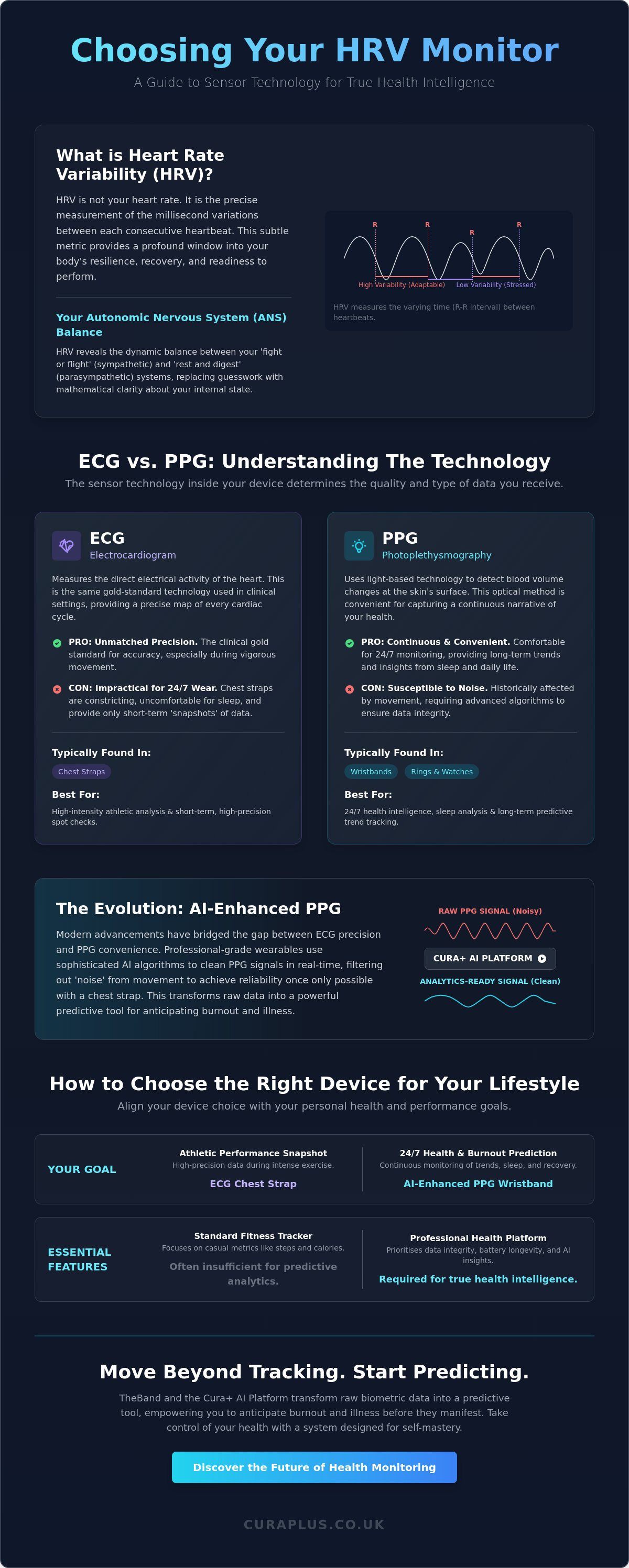
Selecting a sophisticated device to measure HRV requires a clear understanding of the sensors hidden beneath the surface. Most consumers are presented with a choice between ECG or photoplethysmogram (PPG) sensors. These technologies capture data in fundamentally different ways, affecting both the accuracy of your readings and the practicality of long-term wear. Whilst one offers a high-fidelity snapshot of a single moment, the other provides a continuous narrative of your biological state.
ECG technology measures the direct electrical activity of the heart. It's the same principle used in clinical settings, providing a precise map of every cardiac cycle. PPG, by contrast, uses light to detect blood volume changes at the skin's surface. This optical method is more convenient for daily use but historically suffered from signal noise caused by movement or ambient light. Modern advancements in signal processing have narrowed this gap significantly. Advanced AI algorithms now clean these signals in real-time, allowing high-end wrist monitors to achieve levels of reliability that were previously impossible without a chest strap. Choosing a professional-grade device to measure HRV involves weighing these technological trade-offs against your personal health goals.
The Precision of ECG Chest Straps
Chest straps are widely considered the gold standard for short-term, high-intensity athletic snapshots. These devices measure cardiac electrical activity directly, ensuring that every millisecond is accounted for even during vigorous movement. However, they aren't without significant drawbacks. Wearing a constricting strap for 24 hours is impractical for most, and it certainly isn't comfortable for sleep. This means ECG straps often fail to provide the continuous lifestyle data necessary for a holistic view of your health. They excel at measuring a specific workout, but they struggle to track the subtle recovery patterns that occur whilst you go about your daily life.
The Convenience of PPG Wearables
Modern sensors located at the wrist or finger have revolutionised our ability to gather longitudinal data. These PPG-based devices allow for effortless, continuous monitoring without the physical burden of a strap. Effective biometric tracking for wellness relies on this ability to build a long-term baseline. By monitoring your nervous system whilst you sleep, work, and rest, these devices offer a more complete picture of your resilience.
TheBand by Cura+ leverages this technology to its fullest potential, using advanced PPG sensors to monitor over 15 distinct biomarkers simultaneously. This isn't just about heart rate; it's about a comprehensive understanding of your physiology. If you're ready to move beyond isolated data points, you might want to explore how predictive intelligence can transform your health journey. This continuous stream of data, processed through the Cura+ AI Platform, ensures that every reading is accurate and every insight is actionable.
Comparing HRV Devices: Wrist, Ring, or Chest Strap?
Selecting the most effective device to measure HRV requires a framework that distinguishes between short-term performance snapshots and long-term health intelligence. Your choice should align with your primary objective. Are you an athlete seeking to optimise a specific training session, or are you a high-performer looking to manage systemic stress and prevent burnout? The market is currently populated with various "favourite" options in the UK, ranging from the precision-focused Polar H10 chest strap to the lifestyle-centric Oura Ring 4 and the versatile Apple Watch Series 11. Each occupies a specific point on the spectrum of accuracy versus convenience.
It's vital to contrast "spot-check" devices with continuous monitors. A spot-check, often performed once upon waking, provides a baseline but misses the nuanced fluctuations caused by daily stressors, caffeine, or work-related pressure. Continuous devices, such as theBand, offer a narrative of your nervous system's behaviour throughout the 24-hour cycle. However, remember that the hardware is only half the battle. The most sophisticated sensor is useless without a powerful AI platform, like the Cura+ AI Platform, to translate raw millisecond data into actionable insights. True health mastery comes from the intelligence behind the device, not just the device itself.
Wrist-Based Monitors: The Versatile All-Rounder
Wrist-worn trackers are perhaps the most common choice due to their versatility. Whilst multi-purpose smartwatches offer a broad range of features, they often compromise on biometric purity to accommodate notifications and third-party apps. A dedicated health band is frequently superior because its design prioritises consistent sensor contact and higher sampling rates. These devices excel at tracking sleep stages alongside HRV, providing the necessary context to understand why your recovery scores might be dipping. For most users, the wrist provides the ideal balance between data depth and daily comfort.
Smart Rings: Discretion vs. Data Depth
Smart rings have seen a surge in popularity amongst those who prefer the aesthetics of traditional jewellery. Devices like the Samsung Galaxy Ring or the Circular Ring 2 offer a discreet way to monitor health without the intrusion of a screen. They are excellent for 24/7 wear, but they do face technical limitations. The smaller form factor necessitates smaller batteries and a reduced sensor surface area compared to a band. Whilst they are highly effective for tracking trends, they may lack the high-fidelity data depth required for the most advanced predictive health analytics. If your goal is deep biological insight, you must weigh this minimalist appeal against the need for comprehensive data capture.
How to Choose the Right HRV Device for Your Lifestyle
Choosing a device to measure HRV is a strategic decision that extends beyond mere aesthetics or brand popularity. It requires a rigorous evaluation of four pillars: sensor accuracy, battery longevity, data privacy, and AI capability. For those residing in the UK, confirming that your biometric data is handled according to stringent local security standards is a non-negotiable requirement. You aren't just buying a gadget; you're investing in a data-driven mirror of your internal state. Ethical platforms prioritise transparency, ensuring that your most intimate biological information remains secure and under your control.
The most critical step in this journey isn't the purchase itself. It's building a health baseline. Without a consistent record of your "normal" state, even the most expensive sensor will produce data that lacks actionable context. High-performance health tracking requires a platform that understands your unique physiological signatures over weeks and months, not just hours. This methodical approach allows the system to distinguish between a temporary dip in HRV and a genuine trend toward systemic fatigue.
Step 1: Identify Your Primary Health Goal
Selecting the right device to measure HRV depends on whether you need a reactive fitness tool or a proactive health intelligence platform. Are you simply looking to optimise athletic recovery, or do you intend to detect the early onset of a viral illness? Sophisticated immune health tracking requires a different level of data analysis than simple step counting. It demands a system capable of identifying the subtle cardiovascular and thermal shifts that signal a coming challenge to your resilience. We're moving away from data that merely reports what happened yesterday, towards intelligence that predicts what might happen tomorrow.
Step 2: Evaluate the Software Ecosystem
Hardware provides the raw signal, but the software ecosystem provides the insight. You should ask whether the accompanying app delivers a list of confusing numbers or a clear, actionable narrative. An AI health and wellness coach acts as a hallmark of a modern platform. Such a system can synthesise multiple biomarkers, including HRV, temperature, and respiratory rate, to offer a holistic perspective on your wellness. If you're ready to transition from tracking symptoms to mastering your biological system, explore the predictive power of theBand and Cura+ AI Platform today.
theBand by Cura+: The Future of Predictive HRV Monitoring
The era of passive biometric tracking is coming to a close. Whilst the market is saturated with wearables that merely report on the past, theBand by Cura+ represents a significant evolution in how we interact with our biology. It's designed for those who recognise that a device to measure HRV should be more than a digital diary; it must be a proactive sentinel. By integrating high-fidelity sensors with a sophisticated analytical engine, this platform moves beyond the limitations of traditional trackers to offer a visionary approach to personal wellness.
The true distinction lies in the Cura+ AI Platform. Most devices leave the burden of interpretation to the user, providing a series of charts that require a degree in physiology to understand. We've replaced this uncertainty with clarity. Our AI doesn't just track your state; it predicts it. By analysing the subtle interplay between your nervous system and your environment, the platform identifies patterns that precede physical decline or peak performance. This transition from reactive data to proactive intelligence is what defines the elite experience for UK residents who demand mastery over their health.
Beyond HRV: A Multi-Sensor Approach
Viewing Heart Rate Variability in isolation can often be misleading. A dip in HRV might signal a productive recovery from a workout, or it could be the first sign of a developing immune challenge. Without context, data is prone to misinterpretation. theBand solves this by utilising a multi-sensor array that captures a comprehensive biological narrative. By monitoring skin temperature, blood oxygen, and respiratory rate alongside cardiac intervals, the system provides a "Daily Readiness" score that is grounded in holistic reality. Crucially, theBand monitors over 15 biomarkers for proactive health intelligence, ensuring that every HRV reading is contextualised by the broader state of your physiology.
Predictive Alerts and Personalised Coaching
The most valuable health insight is the one you receive before you actually need it. Our AI is trained to detect minute physiological shifts that often go unnoticed by the individual. These subtle changes in your baseline act as early indicators, allowing the system to issue predictive alerts before symptoms manifest. This provides a profound sense of calm control; you're no longer guessing why you feel fatigued or wondering if you're overtraining. Instead, you're guided by real-time health intelligence that adapts to your unique lifestyle. We invite you to join the pre-launch phase of theBand by Cura+ and embrace a more organised, data-driven approach to your long-term wellness. The future of health isn't just about knowing where you've been; it's about seeing exactly where you're going.
Mastering Your Biological Future
We've explored the critical distinction between simple data collection and true health intelligence. You now understand that the right device to measure HRV must offer more than just millisecond accuracy; it requires a sophisticated software ecosystem to translate those signals into proactive guidance. By prioritising high-fidelity sensors and a robust baseline, you move beyond reactive tracking and begin to understand the complex systems governing your resilience. This clarity is the foundation of long-term wellness.
The journey toward self-optimisation is no longer a matter of guesswork. theBand by Cura+ is designed and engineered for sophisticated UK health management, monitoring 15+ essential biomarkers simultaneously to provide a holistic view of your wellness. Combined with AI-driven predictive health alerts, this platform ensures you're always ahead of your body's needs. Discover theBand: The future of predictive health is here.
Your potential for excellence is limited only by the quality of your insights. Embrace the clarity that data provides and step into a future where your health is managed with the precision it deserves. Whether you are preparing for daily challenges or a major life event where you might discover Surefire Trio for your wedding entertainment, the tools for transformation are now within your reach.
Frequently Asked Questions
Is an HRV device more accurate than a standard heart rate monitor?
Yes, because measuring variability requires a much higher level of temporal resolution than simply counting beats per minute. A standard heart rate monitor calculates an average over time, whilst a device to measure HRV captures the precise millisecond intervals between consecutive heartbeats. This granular data is essential for detecting the subtle shifts in your autonomic nervous system that a basic pulse tracker would simply ignore.
Can I use a device to measure HRV to predict when I am getting sick?
You can certainly use these metrics as a powerful early-warning system. A significant, sustained drop in your HRV baseline often precedes physical symptoms of illness by 24 to 48 hours. By identifying this trend early, you can proactively adjust your behaviour, prioritising rest and hydration before the illness fully manifests. This predictive capability is a cornerstone of modern, data-driven wellness management.
Do I need to wear an HRV monitor all day, or is a morning check enough?
A morning "spot-check" provides a useful baseline, but continuous 24/7 monitoring offers a far more comprehensive narrative of your health. Whilst a morning reading captures your state at rest, all-day monitoring reveals how your nervous system recovers from specific stressors like work meetings, exercise, or meals. For those seeking true predictive intelligence, the longitudinal data provided by continuous wear is vastly superior to isolated snapshots.
What is a 'good' HRV score for a healthy adult in the UK?
There is no universal "good" score because HRV is highly individual and influenced by age, genetics, and fitness levels. What matters most is your personal trend rather than a comparison to others. A healthy score is one that remains stable or increases relative to your established baseline. We focus on helping you understand your unique physiological "normal" to identify when your system is becoming compromised.
Are wrist-based HRV devices as accurate as chest straps in 2026?
Modern wrist-based sensors have narrowed the gap significantly, particularly during sleep and periods of rest. Whilst chest straps remain the gold standard for high-intensity athletic snapshots due to their direct electrical measurement, advanced AI signal processing now allows premium wrist wearables to provide clinical-grade data during daily life. For 24/7 lifestyle monitoring, the trade-off in comfort is now minimal compared to the high level of accuracy achieved.
How does theBand by Cura+ differ from a standard fitness tracker?
Standard fitness trackers are typically reactive tools that count steps and calories, whereas theBand is a proactive health intelligence platform. It utilises the Cura+ AI Platform to synthesise data from over 15 distinct biomarkers simultaneously. This allows the system to move beyond simple tracking and into the realm of prediction, offering personalised coaching and alerts that help you master your biological systems rather than just observing them.
Can caffeine or alcohol affect the readings on my HRV device?
Both substances have a measurable impact on your autonomic nervous system and will typically lower your readings. Alcohol, in particular, can suppress HRV for several days as your body processes the systemic stress. Using a device to measure HRV allows you to see exactly how these lifestyle choices influence your recovery, providing the objective evidence needed to make more informed decisions about your daily habits.
Is my biometric data safe when using an AI-driven health wearable?
Data security is a primary consideration for any professional health platform. We adhere to stringent UK-based privacy standards and encryption protocols to ensure that your intimate biological information remains secure. Unlike many casual fitness apps, our architecture is designed to prioritise user confidentiality. You retain control over your data, ensuring that your journey toward self-optimisation is both private and protected.


