


What if the sudden onset of burnout wasn't actually sudden at all, but a predictable physiological event your body signalled weeks in advance? Learning how to build resilience to stress requires more than just willpower; it requires data. Many high achievers find themselves feeling overwhelmed whilst diligently using "calm" apps, yet they remain unable to quantify if their efforts are actually working. It's a common frustration to feel like you're managing your mental health in the dark, waiting for a crash that feels like it came out of nowhere.
You likely recognise that resilience is a measurable state of autonomic flexibility. In this guide, we'll demonstrate how to quantify and enhance your body's ability to withstand pressure using the latest advancements in biometric intelligence and predictive health. We will explore how tools like theBand and the Cura+ AI Platform decode your body's unique stress signatures. You'll discover how to gain a clear understanding of your physiological limits and receive predictive insights that warn of impending burnout before it compromises your performance.
Key Takeaways
- Recognise resilience as a dynamic biological asset rooted in autonomic nervous system flexibility rather than static mental grit.
- Utilise Heart Rate Variability (HRV) as the gold standard metric for quantifying your physiological readiness and adaptive capacity.
- Learn how to build resilience to stress by establishing a data-driven protocol that aligns your recovery with real-time biometric feedback.
- Bridge the "Resilience Gap" by replacing subjective feelings with predictive insights to prevent burnout before it manifests.
- Leverage the multi-sensor capabilities of theBand to monitor over 15 biomarkers for a comprehensive understanding of your physiological state.
Understanding Resilience as a Biological Asset
Resilience is often mischaracterised as a purely psychological fortress built on willpower. In reality, it is a dynamic biological asset. It represents your body's capacity to maintain internal stability whilst navigating significant external pressure. It is the invisible scaffolding that supports every decision you make and every deadline you meet. For those seeking how to build resilience to stress, the journey begins by shifting focus from the mind to the biology of the Autonomic Nervous System (ANS).
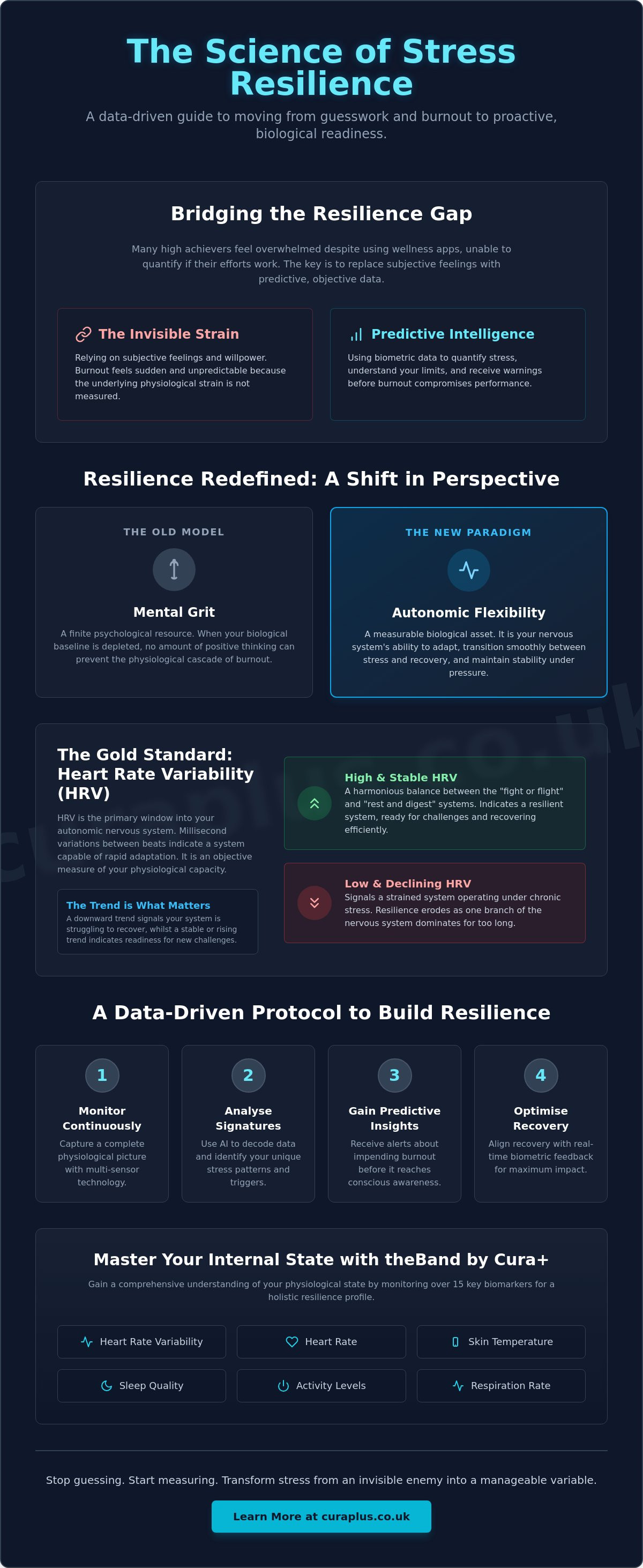
Traditional models of Psychological resilience often emphasise mental grit, yet grit is a finite resource. When your biological baseline is depleted, no amount of positive thinking can prevent the physiological cascade of burnout. True fortitude is found in autonomic flexibility. This represents the ability of your nervous system to transition smoothly between states of high alert and deep recovery, ensuring you remain effective regardless of the environment.
The Shift from Mental Grit to Physiological Readiness
Your internal state dictates how you perceive and react to external challenges. If your body is already burdened by a high "allostatic load", the cumulative wear and tear of chronic stress, even a minor setback can trigger a disproportionate response. Building resilience requires managing this biological load through precision data rather than sheer effort. The high-stakes environment of 2026 demands a shift from reactive coping mechanisms to proactive biological readiness. It is no longer enough to wait for the crash; you must prepare the system in advance.
Identifying Stress Triggers through Biomarker Fluctuations
Stress often manifests in the body long before it reaches conscious awareness. Subtle fluctuations in heart rate and skin temperature serve as early warning signs of an impending shift in your state. By monitoring these trends, you can differentiate between "eustress", the productive stress that drives performance, and "distress", the harmful strain that leads to exhaustion. This distinction is vital for maintaining long-term health and peak cognitive function.
Data allows for a shift toward predictive health. Instead of reacting to a feeling of being overwhelmed, you can track your unique stress signatures. This objective clarity transforms stress from an invisible enemy into a manageable variable. Learning how to build resilience to stress effectively means looking past individual data points to identify the long-term trends that define your health trajectory. This process involves establishing a clear biological baseline, which acts as the foundation for your daily stress threshold and informs your capacity for growth.
The Science of Autonomic Flexibility and HRV
Heart Rate Variability (HRV) serves as the primary window into the state of your autonomic nervous system. Whilst a steady pulse was once the benchmark of health, we now understand that millisecond variations between beats indicate a system capable of rapid adaptation. A high HRV suggests a harmonious balance between the sympathetic branch, responsible for the "fight or flight" response, and the parasympathetic branch, which governs "rest and digest" functions. Understanding this metric is essential for anyone learning how to build resilience to stress, as it provides an objective measure of your current physiological capacity.
When the sympathetic and parasympathetic branches are in a state of healthy tension, your body can respond to a challenge and then return to baseline efficiently. If one branch dominates for too long, typically the sympathetic, your resilience begins to erode. This imbalance is often invisible to the naked eye. You might feel productive whilst your body is actually operating in a state of chronic strain. Data brings this invisible struggle into the light, allowing for precise interventions before the system reaches a breaking point.
HRV: The Gold Standard for Resilience
Interpreting HRV requires looking beyond a single snapshot. It's the trend that matters. A downward trend often signals that your system is struggling to recover from its current load, whereas a stable or rising trend indicates readiness for new challenges. For a deeper technical exploration, you may consult our guide on HRV: The Gold Standard for Nervous System Health. By monitoring these millisecond fluctuations, you transition from guessing how you feel to knowing exactly how your body is coping.
Biomarkers that Reveal Your Stress Signature
While the heart is central, a holistic resilience profile incorporates secondary biomarkers. Skin temperature, for instance, can fluctuate in response to immune system strain or hormonal shifts before physical symptoms manifest. Similarly, blood oxygenation (SpO2) and respiratory rate provide critical context regarding physical and mental fatigue. When these sensors work in tandem, they create a comprehensive stress signature. This multi-sensor approach is what allows individuals to move past generic advice on building your resilience and toward a bespoke strategy for self-optimisation.
Mastering these data points empowers you to adjust your lifestyle with surgical precision. When you can see the impact of a late-night meal or an intense workout on your HRV the following morning, you gain the agency required for true how to build resilience to stress. To begin tracking these vital signs with clinical accuracy, explore the capabilities of predictive health wearables designed for the modern high achiever.
Addressing the Resilience Gap: Why Mindset Isn't Enough
Most conventional advice on how to build resilience to stress focuses almost exclusively on cognitive reframing or positive thinking. Whilst these are valuable skills, they often ignore the physiological foundation required to sustain them. This creates what we define as the "Resilience Gap". It is a state where your mental intentions outpace your biological capacity. You might have the willpower to push through a demanding quarter, but if your nervous system is biologically exhausted, your efforts will eventually lead to a systemic crash. Mindset is the steering wheel, but your physiology is the engine; you cannot navigate effectively if the engine is failing.
The danger of "silent" stress is that it accumulates in the shadows of your daily routine. It is the physiological cost of a high-pressure lifestyle that your brain has learned to ignore through sheer habituation. Whilst you might feel mentally sharp, your internal biomarkers could be signalling high-level inflammation or autonomic imbalance. These are the precursors to burnout that occur without conscious awareness. Resilience is not a character trait to be summoned; it is a biological state to be cultivated and maintained through precise data.
The Limitations of Subjective Stress Assessment
Subjective assessments are notoriously unreliable because they rely on perception, which is often clouded by caffeine, adrenaline, or sheer determination. Research consistently demonstrates a significant disconnect between how individuals perceive their stress levels and what their biomarkers actually reveal. You may report feeling "fine" whilst your heart rate variability is plummeting and your sleep architecture is fragmenting. This is where Cornell Health's guide to building resilience provides a useful starting point by emphasising self-awareness. However, data-driven insights take this a step further by providing an objective, third-party perspective on your internal health that your brain simply cannot provide on its own.
Moving from Coping Mechanisms to Predictive Intelligence
Traditional coping mechanisms are reactive. They wait for the stress response to manifest before attempting to mitigate the damage. In contrast, modern predictive intelligence identifies the subtle patterns that lead to burnout weeks before they happen. By shifting from reactive medicine to predictive intelligence, you gain the ability to intervene early. AI-driven platforms can prompt "micro-recoveries"—short, targeted periods of physiological reset—at the exact moment your system begins to strain. This proactive approach ensures that you are not just managing stress, but actively expanding your capacity for it. Learning how to build resilience to stress in 2026 means mastering the intersection of human intuition and biometric precision.
A Data-Driven Protocol for Building Stress Resilience
Building a robust physiological foundation requires a shift from haphazard self-care to a structured, data-driven protocol. The most critical element of this process is establishing your health baseline. This data point represents your body's "normal" state of operation and serves as the benchmark for all future improvements. Understanding how to build resilience to stress effectively starts with knowing exactly where you stand. Without this reference point, it's impossible to determine if your interventions are yielding real results or if you're simply experiencing the temporary ebb and flow of daily energy levels.
Once your baseline is established, you can begin to optimise your recovery-to-load ratio. This is the delicate balance between the physiological stress you encounter and the recovery you provide. High-achievers often fail because they treat recovery as a passive event rather than an active requirement. By aligning your daily activities with your circadian rhythm, you ensure that your body is primed for action during the day and deep restoration at night. This alignment is the cornerstone of autonomic flexibility and long-term fortitude.
Optimising Recovery Cycles and Sleep Hygiene
Generic advice to "get more sleep" is insufficient for high-level performance. You must instead focus on sleep architecture, specifically the duration and quality of deep and REM stages. Deep sleep facilitates physical repair and immune function, whilst REM is vital for neural restoration and emotional processing. Data reveals that factors like alcohol consumption and late-night eating can significantly degrade these stages, even if you remain unconscious for eight hours. To truly reset your nervous system after a high-pressure event, you must prioritise these restorative windows with clinical precision.
Managing Daily Physiological Load
Your morning readiness score should dictate your work intensity. If your biomarkers signal a dip in readiness, attempting to "power through" is often counterproductive. It creates a biological deficit that can take days to resolve. Instead, utilise "targeted recovery" or active recovery techniques like controlled breathwork to train your body to transition between sympathetic and parasympathetic states more efficiently. For a comprehensive roadmap on starting this journey, refer to our guide on How to Build a Health Baseline: A Definitive Guide.
Mastering the art of how to build resilience to stress is an ongoing process of measurement and refinement. By treating your body as a complex system to be understood, you move away from the uncertainty of burnout and toward sustainable excellence. To begin implementing these protocols with real-time biometric feedback, explore the Cura+ AI Platform to gain total clarity over your physiological state.
Mastering Your Internal State with theBand by Cura+
Mastering your internal state is no longer a matter of intuition alone. It requires precision instrumentation. theBand by Cura+ represents a significant advancement in proactive resilience management. It's a sophisticated multi-sensor wearable that provides continuous monitoring of over 15 biomarkers, offering a 360-degree view of your physiological health. This technology bridges the gap between feeling stressed and knowing exactly how your body is responding to pressure in real-time. By providing an objective mirror to your internal processes, it allows you to refine how to build resilience to stress with clinical accuracy.
By integrating this data with the Cura+ AI Platform, you gain access to a personalised health coach designed for the complexities of 2026. This platform doesn't just display numbers; it interprets them. It identifies the subtle shifts in your autonomic flexibility that precede physical exhaustion. This is the ultimate tool for those who view health as a complex system to be mastered. It replaces the uncertainty of "feeling overwhelmed" with actionable, data-driven clarity that empowers you to stay ahead of your own biology.
Real-Time Alerts and the AI Health Coach
Traditional wearables often stop at data collection. The Cura+ AI Platform takes the next step by providing real-time alerts when your physiological markers deviate from your established baseline. These notifications aren't mere distractions. They are strategic prompts that allow you to implement micro-recoveries exactly when they are most effective. This level of personalised wellness coaching adapts to your real-time biometric data, moving far beyond basic step counting into the realm of deep physiological intelligence. You're no longer reacting to burnout; you're preventing it.
Building a Long-Term Resilience Baseline
Resilience isn't built in a day. It is cultivated through consistent, informed action. theBand tracks your progress over months and years, ensuring that the changes you make lead to lasting physiological fortitude. You can observe your baseline shift as your capacity for stress expands, providing tangible proof that your resilience protocol is working. Throughout this process, the security and privacy of your biometric data are treated with the utmost gravity within the Cura+ ecosystem. Your data belongs to you; the insights belong to your future.
Discover theBand by Cura+ and begin your journey to predictive resilience.
The Future of Autonomous Resilience
The transition from reactive coping to proactive mastery begins with the recognition that your body is a complex system of data. Resilience is not a character trait to be summoned; it is a measurable state of physiological readiness that requires consistent refinement. By focusing on autonomic flexibility and your recovery-to-load ratio, you gain the ability to navigate high-pressure environments with surgical precision. Mastering how to build resilience to stress is now a quantifiable process that replaces uncertainty with the clarity of biometric intelligence.
To lead this new era of self-optimisation, you require instrumentation that matches your commitment to excellence. theBand by Cura+ is specifically designed for high-performance resilience tracking, monitoring 15+ critical biomarkers whilst providing AI-driven predictive health alerts. This system ensures you remain ahead of your own biology by identifying strain before it compromises your performance. Secure your future health: Pre-order theBand by Cura+ today. The future of your wellbeing is already accessible through data. By choosing to master your unique stress signatures, you aren't just surviving the pressure; you're evolving to thrive within it.
Frequently Asked Questions
Can you actually measure resilience with a wearable device?
Yes, you can measure the physiological components of resilience by tracking Heart Rate Variability (HRV) and autonomic flexibility. These metrics provide an objective view of your nervous system's capacity to recover from a stressor. Whilst a wearable cannot measure mental grit, it quantifies your body's readiness to adapt to pressure. This data allows you to see the physical cost of your daily challenges with clinical precision.
How does HRV relate to my ability to handle stress at work?
High HRV indicates a balanced autonomic nervous system that is capable of transitioning smoothly between focus and recovery. When your HRV is elevated, you're more likely to maintain cognitive clarity and emotional regulation during high-stakes meetings or complex projects. A low HRV suggests your system is already strained, which significantly reduces your threshold for handling additional work-related pressure without risking exhaustion.
What is the difference between being 'stressed' and having 'low resilience'?
Stress is your body's immediate physiological response to a specific challenge, whilst resilience is your total capacity to endure that challenge without systemic failure. You can experience high levels of stress and remain effective if your resilience is high. Low resilience occurs when your biological resources are so depleted that even minor setbacks trigger a prolonged or disproportionate internal response that you struggle to recover from.
How long does it take to see a measurable improvement in stress resilience?
You can often observe subtle shifts in your biometric trends within two to four weeks of implementing a consistent recovery protocol. However, a significant and lasting increase in your baseline resilience typically requires at least six to eight weeks of deliberate training. This timeframe allows your autonomic nervous system to adapt and strengthen its regulatory mechanisms. Understanding how to build resilience to stress is a long-term investment in your biological infrastructure.
Can AI really predict when I am about to burn out?
AI can identify the physiological patterns that precede burnout by analysing downward trends in your biomarkers long before you feel mentally exhausted. By comparing your real-time data against your historical baseline, platforms like Cura+ can detect subtle signs of systemic strain. These predictive insights act as an early warning system, allowing you to adjust your workload and prioritise recovery before a total collapse occurs.
Is it possible to be 'too resilient' to the point of ignoring important signals?
It's possible to mentally override your body's signals through sheer willpower, but this isn't true physiological resilience. High mental grit can lead to "silent burnout" if you ignore the biological cost of your efforts. Using data-driven insights ensures that you don't mistake suppression for strength. Your biomarkers will reveal the hidden strain even when your mind is determined to push through, preventing long-term damage.
How do biomarkers like skin temperature help with stress management?
Skin temperature fluctuations often signal shifts in your autonomic state or immune system activity. A persistent increase in nocturnal skin temperature can indicate that your body is struggling to recover from a high allostatic load or is fighting low-level inflammation. Monitoring this biomarker provides an additional layer of context to your stress signature, allowing for more precise interventions in your daily routine.
What are the first steps to building a personal health baseline for resilience?
The first step is to track your core biomarkers consistently for a period of seven to fourteen days under your typical daily conditions. This initial data collection phase establishes your unique "normal" state, accounting for your natural fluctuations in heart rate, sleep, and temperature. Once this baseline is defined, you can accurately measure how to build resilience to stress by observing how specific lifestyle changes move your metrics over time.


