


What if the subtle fluctuations in your physiology could predict an immune response or a metabolic shift days before you felt a single symptom? You likely recognise the frustration of information overload from standard fitness trackers that offer plenty of data but very little actionable clarity. It's easy to feel a sense of uncertainty about what might be happening beneath the surface whilst your current device only provides generic activity scores. Understanding what biomarkers can wearables track is the essential first step in moving past surface-level metrics and into a sophisticated era of predictive health.
With the global wearable market valued at approximately $257 billion in 2026, the technology has evolved into a high-stakes tool for self-optimisation. This guide reveals how advanced solutions like theBand and the Cura+ AI Platform transform raw biological noise into a clear, visionary map of your internal well-being. We will examine the specific sensors monitoring blood pressure trends, ECG, and inflammation markers. You will gain the knowledge required to choose a device that acts as a proactive guardian, ensuring you view your health as a complex system to be mastered rather than a series of symptoms to be managed.
Key Takeaways
- Define the evolution of digital biomarkers and why they are essential for transitioning from reactive healthcare to an organised, proactive, and data-driven lifestyle.
- Identify the critical cardiovascular and respiratory signals, such as resting heart rate and SpO2, that serve as the foundation for your physiological baseline.
- Uncover the role of nervous system indicators, including skin conductance and temperature, whilst revealing your body's hidden stress and recovery patterns.
- Gain a definitive understanding of what biomarkers can wearables track and how monitoring over 15 specific signals provides a holistic view of your metabolic health.
- Learn how theBand and the Cura+ AI Platform employ sophisticated data fusion to detect subtle deviations, offering the predictive intelligence needed for long-term wellness.
What Are Digital Biomarkers and Why Do They Matter?
Digital biomarkers are the physiological and behavioural data points harvested by digital devices during your daily life. They represent a fundamental shift in how we understand human performance. Instead of waiting for a symptom to arise, we now possess the means to observe the body in real-time. This transition from reactive healthcare to proactive health management is not merely a trend; it's a revolution in personal agency. By capturing data outside of a clinical setting, we gain a transparent view of our biology that was previously inaccessible.
Traditional medicine often relies on a snapshot approach. You might visit your GP once a year for a check-up, take a blood test, and receive a single data point. This method is inherently limited. It misses the fluctuations of daily life, the impact of acute stress, and the subtle signs of impending fatigue. Continuous monitoring provides the film of your health rather than a series of disconnected photographs. Sophisticated sensors in modern devices act as translators, converting complex biological signals into actionable intelligence. When asking what biomarkers can wearables track, we must look beyond simple activity logs toward the deep physiological indicators that define our internal state.
The Difference Between Metrics and Biomarkers
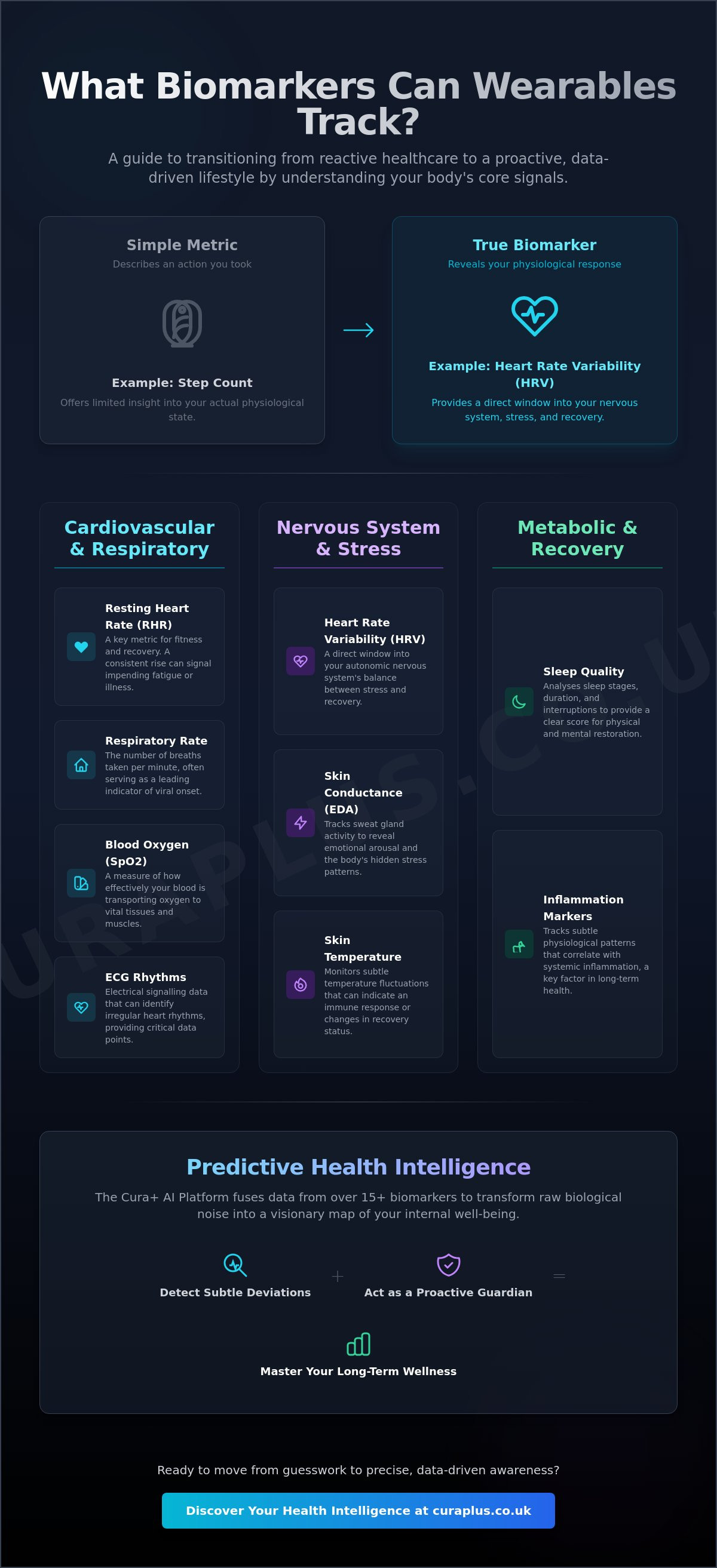
It's vital to distinguish between a simple metric and a true biomarker. A step count is a metric; it describes an action you took. Heart Rate Variability (HRV), however, is a biomarker. It provides a direct window into your autonomic nervous system, revealing how your body is actually responding to stress and recovery. Clinical-grade accuracy is paramount here because low-quality sensors produce noise rather than insight. High-fidelity sensors allow for the measurement of the electrical and thermal signals that govern your systemic health. By focusing on these indicators, you move from tracking movement to understanding the very foundations of your well-being.
Establishing Your Personal Health Baseline
Your body is unique, and what is considered normal for one person might indicate significant strain for another. This is why long-term data collection is essential. You cannot detect a deviation if you don't know your starting point. Establishing this foundation is the critical first step in predictive wellness. You can learn how to build a health baseline to begin your journey toward data-driven mastery. This process allows the Cura+ AI Platform to identify subtle shifts that might otherwise go unnoticed for months. Knowing what biomarkers can wearables track empowers you to build a shield of data around your future self, ensuring that every decision you make is informed by your body's specific needs.
Cardiovascular and Respiratory Biomarkers: The Core Indicators
Your cardiovascular and respiratory systems function as a single, sophisticated circuit. Understanding what biomarkers can wearables track begins with these core indicators, which serve as the engine room of your physiology. Whilst many consumers focus on active heart rate during exercise, the real intelligence lies in the longitudinal trends of your Resting Heart Rate (RHR). A consistent rise in RHR over several days often signals systemic fatigue, impending illness, or a lack of recovery before you feel any physical symptoms. By monitoring these shifts, you move from guesswork to precise, data-driven awareness.
Modern devices have transitioned from simple pulse counters to high-fidelity diagnostic tools. The integration of Electrocardiogram (ECG) technology into theBand allows you to detect irregular heart rhythms directly from your wrist. This level of clarity provides peace of mind and established data points that you can share with professionals. These core indicators include:
- Resting Heart Rate (RHR): A foundational metric for cardiovascular fitness and systemic recovery.
- Respiratory Rate: The number of breaths taken per minute, often serving as a leading indicator of viral onset.
- Blood Oxygen Saturation (SpO2): A measure of how effectively your blood is transporting oxygen to vital tissues.
- ECG Rhythms: Electrical signalling data that identifies deviations from a healthy sinus rhythm.
Exploring these signals with advanced wearables ensures you're never caught off guard by your own biology.
Heart Rate Variability (HRV): The Gold Standard
Heart Rate Variability is the variation in time between consecutive heartbeats; it's the ultimate barometer for your autonomic nervous system. A high HRV suggests a resilient, flexible system that's well-recovered and ready for high-performance demands. Conversely, a suppressed HRV indicates that your body is stuck in a 'fight or flight' state, struggling to manage internal or external stressors. It's a vital tool for anyone committed to self-optimisation, as it reveals the hidden cost of your daily lifestyle choices.
Oxygen and Breath: Monitoring Vital Gas Exchange
SpO2 is a clinical measurement of the oxygen-carrying capacity of your haemoglobin, reflecting the fundamental efficiency of your lung function and systemic oxygen delivery. Significant drops in SpO2 during sleep cycles can indicate respiratory disturbances that compromise your cognitive and physical recovery. Similarly, your respiratory rate is a sensitive marker; spikes in breaths per minute frequently precede the visible symptoms of infection by 24 to 48 hours. As we look toward the future, the scope of Metabolic and Recovery Biomarkers is expanding to include non-invasive sensors that provide even deeper insights into these vital gas exchanges.
Nervous System and Stress Biomarkers
The autonomic nervous system operates largely in the shadows, yet its influence on your vitality is absolute. It governs the body's 'fight or flight' response, often reacting to mental strain long before you recognise the cognitive toll. When exploring what biomarkers can wearables track, the ability to monitor the nervous system represents a shift from observing mechanical output to understanding psychological and physiological strain. Electrodermal Activity (EDA) is central to this. By measuring minute changes in skin conductance, sensors can gauge sympathetic nervous system arousal with clinical precision.
Distinguishing between physical exertion and emotional stress is a hallmark of sophisticated health intelligence. Your body doesn't always differentiate between the stress of a high-intensity interval session and a high-stakes boardroom presentation. Both trigger similar hormonal cascades. However, the Cura+ AI Platform uses data fusion to contextualise these signals. It's the difference between seeing a spike in activity and understanding the emotional cost behind it. This clarity allows you to manage your energy reserves with the same rigour you apply to your professional life.
The Science of Skin Temperature
Skin temperature is a remarkably sensitive indicator, often revealing physiological shifts before they manifest in your core temperature. Tracking these minute fluctuations provides an early alert system for metabolic changes or immune responses. It's also a powerful tool for monitoring hormonal health, as thermal trends can precisely map the phases of the menstrual cycle. Utilising a wearable for tracking immune health ensures that you are alerted to these thermal deviations the moment they occur, rather than days later when symptoms appear.
Decoding Stress Patterns
Mapping your 'stress profile' requires more than a single data point. By using EDA and HRV together, you can identify 'silent stressors' that deplete your energy amongst the bustle of daily life. These are the subtle environmental or social triggers that keep your nervous system in a state of low-level alarm. Quantifying these patterns transforms a vague feeling of being 'burnt out' into a structured dataset. It allows you to move from a reactive state of feeling stressed to a proactive state of mastering your recovery. This methodical approach ensures that your nervous system remains a source of strength rather than a point of failure.
Metabolic and Recovery Biomarkers: Sleep and Beyond
Recovery is the silent engine of high-level performance. It's not merely the absence of activity; it's an active, metabolic process where the body restores its internal systems. Determining what biomarkers can wearables track involves looking at how these devices dissect your sleep architecture to reveal the quality of this restoration. By accurately measuring REM, Deep, and Light sleep stages, theBand provides a granular view of your body's nightly repair cycle. This data is then synthesised with your daily activity rhythms to produce a 'readiness' score, a sophisticated metric that tells you exactly how much strain your system can handle on any given day.
The frontier of this technology lies in non-invasive metabolic monitoring. Whilst traditional methods required invasive blood tests, modern sensors now offer a window into blood glucose trends and activity rhythms. These patterns reflect your internal biological clock, or circadian rhythm, which governs everything from hormone release to energy levels. When you align your lifestyle with these natural cycles, you optimise your metabolic health. The Cura+ AI Platform identifies deviations in these rhythms, allowing you to adjust your behaviour before fatigue or metabolic dysfunction takes hold.
Sleep as a Metabolic Lever
Deep sleep is the phase where the body prioritises physical repair and immune strengthening. During this time, growth hormones are released, and the glymphatic system flushes metabolic waste from the brain. There is a direct, documented link between poor sleep architecture and decreased insulin sensitivity; missing out on these critical stages can disrupt your body's ability to manage blood sugar effectively. REM sleep serves as the primary mechanism for emotional regulation and the consolidation of complex cognitive tasks. By tracking these stages with precision, you can identify which lifestyle factors are sabotaging your metabolic recovery.
The Future of Metabolic Tracking
We are entering an era where hydration and electrolyte balance can be monitored through the skin without a single needle. These emerging technologies are being integrated into the next generation of devices to provide a truly holistic recovery view. TheBand utilises a suite of sensors to ensure that your hydration levels, glucose trends, and sleep quality are all accounted for in your health strategy. You can discover more about these capabilities in our guide to the advanced wellness tracker for 2026. This level of insight ensures that your wellness journey is not based on generic advice, but on the unique requirements of your own biology.
Ready to master your internal systems? Explore how theBand and Cura+ AI Platform can revolutionise your approach to predictive health.
Predictive Health Intelligence: How theBand Uses 15+ Biomarkers
Data is the foundation of modern wellness; however, raw numbers alone are insufficient for true transformation. Most consumer devices offer a retrospective view, merely documenting what has already occurred. True predictive health intelligence moves beyond this by looking forward. It identifies the subtle, early-stage deviations from your established baseline that precede illness or burnout. By the time you feel a symptom, your body has been sending signals for days. The goal of sophisticated monitoring is to capture these signals whilst they are still actionable, allowing for a proactive rather than reactive lifestyle.
The power of this approach resides in the concept of Data Fusion. One biomarker is never enough to provide a complete picture of your internal state. For instance, a rise in resting heart rate might indicate stress, but when synchronised with a drop in skin temperature and a shift in sleep architecture, it may signal an immune system under pressure. When asking what biomarkers can wearables track, the answer lies in the synchronised monitoring of over 15 specific biological signals. This multi-layered analysis ensures that every alert is grounded in a holistic understanding of your unique physiology.
Beyond Fitness: theBand’s Multi-Sensor Array
TheBand represents a significant leap in wearable technology, moving far beyond the limitations of standard fitness trackers. It utilises a sophisticated multi-sensor array to monitor over 15 biomarkers simultaneously, ranging from continuous glucose trends to electrodermal activity. This level of clinical precision is essential for generating reliable predictive health intelligence. You can explore the technical depth of this technology in our dedicated article on the predictive health wearable UK market. By capturing high-fidelity data, theBand provides the accuracy required to make high-stakes decisions about your personal wellness.
Your AI Health Coach
Data collection is only half of the equation; the Cura+ AI Platform provides the interpretation. This AI health and wellness coach acts as a sophisticated guide, translating complex biological noise into simple, actionable recommendations. It learns your body's specific patterns and alerts you to deviations in real-time. Instead of presenting you with confusing charts, it offers clarity. It might suggest an earlier sleep window or a specific hydration protocol based on your current recovery markers. This level of personalised insight empowers you to master your body's complex systems, replacing health anxiety with the quiet confidence of data-driven clarity.
Mastering Your Biological Future
The transition from monitoring movement to mastering biology marks a pivotal moment in personal wellness. We have moved beyond simple step counts into a landscape where your autonomic nervous system, metabolic rhythms, and cardiovascular health are visible in real-time. Understanding what biomarkers can wearables track is the essential first step in moving from a state of uncertainty to one of data-driven clarity. It's no longer about managing symptoms after they appear; it's about identifying the subtle physiological shifts that allow you to intervene before your health is compromised.
The future of health is predictive, personalised, and already within your reach. Through the integration of 15+ complex biomarkers and AI-driven predictive alerts, you can finally align your lifestyle with your body's specific requirements. This clinical-grade precision, designed in the UK, ensures that every insight is as accurate as it is actionable. Secure your future health with theBand by Cura+. Your journey toward self-optimisation is a high-stakes pursuit, but with the right intelligence, you can navigate it with absolute confidence.
Frequently Asked Questions
Can a wearable really detect if I am getting ill before I feel symptoms?
Yes, advanced wearables can identify physiological shifts up to 48 hours before you feel any physical symptoms. By monitoring subtle changes in resting heart rate and respiratory rate, the Cura+ AI Platform identifies deviations that signal your immune system is responding to a threat. This predictive capability allows you to prioritise recovery and adjust your behaviour before an illness fully manifests, turning biological noise into a proactive defence.
What is the most important biomarker for tracking overall health?
Heart Rate Variability (HRV) is arguably the most vital biomarker for assessing systemic resilience and nervous system balance. It provides a direct window into your autonomic nervous system, reflecting how effectively your body manages stress and recovery. Understanding what biomarkers can wearables track helps you prioritise HRV as a primary indicator of your daily readiness. Whilst individual metrics like heart rate are useful, HRV offers a holistic view of your internal state.
How accurate are wearable sensors compared to medical equipment?
Modern sensors in devices like theBand achieve significant correlation with clinical-grade equipment for wellness monitoring and trend analysis. Whilst theBand is not intended for clinical medical diagnosis, its multi-sensor array provides the precision required for high-level health intelligence. This accuracy ensures that the trends and alerts you receive are based on reliable biological signals rather than digital noise, allowing for sophisticated and confident self-optimisation.
Is my biometric data secure when using a health wearable?
Data security is a fundamental pillar of modern health technology, and your biometric information is managed with the same rigour applied to sensitive financial data. The Cura+ AI Platform utilises robust encryption to ensure that your personal health map remains private and secure. This commitment to privacy allows you to focus on your wellness journey with the peace of mind that your most sensitive biological data is protected from unauthorised access.
Do I need to wear the device 24/7 for the biomarkers to be useful?
Consistent wear is essential for establishing an accurate personal baseline and capturing the full picture of your health. Many critical biomarkers, such as resting heart rate and sleep architecture, are measured with the greatest precision whilst you are at rest. Without continuous data, the AI cannot identify the subtle deviations that form the basis of predictive alerts. Wearing theBand 24/7 ensures that your health intelligence remains complete and actionable.
Can wearables track biomarkers related to mental health and stress?
Yes, wearables track mental strain by monitoring the physiological responses of the autonomic nervous system. Electrodermal Activity (EDA) measures skin conductance to gauge sympathetic arousal, whilst HRV reveals how well your body is recovering from emotional stress. These indicators allow you to quantify mental fatigue in the same way you track physical exertion. This clarity helps you identify silent stressors that might otherwise lead to long-term burnout or exhaustion.
What is the difference between a fitness tracker and a predictive health wearable?
A fitness tracker primarily records retrospective metrics like steps and calories, whereas a predictive health wearable is forward-looking. Knowing what biomarkers can wearables track allows you to see how theBand uses data fusion to forecast future states rather than just documenting the past. It analyses how various signals interact to provide early warnings and personalised recommendations. This represents a more sophisticated approach to mastering your internal biological systems.
How does skin temperature help in monitoring my immune system?
Skin temperature serves as a sensitive indicator of your body's inflammatory state and immune activity. Minute fluctuations often precede a rise in core temperature, offering an early signal that your immune system is responding to a challenge. By tracking these thermal trends over time, the Cura+ AI Platform identifies deviations from your normal metabolic baseline. This allows for an organised and proactive approach to maintaining systemic health before symptoms become obtrusive.


