


What if the most critical moments in your health journey happen whilst you feel perfectly fine? For too long, the medical model has functioned as a repair shop, intervening only after a system failure occurs. This reactive approach often leaves you feeling anxious about what might be simmering beneath the surface, especially when generic apps offer little more than digital noise. True proactive health management tools represent a fundamental shift in this logic. They move beyond basic tracking to offer a visionary window into your future well-being, replacing guesswork with clinical precision.
It is time to replace uncertainty with data-driven clarity. In this article, you'll discover how the Cura+ AI Platform and theBand are redefining the standard of care by identifying subtle physiological deviations before they manifest as illness. We'll demystify the common myths surrounding AI in healthcare and provide a rigorous framework for understanding predictive biomarkers. This guide offers a clear path to move beyond the frustration of reactive medicine. It provides the insight necessary to transition from a passive patient to a sophisticated architect of your own longevity.
Key Takeaways
- Define the 2026 standard of proactive care and understand why relying on physical symptoms is a legacy approach that risks delayed intervention.
- Identify the 15+ critical biomarkers and the role of the Autonomic Nervous System in providing early warning signals for internal health shifts.
- Establish a rigorous framework for selecting proactive health management tools based on clinical sensor depth and the sophistication of predictive AI.
- Uncover how theBand by Cura+ leverages a comprehensive sensor suite to transform complex biological data into actionable insights for long-term vitality and self-optimisation.
What is Proactive Healthcare? Defining the 2026 Standard
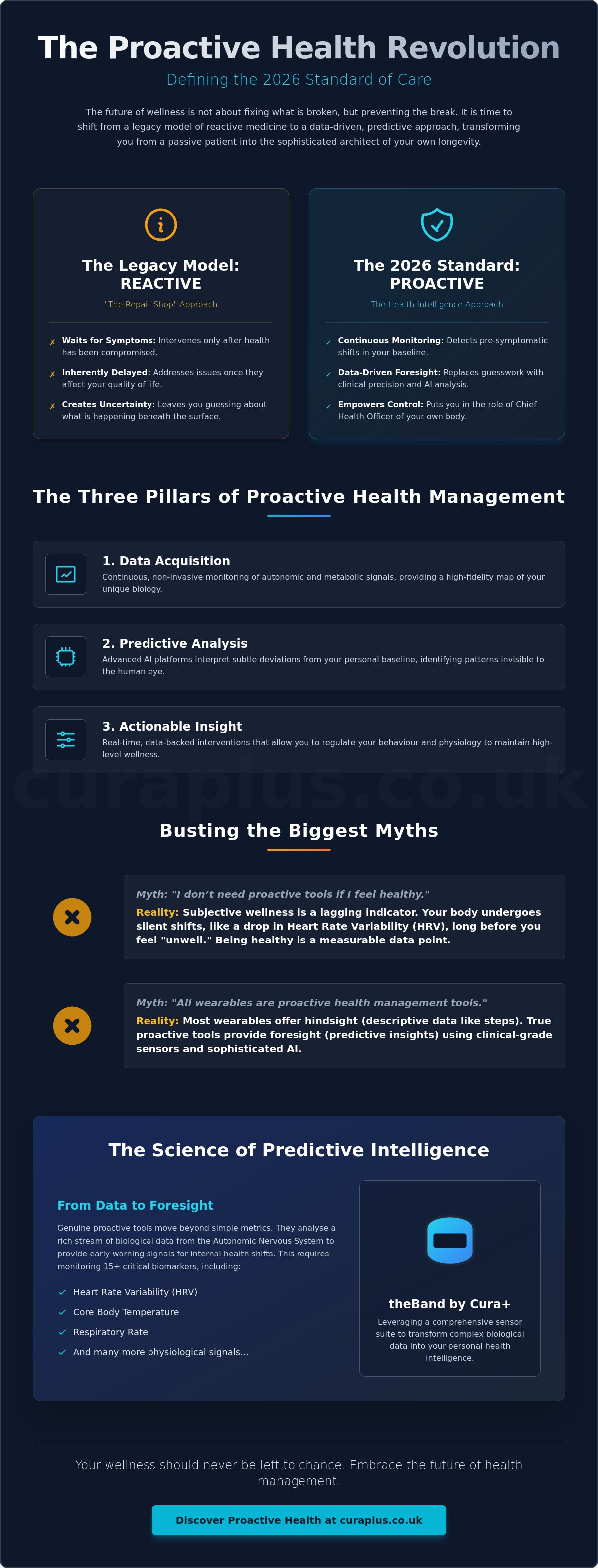
Proactive healthcare represents the evolution of Preventive healthcare into a high-precision, data-led discipline. It is defined as the continuous monitoring of physiological baselines to detect pre-symptomatic shifts in health status. Whilst traditional medicine often waits for a system failure to manifest as a physical symptom, the proactive model prioritises the maintenance of homeostasis through constant vigilance. This shift is driven by health intelligence: the synthesis of complex biological data into actionable foresight. Within the UK, the healthcare landscape is undergoing a significant transformation. Individuals are increasingly moving away from a total reliance on reactive medical systems, opting instead for sophisticated proactive health management tools that offer a visionary window into their future well-being.
The Reactive vs. Proactive Paradigm
The legacy medical model is built on reaction. You feel a symptom, you seek a diagnosis, and you receive a treatment. This approach is inherently delayed, as it only addresses issues once they have already compromised your quality of life. By contrast, the proactive model operates on the illness-wellness continuum. It aims to keep the body within the high-level wellness zone by identifying risks long before they become clinical realities. The economic and personal benefits of this strategy are profound. Preventing the onset of chronic conditions is significantly more effective than managing their lifelong consequences. In this new era, you assume the role of Chief Health Officer of your own body. You use precise data to govern your internal environment with the same rigour a consultant might apply to a complex system.
The Three Pillars of Proactive Health Management
A robust proactive strategy rests on three fundamental pillars that transform raw data into life-altering intelligence. First is Data Acquisition. This requires the continuous, non-invasive monitoring of autonomic and metabolic signals, providing a high-fidelity map of your unique biology. Second is Predictive Analysis. Advanced AI platforms interpret subtle deviations from your established personal baseline, identifying patterns that would be invisible to the human eye. Finally, there is Actionable Insight. These are real-time, data-backed interventions that allow you to regulate your behaviour and physiology in the moment. This process replaces the ambiguity of "feeling fine" with the quiet excitement of scientific discovery. Using proactive health management tools ensures that your wellness is never left to chance.
Busting the 4 Biggest Myths of Proactive Health
Whilst the transition to predictive wellness is accelerating, several pervasive misconceptions continue to cloud public understanding. Many believe proactive care is a reactive measure in disguise, reserved solely for the elderly or those managing chronic conditions. Others assume that a basic step-counter provides sufficient insight into their biological state. These myths create a dangerous complacency. To truly master your well-being, you must look beyond the surface and understand that health is a dynamic system, not a static condition.
Myth 1: "I Don’t Need Proactive Tools if I Feel Healthy"
Subjective wellness is often a lagging indicator of your true physiological state. Your body frequently undergoes silent shifts, such as a sustained drop in Heart Rate Variability (HRV) or subtle rises in core temperature, long before you feel "unwell." These are the early warning signs of systemic stress or impending illness. By tracking health metrics at home, you can identify these hidden stressors before they escalate into clinical issues. Feeling healthy is a subjective state; being healthy is a measurable data point.
Myth 2: "All Wearables are Proactive Health Management Tools"
There is a critical distinction between descriptive and predictive technology. Most consumer wearables are merely digital logs that record past behaviour, such as steps taken or calories burned. True proactive health management tools operate on a different level. They utilise multi-sensor arrays to feed data into sophisticated AI models that predict future states. This represents the core philosophy of theBand by Cura+. It moves the needle from simple tracking to genuine health intelligence, requiring clinical-grade sensor depth and AI processing to provide foresight rather than just hindsight.
We must also debunk the idea that these tools aim to replace your doctor. On the contrary, they serve to enhance the patient-provider relationship by providing a continuous stream of objective data. Instead of relying on a twice-yearly snapshot, you provide your clinician with a high-definition film of your internal health. This level of detail is accessible to anyone committed to self-optimisation, regardless of age or current fitness level. If you're ready to see what's happening beneath the surface, exploring advanced biomarker monitoring is the logical next step.
Finally, do not fall into the trap of thinking that more data always equals better health. Data without interpretation is just noise. The value of modern proactive tools lies in their ability to filter that noise, presenting you with only the most relevant, actionable insights. This ensures that your efforts are always focused on the interventions that will have the greatest impact on your longevity and performance.
The Science of Predictive Intelligence: Biomarkers and AI
Predictive intelligence is the engine of modern wellness. It moves beyond the anecdotal and enters the rigorous world of biological data management. Unlike legacy systems that rely on population averages, advanced proactive health management tools utilise a suite of 15+ essential biomarkers to map your unique internal landscape. This high-fidelity approach allows for the detection of subtle physiological shifts that precede physical symptoms. By synthesising these data points, technology creates a visionary window into your future health, transforming uncertainty into a strategy for long-term vitality.
The Autonomic Nervous System (ANS) serves as the primary "canary in the coal mine" for your well-being. It manages the delicate balance between your sympathetic and parasympathetic branches, regulating everything from heart rate to metabolic recovery. When your ANS shows signs of strain, it's often the first indication of systemic stress or impending illness. AI algorithms process these signals to establish a "digital twin"—a dynamic baseline of your personal physiology. By comparing real-time data against this longitudinal history, the system identifies meaningful anomalies. This process enables the transition from raw data to predictive alerts, signalling viral onset or burnout long before you feel a change in your physical state.
Key Biomarkers for Early Detection
Heart Rate Variability (HRV) remains the gold standard for assessing stress and recovery. It provides a precise measurement of the time between heartbeats, reflecting your body's ability to adapt to external pressures. However, HRV alone is insufficient. For a comprehensive view, it must be paired with skin temperature and respiratory rate monitoring. These metrics are vital for immune system oversight; a sustained rise in core temperature or a deviation in breathing patterns often indicates that the body is diverting resources to fight an underlying threat. For those focused on resilience, understanding how to use a wearable for tracking immune health is a critical component of a proactive strategy.
How AI Coaches Transform Data into Strategy
The era of the "data dump" is over. Modern platforms have moved beyond providing a list of numbers to offering personalised wellness coaching. Sophisticated AI health and wellness coaches now provide the necessary context to your physiological data, explaining not just what your numbers are, but what they mean for your daily behaviour. This shift prioritises longitudinal data over one-off snapshots. It allows the system to distinguish between a temporary dip in performance and a genuine downward trend in health. By providing actionable insights in real-time, these tools empower you to make precise adjustments to your sleep, activity, and recovery, ensuring you remain in a state of peak homeostasis.
Selecting Proactive Health Management Tools for 2026
Choosing the right proactive health management tools requires a shift from consumer-grade novelty to clinical-grade rigour. In the 2026 landscape, the market is saturated with devices that track metrics but fail to provide insight. A visionary strategy demands a framework focused on sensor depth and the sophistication of the underlying AI platform. It's no longer enough to merely record data; the system must understand it. Security is equally critical, particularly within the UK health tech market. Ensuring your biological data is protected by high-level encryption is a non-negotiable standard for any serious practitioner of self-optimisation.
The most effective approach involves a "closed-loop" system where hardware and software are designed in tandem. This integration ensures that the raw signals captured by the sensors are processed with maximum fidelity by the AI. Before making significant lifestyle adjustments, it is vital that you focus on building a health baseline. Without this personalised reference point, even the most advanced data lacks the context necessary for accurate prediction. Establishing this foundation allows the system to distinguish between your unique normal and a genuine physiological deviation.
Essential Hardware Features
Your hardware must be capable of medical-grade accuracy across a multi-point biomarker array. Periodic checks are insufficient for proactive care; you require continuous, 24/7 monitoring to capture the full spectrum of your body's circadian and stress responses. Ergonomics also play a vital role. If a device is uncomfortable, consistent data collection becomes impossible, undermining the longitudinal integrity of your health profile. High-performance materials and a discreet form factor are essential for long-term adherence, ensuring the data stream remains uninterrupted whilst you live your life.
Software and AI Requirements
The software platform must move beyond historical charts to offer genuine predictive alerts. You don't need a tool that tells you that you slept poorly last night; you need a system that warns you of rising systemic strain before you feel fatigued. Clarity is the ultimate luxury in health tech. The AI should provide specific, actionable advice, such as recommending an increase in recovery time, rather than simply presenting raw numbers like HRV or respiratory rate. Finally, verify that the AI is adaptive. It must learn your unique physiological patterns over months and years, refining its sensitivity to ensure that every insight is tailored specifically to you.
If you are ready to transition from passive tracking to active health mastery, exploring the Cura+ ecosystem provides the clinical precision and predictive power required for the modern age.
Cura+: Pioneering the Proactive Revolution
The transition from reactive medicine to predictive wellness is no longer a distant aspiration. It is a tangible reality for those who choose to lead. Amongst the various proactive health management tools available today, Cura+ stands as the definitive standard for the UK market. We don't merely track your activity; we provide a comprehensive, data-driven strategy for your biological future. By synthesising advanced hardware with a sophisticated intelligence platform, we offer a level of insight that was previously reserved for clinical researchers. The future of your health is already accessible through data.
The Power of theBand
At the heart of this revolution is theBand. This isn't just another wearable; it is a clinical-grade instrument designed for continuous, high-fidelity monitoring. With an integrated array of 15+ sensors, it captures a detailed map of your internal state, including HRV, skin temperature, and sleep architecture. The design is as sophisticated as the technology it houses, ensuring that long-term wear is both comfortable and discreet. Because our development and support teams are based entirely in the UK, you can trust that your journey is backed by local expertise and a commitment to the highest standards of data security.
A Personal Intelligence Platform
The hardware provides the data, but the Cura+ AI Platform provides the strategy. It acts as a personal health strategist that never sleeps, constantly analysing your physiological baselines to identify the earliest signs of deviation. This includes a robust Early Warning system capable of detecting the subtle markers of viral onset or systemic burnout days before you feel the first symptom. The platform doesn't just present numbers; it offers intelligent coaching that helps you organise your daily choices around your body's actual needs. It's time to stop guessing.
Choosing to be proactive is a commitment to excellence. It is an acknowledgment that your health is your most valuable asset and deserves the most advanced management available. Whilst the legacy medical system continues to struggle with the demands of the modern age, you have the opportunity to step ahead of the curve. We invite you to join our exclusive pre-launch phase and secure your place at the forefront of this biological revolution. Register your interest for theBand by Cura+ and take control of your health today.
Mastering the Future of Personal Wellness
The transition from a reactive medical model to a predictive one is a fundamental shift in how we perceive human potential. You now have the ability to move beyond the ambiguity of subjective feeling and embrace the clinical certainty of biological data. By monitoring 15+ critical biomarkers, you establish a high-fidelity baseline that transforms your health from a series of managed symptoms into a mastered system. Modern proactive health management tools offer the visionary clarity needed to detect physiological shifts long before they manifest as physical illness.
The Cura+ AI Platform provides the intelligence required to navigate this new landscape with confidence. Designed and engineered in the UK, theBand offers medical-grade precision and AI-driven predictive alerts that empower you to act with foresight. This isn't just about tracking; it's about reclaiming control over your internal environment through sophisticated insight. Join the waitlist for theBand by Cura+ and be the first to experience proactive health intelligence. Pre-launch exclusive access is available now for those ready to lead the revolution in self-optimisation. Take the first step toward a future of total biological clarity.
Frequently Asked Questions
Is proactive healthcare the same as preventative medicine?
Proactive healthcare is an evolution of preventative medicine that prioritises continuous monitoring over periodic check-ups. Whilst preventative care often focuses on general population risks, proactive strategies use proactive health management tools to map your unique physiological baseline. This allows for the detection of pre-symptomatic shifts, ensuring that interventions are tailored to your specific internal state rather than a broad medical average.
How much do proactive health management tools usually cost in the UK?
Costs for advanced health technology in the UK vary depending on the complexity of the hardware and the depth of the AI analysis provided. Investing in high-fidelity sensors and a sophisticated intelligence platform generally reflects a higher price point than basic fitness trackers. It's essential to consider the long-term value of predictive insights and the clinical precision of the data when evaluating the total cost of these systems.
Can a wearable really detect an illness before I feel sick?
Yes, advanced wearables can identify physiological deviations that occur days before physical symptoms manifest. By monitoring metrics like Heart Rate Variability and skin temperature, the AI detects the body's early response to stress or viral threats. This visionary window allows you to adjust your behaviour, such as increasing recovery time, before a minor shift escalates into a significant health event.
What are the most important biomarkers to track for proactive health?
A comprehensive strategy should focus on biomarkers that reflect the state of the Autonomic Nervous System and metabolic health. Key metrics include Heart Rate Variability (HRV), skin temperature, respiratory rate, and detailed sleep architecture. Tracking these 15+ sensors simultaneously provides the high-definition data needed for the AI to build an accurate digital twin of your unique biology and identify meaningful anomalies.
Is my health data safe with AI-driven proactive tools?
Data security is a primary pillar of modern health technology, especially within the UK regulatory landscape. Leading proactive health management tools utilise enterprise-grade encryption and adhere to strict privacy protocols to ensure your biological information remains confidential. It's vital to choose platforms that prioritise transparent data handling and maintain their development and support infrastructure within secure jurisdictions.
Do I need to be an athlete to benefit from proactive health management?
You don't need to be an elite athlete to gain significant benefits from proactive monitoring. These tools are designed for anyone committed to self-optimisation, longevity, or simply maintaining clarity over their internal health. Whether you are managing a high-pressure career or looking to age with vitality, having a data-driven understanding of your body's stress and recovery cycles is an invaluable asset.
What happens if the tool predicts a health issue?
When a system predicts a potential health issue, it provides clear, actionable insights to help you regulate your physiology. This might include recommendations for immediate rest, improved hydration, or specific stress-management techniques. Crucially, the tool provides a high-definition record of objective data that you can share with your healthcare provider, facilitating a more informed and precise clinical conversation.
Can proactive health tools help with chronic condition management?
Proactive tools are exceptionally effective at helping individuals maintain homeostasis, which is critical for managing chronic conditions. By identifying the subtle triggers that lead to symptomatic flare-ups, these systems allow for earlier, more refined adjustments to daily habits. This data-led approach reduces the frequency of reactive medical interventions and empowers you to manage your health with clinical precision.


