


What if your wearable could detect a physiological shift forty-eight hours before you felt a single symptom? Most people currently feel trapped in a cycle of reactive wellness, viewing their biometric data as a confusing collection of heart rate spikes and sleep scores that offer little foresight. This uncertainty often leads to a persistent anxiety regarding unexplained fluctuations in your daily metrics. You deserve more than a digital step counter; you require a sophisticated strategist for your biology. By leveraging advanced AI algorithms for health prediction, we are moving beyond mere tracking into an era of genuine physiological intelligence.
You likely recognise that a high heart rate during rest is suboptimal, yet the lack of context often leaves you overwhelmed by data noise. This article promises to demystify the sophisticated science behind these predictive models, illustrating how tools like theBand and the Cura+ AI Platform transform raw biometrics into actionable, life-saving foresight. You will learn how to distinguish between low-quality trackers and high-performance forecasting systems. We will explore how to achieve a sense of calm control over your future health outcomes by understanding the subtle signals hidden within your own body.
Key Takeaways
- Learn how to transition from reactive tracking to proactive intelligence by understanding how modern systems forecast physiological shifts before symptoms manifest.
- Discover the sophisticated mechanics of AI algorithms for health prediction and how neural networks identify subtle deviations from your unique biological norms.
- Understand why dynamic, second-by-second biometric data offers superior predictive accuracy over static medical records, including the ability to detect viral onset days in advance.
- Master the concept of the 'Health Baseline' to eliminate the frustration of false positives caused by generic, outdated population averages.
- Explore how the Cura+ AI Platform translates complex data into actionable lifestyle adjustments through precise, personalised predictive alerts.
The Evolution of Health Intelligence: From Tracking to Prediction
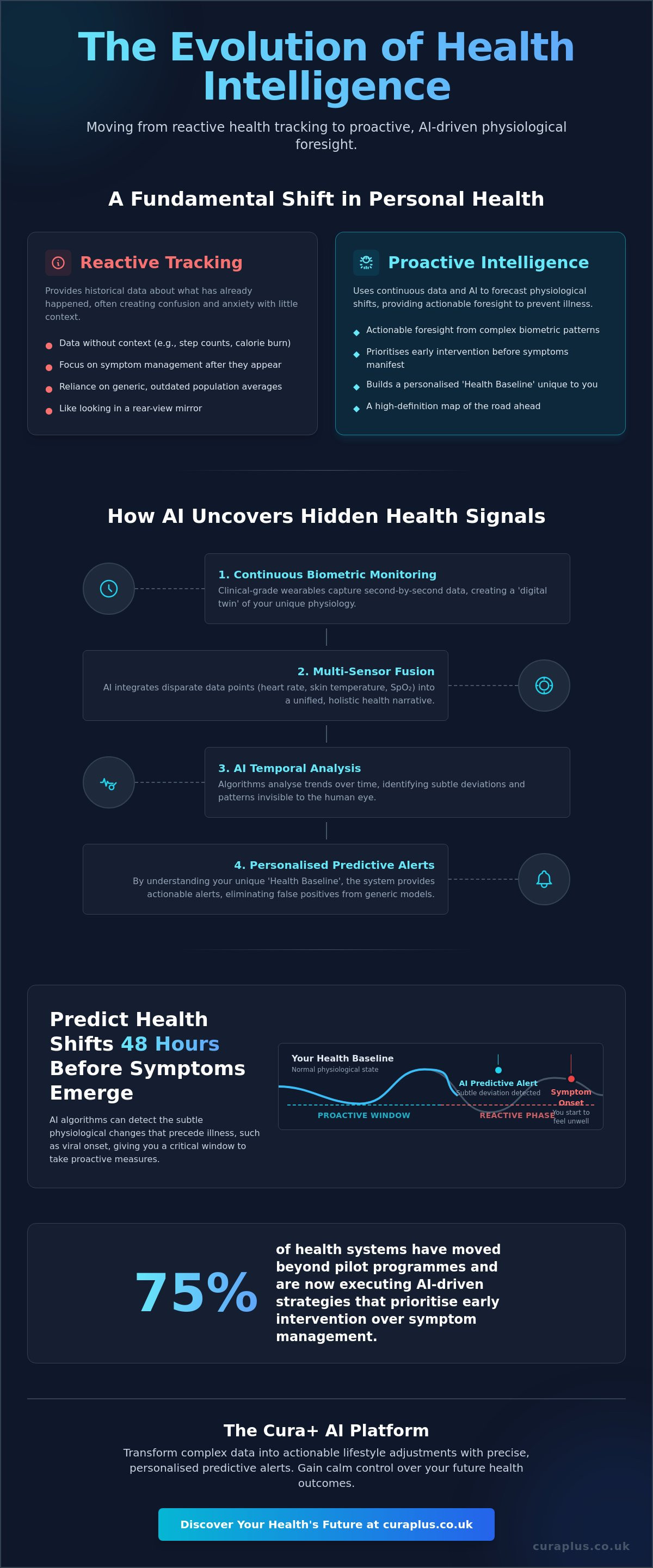
The journey from counting steps to forecasting physiological states represents a fundamental shift in human self-knowledge. In previous years, we relied on reactive monitoring, which essentially meant measuring biological events after they had already occurred. Today, Artificial intelligence in healthcare has evolved into a proactive force. We define AI algorithms for health prediction as sophisticated computational systems that identify intricate patterns within continuous biological data to forecast upcoming physiological shifts. By 2026, this technology has moved beyond the laboratory. It now provides clinical-grade insights within the sanctuary of your own home, allowing you to anticipate illness or fatigue before the first symptom manifests. This transition is mirrored by the industry at large; currently, 75% of health systems have moved beyond pilot programmes to execute AI-driven strategies that prioritise early intervention over symptom management.
Why 'Fitness Tracking' is No Longer Enough
Basic wearables often fail because they provide data without context. Recording ten thousand steps or a specific calorie burn is a historical account; it tells you what you did, not how your body responded. These isolated metrics lack the depth required to predict a decline in wellness or a surge in systemic stress. We are witnessing the rise of physiological intelligence as the new standard. This standard moves beyond the 'what' of physical movement to the 'why' of internal biological behaviour. It's the difference between looking in a rear-view mirror and having a high-definition map of the road ahead. You don't need more data points. You need more clarity.
The Shift Towards Continuous Biometric Monitoring
Traditional health assessments are static. A blood test or a blood pressure reading at your GP surgery offers a single data point in time, which can be easily skewed by temporary stress or even the time of day. Continuous monitoring changes the equation. By capturing biometrics every second, AI creates a 'digital twin' of your unique physiology. This allows for the real-time analysis of the autonomic nervous system (ANS), which serves as the primary regulator of your body's unconscious functions. Consider these advantages of the continuous approach:
- Identifying the 'Noise': Algorithms capture the subtle variations between heartbeats where early warning signs of illness live.
- Individualised Context: The system learns your specific rhythms rather than comparing you to generic population averages.
- Proactive Adjustments: Real-time monitoring transforms your wellness strategy from a series of guesses into a methodical, data-driven process.
By 2026, the focus has shifted toward clinical-grade, validated AI that works alongside your daily routine. This evolution ensures that the information you receive is not just a notification, but a sophisticated guide for self-optimisation.
How AI Algorithms Model Human Physiology: The Mechanics of Prediction
Modern AI algorithms for health prediction operate by ingesting vast streams of high-fidelity data from wearable sensors. This process, known as data ingestion, feeds a central AI engine that never sleeps. Instead of looking at a single metric in isolation, the system employs multi-sensor fusion. This technique integrates disparate data points, such as heart rate, skin temperature, and blood oxygen saturation, to form a unified health narrative. It is a holistic approach that mirrors the complexity of human biology itself. By synthesising these variables, the system constructs a high-fidelity model of your internal state.
These AI and machine learning algorithms don't just record numbers; they perform temporal analysis. They examine how your biometrics change over seconds, minutes, and days. A single high heart rate reading might be a reaction to a cup of coffee. However, a sustained elevation in resting heart rate combined with a subtle rise in skin temperature suggests something entirely different. By looking at the 'noise' between data points, the AI identifies trends that would be invisible to the human eye. Data is the foundation, but time is the context.
Pattern Recognition and Neural Networks
Neural networks are the architects of this foresight. They learn to recognise the specific physiological signature that precedes an illness. Think of it as a weather forecast for the human body. Much like a meteorologist identifies the specific atmospheric conditions that precede a storm, these algorithms recognise the biological 'low pressure' that signals an impending immune response. Unlike older, rule-based systems that only trigger an alert when you cross a generic threshold, deep learning models adapt to you. Rule-based alerts are rigid. Deep learning is fluid. They understand that your 'normal' is different from everyone else's, ensuring that every insight is tailored to your unique biology.
The Power of 15+ Biomarkers Working in Unison
The efficacy of AI algorithms for health prediction relies on the breadth of the data they consume. Tracking 15+ biomarkers, a capability showcased by theBand, provides a comprehensive 360-degree view of your wellness. There is a powerful synergy between metrics like Heart Rate Variability (HRV) and skin temperature. When these biomarkers are synchronised, the AI can distinguish between simple physical exertion and the onset of systemic inflammation. Achieving this level of precision requires a platform that can interpret these complex relationships, such as the Cura+ AI Platform. It's about moving from raw data to refined, actionable intelligence that empowers you to take control of your health journey.
Predictive Accuracy: Why Dynamic Data Outperforms Static Records
Static medical records are essentially historical documents. They provide a retrospective glance at your health through annual blood tests or occasional GP visits. Whilst valuable, these snapshots lack the temporal resolution required to capture the dynamic nature of human biology. In contrast, dynamic data captured every second provides a high-definition view of your physiological state. AI algorithms for health prediction thrive on this continuous stream; they filter the daily 'noise', such as a temporary heart rate spike from a stressful meeting, to identify the genuine signals of systemic change. This high signal-to-noise ratio is what allows for a level of foresight previously reserved for elite clinical environments.
Detecting Viral Onset and Immune Response
The immune system doesn't wait for you to feel ill before it begins to act. Sophisticated AI can often detect viral onset up to 72 hours before the first physical symptom appears. This is achieved by monitoring subtle rises in nocturnal skin temperature and shifts in respiratory rate during sleep. When your body is fighting an invisible threat, these metrics deviate from your established baseline in predictable ways. Utilising a wearable for tracking immune health allows you to see these internal shifts in real-time, providing a window of opportunity to adjust your behaviour and prioritise recovery before an illness takes hold.
Identifying Autonomic Stress and Burnout
Predictive accuracy isn't limited to physical illness; it extends to mental and physical fatigue. Algorithms powered by Heart Rate Variability (HRV) can forecast burnout by identifying a suppressed autonomic nervous system. By calculating a 'Recovery Score', the AI determines whether your body has successfully recharged or if you're operating in a state of chronic stress. We believe that tracking stress patterns is the essential first step in achieving algorithmic wellness. It transforms the vague feeling of being 'tired' into a precise measurement of physiological readiness, allowing you to modify your workload before exhaustion sets in.
Can you trust an algorithm over a professional? This is a common misconception. Instead, view these AI algorithms for health prediction as a sophisticated pre-screening tool. They provide the high-fidelity data that allows for more informed, data-driven conversations with your doctor. You're not replacing clinical expertise; you're augmenting it with a clear, evidence-based understanding of your body's trajectory. It replaces uncertainty with a methodical approach to self-optimization.
Establishing Your Health Baseline: The Key to Algorithmic Precision
To achieve true foresight, a system must first understand what 'normal' looks like for your specific body. We define a Health Baseline as your unique physiological fingerprint; it's a dynamic signature encompassing your resting heart rate, sleep architecture, and metabolic rhythms. Without this foundation, even the most advanced AI algorithms for health prediction risk producing generic insights that lack personal relevance. Population averages, whilst useful for large-scale studies, often lead to false positives in individual monitoring because they ignore the vast biological diversity amongst users. By 2026, the focus has shifted entirely toward this personalised model, ensuring every alert is grounded in your specific reality.
Establishing this baseline requires a dedicated calibration period. During this time, the algorithm observes your body’s responses to various stimuli, learning how you recover from a late-night meal or how a glass of wine impacts your nocturnal heart rate. These lifestyle factors cause significant physiological deviations. For instance, alcohol can suppress Heart Rate Variability (HRV) for up to 24 hours, a shift that a generic tracker might mistake for illness. By understanding these patterns, the AI distinguishes between a self-induced lifestyle fluctuation and a genuine health risk. Precision is the result of this methodical observation.
Personalised vs. Population-Averaged Data
Consider a resting heart rate of 60 beats per minute. For a highly trained athlete, this might represent an elevated state indicating overtraining; for a sedentary individual, it could be a perfect baseline. AI algorithms for health prediction 'normalise' this data by accounting for your age, fitness level, and historical trends. This ensures you aren't compared to an abstract 'average' person, but rather to the best version of yourself. To understand the metrics that define your unique signature, consult our guide on building a health baseline.
Minimising False Alarms through Contextual Intelligence
Precision is not just about measuring data; it's about interpreting it through the lens of your life. Contextual intelligence allows the AI to distinguish between 'good stress'—the physiological demand of a vigorous workout—and 'bad stress'—the systemic strain of an emerging infection. User-tagging plays a vital role here, as it provides the algorithm with the qualitative context needed to refine its accuracy. Algorithmic precision is a product of data volume multiplied by personal context. When you provide the system with the 'why' behind your data spikes, you empower it to ignore the noise and focus on the signals that truly matter. Start your journey toward physiological mastery by exploring the Cura+ AI Platform today.
The Cura+ AI Platform: Implementing Predictive Health in 2026
The Cura+ AI Platform serves as the essential bridge between high-fidelity raw data and actionable human insight. Whilst earlier sections of this article detailed the complex mechanics of neural networks and baseline calibration, this platform is where those AI algorithms for health prediction are translated into a clear, strategic roadmap for your daily life. It doesn't merely present you with a dashboard of disconnected numbers. Instead, it generates 'Predictive Alerts' that suggest precise lifestyle adjustments, such as modifying your sleep schedule or adjusting your training intensity, before your physiological state begins to drift into a sub-optimal zone. By integrating personalised health coaching based on these algorithmic findings, we provide you with a sophisticated guide for your body's high-stakes journey toward excellence.
From Data Visualisation to Actionable Intelligence
Simple graphs often lead to information overload and unnecessary anxiety. The Cura+ AI Platform replaces these confusing visualisations with a unified 'Readiness Score' that distils 15+ biomarkers into a single, intuitive metric. It translates technical jargon into plain English recommendations, telling you exactly why you should prioritise rest or increase hydration on any given day. Having an AI health and wellness coach available 24/7 means you never have to guess the meaning of a metric again. It provides the clarity required to move from passive observation to active command over your biology. This focus on clinical-grade AI algorithms for health prediction ensures that every insight is backed by methodical reliability and scientific rigour.
Securing the Future of Preventative Care
Our mission is to shift the global healthcare paradigm from 'sick-care', the practice of treating illness after it arrives, to 'well-care', the science of maintaining peak performance through foresight. This vision requires absolute trust and transparency. We prioritise data sovereignty and adhere to the most stringent British security standards to ensure your biometric fingerprint remains secure and private. In 2026, managing your wellness is no longer a series of reactive appointments but a continuous, secure, and empowered process. You are no longer a passenger in your own health journey; you are the strategist. Achieve a sense of calm control and replace uncertainty with data-driven clarity today.
Join the future of proactive health with theBand by Cura+.
Embracing the Era of Biological Foresight
The transition from reactive tracking to proactive intelligence represents a fundamental shift in how we inhabit our bodies. You've discovered that the true power of wellness lies in foresight rather than hindsight. By leveraging AI algorithms for health prediction, you can finally move beyond the confusion of generic metrics and embrace a strategy tailored to your unique biological fingerprint. We've established that dynamic monitoring and a personalised baseline are the essential pillars of this new standard of care.
This level of sophisticated insight is no longer a distant vision. By utilising theBand to monitor 15+ key biomarkers, you gain access to UK-based predictive intelligence that works in real-time. The Cura+ platform serves as your dedicated health strategist, offering a real-time AI health coaching platform that transforms raw data into refined, actionable wisdom. It's time to replace the anxiety of the unknown with the calm confidence of data-driven clarity.
Discover theBand and start your journey with Cura+ AI
The future of your health is already accessible through your data. We invite you to begin this journey of discovery and self-optimisation today.
Frequently Asked Questions
Can AI algorithms really predict illness before I feel any symptoms?
Yes, sophisticated AI algorithms for health prediction can often detect the onset of illness up to 72 hours before physical symptoms manifest. They achieve this by identifying minute deviations in your nocturnal skin temperature and respiratory rate. These subtle signals indicate that your immune system is already responding to a threat. This foresight allows you to prioritise rest and recovery before you feel genuinely unwell.
How accurate are AI health predictions compared to clinical tests?
These systems serve a different purpose than traditional clinical tests. Whilst a blood test provides a high-fidelity snapshot of a single moment, AI offers continuous temporal analysis of your biological trends. This provides a high signal-to-noise ratio that helps identify emerging patterns. It's best viewed as a sophisticated pre-screening tool that provides the data needed for more informed medical consultations.
What biomarkers are most important for health prediction algorithms?
The most critical biomarkers include Heart Rate Variability (HRV), resting heart rate, and skin temperature. When these metrics are analysed in unison, they provide a 360-degree view of your autonomic nervous system. The Cura+ AI Platform synthesises these disparate data points to form a unified health narrative. This holistic approach ensures that every prediction is grounded in the complex reality of human biology.
Will an AI health algorithm replace my regular GP visits?
No, these tools are designed to augment, not replace, your relationship with healthcare professionals. They provide you with objective, evidence-based data that makes your GP visits more productive. Instead of relying on vague recollections of how you've felt, you can present clear physiological trends. This empowers you to be a more active and informed participant in your own preventative care journey.
How long does it take for an AI to learn my personal health baseline?
It typically takes a fourteen-day calibration period for AI algorithms for health prediction to understand your unique biological rhythms. During this fortnight, the system learns how your body responds to sleep, stress, and daily activity. This initial phase is essential for establishing a precise Health Baseline. Once this signature is defined, the algorithm can accurately distinguish between temporary fluctuations and genuine health alerts.
Is my biometric data safe when using an AI health platform?
Your data security is a primary priority. We adhere to the most stringent British security standards and data sovereignty protocols to ensure your information remains private. All biometric data processed through the Cura+ AI Platform is encrypted and managed with clinical-grade care. You maintain full ownership of your biological information, ensuring that your journey toward self-optimisation remains entirely secure and confidential.
Can AI detect chronic conditions or only short-term illnesses?
Algorithms are highly effective at identifying the systemic stress and persistent inflammation associated with both acute and long-term health trends. Whilst the platform isn't a diagnostic tool, it highlights sustained deviations from your baseline that may warrant further investigation. By monitoring these long-term physiological shifts, you gain a clearer understanding of your overall resilience and the effectiveness of your lifestyle choices.
Do I need to wear the device 24/7 for the algorithms to work?
Continuous wear is recommended to achieve the highest level of predictive precision. The most vital physiological data, such as your recovery score and sleep architecture, is captured whilst your body is at rest. Wearing theBand throughout the day and night ensures the algorithm has a complete dataset. This constant stream of information is what allows the system to provide accurate, life-saving health predictions.


