


What if the crushing exhaustion you feel at 3:00 PM isn't a failure of willpower, but a measurable biological deviation that your current technology is simply failing to see? You've likely been told that your persistent brain fog is merely a symptom of a busy life or that another espresso will resolve your flagging focus. It is deeply frustrating to feel your performance slip whilst your standard medical results remain stubbornly "normal," leaving you caught in the confusing space between mental burnout and physical recovery debt. You deserve more than a guess; you deserve clarity.
In this guide, you will discover how to identify and track the specific biomarkers for fatigue that signal a physiological system on the brink of collapse. We will move beyond the limitations of traditional medicine to explore the 15+ metrics that provide objective health intelligence. You will learn how to build a sophisticated early-warning system for burnout, giving you the data-driven proof required to justify essential rest and organise your lifestyle for peak performance. By the end, you'll have a clear roadmap to master your energy levels through precision data rather than intuition.
Key Takeaways
- Understand why subjective exhaustion is an unreliable metric and how to utilise objective data to identify physiological strain before performance declines.
- Identify the essential biomarkers for fatigue, such as Heart Rate Variability, to gain a precise understanding of your autonomic nervous system's current state.
- Learn to differentiate between reactive symptoms and predictive intelligence, allowing you to intercept burnout through advanced pattern recognition.
- Discover the protocol for establishing a personalised health baseline over 14 days, providing a stable reference point for all future lifestyle adjustments.
- Explore how continuous multi-sensor monitoring enables a shift from merely managing symptoms to mastering your body’s complex internal systems.
Understanding Biomarkers for Fatigue: The Shift to Objective Data
For decades, our collective understanding of what fatigue is has relied almost exclusively on subjective self-reporting. We wait until we feel "drained" or "burnt out" before taking action. However, the human mind is often a lagging indicator of physical reality. By the time you consciously register exhaustion, your internal systems have likely been struggling for days. This is why we must shift our focus toward biomarkers for fatigue, which are objective, biological indicators of systemic exhaustion that can be measured and tracked with clinical precision.
The primary regulator of your energy is the Autonomic Nervous System (ANS). It manages the delicate balance between your sympathetic (stress) and parasympathetic (recovery) branches. When the ANS is under prolonged strain, it leaves a data trail. Identifying these signals allows you to move from reactive lifestyle choices to a model of proactive health intelligence. Instead of wondering why your energy is inconsistent despite healthy habits, you can look at the data to see exactly where your recovery is failing.
The Difference Between Clinical and Digital Biomarkers
Traditional clinical biomarkers often require invasive blood tests to measure specific compounds like tryptophan or haemoglobin. Whilst these are vital for diagnosing underlying medical conditions, they offer only a static snapshot of your health. Energy levels are dynamic and fluctuate throughout the day. Digital biomarkers, captured through continuous monitoring, provide a high-definition "fatigue profile" that a one-off laboratory test cannot match. By tracking metrics such as heart rate variability and sleep architecture every night, you gain a clear view of how your body responds to specific stressors in real time.
Why Your Body Signals Fatigue Before Your Mind Does
Your body is an expert at resource allocation. It prioritises vital functions like heart rate and organ health whilst silently sacrificing the energy reserves needed for cognitive focus and physical performance. This cumulative strain is known as "allostatic load." Digital biomarkers serve as the check-engine light for human biology. They illuminate the physiological debt you are accruing before it manifests as brain fog or physical collapse. Understanding this allows you to intervene early, protecting your long-term wellbeing before the "feeling" of fatigue becomes an inescapable reality. This data-driven approach ensures that rest is no longer a guilty luxury but a calculated strategic requirement based on your body's actual needs.
Key Digital Biomarkers for Fatigue: What Your Body is Telling You
To master your energy, you must identify the specific biological signatures of exhaustion. Whilst a single metric can provide a snapshot, a constellation of data points creates a comprehensive "fatigue profile." These biomarkers for fatigue serve as objective evidence of your body’s internal state, allowing you to distinguish between a temporary dip in motivation and genuine physiological depletion. By monitoring these signals, you can adjust your output before your performance suffers.
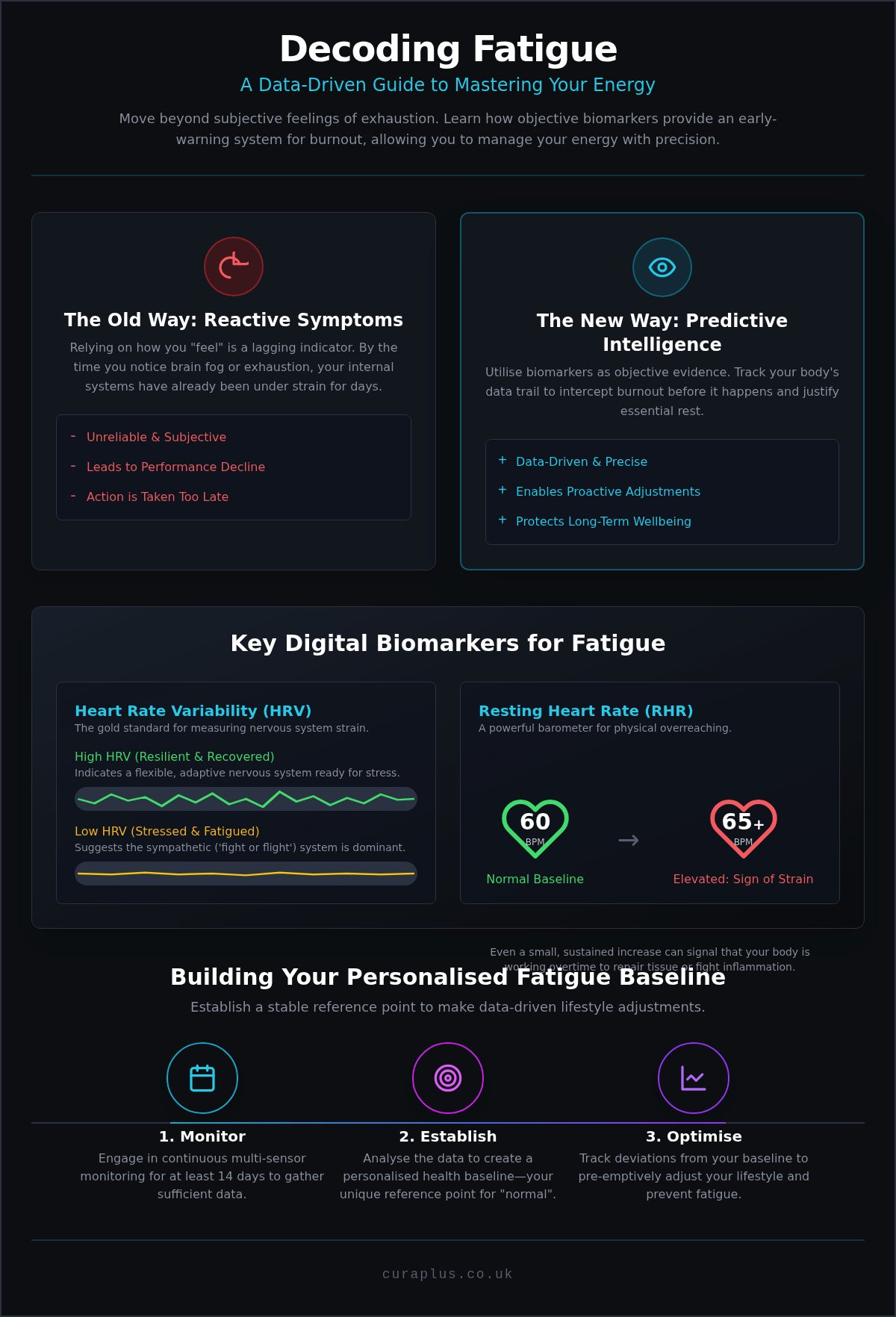
Heart Rate Variability (HRV) remains the gold standard for measuring nervous system strain. It reflects the millisecond variations between heartbeats, providing a direct window into your Autonomic Nervous System. A high HRV suggests a resilient, recovered state, whereas a persistent drop often indicates that your sympathetic nervous system is stuck in a "fight or flight" loop. This lack of variation is frequently cited in research regarding Biomarkers for Chronic Fatigue, highlighting how nervous system dysregulation precedes the feeling of burnout. Integrating this data is the cornerstone of sophisticated biometric tracking for wellness.
Secondary indicators provide essential context to your HRV. Your Resting Heart Rate (RHR) is a powerful barometer for overreaching; an elevation of even five beats per minute can signal that your body is working overtime to repair tissue or fight off sub-clinical inflammation. Similarly, subtle increases in your nocturnal respiratory rate or fluctuations in skin temperature often act as early-warning signals. These shifts suggest immune system activation, which typically manifests as lethargy long before other symptoms appear.
HRV and the Autonomic Nervous System
The balance between your sympathetic and parasympathetic branches determines your daily vitality. Burnout occurs when the parasympathetic "rest and digest" system is consistently overshadowed by stress responses. Monitoring HRV allows you to see this imbalance in real time. It helps you determine if your tiredness is mental, perhaps requiring a change of environment, or physical, requiring absolute rest. This level of clarity is only possible through continuous, high-fidelity monitoring.
Sleep Architecture and Recovery Debt
True recovery is found in the structure of your sleep, not just its duration. Deep sleep is critical for physical restoration and hormonal balance, whilst REM sleep facilitates cognitive processing and emotional regulation. A deficiency in either stage creates a specific type of recovery debt that compounds over time. Factors amongst your lifestyle, such as late-night blue light exposure or alcohol consumption, often disrupt these stages without you realising it. Tracking sleep efficiency provides a predictive look at your next-day cognitive performance, ensuring you don't over-commit when your reserves are low. Utilising a precision tool like theBand ensures these metrics are captured with the accuracy required for high-stakes health management.
Reactive Symptoms vs. Predictive Intelligence: A New Standard
The traditional approach to exhaustion is fundamentally reactive. Most people wait for the arrival of brain fog, irritability, or physical lethargy before acknowledging a need for rest. This "push through" mentality treats systemic depletion as a mental hurdle rather than a measurable biological limit. However, ignoring the early shifts in your biomarkers for fatigue carries a significant personal and economic cost. When you bypass these signals, you aren't demonstrating resilience; you're accumulating a high-interest recovery debt that eventually demands payment in the form of burnout or illness.
We've moved beyond the theoretical future of personal health. The transition from reactive medicine to predictive intelligence is already achievable through current multi-sensor technology. By synthesising data across various physiological systems, it's possible to identify the "micro-deviations" that precede a total system crash. This shift allows you to manage your energy with the same precision a pilot uses to monitor flight systems, ensuring you never reach the point of engine failure.
The Myth of the 'Fitness Tracker' in Fatigue Management
Standard consumer wearables often prioritise "vanity metrics" such as step counts or estimated calorie expenditure. Whilst these provide a general sense of activity, they are insufficient for monitoring complex systemic health. To accurately analyse biomarkers for fatigue, you require clinical-grade sensors capable of high-fidelity data capture. This is where theBand differs from standard trackers. Instead of merely recording movement, it monitors the underlying physiological strain that movement—and stress—places on your body, providing the granular detail necessary for professional-level health mastery.
Predictive Alerts: Catching Fatigue Before it Starts
The true power of modern health intelligence lies in its ability to see patterns invisible to the human eye. AI-driven algorithms, such as those within the Cura+ AI Platform, compare your real-time data against your established baseline to detect anomalies before they manifest as symptoms. These systems can identify the physiological signatures of viral onset or severe overreaching up to 48 hours before you feel unwell. By receiving a personalised alert during this window, you can modify your behaviour immediately. This proactive intervention transforms a potential week of forced inactivity into a minor, 24-hour recovery adjustment, preserving your long-term performance and wellbeing.
Building Your Fatigue Baseline: Practical Strategies for Daily Management
Relying on population averages is a fundamental error in high-level health management. What constitutes a "healthy" heart rate or sleep duration for the general public may be a sign of significant strain for you. To achieve true mastery over your energy, you must move beyond generic benchmarks and establish a personalised reference point. This process allows you to interpret your biomarkers for fatigue with clinical accuracy, ensuring that every lifestyle adjustment you make is based on your unique physiological reality rather than a statistical guess.
The most effective way to achieve this is to build a health baseline over a dedicated 14-day period. During this window, you should maintain your standard routines whilst the technology maps your "Personal Normal" for metrics like HRV, resting heart rate, and sleep architecture. By the end of these two weeks, you will have a stable foundation that filters out daily noise, allowing you to see how specific variables like caffeine intake or late-night exercise actually impact your recovery. This baseline is the anchor for all future health intelligence.
Identifying Fatigue Triggers with Data
Once your baseline is established, you can utilise the Cura+ dashboard to identify long-term trends that would otherwise remain invisible. Many high-performers suffer from a "Friday Burnout" pattern, where their HRV steadily declines and their resting heart rate climbs throughout the week. Recognising this amongst your data allows you to intervene on Wednesday or Thursday, preventing the weekend from being a period of forced recovery. It also helps you distinguish between acute fatigue, which is the healthy result of a challenging workout, and chronic fatigue, which is the destructive result of unmanaged psychological stress.
Actionable Adjustments Based on Biomarker Data
Data is only valuable if it informs action. When your recovery score drops into a "high-strain" zone, your behaviour must change to match your biological capacity. This might mean prioritising an extra hour of sleep over a planned morning workout or delegating high-stakes cognitive tasks until your biomarkers return to their baseline. You should treat your recovery score as a non-negotiable budget for your daily output. By respecting these physiological limits, you ensure that you are always operating from a position of strength rather than slowly depleting your reserves. To begin building your own predictive health profile, explore the capabilities of theBand and the Cura+ platform today.
Optimising Vitality with theBand: AI-Driven Insights for Fatigue Prevention
The transition from understanding physiological signals to mastering them requires a tool capable of high-fidelity, simultaneous data capture. Whilst traditional trackers offer fragmented insights, theBand monitors over 15 distinct biomarkers for fatigue concurrently, providing a holistic view of your systemic health. This level of precision is not merely a technical achievement; it is a fundamental shift in how we approach human performance. By integrating these metrics into a single, cohesive interface, theBand serves as the essential advanced wellness tracker for 2026. It bridges the gap between raw biological data and actionable intelligence, allowing you to maintain a high-performance lifestyle without the risk of silent depletion.
Success in any high-stakes environment depends on the quality of your decision-making. When your health data is siloed or misinterpreted, your ability to respond to strain is compromised. theBand ensures that every data point, from blood pressure trends to continuous glucose levels, is synthesised into a predictive model. This allows for a level of vitality optimisation that was previously reserved for elite athletes, now accessible to anyone committed to personal excellence and long-term health stability.
A Personal Health Consultant on Your Wrist
The Cura+ AI Platform acts as a sophisticated translator for your body’s complex signals. Raw biometric data can be overwhelming, yet the platform distils these numbers into clear, professional-grade advice tailored to your specific goals. It does not simply report that your heart rate variability is low; it explains the implications for your day and suggests immediate adjustments to your schedule. The platform provides several key advantages for maintaining peak energy:
- Real-time translation of complex physiological data into actionable coaching.
- Predictive alerts that anticipate illness or burnout 48 hours before symptoms manifest.
- Personalised recovery protocols based on your unique 14-day baseline.
For the busy professional or parent, these proactive alerts are invaluable. The system continuously learns your unique biological rhythm, refining its predictive capabilities the longer you wear it. This ensures that the guidance you receive is always grounded in your evolving baseline rather than static population averages.
Empowering Your Health Journey
True empowerment comes from replacing the anxiety of the unknown with the clarity of evidence. When you understand the underlying cause of your energy fluctuations, you gain a sense of calm control over your daily output. Long-term monitoring of biomarkers for fatigue allows you to witness the tangible impact of your lifestyle choices, reinforcing positive behaviours and identifying hidden stressors amongst your daily routine before they cause damage. This is not about managing symptoms; it is about mastering a complex system for sustained excellence. By choosing a data-driven path, you ensure that your health is no longer a matter of chance, but a result of deliberate, informed strategy.
Discover how theBand by Cura+ can transform your health today.
Mastering Your Energy Through Predictive Intelligence
The era of guessing why you feel exhausted has ended. By shifting your focus from subjective feelings to the continuous monitoring of biomarkers for fatigue, you gain the clarity required to optimise your performance and protect your long-term wellbeing. You've learned that established baselines and clinical-grade data are the only reliable tools for distinguishing between mental stress and genuine physical depletion. This objective intelligence allows you to intervene before burnout becomes inevitable, transforming your approach to health from a reactive struggle into a proactive strategy. You're no longer at the mercy of inconsistent energy; you're the architect of your own vitality.
As a UK-based specialist in health technology, Cura+ provides the sophisticated tools necessary for this high-stakes journey. theBand monitors over 15 distinct clinical-grade biomarkers, whilst our AI platform delivers predictive alerts for early health intervention. Don't wait for your energy to fail before you take action. Secure your place for theBand by Cura+ and start tracking your biomarkers today. You have the power to replace uncertainty with data-driven confidence and reclaim your peak performance. Your body is speaking; it's time you had the technology to listen.
Frequently Asked Questions
What are the most accurate biomarkers for fatigue that I can track at home?
The most accurate biomarkers for fatigue available for home monitoring include Heart Rate Variability (HRV), Resting Heart Rate (RHR), and sleep architecture. These metrics provide a direct window into your autonomic nervous system's resilience. By utilising high-fidelity sensors like those in theBand, you can track these signals continuously to identify exactly when your body is struggling to recover from daily stressors.
Can a wearable device really predict when I am going to get sick or burnt out?
Advanced wearables can predict illness or burnout by identifying subtle deviations from your established physiological baseline. AI algorithms detect shifts in skin temperature, respiratory rate, and HRV that often occur up to 48 hours before physical symptoms manifest. This predictive intelligence allows for immediate lifestyle adjustments, effectively intercepting a potential health crisis before it impacts your performance or wellbeing.
How long does it take to establish a reliable health baseline for fatigue?
Establishing a reliable health baseline typically requires 14 days of continuous, high-fidelity monitoring. This period allows the Cura+ AI platform to map your unique biological rhythms and filter out the noise of daily fluctuations. Once this reference point is set, any deviation in your biomarkers for fatigue becomes a clear, actionable signal rather than a confusing or isolated data point.
Is there a difference between mental fatigue and physical fatigue in biomarker data?
Mental and physical fatigue manifest differently within biometric data, though they often overlap in their systemic impact. Mental exhaustion typically presents as a persistent sympathetic dominance in HRV without a corresponding spike in physical recovery markers. Conversely, physical fatigue often shows elevated RHR and disrupted deep sleep stages. Distinguishing between them ensures you choose the correct recovery strategy, whether that is cognitive rest or physical sleep.
Why is HRV considered the best metric for measuring recovery and exhaustion?
Heart Rate Variability is considered the gold standard because it directly reflects the balance of your Autonomic Nervous System. A high HRV indicates a flexible, recovered system ready for strain, whilst a low HRV signals that your body is stuck in a stress response. It is the most sensitive indicator of how your body is truly managing its total allostatic load and overall energy reserves.
Can tracking biomarkers help with chronic fatigue syndrome (CFS) or Long COVID?
Tracking biomarkers provides objective data that can help individuals with Chronic Fatigue Syndrome or Long COVID manage their energy through precise pacing. Whilst this technology is not a tool for clinical medical diagnosis, identifying specific thresholds in HRV and RHR helps users avoid the "boom and bust" cycle. This data-driven approach allows for a more stable management of limited energy reserves and prevents overexertion.
How does skin temperature correlate with my energy levels and immune health?
Nocturnal skin temperature is a powerful indicator of immune system activation and systemic inflammation. A subtle but consistent rise in temperature often precedes the feeling of lethargy or the onset of a viral infection. By monitoring these fluctuations, you can identify when your body is diverting energy toward immune defence, allowing you to prioritise rest before physical exhaustion or symptoms set in.
What happens if my biomarkers for fatigue are consistently out of the normal range?
Consistently abnormal biomarkers suggest that your body is under chronic strain or failing to recover effectively from your daily environment. This state often indicates that your current lifestyle habits are unsustainable or that an underlying issue requires professional attention. If your metrics remain in a high-strain zone despite prioritising rest, it is advisable to consult a healthcare professional for a comprehensive clinical assessment.


