


What if your body could alert you to a potential illness months before you felt a single symptom? Most of us are weary of the traditional "wait and see" model of medicine, whilst feeling overwhelmed by basic wearables that offer data without clinical direction. Learning how to be more proactive with your health requires moving beyond these superficial metrics. It's about establishing a high-resolution physiological baseline that transforms your biological signals into actionable intelligence.
You're likely seeking an early warning system that replaces uncertainty with a sense of calm control. This guide outlines how to transition from reactive symptom management to a sophisticated, predictive health strategy using the latest biomarker intelligence. We'll examine the framework necessary to interpret your body's specific signals, moving from basic tracking to clinical-grade insight. By leveraging tools like theBand and the Cura+ AI Platform, you can finally move ahead of the curve to recognise deviations early and optimise your biological performance.
Key Takeaways
- Understand the fundamental shift from reactive "sick-care" to a predictive model that prioritises biological data and long-term vitality.
- Discover how to be more proactive with your health by monitoring 15 concurrent biomarkers to identify subtle internal changes before they manifest as symptoms.
- Learn to establish a precise physiological baseline, which serves as a critical clinical asset for identifying early deviations from your personal norm.
- Implement a "Proactive Morning Review" to intelligently adjust your daily routine based on real-time readiness scores and metabolic data.
- Explore how theBand and the Cura+ AI Platform synthesise complex biological signals into a clear, actionable dashboard for self-optimisation.
Defining Proactive Healthcare: Moving Beyond Reactive Medicine
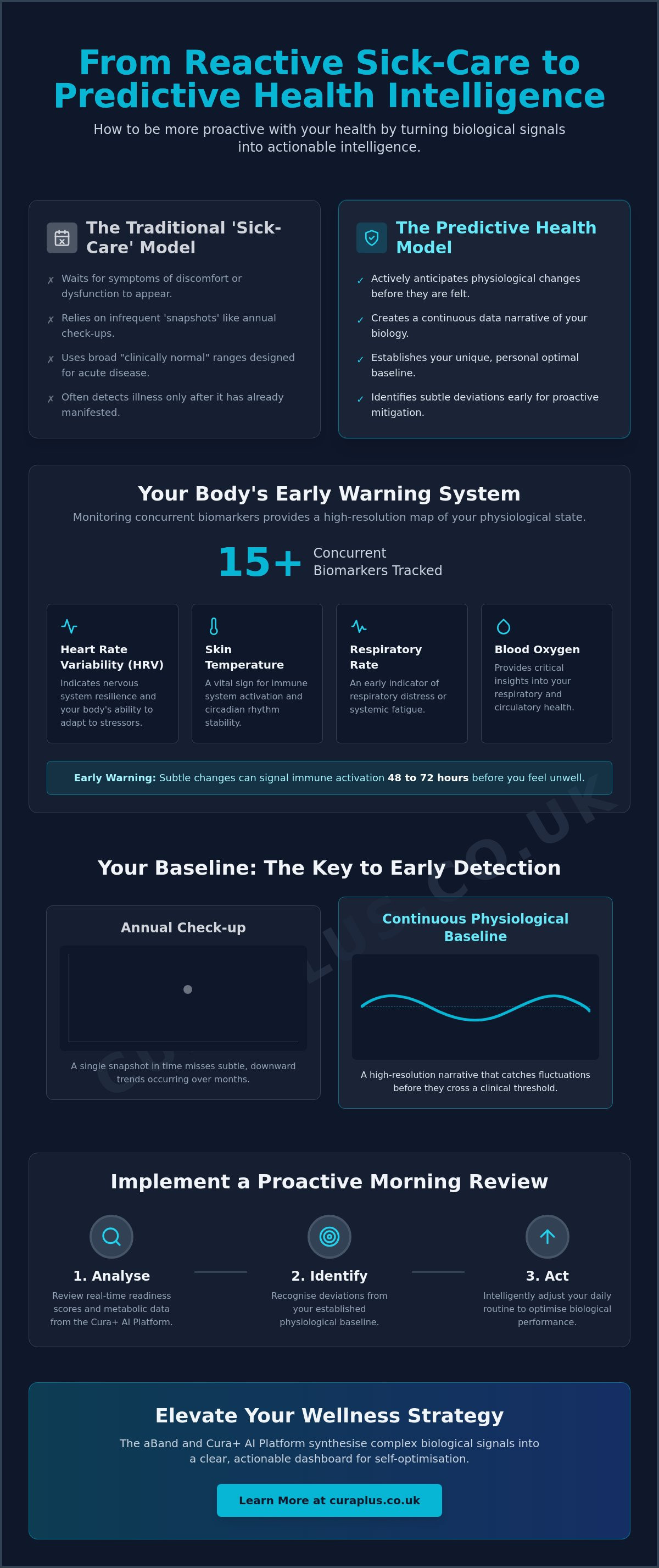
For decades, the standard approach to medicine has been fundamentally reactive. We wait for discomfort or dysfunction before seeking professional counsel. This "sick-care" model is increasingly insufficient for those prioritising longevity and peak performance. True health isn't the absence of disease; it's the presence of high-level physiological function. Understanding how to be more proactive with your health requires a departure from this passive stance. It demands a transition into a three-pillared framework: reactive treatment of existing issues, preventive care through lifestyle choices, and the emerging gold standard: predictive intelligence.
2026 marks a significant turning point for health autonomy in the United Kingdom. With the implementation of the Data (Use and Access) Act 2025 and updated medical device regulations, individuals now have unprecedented access to their own biological data. This shift empowers a "detective" mindset. Instead of assuming health in the absence of pain, you're now equipped to actively investigate internal biological shifts whilst feeling perfectly well. You're no longer a passive passenger in your own biology; you're the lead investigator.
The Limitations of Annual Check-ups
A single appointment at your GP surgery offers little more than a physiological snapshot. These infrequent measurements often miss subtle, downward trends that occur over months or years. The primary danger lies in the "clinically normal" range. These broad averages are designed to identify acute disease, not to define your personal optimal baseline. By the time traditional screenings detect a deviation, the underlying condition has often already manifested. Real proactivity requires continuous observation to catch these fluctuations before they cross the threshold into clinical illness.
Predictive Intelligence: The Future of Wellness
The objective is no longer merely avoiding illness. It's about optimising biological performance and extending your healthspan. Predictive wellness is the use of real-time biomarker data to anticipate physiological changes. By utilising advanced AI to synthesise complex data points, you can access personalised insights that adapt to your body's immediate needs. This strategy ensures you aren't just reacting to the past or following generic advice. Instead, you're using data-driven intelligence to master your future health trajectory.
The Role of Continuous Biomarker Monitoring in Predictive Intelligence
Biomarkers are the biological breadcrumbs left by your internal systems. They provide a high-resolution map of your physiological state, offering insights that remain invisible to the naked eye. To understand how to be more proactive with your health, you must move beyond occasional snapshots and embrace a continuous data narrative. Monitoring 15 or more concurrent biomarkers allows for a holistic view that isolated metrics simply cannot provide. It is the synthesis of these signals that reveals the true story of your well-being, allowing you to recognise patterns before they become problems.
The Autonomic Nervous System (ANS) serves as a primary focus for this predictive intelligence. By tracking the delicate balance between your sympathetic and parasympathetic branches, you can quantify stress and recovery with clinical precision. This continuous stream of data allows for the detection of viral onset long before physical symptoms appear. A subtle rise in nocturnal skin temperature or a sustained drop in baseline HRV often signals immune activation 48 to 72 hours before you feel unwell. This early warning system transforms your response from reactive treatment to proactive mitigation.
Key Metrics for Proactive Management
Effective health management relies on specific, high-fidelity data points. Heart Rate Variability (HRV) stands as the primary indicator of nervous system resilience, reflecting your body's ability to adapt to stressors. Skin temperature serves as a vital sign for immune system activation and the stability of your circadian rhythm. Additionally, monitoring respiratory rate and blood oxygen levels provides early indicators of respiratory distress or systemic fatigue, ensuring that no physiological shift goes unnoticed.
Moving Beyond Basic Fitness Trackers
Most consumer gadgets focus on superficial metrics like step counts and calories, which lack the clinical depth required for true predictive health. Transitioning to advanced biometric tracking for wellness ensures that your strategy is built on a foundation of data accuracy. High-fidelity sensors are essential for establishing a reliable baseline. Raw data alone is insufficient; it requires AI processing to transform biological noise into "Health Intelligence." This level of insight allows you to make informed decisions about your daily intensity and long-term recovery needs. Refining your internal awareness starts with a sophisticated physiological overview that empowers you to act with confidence.
Establishing Your Physiological Baseline: The Key to Early Detection
Your physiological baseline is the most valuable clinical asset you possess. It's not a static entry in a medical file; it's a dynamic, high-fidelity record of your unique biological rhythms. To truly understand how to be more proactive with your health, you must move beyond the generic "normal" ranges used by traditional medicine. These broad averages often mask early warning signs that are specific only to you. By establishing a personalised norm, you create a point of reference that allows for the "Deviation Principle" to function. This principle identifies potential health issues by measuring the distance between your current state and your established baseline.
Learning how to build a health baseline involves the continuous collection of data over a minimum of 14 to 21 days. This period allows AI algorithms to filter out daily noise and identify your true physiological centre. Your baseline is not permanent. It evolves as you age, improve your fitness, or change your lifestyle habits. Recognising these shifts ensures that your early warning system remains calibrated to your present self rather than a version of you from years ago.
The Science of Deviation Detection
AI excels at identifying "micro-trends" that are invisible to the human eye. Whilst a standard GP visit might show a heart rate within the traditional range, your continuous data might reveal a subtle, persistent elevation over several nights. This is the power of long-term trend analysis amongst daily fluctuations. For instance, detecting a 0.5-degree rise in nocturnal skin temperature 48 hours before a fever manifests can allow for immediate intervention. You can adjust your hydration, sleep, and activity levels before the illness takes hold. This level of foresight transforms health management from reactive recovery into proactive mastery.
Personalised Reference Ranges
Standard medical reference ranges are designed to capture a broad population mean. For high-performing individuals, these "averages" are often misleading. Your optimal heart rate variability or blood oxygen levels might sit at the very edge of these generic brackets. Crafting a bespoke wellness profile ensures that your health strategy reflects your unique biology rather than a statistical average. This data-driven clarity empowers more productive conversations with your healthcare provider. Instead of reporting vague symptoms, you can present a clear narrative of physiological deviations, allowing for faster and more accurate clinical decisions.
Practical Strategies for Organising a Proactive Health Routine
Establishing a physiological baseline is a vital first step, but true mastery occurs when you integrate this intelligence into your daily behaviour. Transitioning from passive monitoring to active health management requires a structured approach to data. Learning how to be more proactive with your health means using your biological signals as a compass for daily decision-making. This strategy ensures that your lifestyle choices are not based on generic advice or fleeting intuition, but on the specific needs of your biology at any given moment.
A central pillar of this routine is the "Proactive Morning Review." By examining your readiness score—a metric synthesised from sleep quality, HRV, and resting heart rate—you can dictate the appropriate intensity for your day. If your recovery metrics are suppressed, it's a clear signal to prioritising restorative activities. Conversely, high readiness scores indicate an opportunity for peak physical or cognitive performance. This methodical approach replaces the guesswork of traditional wellness with clinical precision.
Your environment should also be organised based on biometric feedback. If your data indicates poor sleep quality, you might adjust your room temperature or lighting based on what your body actually reports. It's equally important to use a wearable for tracking stress patterns to identify when psychological pressure begins to manifest as physiological strain. This foresight allows you to intervene before burnout occurs. Conduct regular "data audits" every fortnight to assess how your body is responding to these adjustments, ensuring your interventions remain effective as your fitness evolves.
Data-Driven Lifestyle Adjustments
Biomarker feedback allows you to validate your diet and exercise choices with objective evidence. You might find that certain foods cause a "silent" inflammatory response, visible only through subtle HRV dips or elevated resting heart rates. Identifying these silent stressors in your routine allows for a level of personalisation that generic programmes cannot match. Whilst self-tracking is powerful, personalised health coaching can help interpret complex trends, ensuring you maintain long-term proactivity without feeling overwhelmed by the data.
Building a Proactive Support Network
Proactivity extends to how you interact with others. You can now share predictive data with family or medical specialists securely, providing them with a high-resolution view of your health trajectory. This shifts the dynamic of clinical consultations. You move from "complaining of symptoms" to "presenting data-driven insights," which facilitates more accurate and efficient care. Ultimately, the greatest benefit is psychological. Replacing health anxiety with health agency provides a sense of calm control over your future well-being. Begin your journey toward physiological mastery by exploring the Cura+ AI Platform today.
Elevating Your Wellness Strategy with theBand by Cura+
The transition from theoretical knowledge to practical mastery requires a tool that matches the complexity of the human body. Whilst previous sections have outlined the framework for predictive wellness, successful implementation depends on high-fidelity data acquisition. theBand by Cura+ represents the pinnacle of this technological evolution. It's a sophisticated multi-sensor wearable engineered specifically for predictive intelligence. By monitoring over 15 concurrent biomarkers, including continuous glucose, ECG, and inflammation markers, it provides the resolution necessary to move beyond basic step-counting into true physiological oversight.
The Cura+ AI Platform serves as the intellectual engine for this hardware, transforming raw biological noise into a real-time health dashboard. This synergy allows you to understand how to be more proactive with your health by visualising subtle internal shifts before they manifest as physical discomfort. Predictive alerts act as a secondary nervous system, identifying the early signals of viral onset or systemic strain with clinical precision. This level of foresight is why theBand is recognised as the best advanced wellness tracker for individuals who refuse to settle for the traditional "wait and see" model of medicine.
Continuous Monitoring, Personalised Intelligence
Continuous observation is the foundation of theBand's 24/7 "security system" approach to biological health. It doesn't offer episodic snapshots; instead, it maintains a constant narrative of your internal state. Advanced AI algorithms process this continuous stream, identifying micro-trends that indicate long-term health trajectories. The recurring insights provided through the Cura+ membership ensure that your strategy evolves alongside your biology. This methodical process provides a level of clarity that empowers you to make high-stakes decisions about your recovery and performance with absolute confidence.
Join the Future of Proactive Health
Choosing to live a predictive lifestyle is a commitment to self-optimisation and long-term vitality. Cura+ is dedicated to maintaining clinical-grade accuracy whilst ensuring the highest standards of data privacy, adhering to the latest UK regulations governing health data. You have the power to replace uncertainty with actionable intelligence today. It's time to move beyond the limitations of reactive healthcare and take command of your physiological future. Secure your future health with theBand by Cura+ and experience the calm control of data-driven wellness.
Take Command of Your Biological Future
The transition from reactive medicine to a data-driven strategy is no longer a futuristic concept; it's a present-day reality. By establishing a high-resolution physiological baseline and monitoring deviations in real-time, you replace the uncertainty of "wait and see" with the clarity of clinical insight. Learning how to be more proactive with your health requires using these biological signals to recognise shifts before they become symptomatic. This level of autonomy depends on sophisticated tools that bridge the gap between raw data and actionable intelligence.
theBand by Cura+ provides this essential bridge by monitoring 15+ biomarkers simultaneously with clinical-grade sensor accuracy. Its AI-driven platform delivers predictive alerts that act as a personal early warning system for your body. Don't wait for your health to demand attention. Master your health with theBand by Cura+. Embrace the calm control that comes with true physiological mastery. Your journey toward a more refined, optimised self begins today.
Frequently Asked Questions
What is the main difference between proactive and reactive healthcare?
Proactive healthcare prioritises the maintenance of optimal function and the early detection of physiological shifts before symptoms manifest. In contrast, reactive healthcare, often termed "sick-care," focuses on treating conditions only after they cause discomfort or dysfunction. By adopting a proactive stance, you shift from being a passive recipient of treatment to an active manager of your long-term vitality and biological performance.
How can a wearable device help me be more proactive with my health?
A wearable device provides a continuous narrative of your internal state that episodic clinical visits cannot capture. By tracking high-fidelity data points like heart rate variability and nocturnal skin temperature, these devices reveal subtle trends and deviations from your norm. This intelligence allows you to understand how to be more proactive with your health by adjusting your lifestyle interventions in real-time.
Which biomarkers are most important for predicting illness early?
Heart Rate Variability (HRV), resting heart rate, and nocturnal skin temperature are the primary indicators for early illness prediction. A sustained decrease in HRV or a subtle rise in baseline temperature often signals immune system activation before you feel unwell. Monitoring these alongside respiratory rate and blood oxygen levels provides a comprehensive early warning system for your physiological resilience.
Is it possible to detect a cold or flu before symptoms appear?
Yes, physiological changes often precede the physical symptoms of viral infections by 48 to 72 hours. Subtle elevations in resting heart rate and respiratory rate are common early signals that your body is responding to a pathogen. Using predictive AI to identify these micro-deviations allows you to prioritise rest and hydration earlier, potentially reducing the severity and duration of the illness.
How do I establish a personal health baseline?
You establish a personal baseline by consistently monitoring your biomarkers over a period of 14 to 21 days during your normal routine. This duration allows AI algorithms to filter out daily fluctuations and identify your unique physiological centre. Once this norm is defined, your system can accurately flag significant distances from this baseline as potential health deviations that require your attention.
Can proactive health monitoring reduce my long-term medical costs?
Early detection and prevention are widely recognised as effective strategies for reducing long-term healthcare expenditure by avoiding acute complications. Whilst we don't provide clinical diagnoses, maintaining high-level function through data-driven choices can mitigate the need for emergency interventions later. Investing in predictive wellness tools now is a strategic move to protect both your future health and your financial well-being.
Is my biometric data secure when using AI health platforms?
Data security is governed by rigorous regulations such as the UK GDPR and the Data (Use and Access) Act 2025 to ensure your biological identity remains protected. Reputable platforms utilise end-to-end encryption and anonymised data processing to maintain the highest standards of privacy. It's essential to choose providers that comply with recognised frameworks like the NHS Digital Technology Assessment Criteria (DTAC).
Do I still need to see a doctor if I monitor my health proactively?
Yes, proactive monitoring is designed to complement professional medical counsel, not replace it. Your data serves as a powerful tool to facilitate more informed, data-driven conversations with your healthcare provider. By presenting a clear narrative of your physiological trends and deviations, you help your GP make faster and more accurate clinical decisions during your scheduled appointments.


