


Your wearable device is far more than a digital diary of last night's rest; it's a sophisticated weather forecast for your biological resilience. Whilst most users are inundated with a cascade of graphs and percentages, they often find themselves wondering exactly how to interpret my sleep data to make meaningful changes. You've likely experienced the confusion of seeing a high readiness score whilst feeling fatigued, or struggled to understand why your deep sleep levels fluctuate so dramatically. It's a common state of information overload that often leaves the most vital insights undiscovered.
We view health as a complex system to be mastered rather than a series of symptoms to be managed. This guide provides a clear framework to transform confusing metrics into predictive health intelligence. You'll learn to spot the early warning signs of illness by monitoring subtle shifts in Heart Rate Variability and resting heart rate. We'll move beyond basic tracking to help you build an optimised recovery routine based on the latest 2025 guidelines from the World Sleep Society. By aligning your biometrics with your daily performance, you can finally replace uncertainty with the calm control of data-driven clarity.
Key Takeaways
- Discover how to decode your sleep architecture to understand the glymphatic system's role in cognitive restoration and physiological transformation.
- Learn why Heart Rate Variability (HRV) remains the gold standard for assessing your autonomic nervous system and daily biological readiness.
- Master a precise framework for how to interpret my sleep data using the "Rule of Three" to identify subtle deviations that predict impending illness.
- Understand the correlation between skin temperature fluctuations and immune activation to proactively adjust your recovery and training routines.
- Explore how the Cura+ AI platform synthesises complex biomarkers into a single, clarity-driven dashboard for total health mastery and performance optimisation.
The Language of Rest: Why Interpreting Sleep Data Matters
Sleep is not a passive state of unconsciousness. It is a dynamic, highly regulated physiological process that serves as a direct window into your autonomic nervous system. For the sophisticated health optimiser, your nightly biometrics represent a real-time report on your body's internal balance. We have moved far beyond the era of simple step-counting. Today, the focus has shifted toward complex biomarker monitoring, where every heart beat and breath provides a data point for your long-term wellness strategy.
Many users now experience a specific form of "data fatigue" when confronted with endless, uninterpreted graphs. Looking at a screen full of percentages without context can feel overwhelming rather than empowering. To move past this, you must understand how to interpret my sleep data through the lens of a biological baseline. This baseline is your unique physiological signature. By establishing what is "normal" for your specific biology, you can distinguish between minor daily fluctuations and the significant shifts that signal a need for intervention.
Beyond the Eight-Hour Myth
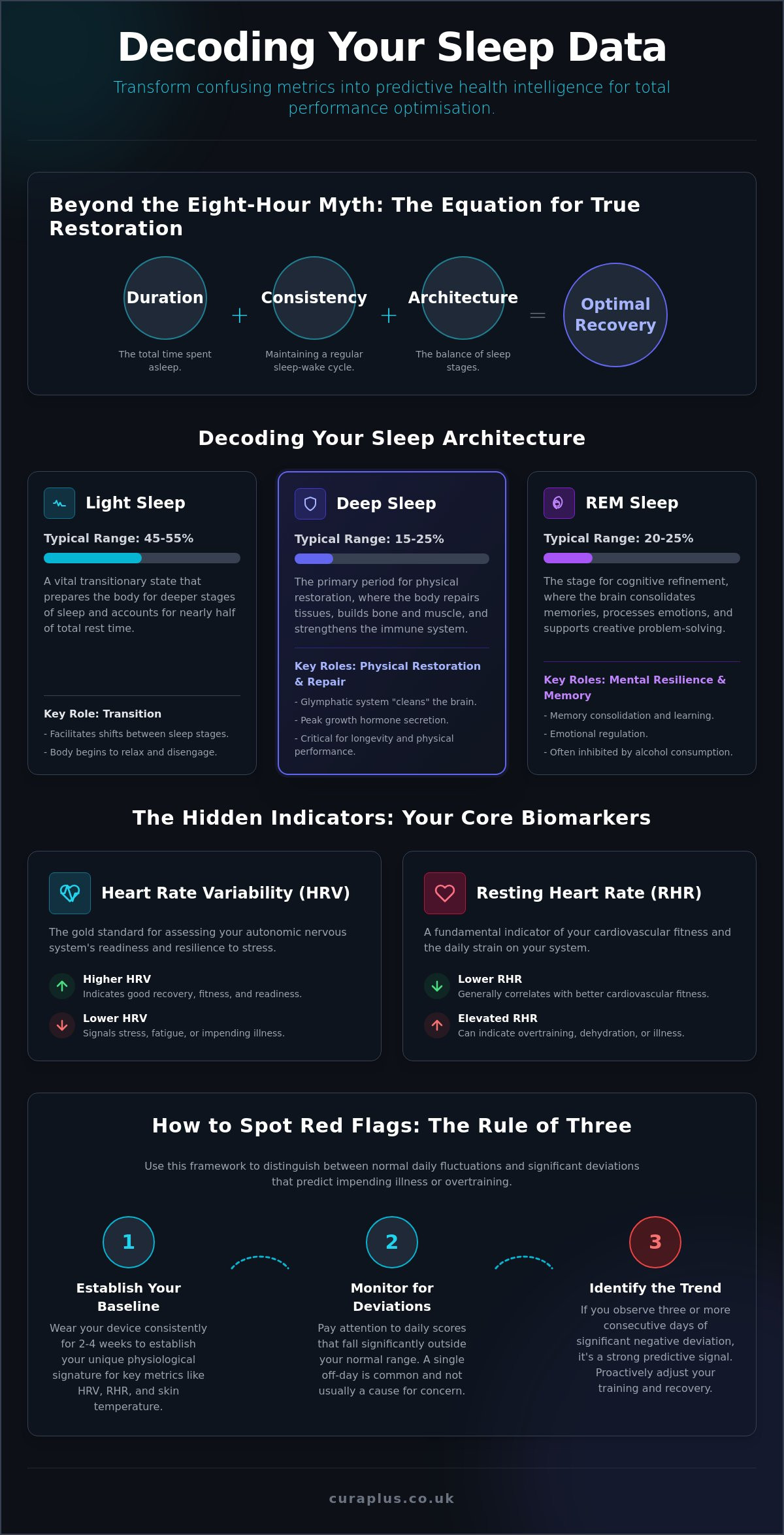
The cultural obsession with sleep duration often obscures the more critical dimensions of rest. Whilst eight hours is a common benchmark, it represents only one-third of the total health equation. True restoration depends on consistency and the intricate balance of sleep architecture. Your body doesn't recover uniformly throughout the night. Instead, it follows a strict hierarchy of needs. It prioritises physical repair and growth hormone release during the early hours, whilst cognitive processing and emotional regulation take precedence in the later stages. If your schedule is inconsistent, you disrupt this delicate rhythm, regardless of how many hours you spend in bed.
The Distinction Between Tracking and Intelligence
There is a fundamental difference between tracking and intelligence. Tracking is the passive collection of data; intelligence is the synthesis of that data into actionable insight. This is where predictive health wearables UK diverge from standard fitness trackers. High-performance optimisation requires high-fidelity sensors capable of clinical-grade accuracy. Without precise measurement, the data is merely noise. When you have access to high-resolution biometrics, your sleep data stops being a summary of the past and starts becoming a predictive dashboard for your future performance. It's the difference between knowing you slept poorly and knowing exactly how to adjust your day to compensate for it.
Decoding Sleep Architecture: REM, Deep, and Light Sleep
True sleep is a sequence of 90-minute windows, each facilitating a distinct phase of physiological transformation. Whilst many users dismiss light sleep as filler, it serves as a vital transitionary state that accounts for nearly half of your total rest. Learning how to interpret my sleep data requires moving beyond the surface totals to examine how your body navigates these specific cycles. Each stage plays a unique role in your biological readiness. Understanding the nuances of HRV during specific sleep stages allows you to measure the depth of your autonomic recovery with precision.
Deep Sleep: The Body’s Repair Shop
Deep sleep, or slow-wave sleep, is your primary period of physical restoration. During this phase, the glymphatic system becomes highly active. It essentially "cleans" the brain of metabolic waste products. It is also the window where growth hormone secretion peaks. This facilitates muscle repair and tissue growth. As we age, the percentage of deep sleep naturally declines. Protecting this stage is critical for longevity. You should manage environmental variables like ambient light and core body temperature to safeguard these cycles. Sophisticated tools like theBand provide the high-resolution metrics needed to track these fluctuations with clinical accuracy.
REM Sleep: Mental Resilience and Memory
Rapid Eye Movement (REM) sleep is the theatre of cognitive refinement. This is where your brain organises memories, processes emotional experiences, and engages in creative problem-solving. A lack of REM sleep often manifests as irritability. It can also lead to a decrease in executive function. Certain substances, particularly alcohol and specific medications, can selectively inhibit these cycles. This leads to fragmented, non-restorative rest. When you assess your metrics, pay close attention to REM latency. If you enter REM too quickly, it's often a sign of chronic sleep deprivation. By mastering how to interpret my sleep data, you can identify these patterns and proactively adjust your evening routine to prioritise mental resilience.
The Hidden Indicators: HRV and Resting Heart Rate
Whilst sleep stages define the structural architecture of your night, your cardiovascular biometrics reveal the true depth of your internal recovery. Heart Rate Variability (HRV) is the gold standard for assessing the health of your autonomic nervous system. It measures the millisecond variations between consecutive heartbeats, serving as a real-time proxy for your body's ability to navigate stress. A high HRV indicates a nervous system that is responsive and resilient, whilst a low HRV suggests that your body is trapped in a state of sympathetic "fight or flight" dominance. When you evaluate how to interpret my sleep data, these heart-centric metrics often provide a more nuanced picture of your biological readiness than sleep duration alone.
Your Resting Heart Rate (RHR) acts as a secondary anchor for this analysis. A lower nocturnal RHR typically signals superior cardiovascular efficiency and a body that has successfully transitioned into a state of deep rest. There is an inverse relationship between physiological stress and these indicators. If your RHR remains elevated throughout the night, your heart is working harder than necessary, often at the expense of tissue repair and immune function. By synthesising these biomarkers, you can transform abstract numbers into a predictive dashboard for your daily performance.
HRV: Your Stress Compass
HRV is the ultimate stress compass, reflecting the delicate balance between your sympathetic and parasympathetic nervous systems. It's vital to track your individual HRV baseline rather than chasing population averages. For context, research indicates that the average RMSSD (a common HRV metric) for individuals aged 18 to 25 is 60 to 80 ms, whilst this typically drops to 25 to 38 ms for those aged 56 to 65. Because HRV is highly individual, a "good" number is simply one that aligns with your personal peak performance. Utilising a sophisticated device to measure HRV allows you to monitor these trends with the precision required for high-level health mastery.
Resting Heart Rate and Immune Response
Your nocturnal RHR is a sensitive early warning system for your immune health. A sudden spike in RHR, often occurring 24 to 48 hours before you feel any symptoms, can predict the onset of viral infection or systemic inflammation. External factors like late-night meals, alcohol consumption, or evening caffeine can artificially elevate your heart's recovery floor, preventing it from reaching its lowest point until the early morning hours. Monitoring these deviations is essential for determining your "daily readiness." If your RHR is significantly above your baseline, it's a clear signal to prioritise recovery over high-intensity physical or mental exertion. Mastering how to interpret my sleep data in this way ensures you are always working with your biology, not against it.
How to Spot Red Flags and Predictive Signals in Your Data
Most individuals view their biometrics as a retrospective report card. They look at last night's score and move on. To truly master how to interpret my sleep data, you must shift your perspective from historical analysis to predictive intelligence. Your body often signals a decline in resilience long before you feel the first symptoms. By identifying specific patterns, you can intervene before a minor stressor becomes a systemic failure. This transition from passive observer to active strategist is the foundation of high-level health optimisation.
We utilise the "Rule of Three" as a primary diagnostic framework for our users. A single night of poor data might be an outlier caused by a late meal or a stressful evening. However, if your metrics deviate from your established baseline for 72 consecutive hours, it indicates a significant biological shift. This is not just a bad night; it is a trend that requires immediate attention. Understanding how to interpret my sleep data allows you to distinguish between an acute drop, which is a normal response to temporary exertion, and a chronic downward trend that suggests systemic fatigue.
Skin temperature is a vital, often overlooked component of this predictive model. Whilst your core temperature is tightly regulated, your peripheral skin temperature fluctuates in response to immune system activation. A sustained increase in nocturnal skin temperature, whilst often subtle, is a hallmark of the body's inflammatory response. When this is coupled with a suppressed Heart Rate Variability, the data is no longer just reporting on your sleep; it is forecasting your health status for the days ahead.
Predicting Illness Before the First Symptom
The science behind a wearable for tracking immune health relies on the correlation between heart rate, HRV, and temperature. A simultaneous drop in HRV and a rise in skin temperature is a major red flag. When this pattern emerges, you should prioritise hydration, rest, and micronutrient support immediately. This proactive approach allows you to manage the severity of an illness before it fully manifests, ensuring you remain in control of your performance schedule.
Identifying Overtraining and Burnout
You can track daily readiness by monitoring how sleep debt accumulates over a working week. A difficult day leaves a distinct "stress signature" in your data, typically manifesting as a delayed heart rate drop and increased restlessness. If your deep sleep stages are consistently truncated, your physical repair shop is effectively closed. Use this data to justify a rest day to yourself or a coach. It's not laziness; it's data-driven precision. To access this level of predictive insight, explore the advanced capabilities of theBand and the Cura+ AI platform.
Mastering Your Health with theBand and Cura+ AI
The transition from fragmented data points to a unified health strategy requires a tool that matches the complexity of the human body. Whilst standard wearables offer a glimpse into your nightly rest, theBand by Cura+ serves as a high-fidelity bridge between raw biological signals and cognitive clarity. By synthesising 15+ biomarkers, including HRV, respiratory rate, and oxygen saturation, our platform transforms a chaotic stream of numbers into a single, clarity-driven dashboard. You no longer have to wonder how to interpret my sleep data; instead, you receive a definitive report on your body's readiness and resilience.
Our approach moves beyond the passive notifications found in generalist ecosystems. The Cura+ AI platform utilizes predictive intelligence to issue real-time alerts that forecast physiological shifts before they impact your performance. If your data indicates a suppressed recovery trend, the system doesn't just notify you of the decline. It provides specific, personalised coaching based on your unique physiological history. This level of insight ensures that every decision you make, from your morning workout to your evening wind-down, is anchored in the reality of your current biological state.
From Raw Data to Actionable Intelligence
The primary challenge for most users is the initial setup of their biological parameters. Our AI removes the guesswork from how to build a health baseline by automatically identifying your personal norms through continuous monitoring. This persistent oversight is fundamentally superior to sporadic health check-ups, which only offer a static snapshot in time. Having an AI health and wellness coach in your pocket means your data is being analysed every second. It ensures that your interpretation of "normal" evolves as your fitness and health improve.
Your Journey to Biological Optimisation
Mastering how to interpret my sleep data is a long-term investment in your longevity. By understanding the subtle language of your autonomic nervous system, you gain the power to mitigate chronic stress and prevent burnout before it takes root. theBand empowers you to take absolute control of your future health today, replacing the uncertainty of "feeling" tired with the precision of knowing your limits. We invite you to join our exclusive pre-launch community. Secure your place at the forefront of the proactive health revolution and begin your journey toward total biological mastery.
Elevate Your Health Intelligence
Transitioning from passive tracking to active health mastery is no longer a futuristic concept; it's an accessible reality. By understanding the intricate interplay between your sleep architecture and autonomic nervous system, you've gained a framework to predict illness and optimise your recovery. Mastering how to interpret my sleep data allows you to act on subtle biometric shifts before they manifest as physical symptoms, replacing uncertainty with strategic control.
Precision is the foundation of this mastery. theBand, designed and engineered in the UK, monitors over 15 biomarkers simultaneously to provide a comprehensive view of your internal state. When paired with the Cura+ AI platform, these signals become actionable through AI-driven predictive health alerts that guide your daily decisions with clinical accuracy.
Discover theBand by Cura+: The Future of Predictive Health
You now possess the tools to move beyond guesswork and step into a life of data-driven clarity. Your journey to total biological optimisation begins tonight.
Frequently Asked Questions
Is it normal for my sleep data to change every night?
Fluctuations in your nocturnal biometrics are entirely expected and reflect your body's response to daily variables. Factors such as physical exertion, dietary choices, and mental stress will cause your metrics to shift from one night to the next. Rather than focusing on a single data point, you should observe the broader trends over a seven-day period. This perspective helps you understand how your lifestyle impacts your long-term biological resilience.
Can I trust the accuracy of my wearable’s sleep stages?
Consumer wearables are highly effective at distinguishing between sleep and wake states, often reaching over 95% sensitivity. However, the precision of specific sleep stage classification is more variable, typically ranging from 50% to 86% accuracy. Whilst these devices are not a substitute for clinical polysomnograpy, they are invaluable for identifying personal trends and patterns. Use the data as a directional guide for self-optimisation rather than a definitive medical diagnosis.
What is a good HRV score for a healthy adult?
Heart Rate Variability is a deeply personal metric, and a "good" score is simply one that aligns with your individual peak performance. For context, the average RMSSD for adults aged 18 to 25 is 60 to 80 ms, whilst those aged 56 to 65 typically see 25 to 38 ms. Because these numbers naturally decline with age and vary by individual, you should focus on your personal baseline. Chasing population averages is less effective than monitoring your own deviations.
Why does my tracker say I had a bad sleep when I feel fine?
Subjective feelings of alertness don't always reflect the underlying state of your autonomic nervous system. Your device may detect physiological strain, such as a suppressed HRV or a delayed heart rate drop, that hasn't yet manifested as conscious fatigue. Understanding how to interpret my sleep data allows you to recognise these invisible stressors early. This predictive insight enables you to adjust your intensity before systemic exhaustion or illness takes hold.
How much deep sleep do I actually need per night?
Healthy adults generally require between 1.5 and 2 hours of deep sleep, which usually accounts for 15% to 25% of their total sleep time. This stage is critical for the glymphatic system's role in waste clearance and the secretion of growth hormones for physical repair. If you consistently fall below this threshold, your body's ability to recover from physical and cognitive strain is significantly compromised, regardless of your total sleep duration.
Can sleep data really predict if I am getting a cold?
Your biometrics often serve as a sophisticated early warning system for immune activation. A sudden spike in nocturnal resting heart rate combined with a rise in skin temperature can predict the onset of symptoms by 24 to 48 hours. By mastering how to interpret my sleep data, you can identify these subtle red flags. This allows you to prioritise rest and hydration immediately, potentially reducing the severity or duration of the impending illness.
What should I do if my resting heart rate is consistently high at night?
A persistently elevated nocturnal resting heart rate suggests that your body is struggling to enter a restorative state. You should first evaluate lifestyle factors such as late-night meals, alcohol consumption, or excessive evening blue light exposure. If these adjustments don't lower your heart rate, it may indicate chronic stress or overtraining. Use this data as a foundation for a conversation with a healthcare professional to investigate potential systemic issues.
How long does it take for a wearable to establish my health baseline?
Most advanced systems require between 14 and 30 days of consistent data collection to establish a reliable biological baseline. This duration allows the AI to account for your natural physiological cycles and various lifestyle stressors. Once this reference point is set, the platform can accurately identify significant deviations. This ensures that the alerts and coaching you receive are tailored specifically to your unique biology rather than generic population norms.


