


What if the first sign of illness isn't a fever, but a subtle shift in your heart rate variability that occurs long before you feel a single symptom? You recognise that your body is a complex system, yet it often feels like a black box until a sudden viral onset halts your progress. It's frustrating to rely on generic devices that offer data without context; you need clarity to make informed decisions. Utilising a wearable for early illness detection allows you to move beyond reactive habits and embrace a visionary approach to personal health. By identifying deviations from your unique physiological baseline, you can reclaim control over your professional performance and your wellbeing.
You've likely felt the anxiety of interpreting subtle physiological changes without a clear framework for action. This guide will provide the clinical precision you need to transform those raw numbers into a decisive strategy for self-optimisation. You'll learn how to leverage the advanced biometrics of theBand and the analytical power of the Cura+ AI Platform to detect illness in its earliest stages. We'll outline a methodical system for interpreting biometric alerts, ensuring you have the confidence to take pre-emptive action whilst others are still waiting for symptoms to appear.
Key Takeaways
- Transition from retrospective fitness tracking to a proactive model of health intelligence to anticipate physiological changes before they disrupt your performance.
- Understand the significance of Heart Rate Variability and skin temperature as primary indicators of your nervous system's response to emerging immune threats.
- Discover the methodical process of establishing a personal baseline, which is the essential foundation for using a wearable for early illness detection effectively.
- Gain the analytical skills required to differentiate between standard stress-induced deviations and the distinct data patterns associated with viral infections.
- Explore how the comprehensive 15+ biomarker array within theBand and the Cura+ AI Platform provides the clarity needed for precise health mastery.
The Evolution of Predictive Health: Beyond Basic Fitness Tracking
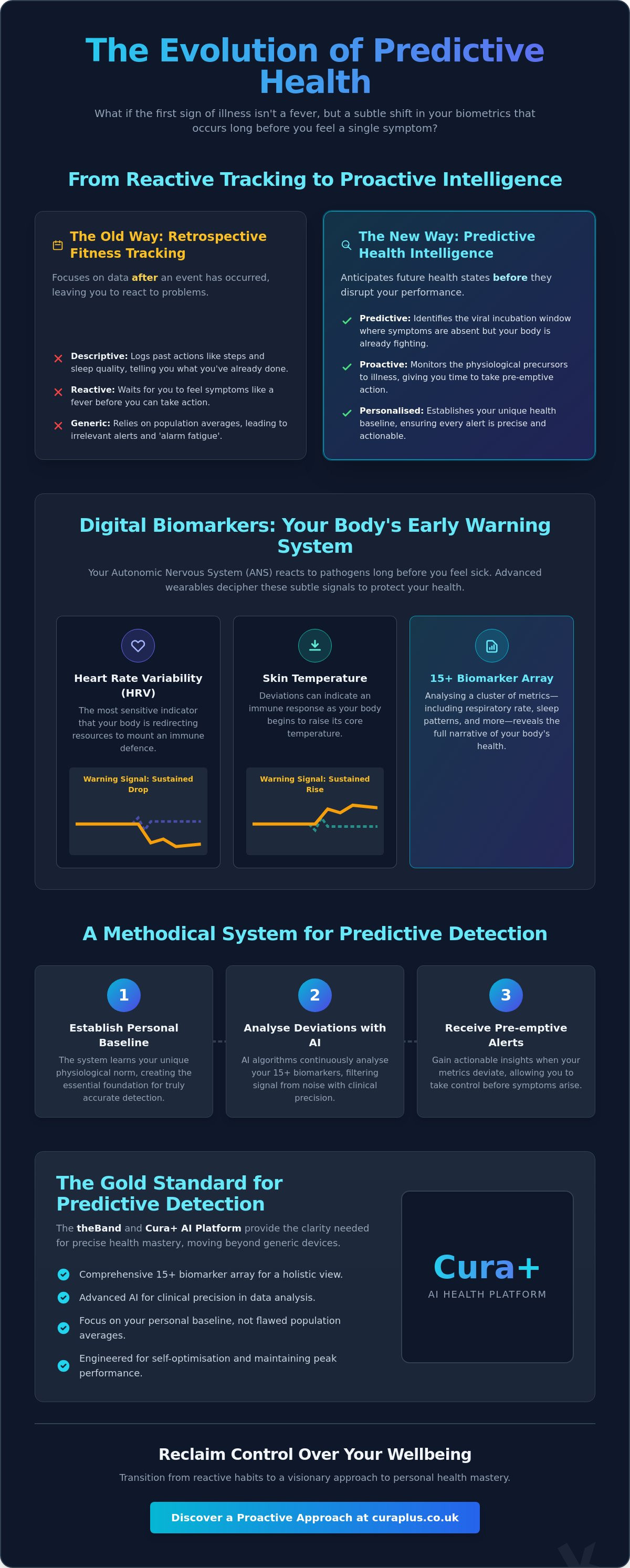
For decades, the health technology market has focused on retrospective data. You track your steps after you've walked them; you log your sleep quality after you've woken up. This approach is descriptive, but it isn't transformative. A true wearable for early illness detection represents a fundamental shift from counting past actions to predicting future states. It functions as a sophisticated health intelligence tool, monitoring biomarkers to identify the subtle incubation window where a virus is present but symptoms are absent. Whilst traditional trackers wait for you to feel a fever, predictive monitoring looks for the physiological precursors that signal your body is already mounting a defence.
The core of this technology lies in the concept of physiological homeostasis. Your body is a complex system that constantly works to maintain a stable internal environment. When an illness begins to take hold, this balance is disrupted long before you experience a sore throat or a cough. Advanced AI algorithms, such as those within the Cura+ AI Platform, are trained to recognise these micro-fluctuations. By identifying when your metrics deviate from your established norm, the system provides a visionary glimpse into your health status, allowing for a level of proactive management that was previously impossible.
Why 2026 is the Year of Predictive Wellness
The maturation of AI algorithms has finally reached a point where they can process complex biological signals with clinical precision. We're seeing a distinct shift in British consumer behaviour, where the focus has moved from mere aesthetics to long-term longevity and preventative care. Modern wearable technology now possesses the processing power to filter through thousands of data points to find the signal amongst the noise. This isn't about biohacking for the sake of novelty. It's about maintaining peak performance. As these tools become more accessible, the ability to anticipate a health decline becomes a standard requirement for those committed to excellence.
The Problem with Generic Health Averages
The greatest flaw in traditional health monitoring is the reliance on population averages. What is "normal" for the general public is often entirely irrelevant to your specific physiology. If you rely on generic thresholds, you'll likely experience alarm fatigue, where your device flags issues that don't exist or ignores those that do. Precision requires a personalised approach. By refining data to your unique baseline, a wearable for early illness detection becomes a reliable strategist for your health. This level of refinement ensures that every alert is actionable, replacing the anxiety of uncertainty with the clarity of data-driven insight. Tools like theBand are designed to bypass these generic pitfalls, focusing instead on the high-stakes journey of self-optimisation.
Identifying the Digital Biomarkers of Early Illness
The transition from general tracking to high-fidelity monitoring begins with understanding the specific biological signals your body emits. A high-quality wearable for early illness detection doesn't just record data; it deciphers the complex language of your physiology. This process involves monitoring a cluster of metrics that, when viewed in isolation, might seem insignificant. However, when analysed together, they reveal a clear narrative of your body's internal struggle against emerging threats. By focusing on the synergy of 15+ biomarkers, you move beyond the limitations of basic heart rate monitoring and into the realm of predictive health mastery.
The Autonomic Nervous System (ANS) as an Early Warning Signal
Your ANS is the silent conductor of your body's internal functions. It maintains a delicate balance between the sympathetic state, which prepares you for action, and the parasympathetic state, which facilitates recovery. When a pathogen enters your system, your ANS reacts immediately. This reaction occurs long before physical symptoms manifest. The most sensitive indicator of this shift is Heart Rate Variability (HRV). A sudden, sustained drop in HRV suggests that your body is redirecting its resources to the immune system. To understand the full scope of these signals, it's beneficial to explore what biomarkers can wearables track to see how they interplay to protect your wellbeing.
Thermal Trends and Immune Responses
Whilst a clinical fever is a late-stage symptom, subtle thermal trends provide a much earlier warning. A thermal deviation of just 0.5°C from your established baseline can be far more significant than a full fever. This is because your body begins to regulate its core temperature upward to create an inhospitable environment for viruses. Nocturnal monitoring is essential for this. During sleep, external variables like movement or ambient temperature are minimised, allowing for an accurate thermal baseline. We define a thermal deviation as a primary digital biomarker for viral onset. It serves as a clear indicator that your immune system has activated its first line of defence.
True precision emerges from the synergy of monitoring multiple metrics simultaneously. For instance, a drop in HRV combined with a slight rise in respiratory rate and a dip in blood oxygen saturation provides a high-fidelity insight that a single heart rate reading cannot match. This multi-layered approach eliminates the guesswork. By integrating these diverse signals, the Cura+ AI Platform offers a comprehensive view of your physiological state. This level of detail ensures you aren't just reacting to symptoms, but mastering the intelligence of your unique body. When you utilise a wearable for early illness detection, you're investing in a sophisticated strategist for your long-term health.
How to Establish a Personal Health Baseline for Accurate Detection
The efficacy of a wearable for early illness detection depends entirely on the quality of your personal baseline. Think of this baseline as the blueprint of your body's optimal state. Without it, the data provided by your device lacks the necessary context to distinguish between a minor lifestyle fluctuation and a genuine viral threat. Establishing this foundation requires a deliberate period of "clean" data collection, where your physiological markers aren't influenced by active illness or extreme, uncharacteristic stress. This methodical approach ensures that the alerts you receive are precise and actionable rather than distracting noise.
Consistency is your greatest ally during this phase. To ensure data integrity, you must maintain steady habits, including device placement and sleep hygiene. The Cura+ AI Platform utilises these initial readings to build a high-fidelity model of your unique circadian rhythms and physiological responses. Over several months of continuous wear, the AI further refines this model; it becomes increasingly adept at identifying even the most microscopic deviations from your norm. This isn't a static process but a continuous refinement of your health intelligence.
Step 1: The Initial Calibration Period
A minimum 14-day calibration period is essential for the AI to learn your body's specific patterns. During these two weeks, you should aim to live as normally as possible whilst being diligent about tagging "outlier" events. If you've had a night of heavy alcohol consumption or you're recovering from long-haul travel, these events must be logged to prevent them from skewing your baseline. For a more comprehensive look at this process, you can consult our detailed guide on how to build a health baseline. This initial investment in accuracy pays dividends in the long-term reliability of your predictive wellness strategy.
Step 2: Monitoring Multi-Variate Deviations
Effective detection isn't about reacting to a single metric spike. A high heart rate after a stressful meeting is a normal response, not an illness. You must learn to look for clusters of changes across multiple biomarkers. For example, a simultaneous drop in Heart Rate Variability and a rise in resting heart rate is far more indicative of a viral onset than either metric alone. Your Readiness Score within the Cura+ ecosystem provides a synthesised view of these metrics in relation to your baseline. To maintain accuracy, consider this daily review checklist:
- Check for clusters: Are multiple markers, such as HRV, temperature, and respiratory rate, deviating simultaneously?
- Contextualise alerts: Can a deviation be explained by a known factor like a late-night workout or poor sleep hygiene?
- Verify data quality: Was theBand securely positioned throughout the night for optimal sensor contact?
By following this system, you move from passive tracking to active health mastery. A wearable for early illness detection is only as powerful as the baseline it references. Your commitment to this process is what unlocks its visionary potential, allowing you to intercept illness before it gains a foothold.
Interpreting Physiological Deviations: Stress, Fatigue, or Viral Onset?
Your body is a masterpiece of communication, yet its signals are often misinterpreted. One of the primary challenges you'll face is determining whether a biometric alert signifies a genuine health threat or merely the residue of a demanding day. Accuracy in this interpretation is what separates generic tracking from true physiological mastery. When you utilise a wearable for early illness detection, you're looking for a specific cluster of deviations that suggest your immune system has shifted its priorities. Understanding these distinctions replaces reactive anxiety with the calm control of data-driven insight.
Decoding the "Stress Signature"
Acute stress and viral onset can initially look similar on a dashboard, as both typically cause a spike in heart rate and a sharp drop in Heart Rate Variability (HRV). However, stress is usually a transient disruption whilst illness represents a systemic shift. Stress-induced changes often normalise quickly once the stimulus is removed. If you notice a suppressed HRV after a high-stakes meeting but your skin temperature remains stable, you're likely looking at a stress signature. To refine your understanding of these patterns, you can consult our guide on a wearable for tracking stress patterns, which details how to isolate lifestyle variables from biological threats.
When to Trust the Alert: The 3-Biomarker Rule
To eliminate the "false alarm" fatigue common with lower-tier devices, we recommend a specific heuristic: the 3-biomarker rule. If your HRV, skin temperature, and resting heart rate all deviate from your baseline simultaneously, the probability of an emerging illness is significantly higher. TheBand by Cura+ is engineered to automate this complex cross-referencing, utilizing the Cura+ AI Platform to identify these clusters in real-time. When this predictive alert triggers, it's a signal to pivot from high-performance mode to a "rest-first" strategy. This pre-emptive action often reduces the severity and duration of the impending illness.
The "recovery curve" provides the final piece of the puzzle. If your metrics begin to return to baseline after a night of deep sleep and increased hydration, your body was likely managing acute fatigue. If the metrics remain suppressed or continue to trend away from your norm, it confirms a systemic immune response is underway. This level of clarity allows you to make informed decisions about your schedule and commitments before physical symptoms even appear. To secure this level of physiological intelligence for yourself, explore the capabilities of theBand and the Cura+ AI Platform.
- Rest: Prioritise an additional 90 minutes of sleep to support immune function.
- Hydration: Increase water intake to assist in cellular repair and temperature regulation.
- Monitoring: Review your biomarkers every four hours to track the trajectory of the deviation.
By following this framework, you transform raw data into a sophisticated strategy for self-optimisation. You don't have to guess if you're getting sick; you have the data to prove it. This proactive approach ensures you remain the architect of your own wellbeing, even when your internal environment is under threat.
Why theBand by Cura+ is the Gold Standard for Predictive Detection
The previous sections have established a rigorous framework for personal health mastery, from establishing a baseline to decoding complex stress signatures. However, the efficacy of this strategy is ultimately limited by the quality of the hardware you choose. To move from theoretical knowledge to practical, life-altering insight, you require a tool that matches the sophistication of your own biology. This is where theBand by Cura+ excels. It represents the logical conclusion of your journey toward self-optimisation, providing the high-fidelity data necessary to act as a reliable wearable for early illness detection.
Whilst generic trackers often provide a flood of data without context, theBand is designed to offer health intelligence. It doesn't just tell you that your heart rate is elevated; it interprets that elevation within the context of your unique physiological history. By integrating clinical-grade hardware with UK-based support, we ensure that you have access to a level of precision previously reserved for professional athletes and research institutions. This is a visionary approach to wellness that values accuracy above all else, positioning you as a partner in a high-stakes journey toward peak performance.
Sophisticated Sensors for Serious Health Management
The technical advantage of theBand lies in its comprehensive 15+ biomarker array. Most wrist-based devices rely on rudimentary sensors that struggle to detect the microscopic immune shifts we've discussed. In contrast, our hardware captures a multi-layered spectrum of signals, including precise thermal trends and respiratory nuances. When compared to the best health wearable for data accuracy, theBand stands alone in its ability to filter environmental noise from biological reality. Its elegant, professional design ensures it remains comfortable for 24/7 wear, which is essential for the continuous monitoring required to catch a viral onset in its incubation window.
Your AI Health Partner
Data is only as valuable as the insights it generates. The Cura+ AI Platform acts as a sophisticated consultant for your body, processing your biometric stream to provide proactive coaching. When the system detects a cluster of deviations that suggest an emerging threat, it doesn't just send a generic alert. It provides actionable guidance, helping you pivot your schedule and recovery protocols before you feel the first symptoms. The platform evolves with you; it learns your body's specific responses to stress, travel, and exertion, ensuring your baseline remains a living, breathing model of your health. This is the future of proactive wellness, accessible today.
You no longer have to settle for the uncertainty of generic averages or the frustration of reactive healthcare. By choosing a dedicated wearable for early illness detection, you're securing your professional performance and your long-term wellbeing. The technology is ready; the question is whether you're ready to master it. Explore theBand by Cura+ and secure your proactive future.
Mastering Your Physiological Future
You've transitioned from the uncertainty of generic tracking to the precision of predictive health intelligence. By establishing a rigorous personal baseline and understanding the synergy of multi-variate biomarker clusters, you've gained the ability to intercept illness before it disrupts your professional performance. This shift from reactive management to proactive mastery is the hallmark of a visionary approach to wellness. It replaces the anxiety of the unknown with the calm control of data-driven insight.
Choosing a sophisticated wearable for early illness detection is the final step in securing this clarity. TheBand provides the UK-based clinical precision needed to monitor 15+ critical biomarkers, whilst the Cura+ AI Platform delivers the predictive alerts required for decisive action. Pre-order theBand and join the proactive health revolution. You're investing in a partner that understands your unique biology and evolves with your needs.
Your body is no longer a black box; it's a complex system you now have the tools to understand and master. This level of refinement ensures that you remain the architect of your own wellbeing, even in the face of emerging threats. Embrace the quiet excitement of discovery as you step into a future defined by clarity and enduring vitality.
Frequently Asked Questions
How far in advance can a wearable detect an illness?
A wearable for early illness detection can identify physiological deviations up to 72 hours before physical symptoms manifest. By monitoring heart rate variability and skin temperature trends, the system detects the incubation phase of common viral infections. This window allows you to adjust your commitments and prioritise recovery before the illness reaches its peak severity. It's about gaining a tactical advantage over your health before you're forced to halt your progress.
Can a wearable distinguish between COVID-19, the flu, and a common cold?
No, the technology identifies systemic physiological strain rather than specific viral pathogens. Whilst it can flag the biological disruption caused by an infection, it won't differentiate between COVID-19, the flu, or a common cold. You should treat any predictive alert as a signal that your body's under stress and requires rest, regardless of the specific underlying cause. The goal is to manage the system's stability rather than identifying the invader.
Will my data be used to diagnose me with a medical condition?
Your data's utilised for health intelligence and self-optimisation, not for clinical medical diagnosis. TheBand and the Cura+ AI Platform are designed to provide a visionary look at your personal wellness trends and physiological shifts. If the system flags a significant deviation, view it as a prompt for proactive self-care rather than a definitive medical conclusion. We don't provide clinical diagnoses or replace professional medical consultations.
How accurate are wearable sensors compared to clinical thermometers?
Wearable sensors focus on identifying relative deviations from your baseline rather than providing a single point-in-time core temperature reading. Whilst clinical thermometers are the standard for measuring fever, theBand provides superior value by identifying microscopic thermal trends whilst you sleep. This continuous monitoring's essential for detecting the subtle shifts that precede a traditional fever. It's the difference between a static snapshot and a continuous, high-definition film of your health.
Is it possible to have a "false positive" alert from my wearable?
Yes, false positives can occur if your body experiences significant stress from non-viral sources. Factors like heavy alcohol consumption, intense late-evening exercise, or severe sleep deprivation can mimic the early signs of illness in your biomarkers. Tagging these events within the Cura+ AI Platform helps the system refine your baseline and improves the accuracy of future predictive alerts. It's a collaborative process between your lifestyle choices and the data's interpretation.
Do I need to wear the device 24/7 for early detection to work?
Continuous wear's highly recommended to ensure the highest level of predictive accuracy. Monitoring your physiology during sleep's particularly critical, as this is when the system establishes your most stable baseline away from the noise of daily activity. Consistent use of a wearable for early illness detection ensures the AI has a complete data set to identify subtle deviations that might otherwise go unnoticed during the chaos of the day.
What should I do immediately after receiving a predictive health alert?
Upon receiving a predictive alert, you should immediately pivot to a recovery-focused mindset. Prioritise an earlier bedtime, increase your hydration levels, and reduce your cognitive or physical workload for the following 24 hours. This pre-emptive strategy supports your immune system's early response and may significantly reduce the impact of the emerging illness on your performance. It's your body's way of asking for a temporary reprieve to maintain its long-term excellence.
How does theBand by Cura+ protect my biometric data privacy?
TheBand by Cura+ employs enterprise-grade encryption and strict data protocols to ensure your biometric information remains secure. We view your health data as an exclusive asset that belongs solely to you. Our platform's designed with privacy at its core, ensuring that your physiological insights are used only to empower your journey toward self-mastery and longevity. You maintain complete control over your biological information whilst benefiting from our UK-based clinical precision.


