


What if your afternoon energy crash isn't a lack of willpower, but a predictable failure of your internal biological clock? Most of us are trapped in a cycle of reactive caffeine consumption and frustrating mental fog, trying to force productivity when our bodies are screaming for a different approach. You've likely followed the standard advice of sleeping eight hours and staying hydrated, only to find your focus still wavers during critical work hours. It's exhausting to feel like a passenger in your own body, never quite sure when the next wave of fatigue will hit.
This guide moves beyond generic wellness tips to show you how managing energy levels throughout the day becomes a precise science when you utilise real-time biometric data. We'll explore how physiological intelligence allows you to synchronise your most demanding tasks with your body's natural peaks. By understanding your unique biological limits, you can replace uncertainty with clarity and transform unpredictable exhaustion into sustained, high-level performance. We'll examine the data-driven strategies that turn health from a series of symptoms into a complex system you can finally master.
Key Takeaways
- Understand the fundamental role of the Autonomic Nervous System in regulating your daily vitality and cognitive output.
- Learn how to establish a personalised health baseline to move beyond subjective feelings and master managing energy levels throughout the day with objective data.
- Discover the "Biological Reset" technique, a strategic intervention designed to shift your internal state and sustain mental clarity during high-stakes tasks.
- Explore how predictive AI algorithms can identify the subtle physiological signatures of fatigue before they impact your performance.
- Gain insight into utilising clinical-grade sensors and the Cura+ AI Platform to optimise your body’s performance and reach your biological peak.
The Science of Vitality: Understanding Your Body’s Internal Rhythm
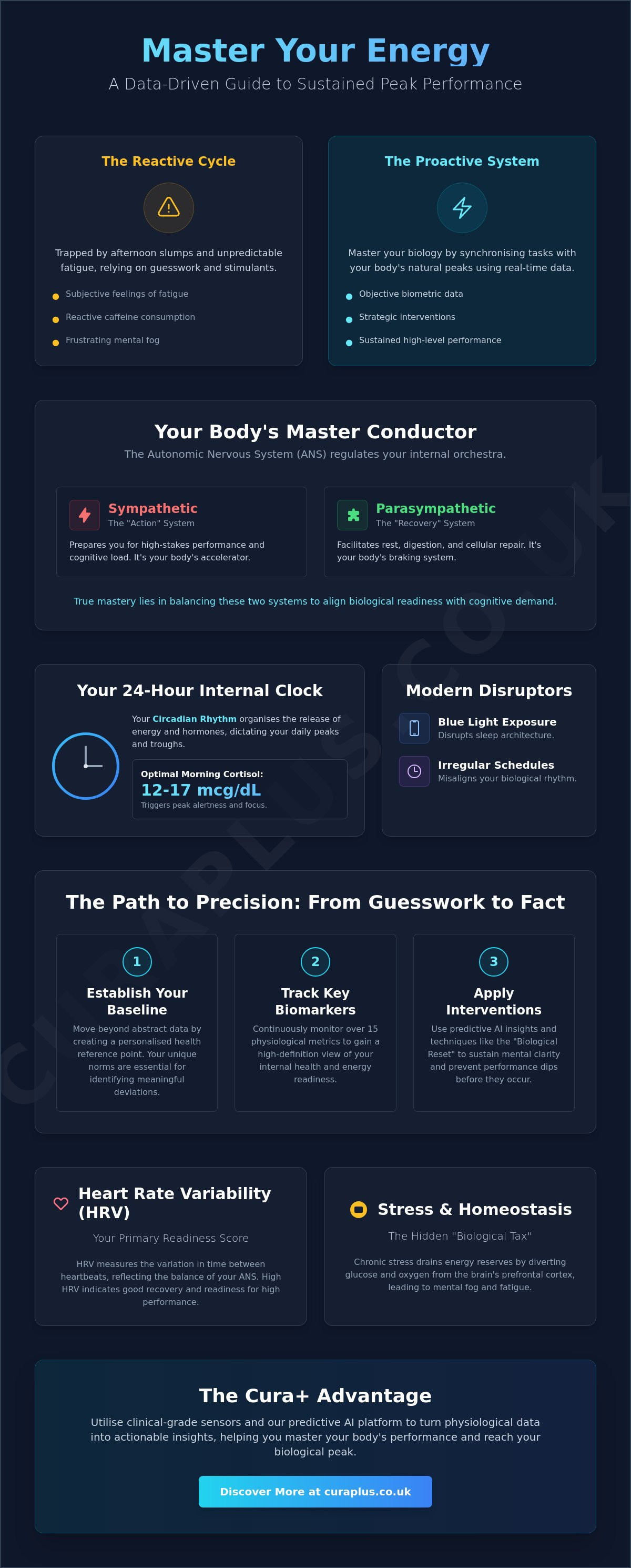
Energy isn't merely a feeling; it's the primary currency of the human system. It flows through a sophisticated network regulated by your Autonomic Nervous System (ANS), which acts as the master conductor of your internal biological orchestra. Within this system, two distinct branches operate in a delicate, constant dance. The sympathetic branch prepares you for action and high-stakes performance, whilst the parasympathetic branch facilitates recovery, digestion, and cellular repair. True mastery in managing energy levels throughout the day requires more than just discipline. It demands a deep understanding of how these biological systems interact to fuel your cognitive and physical output. Energy management is the strategic alignment of cognitive load with biological readiness.
When you experience the typical "afternoon slump," you're likely witnessing a physiological misalignment rather than a simple deficiency in caffeine. This dip often occurs when your cognitive demands exceed your system's current capacity to deliver fuel. It’s a clear signal that your schedule has drifted away from your biological rhythm. Instead of masking the symptom with stimulants, we must look at the underlying data to understand why the system is flagging.
Circadian Rhythms and Sleep Architecture
Your internal master clock, or circadian rhythm, organises the release of energy across a precise 24-hour cycle. It dictates the timing of essential hormones, ensuring that cortisol reaches its optimal morning range of 12-17 mcg/dL to trigger alertness and focus. However, modern environments saturated with blue light and irregular schedules frequently disrupt these delicate cycles. This disruption explains why a standard eight-hour sleep often fails to result in high energy. If your sleep architecture is fragmented, your body cannot reach the restorative depths required to reset your system for the following day's challenges.
Homeostasis and the Cost of Stress
Every moment of chronic low-level stress imposes a significant biological tax on your energy reserves. This constant strain forces the body into a state of high alert, prioritising basic survival functions over high-level cognitive performance. It's a resource allocation problem. When your system perceives a persistent threat, it diverts glucose and oxygen away from the prefrontal cortex to support more primitive functions. This systemic drain leads to the mental fog that many professionals mistake for a lack of focus. It's vital to distinguish between mental fatigue, which may be solved by a change in task, and true physiological exhaustion, which requires a systemic intervention to restore homeostasis. Managing energy levels throughout the day is ultimately about protecting these reserves from unnecessary depletion.
Decoding Biomarkers: The Metrics That Dictate Daily Performance
For most, the day is a series of subjective guesses. We "feel" tired or "sense" a drop in focus, yet these sensations are often lagging indicators of a system already in decline. Managing energy levels throughout the day requires a fundamental shift from intuition to evidence. By tracking over 15 distinct biomarkers, you move beyond the ambiguity of physical sensation into the clarity of physiological fact. Continuous monitoring reveals the subtle oscillations of your system, capturing patterns that a single clinical snapshot would inevitably miss. It's the difference between seeing a still photograph and watching a high-definition film of your internal health.
Central to this process is the ability to build a health baseline. Without a personalised reference point, data remains abstract and difficult to action. Establishing your unique norms allows you to identify even the slightest deviations, which often serve as early warnings of systemic strain or impending fatigue. This predictive approach transforms wellness from a reactive struggle into a managed system. Understanding these signals is the first step toward true self-optimisation through predictive health intelligence.
Heart Rate Variability (HRV) as a Readiness Score
Heart Rate Variability (HRV) serves as a primary metric for energy readiness. It measures the variation in time between consecutive heartbeats, reflecting the balance of your biological clock and autonomic nervous system. A high HRV suggests a resilient, energy-ready system capable of handling significant cognitive load. Conversely, a low HRV signals that your body is under stress and requires recovery. Utilising a specialised device to measure HRV enables you to decide with clinical certainty when to push for peak performance and when to prioritise rest.
Skin Temperature and Respiratory Trends
Subtle fluctuations in skin temperature can reveal metabolic energy shifts or the earliest signs of immune strain before symptoms manifest. Similarly, your respiratory rate often acts as a leading indicator of physiological stress; a rising rate suggests your system is working harder to maintain homeostasis. When combined, these metrics create a comprehensive readiness picture for the day ahead. They allow for precise adjustments in your schedule, ensuring you aren't forcing productivity when your body is diverted toward internal repair. This data-driven strategy is essential for managing energy levels throughout the day with consistency and confidence.
Strategic Interventions for Sustained Cognitive Focus
Managing energy levels throughout the day demands a departure from the "push through" mentality that often leads to systemic burnout. Instead of reacting to exhaustion with temporary fixes, we must adopt a framework of proactive maintenance. One of the most effective tools in this repertoire is the "Biological Reset" technique. By utilising short, purposeful movements, you can actively shift the state of your Autonomic Nervous System (ANS), transitioning from a state of sympathetic over-arousal to one of focused parasympathetic balance. This isn't about fitness; it's about neurological recalibration. It's the difference between forcing a stalled engine and clearing the path for optimal performance.
Precision in task organisation is equally vital for long-term vitality. By referencing the biometric readiness scores established in your health baseline, you can organise your most cognitively demanding tasks amongst your periods of peak physiological readiness. When your data indicates high HRV and stable core metrics, you possess the biological bandwidth for deep, complex work. Conversely, periods of lower readiness should be reserved for administrative or routine tasks, protecting your system from unnecessary strain and preventing the accumulation of deep fatigue.
We must also address the common reliance on stimulants. Reflexive caffeine consumption often creates a "caffeine debt," masking the signal of adenosine whilst the underlying fatigue continues to accumulate. Strategic use involves timing stimulants only when your biological clock naturally requires a minor lift, rather than using them to override significant physiological signals. True mastery comes from using these tools as enhancers rather than crutches, ensuring your system remains resilient and responsive.
Nutritional Timing and Glycaemic Control
Your cognitive output is inextricably linked to glycaemic control. Blood sugar spikes, followed by inevitable crashes, are a primary driver of mental energy fluctuations. To maintain steady focus, prioritise foods that provide a sustained glucose release. This steady fuel supply prevents the neurochemical turbulence that triggers brain fog and irritability. Additionally, hydration remains a foundational requirement for cellular energy production. Even mild dehydration can impair cognitive processing speeds and increase the perceived effort of simple tasks.
Active Recovery and Micro-Breaks
The human brain operates on 90-minute ultradian cycles, moving through peaks and troughs of alertness. Breaks are not a luxury; they are a biological necessity for managing energy levels throughout the day. However, true recovery requires a shift in state. Whilst scrolling through a digital feed may feel like a distraction, it actually increases cognitive load. Instead, utilise brief periods of active recovery, such as targeted breathwork, to "refill" your energy tank by activating the parasympathetic nervous system and clearing metabolic waste from the brain.
Predictive Energy Management: The Role of AI and Data
Predictive intelligence represents a significant leap beyond proactive healthcare, moving from general prevention to specific, data-driven forecasting. Whilst traditional methods focus on reacting to symptoms, AI algorithms now identify the unique physiological "signature" of fatigue long before you consciously feel its effects. This foresight is revolutionary for managing energy levels throughout the day. By receiving predictive alerts that forecast a dip in performance, you can adjust your schedule in real-time, effectively neutralising the infamous 3 PM crash before it begins. It's about shifting from a state of constant recovery to a state of permanent readiness.
A common objection amongst high achievers is the belief that they "know their body" better than any digital tool. However, human intuition is often clouded by psychological factors like determination or external pressure. Your subconscious physiological shifts, such as subtle changes in pulse wave velocity or hormonal oscillations, occur well below the threshold of conscious awareness. Whilst you might feel capable of pushing through a difficult morning, your data might reveal a suppressed immune response or elevated cortisol levels that suggest a different priority. Acknowledging these biological facts doesn't diminish your autonomy; it enhances it by providing the clarity needed to make superior decisions. Experience the power of predictive intelligence with the Cura+ AI Platform.
Identifying Early Signs of Physiological Strain
Subtle shifts in your resting heart rate (RHR) can serve as a powerful leading indicator, often predicting a low-energy day up to 24 hours in advance. When your RHR deviates from its established baseline, it signals that your system is working harder to maintain homeostasis, even whilst you are at rest. This data, when correlated with sleep quality metrics, provides a precise map of your cognitive endurance for the coming day. AI synthesises over 15 biomarkers into a single, actionable readiness score that provides a clear directive for your daily output.
Personalising Your Recovery Protocol
The future of personal health lies in a continuous feedback loop between the device and the wearer, where recovery is as personalised as a medical prescription. Often, your "favourite" recovery method, such as a high-intensity workout, might actually be counterproductive if your system is already strained. Data-driven insights determine whether you require active recovery through gentle movement or passive recovery through targeted rest. This level of precision ensures that every intervention you take is aligned with your body's immediate physiological requirements, rather than a generic wellness trend.
theBand by Cura+: Mastering Your Biological Peak
In the high-stakes environment of the UK's professional "always-on" culture, the ability to maintain peak performance is a competitive necessity. Generic advice fails because it ignores the unique biological constraints of the individual. This is why we developed theBand, the ultimate tool for advanced wellness tracking. By integrating clinical-grade sensors with the Cura+ AI Platform, we've created a system that moves beyond simple step counts into the realm of comprehensive biomarker monitoring. It provides the absolute precision required for managing energy levels throughout the day, allowing you to navigate your professional demands without sacrificing your long-term health.
The synergy between the hardware and our predictive intelligence platform transforms raw data into a strategic advantage. Whilst other devices provide historical summaries, theBand offers immediate insight into your current state of readiness. It empowers you to take control of your vitality by revealing exactly how your lifestyle choices impact your internal systems. You're no longer guessing at the cause of your fatigue; you're managing it with the same rigour you apply to your professional balance sheets. This level of insight is the foundation of physiological intelligence.
Continuous Monitoring for Real-Time Intelligence
TheBand monitors over 15 biomarkers simultaneously, providing a constant stream of high-fidelity data whilst you navigate your daily schedule. This continuous oversight allows for real-time alerts regarding emerging stress patterns and impending energy dips, giving you the window of opportunity needed to intervene. Despite its clinical capabilities, the device features a sleek, professional design that integrates seamlessly into a high-level lifestyle. It is a sophisticated instrument that commands respect without being intrusive or distracting.
Data-Driven Coaching and Insights
The Cura+ AI platform serves as a sophisticated guide, translating complex biometric data into simple, actionable steps for your body. It removes the cognitive load of data analysis, providing clear directives on when to push and when to pivot. This personalised coaching ensures that your efforts are always aligned with your physiological potential, rather than a generic wellness template. Discover how to optimise your recovery and master the art of managing energy levels throughout the day with theBand.
Transitioning to a Future of Physiological Mastery
The transition from subjective guesswork to physiological intelligence marks a fundamental shift in how we approach our daily performance. By understanding the intricate dance of your Autonomic Nervous System and utilising a personalised health baseline, you move beyond the limitations of willpower. You've seen how the strategic synchronisation of cognitive load with biological readiness eliminates the cycle of reactive caffeine use and chronic fatigue. Managing energy levels throughout the day is no longer an elusive goal; it's a measurable, predictable outcome of data-driven decision-making.
True mastery requires a tool that matches your commitment to excellence. theBand by Cura+ is British-engineered for clinical precision, monitoring over 15 essential biomarkers to provide you with a comprehensive view of your internal state. With AI-driven predictive health alerts, you gain the foresight needed to intercept exhaustion before it impacts your output. It's time to replace uncertainty with the calm control of objective insight. Secure your place for theBand by Cura+ and master your energy today. Your peak performance is no longer a matter of chance, but a matter of intelligence.
Frequently Asked Questions
Is it possible to manage energy levels without relying on caffeine?
It's entirely possible to sustain vitality by aligning your cognitive load with your biological readiness rather than masking fatigue with stimulants. Managing energy levels throughout the day without caffeine requires stabilising blood sugar and respecting your internal master clock. By utilising real-time data, you can identify when your system possesses the natural bandwidth for high-intensity work, allowing you to bypass the need for temporary chemical lifts.
How does heart rate variability (HRV) affect my energy throughout the day?
Heart rate variability serves as a direct indicator of your Autonomic Nervous System's resilience and current readiness score. High variability indicates a balanced, energy-ready state where you're primed for demanding tasks. Conversely, low HRV suggests your system is diverted toward recovery or stress management. Monitoring these fluctuations allows you to allocate your energy resources with clinical precision rather than pushing through significant biological resistance.
Can a wearable device really predict when I will feel tired?
Advanced wearables like theBand use AI to identify the physiological signature of fatigue before it reaches your conscious awareness. These devices detect the biological precursors to a slump, such as rising systemic strain or metabolic shifts, well before you feel tired. This predictive intelligence transforms health from a reactive struggle into a managed system, providing the foresight needed to adjust your schedule proactively.
What are the most important biomarkers to track for daily energy management?
Whilst theBand tracks over 15 distinct biomarkers, the most critical for daily energy include heart rate variability (HRV), resting heart rate (RHR), and respiratory trends. HRV indicates systemic readiness, whilst RHR serves as a leading indicator of cumulative strain or impending illness. By monitoring these metrics simultaneously, you gain a high-fidelity view of your internal health, allowing for the precise management of your cognitive output.
How much sleep do I actually need for peak cognitive performance?
Sleep requirements are highly individual, but the quality of your sleep architecture is more important than the standard eight-hour duration. High-quality restorative sleep resets your hormonal cycles, particularly cortisol and melatonin, which fuel your alertness. Instead of chasing a generic number, use biometric data to monitor your deep and REM sleep stages. This ensures your system reaches the restorative depths required for high-stakes demands.
What happens if I ignore my body's early signals of fatigue?
Ignoring early signals of exhaustion forces your body to divert resources away from high-level cognitive functions to maintain basic homeostasis. This results in persistent mental fog and increased susceptibility to systemic strain. Over time, chronic neglect of these physiological warnings leads to a state of deep exhaustion that requires significant time to rectify. Managing energy levels throughout the day prevents this accumulation of biological debt.
How does stress impact my energy levels on a physiological level?
Stress triggers a sympathetic response that prioritises basic survival functions over cognitive clarity. On a physiological level, this causes the body to divert glucose and oxygen away from the prefrontal cortex, which directly impairs focus and decision-making. Chronic low-level stress acts as a constant drain on your energy reserves, making it essential to use data-driven interventions to shift back into a restorative, parasympathetic state.
Can I use data to improve my energy levels if I have a busy schedule?
A demanding schedule makes precise energy management even more vital to prevent burnout and ensure consistent output. By utilising the Cura+ AI Platform, you can identify the specific windows where your biological readiness is highest, ensuring you tackle your most critical tasks during peak performance periods. This data-driven approach removes the guesswork from your day, allowing you to optimise your output without overextending your system's current capacity.


