


What if the heart rate alert on your wrist is not a sign of a medical emergency, but a simple sensor artefact caused by the way you held your morning tea? It's a common source of modern anxiety. You likely feel the frustration of staring at conflicting data between different devices whilst trying to decipher what complex biological terms actually mean for your daily performance. With the global wearable market projected to reach nearly £188 billion in 2026, the volume of data is increasing, but the clarity often remains elusive.
The truth is that most devices are designed for activity, not clinical insight. We'll help you understand the clinical reality behind these sensors and show you how to transition from simple activity tracking to predictive health intelligence. By exploring the nuances of a predictive health wearable vs fitness tracker, you'll learn which metrics are truly reliable and how to move beyond basic step counting. We will examine how to use advanced biomarkers to anticipate illness before the first symptom appears, transforming raw data into a sophisticated strategy for self-optimisation and long-term wellness.
Key Takeaways
- Understand the critical distinction between clinical gold standards and consumer aesthetics to eliminate uncertainty and data-driven anxiety.
- Evaluate the fundamental differences of a predictive health wearable vs fitness tracker to determine which technology supports proactive medical intelligence.
- Identify which biomarkers, such as heart rate and HRV, offer high reliability whilst learning why calorie tracking remains notoriously inaccurate.
- Discover the methodology for establishing a personal biological baseline over 30 days to replace generic population averages with precise, individualised insights.
- Learn how theBand utilises the Cura+ AI Platform to synthesise 15+ biomarkers into a holistic, predictive view of your systemic health.
Understanding the Accuracy Gap: Clinical Standards vs Consumer Wearables
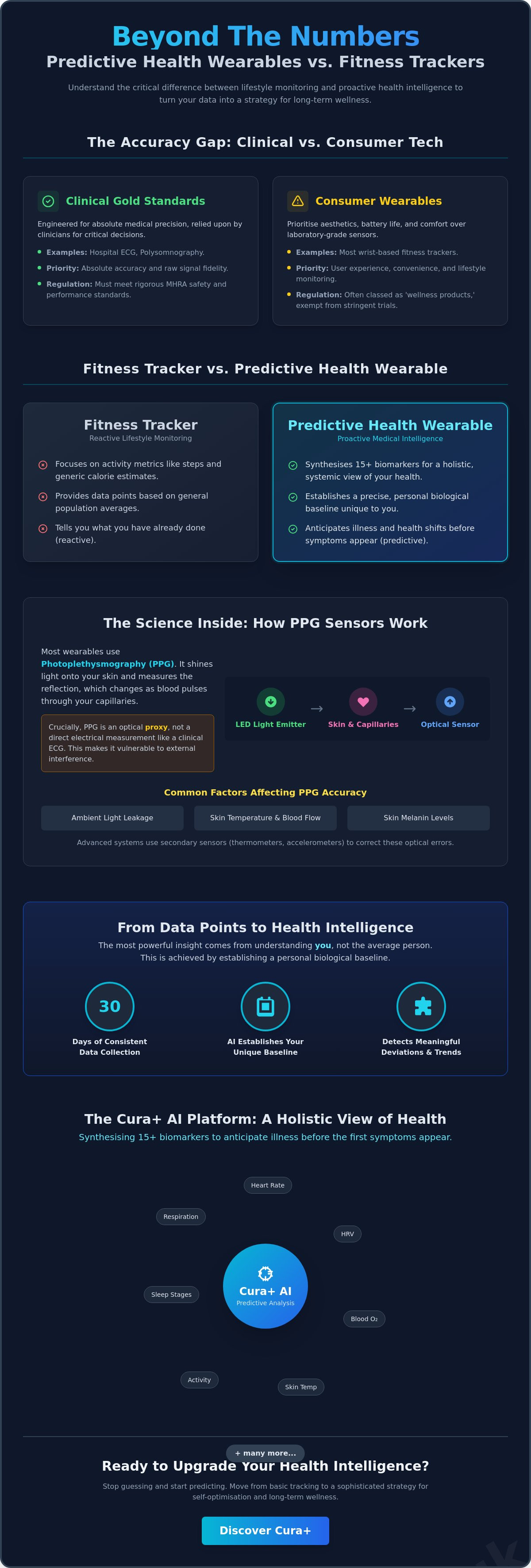
Medical accuracy is the gold standard of the clinical environment. In a hospital, doctors rely on electrocardiograms (ECG) or polysomnography to make life altering decisions. These systems are designed for absolute precision. Consumer devices, however, operate under a different set of constraints. Manufacturers often prioritise battery longevity, sleek aesthetics, and user comfort over laboratory grade sensors. This compromise creates a fundamental distinction when comparing a predictive health wearable vs fitness tracker. To grasp the evolution of this technology, it is helpful to define what fitness trackers are: essentially, consumer grade accelerometers and optical sensors designed for lifestyle monitoring rather than clinical intervention. A hospital grade ECG measures the electrical activity of the heart directly with clinical precision; conversely, a wrist based PPG sensor estimates heart rate by measuring light reflection through blood vessels, creating an inherent gap in raw signal fidelity.
The Role of MHRA and Regulatory Clearance in the UK
The Medicines and Healthcare products Regulatory Agency (MHRA) maintains strict boundaries between medical devices and general wellness tools. If a device is marketed to diagnose or treat a specific condition, it must meet rigorous safety and performance standards to receive UKCA marking. Many popular wearables are categorised merely as wellness products. This means they're exempt from the most stringent clinical trials. Even when a device receives MHRA clearance for a specific feature, such as atrial fibrillation detection, it doesn't mean the entire unit is equivalent to a diagnostic tool found in an NHS ward. In the 2026 health tech landscape, data transparency is paramount. You must look for devices that clearly state their regulatory status to ensure you aren't over-relying on unverified algorithms for critical health insights.
Absolute Accuracy vs Relative Consistency
Whilst absolute accuracy is the goal for clinicians, directional accuracy is often more valuable for personal health management. A tracker might miscalculate your exact heart rate by three beats per minute, but it can still be remarkably effective at identifying a trend. If your resting heart rate rises consistently over four days, the specific number matters less than the upward trajectory. This is the core strength of a predictive health wearable vs fitness tracker. It focuses on the shift from your established baseline. Misinterpreting minor data deviations can lead to cyberchondria, a state of heightened anxiety caused by self-diagnosing through digital readings. By focusing on relative consistency, you can identify physiological shifts, such as the onset of overtraining or systemic stress, without becoming overwhelmed by the noise of imperfect sensors. Consistency allows you to master your body's unique signals through methodical observation.
The Science of Sensors: How PPG and AI Interpret Your Biology
At the core of almost every modern wrist-mounted device lies Photoplethysmography, or PPG. This technology utilises green or red light-emitting diodes to illuminate the capillary bed beneath your skin. As your heart beats, blood volume in the tissue changes, altering the amount of light reflected back to the sensor. Whilst this provides a convenient window into your physiology, it is essential to understand the regulatory nuance. The distinction between Clinical Standards vs Consumer Wearables is often defined by how these sensors are used and the claims manufacturers make about their precision. When evaluating a predictive health wearable vs fitness tracker, the primary differentiator is not just the number of sensors, but the sophistication of the multi-sensor array. Modern systems move beyond simple heart rate monitoring to track 15+ simultaneous biomarkers, including blood oxygen, skin temperature, and electrodermal activity.
Why PPG is a Proxy, Not a Direct Measurement
PPG is a proxy, not a direct measurement. Unlike chest straps that detect electrical impulses from the heart (ECG), PPG relies on optical signals. This makes it susceptible to external interference. Ambient light can leak into the sensor; skin temperature can affect blood flow; even melanin levels in the skin can absorb light differently, potentially skewing results. High-performance devices now use secondary sensors, such as thermometers and accelerometers, to correct these optical errors in real-time. This multi-layered approach ensures that movement noise is minimised, allowing for a more stable data stream during daily activities. Understanding these physical limitations is the first step toward mastering your data.
The AI Revolution in Data Processing
Raw sensor data is often chaotic and noisy. Movement during a brisk walk can create signals that mimic a rapid pulse, leading to inaccurate readings. This is where the Cura+ AI Platform becomes indispensable. It acts as a digital filter, separating physical noise from actual biological signals. We are moving from simple notifications to sophisticated predictive health wearable UK alerts. By synthesising data across multiple biomarkers, theBand identifies subtle patterns that indicate systemic changes long before they become visible to the naked eye. This transition from raw data to processed intelligence represents a paradigm shift in personal health. You can discover how theBand uses clinical precision to transform these signals into a clear, actionable strategy for your long-term wellness.
Evaluating Metric Reliability: What Your Tracker Gets Right
Not all data points carry equal weight. When assessing a predictive health wearable vs fitness tracker, you must distinguish between high-fidelity signals and speculative estimates. Technical reliability follows a clear hierarchy. Heart rate monitoring sits at the summit of accuracy, followed closely by Heart Rate Variability (HRV). Conversely, metrics such as sleep staging and calorie expenditure occupy the lower tiers of clinical confidence. Understanding this spectrum allows you to filter out junk data-those sudden spikes or inexplicable gaps-that often trigger unnecessary health anxiety. By prioritising verified signals, you transform a confusing dashboard into a precise instrument for self-optimisation.
Calorie counting remains the most notoriously inaccurate metric in the consumer space. Most devices estimate energy expenditure using a combination of your reported weight, age, and accelerometer data. This method is fundamentally flawed because it ignores individual metabolic rates and the thermic effect of food. Research into the clinical accuracy of wearable devices suggests that energy expenditure estimates can deviate significantly from laboratory standards. Treat these numbers as a broad guide for activity volume rather than a precise metabolic record. In contrast, skin temperature has emerged as a critical biomarker in 2026. It provides a subtle, early signal of immune system activation, often rising slightly days before you feel the first symptoms of a seasonal illness.
Heart Rate and HRV: The Most Reliable Signals
Heart Rate Variability (HRV) is the gold standard for tracking the autonomic nervous system. It measures the millisecond variations between consecutive heartbeats, reflecting the delicate balance between your sympathetic (stress) and parasympathetic (rest) branches. This metric is central to biometric tracking for wellness because it quantifies systemic recovery. To ensure maximum accuracy, your device must be positioned snugly, roughly two fingers above the wrist bone, particularly during sleep. When the sensor maintains consistent contact with the skin, the predictive health wearable vs fitness tracker can deliver a high-resolution view of your physiological readiness for the day ahead.
The Challenge of Sleep Staging
Wrist-worn sensors cannot replicate the precision of an electroencephalogram (EEG). Whilst your tracker uses movement and heart rate to guess when you are in REM or deep sleep, these are merely statistical approximations. No consumer device can perfectly match a clinical sleep study. Instead of obsessing over exact minutes spent in specific stages, focus your attention on total sleep duration and consistency. These broader trends are far more reliable indicators of recovery. Use sleep data as a proxy for your daily readiness; if your duration is stable but your HRV is declining, it's a clear signal that your body requires additional rest, regardless of what the "REM" chart suggests.
From Data Points to Health Intelligence: Establishing a Personal Baseline
Population averages are often misleading. Whilst a resting heart rate of 60 beats per minute is considered healthy for the general public, it might be an outlier for your specific physiology. This is why the distinction between a predictive health wearable vs fitness tracker is so profound. A fitness tracker simply records your activity against generic benchmarks; a predictive system learns your unique biological rhythm. To achieve this, you must follow a methodical approach to how to build a health baseline over a period of 14 to 30 days. This initial calibration period allows the technology to understand your dynamic biological signature. Your baseline is not a static number but a living, breathing map of your physiological state that evolves with you.
Identifying Deviations from Your Norm
Detecting a viral onset before physical symptoms appear is the ultimate benefit of a well-established baseline. When you use a wearable for tracking immune health, you look for a specific "triad" of symptoms: an elevated resting heart rate, suppressed HRV, and rising skin temperature. If these three markers deviate from your norm simultaneously, it's a clear signal of systemic stress. However, you must distinguish between "good" stress, such as a high-intensity workout, and "bad" stress, such as impending illness or burnout. Exercise-induced stress typically sees a rapid HRV recovery within 24 hours, whilst illness-related suppression persists. This level of insight replaces generic anxiety with calm, data-driven control over your daily health decisions.
The Role of Longitudinal Data
Context is everything in biological monitoring. One night of poor sleep is merely a data point that might be caused by a late meal or a warm room. Conversely, a month of declining HRV is a profound insight into your long-term recovery capacity. The Cura+ AI Platform excels here by tracking these trends over years rather than days, allowing it to predict your biological age based on your physiological resilience. This shift from reactive check-ins to proactive intelligence is what separates a basic tracker from a high-level health consultant. You move from wondering if you're healthy to knowing exactly how your body is performing at a systemic level. To begin your journey toward predictive mastery, explore how the Cura+ AI Platform integrates with your daily life.
Beyond Tracking: The Transition to Predictive Health with theBand
The consumer market is saturated with devices that look backward. They tell you how many steps you took yesterday or how long you slept last night. Whilst this information is useful, it is fundamentally reactive. The transition from a predictive health wearable vs fitness tracker represents a profound shift from historical logging to future-focused intelligence. theBand by Cura+ is engineered to bridge this gap. It does not merely track; it anticipates. By synthesising complex biological data in real-time, it allows you to move from a state of passive observation to one of active mastery over your systemic health.
Traditional trackers often rely on a single data point to guess your physical state. In contrast, theBand monitors 15+ biomarkers simultaneously. This multi-sensor approach creates a holistic view of your physiology that includes autonomic nervous system signals, metabolic indicators, and immune response markers. When these signals are viewed in isolation, their value is limited; however, when processed through the Cura+ AI Platform, they reveal the underlying state of your internal systems. This is why it is considered the advanced wellness tracker for 2026. It provides a level of clinical confidence that simple lifestyle trackers cannot match.
Why 15+ Biomarkers Change the Conversation
Data without interpretation is just noise. The Cura+ AI Platform removes the burden of analysis from the user by translating sophisticated biological trends into clear, actionable wellness steps. If your HRV is suppressed whilst your skin temperature rises, the system doesn't just show you a graph; it provides a strategic recommendation to adjust your recovery protocol. This is the essence of proactive healthcare. We are moving away from the question of "what happened?" and toward a definitive understanding of "what will happen?". The synergy of multi-sensor data ensures that every alert is backed by clinical-grade logic rather than simple motion detection.
Empowerment Through Personal Intelligence
You are no longer just a user of a device. You are the CEO of your own biology. This empowerment is facilitated by real-time alerts and personalised health coaching that encourages constant self-optimisation. The high-stakes journey of personal health requires a partner that values accuracy and foresight above all else. By choosing a predictive health wearable vs fitness tracker, you are investing in a future where illness is managed before it arrives and performance is a choice rather than a chance. Discover how theBand by Cura+ provides the predictive health intelligence you need.
Mastering Your Biological Future
The health landscape of 2026 demands more than just a record of your daily steps. True wellness stems from the ability to distinguish between clinical gold standards and consumer approximations. By prioritising high-fidelity biomarkers like HRV and establishing a robust personal baseline, you transform raw data into a sophisticated strategy for self-optimisation. The critical distinction in the predictive health wearable vs fitness tracker debate is the shift from reactive logging to proactive intelligence. You deserve a partner that interprets the subtle nuances of your biology with clinical precision rather than generic algorithms.
It is time to move beyond the limitations of basic tracking and embrace a system that anticipates your needs. With the ability to monitor over 15 critical biomarkers, theBand provides the clarity required to identify systemic shifts before they manifest as symptoms. Through the Cura+ AI Platform, you gain access to AI-driven predictive health alerts and a personalised health coaching platform designed for your unique physiology. Join the future of proactive health: Explore theBand by Cura+. You have the power to master your own biology; start today.
Frequently Asked Questions
Can a fitness tracker detect an irregular heart rhythm like AFib?
Many high-end devices now include MHRA-cleared ECG features specifically designed to detect Atrial Fibrillation. However, standard PPG sensors used for continuous heart rate monitoring are not diagnostic tools. They may flag potential irregularities, but a medical-grade ECG remains the clinical requirement for a definitive diagnosis. You should always consult a healthcare professional if your device alerts you to a suspected cardiac irregularity.
Is the calorie burn data on my wearable accurate enough for weight loss?
Calorie expenditure estimates are notoriously unreliable and should be treated as a broad activity guide rather than a precise metabolic record. Most wearables calculate this using population averages and accelerometer data, which often deviates significantly from laboratory-grade indirect calorimetry. For effective weight loss, focus on the long-term trend of your activity volume rather than the absolute number of calories displayed on your dashboard.
How much does skin tone affect the accuracy of my heart rate monitor?
Optical PPG sensors can experience reduced accuracy on darker skin tones because higher melanin levels absorb more green light. This physical interaction can lead to weaker signal quality or increased noise in the data. Advanced wearables mitigate this issue by utilising multi-wavelength sensor arrays, including red and infrared light, which penetrate more effectively to provide consistent readings across all skin complexions.
Can I use my wearable data to show my GP if I feel unwell?
You can certainly share your data with your GP to illustrate physiological trends, but it shouldn't be presented as a clinical diagnosis. Doctors often find longitudinal data, such as a multi-day rise in resting heart rate, useful for contextualising your reported symptoms. When discussing a predictive health wearable vs fitness tracker with a clinician, focus on established baselines rather than isolated or potentially erroneous readings.
What is the most accurate metric tracked by consumer wearables?
Resting heart rate and Heart Rate Variability (HRV) are the most reliable signals provided by modern sensors. When measured during sleep or periods of absolute stillness, these metrics closely align with clinical standards. Whilst other data points like sleep stages remain speculative, the timing between heartbeats is a high-fidelity measurement that offers deep insight into your autonomic nervous system and overall recovery status.
Why does my tracker show a different heart rate than the machine at the gym?
Discrepancies usually occur because of different sensor placements and technologies. Gym equipment often uses hand-grip sensors that measure electrical signals, whilst your wearable relies on optical light at the wrist. Factors such as your grip strength, wrist movement, and sensor contact can cause your wearable to lag or show different values during high-intensity exercise compared to stationary gym machines.
How can I tell if my wearable is malfunctioning or if my health has changed?
Look for the "triad" of symptoms established in your biological baseline: elevated heart rate, suppressed HRV, and rising skin temperature. If all three markers shift simultaneously, it's likely a physiological change. If only one metric shows a wild, illogical spike whilst you feel perfectly fine, it's probably a sensor error caused by poor fit, low battery, or environmental interference.
Is it worth upgrading to an advanced wearable for better accuracy?
Upgrading is beneficial if you require predictive intelligence rather than simple activity logging. The primary advantage of a predictive health wearable vs fitness tracker is the integration of multi-sensor arrays and AI processing. These systems filter out movement noise and synthesise multiple biomarkers into actionable insights, providing a level of clinical confidence that basic trackers simply cannot achieve for long-term health mastery.


