


What if the first sign of a relative's health decline wasn't a frantic midnight phone call, but a calm notification on your screen forty-eight hours before symptoms even manifested? For many, the weight of caring for distant family members is defined by a persistent, underlying anxiety. It's a valid concern; most consumer wearables often feel like sophisticated toys that lack the clinical rigour required for serious medical oversight. You deserve more than a simple step count when the stakes involve those you love most.
We recognise that navigating complex biological data can be overwhelming, yet the transition to a proactive lifestyle is now within reach. This guide demonstrates how to master remote health monitoring for family by shifting from reactive care to predictive intelligence. Through the integration of theBand and the Cura+ AI Platform, you can leverage advanced biomarker monitoring to replace uncertainty with clarity. We'll examine how to synthesise medical-grade data into a unified view of wellness, ensuring early detection and lasting peace of mind whilst maintaining the highest standards of data security.
Key Takeaways
- Transition from reactive, event-driven care to a model of predictive intelligence that identifies subtle health shifts before they become emergencies.
- Harness the power of over 15 digital biomarkers to gain a comprehensive, medical-grade understanding of your loved ones' physiological trends.
- Establish a sustainable strategy for remote health monitoring for family by organising secure Care Circles that balance proactive oversight with personal privacy.
- Learn why trend-based intelligence is superior to traditional fall sensors, allowing for preventative adjustments to mobility and lifestyle behaviours.
- Discover how theBand and the Cura+ AI Platform synthesise complex biological data into actionable insights for total family wellness.
Defining Remote Health Monitoring for the Modern Family
Remote health monitoring for family is no longer confined to the sterile corridors of clinical settings or the narrow scope of elderly care. It represents the continuous, non-invasive collection of physiological data, transforming how we oversee the well-being of those closest to us. Historically, Remote patient monitoring (RPM) was a tool used by medical professionals to manage chronic illness. In 2026, this technology has evolved into consumer-led proactive health intelligence. This shift empowers a designated family Health Lead to coordinate care through real-time data synthesis rather than relying on occasional check-ins or subjective guesswork.
Effective monitoring extends far beyond basic metrics like step counts or average heart rate. True intelligence requires a deep dive into sophisticated biomarkers such as Heart Rate Variability (HRV), peripheral oxygen saturation (SpO2), and skin temperature. These indicators offer a window into the autonomic nervous system and overall systemic health. By tracking these variables, families can identify subtle physiological shifts that precede visible symptoms, moving health management from the doctor's office directly into the home environment.
The Evolution of Family Health Tech
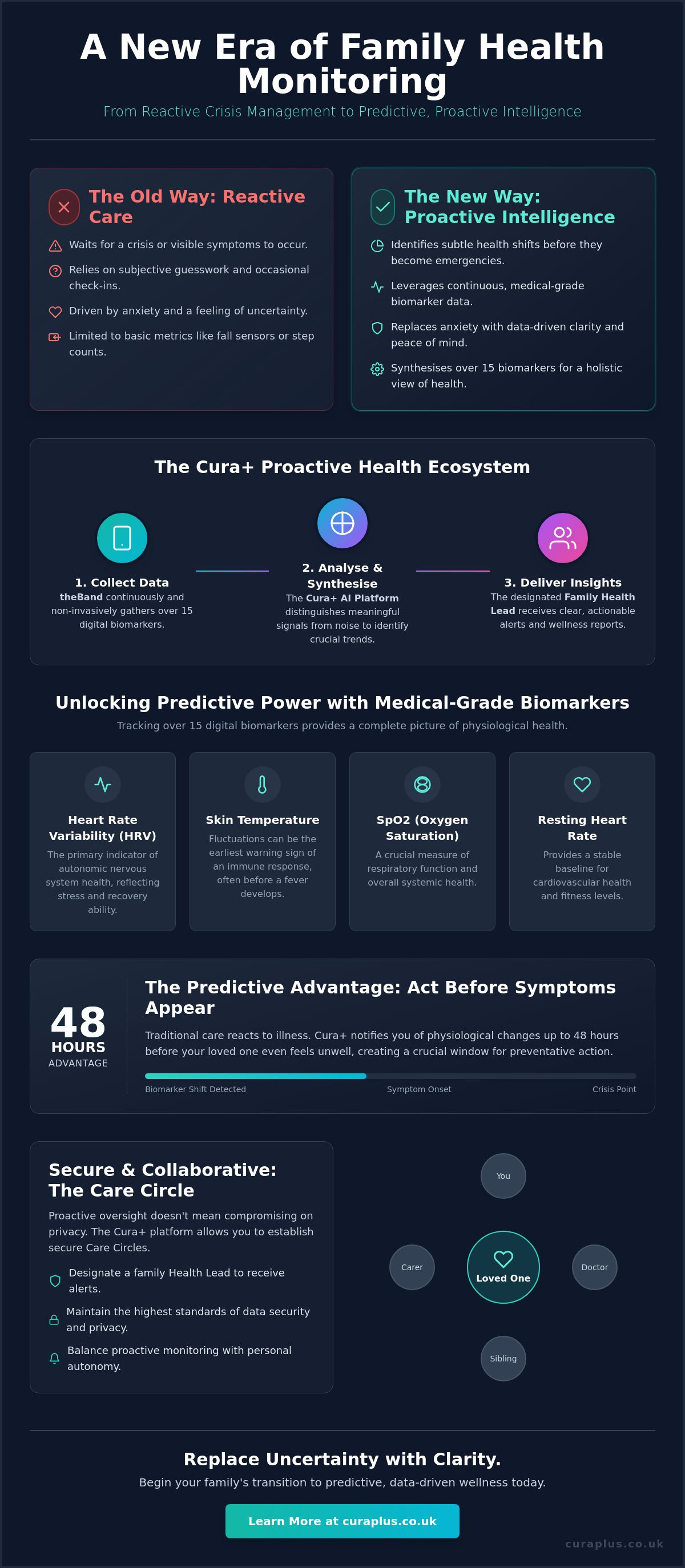
We've moved past the era of rudimentary step-counters that served as mere digital toys. The current landscape is defined by the Biological Baseline, a comprehensive data profile that captures the unique physiological signature of every family member. Instead of episodic doctor visits that only provide a snapshot in time, families now benefit from continuous data streams. This constant flow of information allows the Cura+ AI Platform to establish what is normal for an individual, making any deviation immediately apparent and actionable. It's a transition from guessing to knowing, powered by high-resolution sensors.
Why Proactive Monitoring Outperforms Reactive Care
Waiting for symptoms to appear is a high-stakes gamble. By the time a relative feels unwell, the underlying physiological disruption is often well-advanced. Implementing remote health monitoring for family identifies these deviations early, offering a window for intervention that reactive care simply cannot match. This data-driven clarity effectively replaces the quiet anxiety many feel when living apart from elderly parents or vulnerable relatives. You aren't just reacting to a crisis; you're maintaining a favourable environment for long-term vitality. Detecting a subtle rise in resting heart rate or a dip in HRV allows for lifestyle adjustments before a minor issue escalates into a medical emergency.
The Science of Predictive Intelligence: How Biomarkers Protect Your Loved Ones
The foundation of modern remote health monitoring for family lies in the sophisticated application of digital biomarkers. These are not merely data points; they are objective, quantifiable physiological and behavioural measures collected by high-resolution sensors. As Emerging Wearable Health Technologies continue to advance, we can now capture a high-resolution map of an individual's internal state. By monitoring over 15 distinct biomarkers simultaneously, we gain a holistic view of the body that traditional, single-metric devices simply cannot provide. Heart Rate Variability (HRV) serves as the primary indicator of autonomic nervous system health, reflecting the body's ability to respond to stress and recovery.
AI plays a critical role in this process by distinguishing meaningful signals from background noise. Raw data can be chaotic. A spike in heart rate might be a sign of acute stress, or it could simply be the result of a brisk walk. AI algorithms filter these variables to ensure that only significant trends reach the family Health Lead. This level of precision transforms raw numbers into actionable intelligence, allowing you to act with confidence rather than reacting to false alarms.
Key Biomarkers for Early Illness Detection
Detecting an immune response before a loved one feels "under the weather" is a hallmark of predictive intelligence. Skin temperature fluctuations often serve as the earliest warning signs of viral onset, appearing long before a fever is detectable by a standard thermometer. When combined with respiratory rate and blood oxygen saturation (SpO2), these metrics create a clear picture of respiratory health. A subtle increase in nocturnal respiratory rate coupled with a minor dip in SpO2 can flag a potential illness whilst it's still in the incubation phase. This allows for early intervention and targeted rest, potentially shortening the duration of the illness.
AI Algorithms and the Power of Personal Baselines
The concept of "normal" is entirely relative in biology. A heart rate of 60 beats per minute might be ideal for one person but a cause for concern in another. This is why understanding how to build a health baseline is essential for effective family oversight. AI identifies subtle deviations from these personal norms that the human eye would almost certainly miss. Rather than offering generic wellness advice, the system provides data-driven recommendations tailored to the individual's specific needs. It's about precision. If you're ready to transition from guesswork to data-driven certainty, exploring the integrated capabilities of the Cura+ AI Platform is the logical next step.
Reactive vs Proactive Monitoring: Why Traditional Alerts Are No Longer Enough
Traditional safety systems are built on a reactive foundation. They wait for a crisis, such as a fall or a sudden cardiac event, before triggering a response. This event-based model is inherently flawed because it requires a catastrophe to occur before care actually begins. In contrast, the trend-based intelligence used in modern remote health monitoring for family identifies the subtle physiological erosion that leads to these events. We view a fall sensor as a last resort; a necessary safety net, but ultimately a failure of prevention. Mobility monitoring is a far more potent preventative asset. By tracking changes in gait, cadence, and step symmetry, we can identify a decline in physical stability weeks before a potential accident occurs.
The Limitations of Emergency Medical Alerts
Relying on a family member to press a button during a medical crisis is an unreliable safety strategy. This is especially true in cases of cognitive decline, where a relative might not recognise the gravity of the situation or remember how to operate the device. Traditional systems also suffer from alarm fatigue. This occurs when repeated false positives lead to a diminished response from both the user and their caregivers. Moving towards passive monitoring requires zero effort from the family member. This ensures that data collection remains consistent and reliable, even when the individual is unable to communicate or act. It's about removing the burden of technology from the person who needs it most.
Predictive Alerts: A New Standard of Safety
Predictive intelligence identifies dehydration, systemic fatigue, or chronic stress patterns days before they escalate into a clinical crisis. This shift offers a profound psychological benefit. Instead of feeling under constant surveillance, the wearer feels empowered by a system that supports their independence. For younger relatives, using a wearable for tracking stress patterns can prevent burnout by flagging physiological strain before it manifests as physical illness. For the elderly, these insights are instrumental in extending independent living. By addressing health deviations whilst they are still manageable, we transform the nature of care from rescue to maintenance. Remote health monitoring for family should be a silent, sophisticated guardian that acts before a crisis arrives, replacing fear with data-driven confidence.
Implementing a Family Health Strategy: From Baselines to Actionable Insights
Introducing health technology into a family dynamic requires a nuanced approach. It's a collaborative endeavour rather than a top-down mandate. For active families, the focus shifts from "caregiving" for the frail to a shared commitment to peak physiological performance. A successful strategy begins with the introduction of the technology as a tool for mutual empowerment. Transparency is essential. Every member must understand how their data is collected and, more importantly, how it serves their individual vitality. By framing remote health monitoring for family as a shared asset, you replace the friction of surveillance with the quiet confidence of data-driven support.
The Cura+ AI Platform allows for the seamless organisation of a Care Circle. This is a secure digital environment where selected family members can view high-level wellness summaries whilst respecting individual privacy. It isn't necessary for every member to see every heartbeat. Instead, the system is designed to surface only what is relevant. Effective, long-term remote health monitoring for family relies on establishing bespoke notification thresholds. You might set a high-sensitivity alert for an elderly parent's nocturnal respiratory rate, whilst maintaining a broader baseline for a younger, athletic relative. This ensures that the Health Lead is only notified when a genuine deviation occurs, preventing the alarm fatigue common in lesser systems.
Choosing the Right Wearable for Multi-Generational Use
Hardware must be invisible to be effective. For a device to provide a true biological baseline, it must be comfortable enough for 24/7 wear. When selecting an advanced wellness tracker, prioritise sensor depth and battery longevity. theBand is engineered with a "set and forget" philosophy, making it ideal for non-technical users who require medical-grade accuracy without the complexity of frequent charging or manual syncing. It's a sophisticated guardian that works silently in the background, ensuring that data collection remains uninterrupted across all generations.
Turning Data into Actionable Wellness Coaching
Raw biomarkers only provide value when they are translated into specific lifestyle interventions. This is where the role of an AI health and wellness coach becomes indispensable. Rather than simply reporting a dip in HRV, the platform interprets this as a need for enhanced sleep hygiene or a temporary reduction in physical strain. These insights allow the family to act as a proactive support network. You can suggest a rest day or increased hydration based on objective physiological strain before burnout occurs. For more complex concerns, these exported biomarker reports provide a rigorous data set that can be shared with healthcare professionals to facilitate more informed clinical discussions. Begin your proactive journey by optimising your family's health through theBand and the Cura+ AI Platform today.
theBand by Cura+: Sophisticated Health Intelligence for the Entire Family
theBand represents the physical manifestation of the predictive intelligence we've explored throughout this guide. It stands as the premier predictive health wearable UK solution, engineered to bridge the gap between consumer technology and clinical-grade precision. Whilst traditional trackers often provide fragmented or superficial data, theBand delivers a continuous, high-resolution narrative of the body's internal state. It's the essential hardware for any robust strategy involving remote health monitoring for family, providing the accuracy required to make high-stakes wellness decisions with absolute confidence and clarity.
At the heart of this ecosystem is the Cura+ AI Platform. We view this as the central nervous system for your family's physiological data. It doesn't merely store information; it synthesises over 15 distinct biomarkers, including Heart Rate Variability (HRV), blood oxygen saturation (SpO2), and skin temperature, into a unified view of systemic health. This British-engineered hardware is built for methodical reliability. It ensures that every data point is captured with the rigour expected of a professional medical consultant, allowing the AI to identify trends that would remain invisible to the human eye or basic fitness apps.
Proactive Illness Detection for Your Loved Ones
The ability to anticipate physiological decline is perhaps theBand's most transformative feature. By utilising a wearable for tracking immune health, families can identify the earliest markers of viral onset long before physical symptoms emerge. This real-time intelligence is invaluable for high-stress professionals or vulnerable relatives living independently. The platform also visualises the "Biological Age" of every family member. This sophisticated metric allows you to track longevity progress and the efficacy of lifestyle interventions over months and years. You're no longer just managing symptoms; you're actively mastering the aging process through data-driven refinement.
Seamless Integration into Daily Life
Effective monitoring must be constant to be truly predictive. theBand is designed for an "always-on" lifestyle, featuring an exceptionally long battery life and a discreet, sophisticated aesthetic that complements any professional attire. It's a set-and-forget solution that removes the technical friction often associated with medical-grade hardware. Our subscription model ensures that your family's health intelligence is never static. It provides continuous AI updates and predictive refinement as the platform learns your unique biological signatures over time. Secure your family's health future by pre-ordering theBand from Cura+ today and take the definitive step towards a life of data-driven clarity.
Securing Longevity Through Predictive Intelligence
The era of reacting to symptoms is ending. By embracing remote health monitoring for family, you aren't just watching over your loved ones; you're actively safeguarding their future. We've seen how the synthesis of over 15 digital biomarkers and the establishment of personal biological baselines can reveal health risks before they manifest as physical symptoms. This predictive approach replaces the anxiety of distance with the calm control of data-driven clarity whilst ensuring that care remains proactive rather than reactive.
theBand by Cura+ offers the most sophisticated path forward. It combines British-engineered clinical precision with AI-driven predictive health alerts to provide an unparalleled view of systemic wellness. Whether you're monitoring a parent's recovery or a partner's stress levels, this technology ensures you're always one step ahead. It's time to move beyond the limitations of traditional trackers and step into a world of proactive, intelligent care. Your family's health is a complex system to be mastered, and the tools to do so are finally within reach.
Discover the future of family wellness with theBand by Cura+ and begin your journey toward total health mastery today.
Frequently Asked Questions
How does remote health monitoring actually work for families?
It works by using high-resolution sensors to collect physiological data continuously, which is then processed by AI to identify trends. The system transmits these insights to a centralised platform where designated family members can monitor wellness metrics in real time. This ensures that oversight is based on objective biological evidence rather than subjective check-ins or guesswork.
Is remote health monitoring intrusive or a breach of privacy?
No, it's designed to be a discreet and supportive tool that respects individual autonomy. Users have full control over who enters their Care Circle and what specific level of data is shared with others. Modern systems focus on high-level wellness summaries rather than invasive surveillance, ensuring that privacy is maintained whilst providing essential remote health monitoring for family.
Can a wearable device really detect if a family member is getting sick?
Yes, by tracking subtle shifts in biomarkers like skin temperature, respiratory rate, and Heart Rate Variability (HRV), the system identifies an immune response before symptoms appear. These deviations from a personal biological baseline serve as early warning signs of viral onset. This allows for proactive interventions, such as increased rest, which can potentially mitigate the severity of the illness.
What is the difference between a fitness tracker and a predictive health wearable?
Fitness trackers typically focus on surface-level metrics like steps and calories for recreational use. In contrast, a predictive health wearable like theBand utilises medical-grade sensors to monitor over 15 complex biomarkers. It uses advanced AI to synthesise this data into actionable intelligence, moving beyond simple activity tracking to provide a comprehensive view of systemic health and future risks.
Do I need to be tech-savvy to use remote health monitoring for my parents?
You don't need advanced technical skills to benefit from these sophisticated systems. theBand is engineered with a set and forget philosophy, meaning the wearer simply needs to keep the device charged. The Cura+ AI Platform handles the complex data processing, presenting insights in a clear, intuitive interface that is accessible to users of all technical abilities.
How much does remote health monitoring cost for a family in the UK?
Costs for remote health monitoring for family in the UK vary depending on the depth of sensor technology and the sophistication of the AI platform. Families should expect to invest in both the initial hardware and a recurring subscription for continuous data analysis and predictive updates. It's advisable to compare different providers to find a solution that balances clinical precision with long-term value.
Can I share the health data with my family doctor?
Yes, you can export comprehensive biomarker reports to facilitate more informed clinical discussions with healthcare professionals. Whilst the system doesn't provide a clinical diagnosis, the high-resolution data offers a rigorous longitudinal record that doctors can use to understand a patient's health trends. This bridges the gap between home monitoring and professional medical consultation.
What happens if the device detects a significant change in a loved one’s biomarkers?
The system triggers an immediate predictive alert to the designated family Health Lead via the Cura+ AI Platform. This notification includes a detailed analysis of the deviation and provides data-driven recommendations for the next steps. It allows the family to coordinate a proactive response, such as scheduling a check-up, before the situation escalates into a crisis.


