


What if the most critical indicators of your exhaustion were the ones you couldn't actually feel yet? For many high performers, the subtle signs of chronic stress and fatigue aren't just a heavy morning or a temporary lapse in concentration; they're systemic signals hidden deep within your biology. You've likely experienced that persistent, unexplained tiredness that a holiday cannot fix, or a sudden bout of brain fog that compromises your professional edge. It's a frustrating state of limbo where it's difficult to distinguish between normal tiredness and a looming systemic burnout, especially whilst 72% of workers are currently reporting moderate-to-high stress levels.
We recognise that relying on subjective feelings is often a lagging indicator of a much deeper issue, and you deserve more than guesswork when it comes to your health. This guide will show you how to identify the physiological markers of chronic stress and fatigue before they lead to a total crash by leveraging predictive health intelligence. You'll gain a clear understanding of the biological signals your body is sending, learn how to measure stress objectively through metrics like Heart Rate Variability, and discover how to use actionable intelligence to maintain your peak performance.
Key Takeaways
- Distinguish between transient tiredness and the systemic energy regulation failure that characterises chronic physiological arousal.
- Master the use of Heart Rate Variability (HRV) and Resting Heart Rate (RHR) as objective windows into your autonomic nervous system's resilience.
- Uncover the subtle signs of chronic stress and fatigue, ranging from cognitive "brain fog" to physical manifestations like tension headaches and digestive issues.
- Transition from reactive symptom management to predictive health by establishing a biological baseline that detects subtle deviations before a health crash occurs.
- Discover how theBand and Cura+ AI Platform translate 15+ biomarkers into actionable intelligence for superior physiological self-mastery.
Understanding Chronic Stress and Fatigue: The Silent Health Crisis
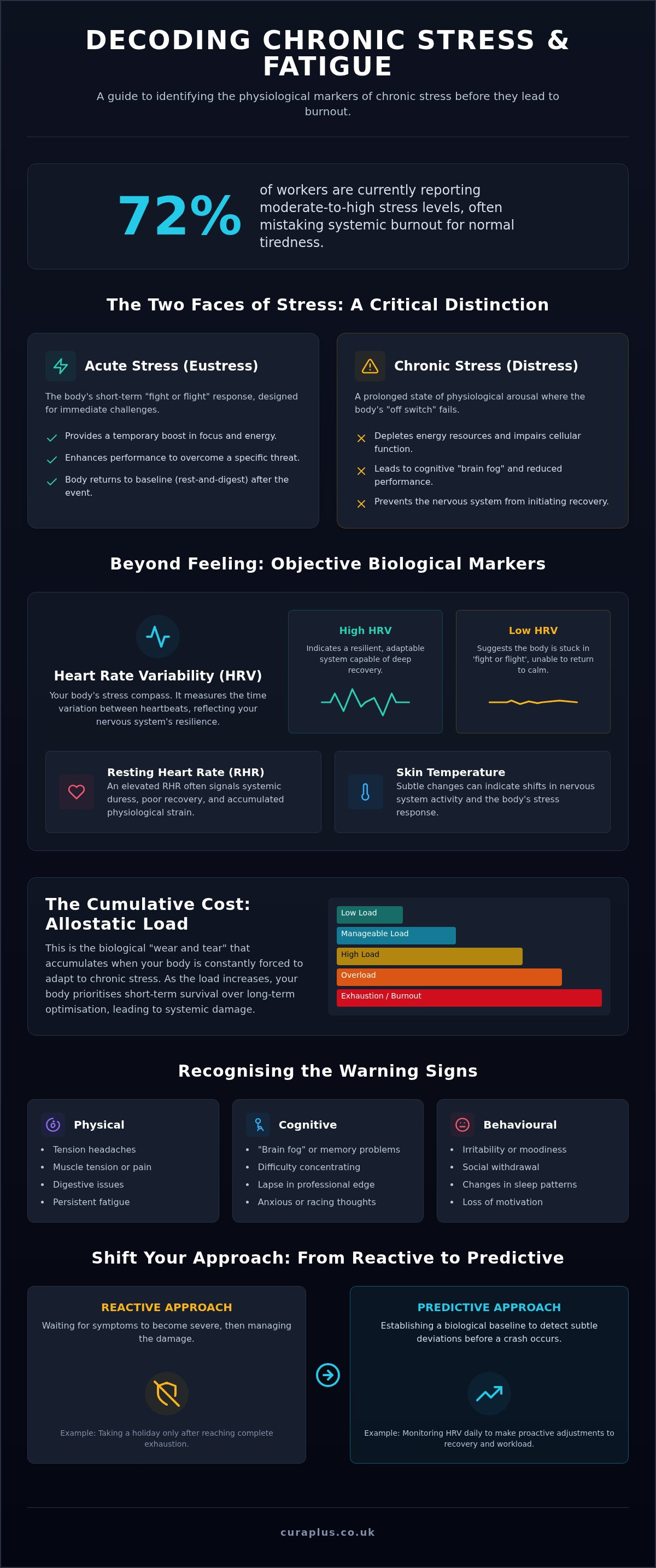
Stress is a biological necessity. In its acute form, often termed "eustress", it provides the focus and energy required to navigate immediate challenges. However, when this state of arousal becomes a permanent fixture rather than a temporary response, it transforms into Chronic stress. This condition represents a prolonged state of physiological activation that consistently exceeds your body's innate capacity for recovery. It's a systemic imbalance where the "off switch" for your survival mechanisms has effectively malfunctioned.
The cumulative impact of this persistent arousal is known as Allostatic Load. Think of this as the biological "wear and tear" that accumulates when your internal systems are forced to work overtime to maintain stability. When your Allostatic Load becomes too heavy, the body begins to prioritise survival over optimization. Recognising the early signs of chronic stress and fatigue is essential because, by the time these symptoms become impossible to ignore, the physiological damage is already well underway.
The Difference Between Acute Stress and Chronic Overload
Your "fight or flight" response was designed for short, intense bursts of activity. It's a brilliant evolutionary tool that redirects resources to your muscles and brain to handle a threat. The problem arises when the body fails to return to its baseline state. In a modern professional environment, the "threat" is often a continuous stream of deadlines and digital notifications. This prevents the parasympathetic nervous system from initiating the rest-and-digest phase. This transition from temporary pressure to permanent physiological strain is the moment where healthy ambition begins to erode your long-term wellbeing. Without a data-driven way to measure this baseline, most people remain unaware that their body is still in a state of high alert whilst they are supposedly resting.
Why Fatigue is More Than Just Feeling Tired
Fatigue is frequently misunderstood as a simple lack of sleep, yet it is more accurately described as a systemic failure of energy regulation. At a cellular level, chronic stress impairs mitochondrial function, which are the powerhouses responsible for producing energy. When these cells are under constant duress, they cannot keep up with the demand. This explains why a weekend holiday or a long night's sleep often fails to "cure" the exhaustion you feel. The brain eventually perceives this energy deficit as a threat to your survival. It then sends out fatigue as a protective signal, effectively forcing you to slow down to prevent further structural damage to your systems. It isn't just a feeling; it's a strategic shutdown of your biological resources.
The Biological Indicators: How Your Body Signals Physiological Strain
Whilst physical symptoms like muscle tension or headaches are common, they are often late-stage echoes of a deeper biological shift. To truly master your health, you must look at the data driving your Autonomic Nervous System (ANS). Your body doesn't just "feel" exhausted; it executes a complex physiological programme that alters your heart rhythm, temperature, and metabolic efficiency. Recognising these signs of chronic stress and fatigue requires a shift from listening to your gut to analysing your biomarkers.
Heart Rate Variability (HRV) as a Stress Compass
HRV is your stress compass. It measures the variation in time, in milliseconds, between each consecutive heartbeat. When your heart beats, the intervals between those pulses aren't uniform; they fluctuate based on the constant tug-of-war between your sympathetic and parasympathetic nervous systems. A high HRV indicates a resilient, flexible system that can pivot between high performance and deep recovery. Conversely, a low HRV suggests your body is stuck in a state of sympathetic dominance, unable to find its way back to a baseline of calm. Utilising a sophisticated wearable for tracking stress patterns allows you to see this invisible strain in real time, long before it manifests as a mental breakdown.
The Role of Skin Temperature and Resting Heart Rate
Resting Heart Rate (RHR) is another critical metric for identifying systemic duress. When you're healthy and recovered, your RHR should remain stable at its lowest point during sleep. Chronic stress, however, creates a "recovery lag" where your heart rate stays elevated throughout the night, indicating that your body is still working to process the day's symptoms of chronic stress. This lack of nocturnal stabilisation is a primary driver of persistent fatigue.
Peripheral skin temperature fluctuations provide further insight into your immune system's state. Chronic stress often triggers peripheral vasoconstriction, diverting blood flow to vital organs and causing micro-fluctuations in your thermal baseline. Skin temperature serves as a direct proxy for the body’s inflammatory response, as chronic stress often triggers peripheral vasoconstriction that alters your thermal baseline. By monitoring your physiological trends with clinical precision, you can intercept burnout before it manifests as a health crash.
Finally, markers like blood oxygenation (SpO2) and respiratory rate offer a window into your metabolic health. Systemic fatigue often correlates with a slight increase in your resting respiratory rate as the body struggles to maintain oxygen efficiency under load. When these biomarkers deviate simultaneously, they form a clear, data-driven picture of the signs of chronic stress and fatigue, providing the clarity you need to take proactive action.
Recognising the Symptoms: Physical, Cognitive, and Behavioural Warning Signs
If your biomarkers are the internal data logs of your health, then your physical and mental symptoms are the dashboard alerts. These signs of chronic stress and fatigue function much like a "check engine" light in a sophisticated vehicle. They are often subtle at first, appearing as minor inconveniences that many professionals tend to dismiss as the cost of a high-stakes career. However, ignoring these signals doesn't make the underlying systemic strain disappear; it merely allows the biological wear and tear to accelerate until a total health crash becomes inevitable.
Invisible Physical Manifestations of Long-Term Pressure
Chronic stress is a physical experience that begins long before you feel mentally overwhelmed. Amongst UK workers, persistent muscle tension is one of the most frequent indicators of elevated cortisol levels. This hormone, whilst necessary for acute action, acts as a corrosive agent when it remains in your system for too long. It leads to tension headaches and digestive irregularities as the body deprioritises non-essential functions. Perhaps most critically, chronic pressure suppresses the immune system's efficacy. You might find yourself catching every minor cold or taking longer to recover from simple infections. Understanding how to use a wearable for tracking immune health can provide the early warning you need to intervene before your defences drop entirely. Recognising these Signs of too much stress is the first step in reclaiming your physiological baseline.
Cognitive Decline and Behavioural Shifts
The cognitive impact of systemic fatigue is often the most distressing for high performers. When your body is under constant duress, the brain effectively "hijacks" the prefrontal cortex, the area responsible for executive function and emotional regulation. This manifests as "brain fog", an inability to focus on complex tasks, and uncharacteristic emotional snappiness. You may experience impaired decision-making, where even minor choices feel insurmountable. This neurological shift is frequently accompanied by the "tired but wired" phenomenon. It's a frustrating state where you feel profound exhaustion yet remain in a state of sympathetic overdrive that prevents restorative sleep.
These internal shifts eventually bleed into your external behaviour. You might find yourself withdrawing from social circles or losing interest in your favourite hobbies. Activities that once provided rejuvenation now feel like additional burdens on your limited energy reserves. Changes in sleep patterns, such as waking up at 3:00 am with a racing mind, are classic signs of chronic stress and fatigue that indicate your body has lost its ability to regulate its own recovery cycles. By identifying these shifts early, you can move from reactive symptom management to a strategy of proactive health intelligence.
Moving from Reactive to Predictive: How to Monitor Your Stress Baseline
Most health management is inherently reactive. We often wait for the signs of chronic stress and fatigue to become debilitating before we seek professional intervention. This "wait and see" approach is inefficient and often leads to a lengthy recovery period that could have been avoided. Establishing a biological baseline shifts the power dynamic. It allows you to build a health baseline that serves as your personal standard for excellence, providing a clear point of comparison for every physiological shift.
Continuous monitoring is vastly superior to occasional spot checks or annual physicals. A single blood pressure reading at a clinic or a yearly blood test provides only a momentary snapshot of your health. In contrast, tracking your physiology 24/7 captures the nuanced interplay between your daily strain and your nocturnal recovery. Sophisticated AI algorithms, like those found in the Cura+ platform, filter out the "noise" of daily life. For instance, a single night of poor sleep after a late flight is an outlier; a three-day trend of declining recovery is a signal. AI identifies these genuine underlying patterns, ensuring you aren't distracted by temporary fluctuations.
The Importance of Continuous Biomarker Tracking
Monitoring over 15 biomarkers simultaneously provides a multi-dimensional view of your system that a single metric cannot offer. This level of comprehensive insight creates what we define as "physiological intelligence". It is a sophisticated tool for self-optimisation that removes the guesswork from your wellness routines. You no longer have to wonder if a new exercise regime or a change in diet is actually supporting your resilience. The data provides a clinical answer, allowing you to refine your habits with absolute confidence.
Interpreting Deviations from Your Physiological Norm
In the context of data-driven health, a "red flag" is rarely a single isolated number. Instead, it is a meaningful deviation from your established norm, such as a consistent three-day downward slide in Heart Rate Variability combined with a rising Resting Heart Rate. These predictive alerts allow you to adjust your professional schedule or prioritise deep recovery before a health crash occurs. It is vital to recognise that your biological baseline is not a static number but a dynamic range unique to your individual biology. To start your journey toward true physiological mastery, invest in theBand and the Cura+ AI platform to begin monitoring your unique baseline today.
Mastering Your Wellbeing with theBand by Cura+
The journey from identifying the signs of chronic stress and fatigue to actually mastering your physiological state requires more than just awareness. It demands a sophisticated interface between your biology and actionable intelligence. theBand by Cura+ serves as this definitive interface. By monitoring over 15 biomarkers simultaneously, this multi-sensor wearable provides a level of clinical precision previously reserved for laboratory settings. It doesn't just record data; it deciphers the complex language of your body to reveal the hidden stressors that compromise your performance.
Real-Time Alerts and Personalised Health Intelligence
Imagine having a high-level biological consultant available at every moment. theBand identifies subtle shifts in your baseline, such as minute elevations in skin temperature or a declining HRV trend, to detect viral onset or stress spikes long before you feel physical symptoms. This predictive capability allows you to intervene early, perhaps by adjusting your workload or increasing your hydration, to prevent a minor strain from becoming a major setback. This is the power of having an AI health and wellness coach in your pocket. It transforms raw numbers into a narrative of your health, offering clarity where there was once only uncertainty.
Bridging the Gap Between Data and Actionable Recovery
Data is only as valuable as the actions it inspires. The Cura+ AI Platform bridges this gap by suggesting specific recovery protocols tailored to your current biomarker profile. If your data indicates that your nervous system is overtaxed, the platform might suggest a specific breathing exercise or a prioritised sleep window to facilitate restoration. By consistently staying within your "optimal zone", you prevent the accumulation of allostatic load discussed earlier in this guide. This is the essence of modern self-mastery. It's about making informed decisions that protect your most valuable asset: your health.
The future of wellness is not found in reactive medicine but in predictive health intelligence. By recognising the signs of chronic stress and fatigue through continuous, high-fidelity monitoring, you move beyond the cycle of burnout and recovery. You enter a state of sustained excellence where health is a system to be understood and refined rather than a series of symptoms to be managed. Explore theBand by Cura+ and take the first step toward a future where you prevent illness rather than simply managing its symptoms.
Reclaiming Authority Over Your Biological Future
Recognising the signs of chronic stress and fatigue marks the beginning of a fundamental shift in your approach to wellbeing. We've established that subjective exhaustion is a lagging indicator; true physiological mastery requires the objective clarity of biomarker data. By establishing a dynamic baseline and monitoring subtle deviations in your autonomic nervous system, you transition from reactive symptom management to a visionary model of predictive health. This clarity replaces the anxiety of the unknown with a strategic roadmap for sustained excellence.
The tools for this transformation are already accessible. theBand monitors over 15 distinct biomarkers simultaneously, whilst AI-driven predictive health alerts provide the real-time coaching necessary to maintain your peak state. This system is meticulously designed for proactive wellness management, ensuring you stay ahead of the curve. It's time to stop managing symptoms and start mastering your system. Discover theBand by Cura+ and master your physiological intelligence. You have the power to redefine your health through data, and we're here to provide the insights you need to thrive.
Frequently Asked Questions
What are the first signs of chronic stress that people usually miss?
The earliest indicators are often subtle physiological shifts that occur long before mental overwhelm sets in. You might notice a slight, persistent rise in your nocturnal resting heart rate or a consistent downward trend in your Heart Rate Variability (HRV). These data points represent your autonomic nervous system struggling to maintain balance. Other frequently overlooked signals include micro-fluctuations in peripheral skin temperature and a marginal increase in your resting respiratory rate.
How is chronic fatigue different from just being very tired?
Chronic fatigue is a systemic failure of energy regulation that does not resolve with standard rest or sleep. Whilst normal tiredness follows a specific period of exertion and is easily corrected, chronic fatigue involves cellular-level dysfunction, specifically within the mitochondria. It acts as a protective shutdown signal from the brain, designed to prevent further structural damage to your biological systems when your allostatic load becomes unsustainable.
Can a wearable device really predict when I am about to burn out?
Yes, by establishing a unique biological baseline and identifying deviations across 15+ biomarkers before physical symptoms manifest. theBand uses AI to filter out temporary "noise", such as a single bad night's sleep, to uncover the real underlying trend. This predictive health intelligence provides real-time alerts when your recovery metrics show a multi-day decline, allowing you to adjust your workload before a total health crash occurs.
What biomarkers are most important for tracking stress levels?
Heart Rate Variability (HRV) is the gold standard for measuring autonomic nervous system health and resilience. However, monitoring a combination of biomarkers provides a more accurate picture of the signs of chronic stress and fatigue. You should also track Resting Heart Rate (RHR), skin temperature, and blood oxygenation (SpO2). Together, these metrics reveal how your body is managing the cumulative wear and tear of your environment.
How long does it take for chronic stress to show physical symptoms?
Physical symptoms can manifest within weeks of sustained physiological arousal, though the internal biological strain begins almost immediately. Initial signs like tension headaches, digestive irregularities, or muscle tension often appear first as cortisol begins to impact your systems. If these early warnings are ignored, the allostatic load can lead to more severe systemic issues, such as immune suppression or cognitive decline, over several months.
What is the best way to lower my resting heart rate if it is high due to stress?
The most effective method is to prioritise parasympathetic nervous system activation through structured recovery protocols. This involves consistent sleep hygiene, deep-breathing exercises, and reducing digital stimulation during your "wind-down" period. Using data from theBand allows you to see exactly which interventions are successfully lowering your RHR. This objective feedback loop ensures your recovery efforts are actually returning your body to its optimal physiological baseline.
Can I recover from chronic fatigue without medical intervention?
Many individuals successfully manage their recovery by staying strictly within their unique energy limits and using predictive data to avoid overexertion. Current NICE guidelines emphasise that management should be individualised and focus on energy envelope maintenance. However, since persistent exhaustion can mirror various underlying conditions, you should consult a healthcare professional for a formal assessment. Data-driven self-management is a powerful tool for recovery, but it works best alongside professional guidance.
How does Heart Rate Variability (HRV) change when I am stressed?
HRV typically decreases when your body is under stress, indicating that your sympathetic nervous system is dominating your physiology. A lower variation between heartbeats suggests your system is less resilient and is stuck in a "fight or flight" mode. High HRV, conversely, is a marker of a well-recovered system that can adapt to challenges with clinical precision. Tracking these fluctuations helps you identify the invisible signs of chronic stress and fatigue early.


