


What if your morning notification didn't just report your previous night's sleep, but actually warned you that a hormonal 'crash' was likely by mid-afternoon? For the 1 in 10 women in the UK living with Polycystic Ovary Syndrome, health often feels like a series of unpredictable disruptions rather than a manageable system. You've likely spent years manually logging irregular cycles and struggling to identify why brain fog or fatigue suddenly intensifies. Tracking PCOS symptoms with a wearable has traditionally been a reactive process; it often leaves you to piece together the data only after the symptoms have already arrived.
It's time to move beyond simple logging and towards true physiological intelligence. By leveraging advanced biometric monitoring and the Cura+ AI Platform, you can transform your biological data into a predictive tool. This guide explores how the future of health management lies in seeing the 'invisible' trends through high-fidelity data. We'll examine how monitoring over 15 biomarkers with theBand allows you to anticipate hormonal shifts, understand the precise impact of stress on your metabolic health, and finally regain a sense of calm control over your body's unique rhythm.
Key Takeaways
- Transition from manual logs to continuous monitoring by understanding how tracking PCOS symptoms with a wearable provides a systemic view of your health rather than just cycle dates.
- Identify the specific biomarkers, such as heart rate variability and skin temperature, that are critical for decoding ovulatory phases and managing the autonomic nervous system’s response to hormonal shifts.
- Learn how AI-driven predictive intelligence moves beyond retrospective data to anticipate physiological changes before they manifest as fatigue or brain fog.
- Discover the structured approach to establishing a 30-day health baseline, allowing you to distinguish between normal biological variations and significant PCOS triggers.
- Explore how the synergy between theBand and the Cura+ AI Platform provides the sophisticated data needed to optimise long-term metabolic health and insulin resistance.
The Evolution of Tracking PCOS Symptoms with a Wearable
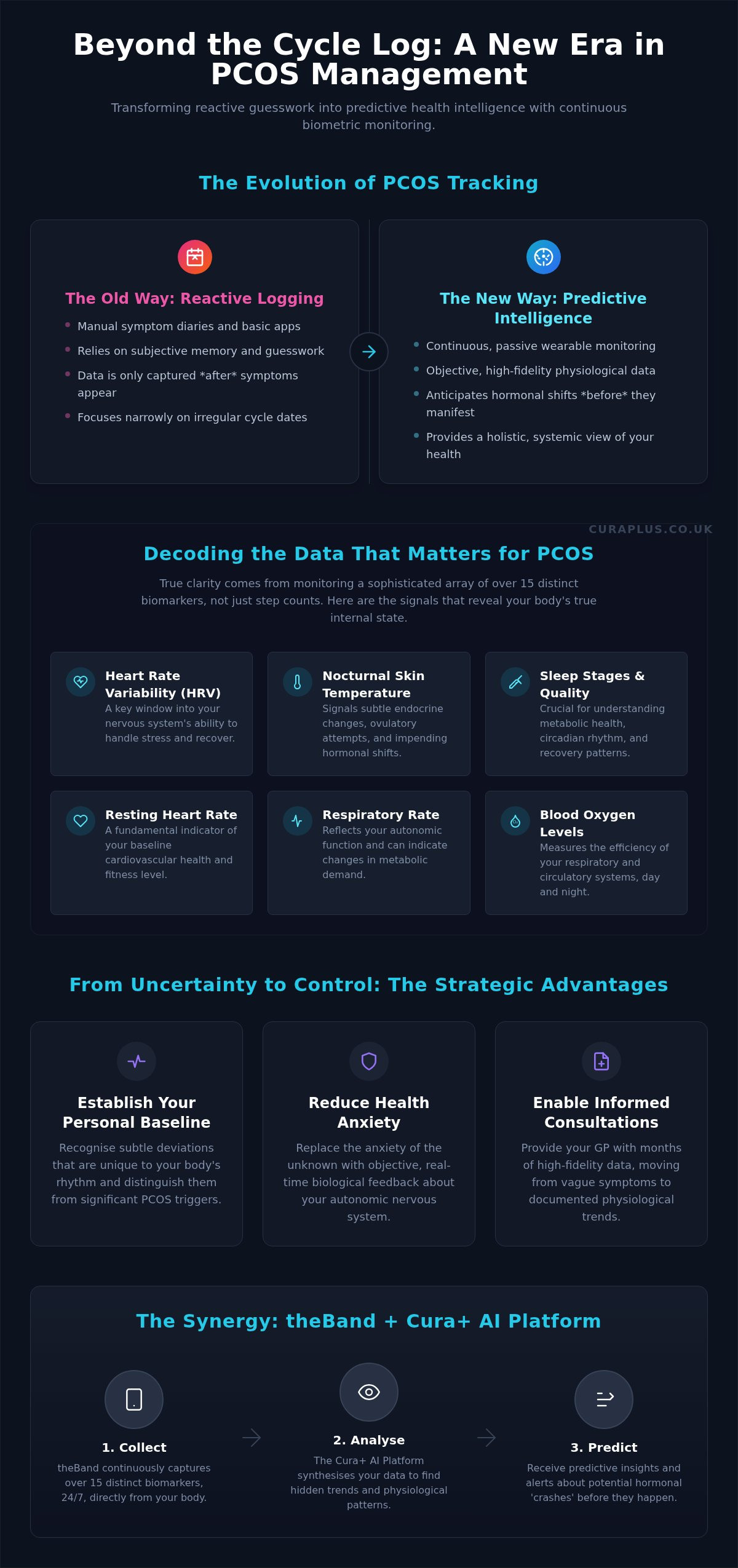
The historical approach to managing Polycystic Ovary Syndrome (PCOS) has often relied on retrospective guesswork. For decades, women have used paper diaries or basic mobile applications to log symptoms after they occur. This reactive method is inherently limited. It relies on subjective memory and fails to capture the subtle physiological nuances that precede a hormonal shift or a metabolic "crash". Today, the paradigm is shifting. Tracking PCOS symptoms with a wearable represents a move towards continuous, passive data collection that works in the background of daily life. This technology acknowledges that PCOS is not merely a reproductive concern; it is a systemic endocrine condition affecting metabolic health, sleep quality, and the stress response. By adopting a multi-sensor approach, we can now access predictive intelligence. This allows us to anticipate shifts in our biology before they disrupt our productivity or wellbeing. British users are increasingly turning to these sophisticated tools, seeking a proactive stance in a healthcare environment where personal data provides the clearest path to clarity.
Why Traditional Fitness Trackers Often Fall Short for PCOS
Most wearable devices were originally engineered for athletes or the general wellness market. They typically prioritise metrics like step counts and calorie expenditure. Whilst these data points are useful for general fitness, they rarely reflect the complex hormonal reality of someone living with PCOS. A standard tracker cannot explain why you feel profound fatigue despite a full night of rest. It ignores the "invisible" biomarkers that actually matter. Heart Rate Variability (HRV) and nocturnal skin temperature are far more indicative of your internal endocrine state than a simple step goal. Without AI-driven analysis to synthesise these metrics, users are often left with a mountain of data but no actionable insights to improve their daily lives.
The Benefits of Continuous Biomarker Monitoring
Continuous monitoring allows you to establish a precise personal baseline. Because PCOS cycles are notoriously irregular, "average" population data is often irrelevant. You need to understand what constitutes "normal" for your specific body. Tracking PCOS symptoms with a wearable provides several strategic advantages:
- Establishing Baselines: You can recognise subtle deviations in skin temperature that signal ovulatory attempts or impending hormonal shifts.
- Reducing Uncertainty: Real-time biological feedback replaces the anxiety of the unknown with objective facts about your autonomic nervous system.
- Informed Consultations: You can bring months of high-fidelity data to your GP or specialist, moving the conversation from vague symptom descriptions to documented physiological trends.
This evolution transforms health tracking from a passive record of the past into a sophisticated guide for future self-optimisation.
Key Biomarkers for Decoding PCOS Hormonal Trends
True physiological clarity requires more than a surface-level understanding of your cycle. Whilst many tools focus exclusively on menstruation, tracking PCOS symptoms with a wearable allows for the simultaneous monitoring of over 15 distinct biomarkers. This multi-sensor approach is essential because the condition influences everything from metabolic rate to cognitive function. By observing the body's internal state in high resolution, we move from vague observations to precise biological insights. TheBand monitors a sophisticated array of data points to provide this clarity, including:
- Autonomic Nervous System markers: Heart Rate Variability (HRV) and resting heart rate.
- Metabolic and Circadian indicators: Sleep stages, respiratory rate, and blood oxygen levels.
- Endocrine signals: Nocturnal skin temperature and cycle-related physiological shifts.
This data-driven perspective transforms the way you interact with your own biology, turning subtle signals into a clear roadmap for health optimisation.
Heart Rate Variability (HRV) and Stress Regulation
Heart Rate Variability (HRV) serves as a critical window into the autonomic nervous system. It measures the minute variations in time between each heartbeat, reflecting your body's ability to switch between "fight or flight" and "rest and digest" modes. In the context of PCOS, hormonal imbalances often lead to elevated cortisol levels, which can suppress HRV and leave you feeling perpetually overwhelmed. theBand functions as a sophisticated wearable for tracking stress patterns, providing a real-time resilience score. Understanding this relationship helps you identify which lifestyle factors, from dietary choices to work deadlines, are taxing your system. When you see your HRV trend downwards, it's a signal to prioritise recovery before a hormonal crash occurs.
Skin Temperature and the Menstrual Cycle
For individuals with irregular cycles, identifying the ovulatory phase can be a significant challenge. Continuous monitoring of distal skin temperature offers a more reliable alternative to traditional spot-checks. Subtle shifts in temperature often signal the hormonal changes that precede ovulation, even when cycles don't follow a standard 28-day pattern. This level of detail is fundamental to the clinical diagnosis and management of PCOS. By capturing data throughout the night, theBand eliminates the inconsistencies of manual readings. This precision is a cornerstone of effective biometric tracking for wellness, allowing you to build a robust profile of your unique biological rhythm. If you're ready to see the invisible trends in your own data, you can explore the capabilities of theBand today.
Sleep stage tracking completes this holistic view. PCOS is frequently linked to disrupted sleep architectures, which can exacerbate insulin resistance and fatigue. When tracking PCOS symptoms with a wearable, you can see how your hormonal health directly impacts your metabolic recovery. This comprehensive dataset ensures that no symptom is viewed in isolation, providing the clarity needed to master your health as a unified system.
Predictive Intelligence: Moving Beyond Retrospective Logging
Traditional health tracking is fundamentally retrospective. It asks you to record a migraine, a bout of fatigue, or a skin breakout after the event has already occurred. Whilst this creates a historical record, it does little to prevent the next disruption. Tracking PCOS symptoms with a wearable should do more than just archive your discomfort; it should anticipate it. Predictive intelligence represents a sophisticated leap from reactive logging to proactive management. By identifying minute physiological shifts before they manifest as physical symptoms, you gain the opportunity to intervene. This foresight transforms your relationship with your body from one of constant damage control to one of informed, strategic action.
How AI Algorithms Forecast Physiological Shifts
The core of this transformation lies in pattern recognition. Human observation is limited by its subjectivity, but the Cura+ AI Platform excels at synthesising multi-biomarker data into a coherent forecast. Recent research into wearables for PCOS management highlights how high-frequency data can reveal trends that remain invisible to the naked eye. The AI doesn't just look at a single metric; it analyses the complex interplay between your resting heart rate, sleep architecture, and skin temperature. It moves the narrative from "What happened?" to "What is about to happen?". By detecting the subtle onset of a hormonal flare, the system provides a window of opportunity to adjust your environment or lifestyle before your energy levels plummet.
Managing Symptom Flares with Proactive Alerts
Proactive alerts serve as a biological early-warning system. When your data indicates that your autonomic nervous system is under undue strain, the system notifies you. This isn't a generic notification; it's a prompt to modify your day. Perhaps it's a suggestion to reduce the intensity of your workout or to prioritise specific dietary choices that support blood sugar stability. This technology also functions as a wearable for early illness detection, using biomarkers as a proxy for your overall immune and hormonal resilience. As a premier predictive health wearable UK option, theBand empowers you to mitigate symptoms through data-driven decisions. Tracking PCOS symptoms with a wearable finally gives you the clarity to choose rest over burnout, ensuring your health remains a managed system rather than an unpredictable burden.
How to Build a Health Baseline with PCOS
Establishing a baseline is the first step in mastering your biological data. For many, the high variability of PCOS makes "standard" health advice difficult to apply. This is why the first 30 days of continuous data collection are vital. During this period, the system learns to distinguish between your unique hormonal fluctuations and external stressors. Tracking PCOS symptoms with a wearable provides the high-resolution data needed to understand what "normal" looks like for your specific body. This foundational month allows the Cura+ AI Platform to calibrate its predictive algorithms to your unique physiology. You can follow this comprehensive guide on how to build a health baseline to ensure your data is both accurate and actionable from day one.
Step-by-Step: Your First Month of Monitoring
Consistency is paramount during the initial phase. Wearing theBand 24/7 ensures that every biomarker, from nocturnal skin temperature to daytime heart rate variability, is captured. These data points act as your "anchor" metrics. They provide a steady point of reference even when your cycle feels unpredictable. As you move through the first month, the AI begins to recognise your physiological fingerprint. It learns how your body recovers from stress and how your sleep efficiency changes throughout different phases. This process moves you away from generic health tracking and towards a personalised model of wellness that respects your body's specific needs.
Interpreting Long-Term Trends vs. Daily Fluctuations
It's easy to overreact to a single night of poor sleep or a temporary dip in HRV. However, true health intelligence focuses on the moving average. You must learn to identify "noisy" data. Factors like travel, a glass of wine, or a late-night meal can cause temporary deviations that don't necessarily reflect a PCOS flare. The Cura+ dashboard helps you visualise these long-term trends, making it easier to see the bigger picture. If you're unsure how to interpret a specific shift, you can consult your AI health and wellness coach for immediate, data-driven context. This support system ensures that you stay focused on progress rather than perfection. You can order theBand today to begin establishing your own health baseline.
theBand by Cura+: The Future of PCOS Management
The management of Polycystic Ovary Syndrome is no longer a matter of reactive logging. It has become a discipline of data-driven foresight. theBand represents the pinnacle of this shift, serving as the advanced wellness tracker of choice for those who demand clarity over their biological data. By integrating high-fidelity hardware with the Cura+ AI Platform, we've created a system that doesn't just record your history; it interprets your future. This synergy ensures that every data point is transformed into an actionable insight, allowing you to master your health with clinical precision.
Our commitment to British engineering excellence is matched only by our dedication to data privacy. We understand that your biometric data is your most personal asset. All information processed through our platform is encrypted to the highest standards, ensuring that your journey toward self-optimisation remains secure. Tracking PCOS symptoms with a wearable should provide peace of mind, not just through health insights, but through the knowledge that your data is protected. It's a partnership built on transparency and scientific rigour.
Unrivalled Sensor Precision for Personal Intelligence
Meaningful hormonal tracking requires more than basic motion sensors. theBand features a sophisticated multi-sensor array designed to monitor over 15 biomarkers simultaneously. This includes medical-grade thermistors for skin temperature and advanced photoplethysmography (PPG) sensors for high-resolution HRV data. We've prioritised clinical-grade accuracy to ensure that the subtle physiological shifts associated with PCOS are captured reliably. This isn't just data for the sake of collection; it's the high-fidelity intelligence needed to make informed lifestyle adjustments.
Continuous wear is essential for building the 30-day baseline mentioned in previous sections. To facilitate this, theBand's design emphasises ergonomic comfort and durability. It's crafted from hypoallergenic materials that feel natural against the skin, making 24/7 monitoring a seamless part of your daily routine. This unobtrusive presence allows for the consistent data collection necessary to reveal the "invisible" trends in your endocrine health without disrupting your lifestyle.
Joining the Pre-Launch Community
We're currently inviting a select group of individuals to join our pre-launch community. This is an opportunity to gain early access to a technology that is redefining the future of personal health. By participating, you aren't just a user; you're a partner in refinement. Feedback from the PCOS community is instrumental in training our AI algorithms to better recognise the diverse ways this condition manifests across different individuals. Your data helps us build a more inclusive and accurate predictive model for everyone.
Moving from uncertainty to clarity requires a commitment to intelligence. Tracking PCOS symptoms with a wearable allows you to replace anxiety with evidence. It's time to stop reacting to your symptoms and start predicting them. Join us as we pioneer a new standard of proactive wellness, designed specifically for the complexities of the human body and the unique challenges of PCOS.
Mastering Your Biological Narrative
Managing a condition as complex as PCOS requires more than intermittent observation; it demands continuous, high-fidelity intelligence. We've explored how the transition to predictive health allows you to anticipate hormonal shifts rather than merely reacting to them after the fact. By establishing a personal baseline and monitoring 15+ essential biomarkers, you replace the anxiety of the unknown with a sense of calm, data-driven control. Tracking PCOS symptoms with a wearable is no longer about simple logging. It's about utilising AI-driven predictive health alerts to optimise your daily resilience and metabolic health. Designed and engineered in the UK, theBand by Cura+ provides the clinical precision needed to decode your body's unique signals with absolute clarity. You have the power to transform your health from a series of unpredictable disruptions into a mastered, transparent system. The future of your wellbeing is no longer a mystery to be solved, but a sophisticated journey to be navigated with confidence. Discover the future of predictive health with theBand by Cura+
Frequently Asked Questions
Can a wearable device really help with PCOS if my periods are irregular?
Yes, a wearable device is particularly effective for individuals with irregular cycles because it monitors physiological shifts rather than relying on calendar dates. By observing continuous trends in heart rate variability and temperature, you can identify ovulatory attempts that traditional apps miss. Tracking PCOS symptoms with a wearable allows you to see the systemic impact of hormones, providing clarity even when your menstrual cycle doesn't follow a predictable pattern.
Which biomarkers are most important to track for PCOS symptoms?
The most critical biomarkers for PCOS include heart rate variability (HRV), nocturnal skin temperature, and sleep architecture. HRV provides a direct window into your autonomic nervous system's response to hormonal stress, whilst skin temperature helps identify metabolic and ovulatory shifts. When you monitor over 15 biomarkers simultaneously, you gain a holistic view of how your endocrine system influences your energy, mood, and metabolic resilience throughout the month.
How does theBand differ from a standard fitness tracker for hormonal health?
Standard fitness trackers typically prioritise external metrics like steps and calories, which offer limited insight into endocrine health. theBand differs by utilising a high-fidelity multi-sensor array to capture internal biological trends. It integrates directly with the Cura+ AI Platform to provide predictive health alerts. This moves the focus from general activity to proactive management of hormonal fluctuations and systemic physiological strain.
Will tracking my skin temperature help me predict my PCOS flares?
Continuous monitoring of distal skin temperature is a powerful tool for anticipating PCOS flares. Subtle elevations in nocturnal temperature often precede hormonal shifts or inflammatory responses. By identifying these deviations early, the system can alert you to potential fatigue or symptom onset before they manifest physically. This predictive approach allows you to adjust your lifestyle proactively, mitigating the impact of sudden biological changes.
How long does it take for the AI to understand my personal PCOS baseline?
The Cura+ AI Platform requires approximately 30 days of continuous wear to establish your unique physiological baseline. This initial period is essential for the algorithms to learn your personal fingerprint and distinguish between normal fluctuations and significant deviations. Once this baseline is established, the system can provide highly personalised predictive insights. Consistency during this first month ensures that the data accurately reflects your body's specific biological rhythms.
Is my health data secure when using the Cura+ AI Platform?
Your health data is protected by high-level encryption and rigorous security protocols within the Cura+ AI Platform. We treat biometric data with the gravity it deserves, ensuring that your personal health narrative remains private and secure. Our commitment to British engineering excellence extends to our digital infrastructure. We prioritise transparency and data integrity, allowing you to focus on self-optimisation without concerns regarding the safety of your information.
Can I use theBand data to show my doctor my PCOS trends?
Yes, theBand provides objective, long-term data that is invaluable during medical consultations. Instead of relying on subjective memory, you can present high-fidelity trends in your HRV, sleep, and temperature. This evidence-based approach facilitates more informed discussions with your GP or specialist. Tracking PCOS symptoms with a wearable helps bridge the gap between your daily experience and clinical management, leading to more personalised and effective care plans.
Does theBand track insulin resistance or metabolic markers?
theBand monitors several metabolic proxies, including heart rate variability and sleep architecture, which are closely linked to insulin sensitivity. Whilst it doesn't perform direct blood glucose measurement, it tracks the physiological impact of metabolic stress on your body. By observing how your biomarkers respond to diet and activity, you can identify patterns that correlate with insulin resistance. This provides a comprehensive view of your metabolic health without invasive testing.


