


Why does your current smartwatch congratulate you on hitting ten thousand steps whilst you are on the verge of a physical collapse? For those living with chronic exhaustion, standard fitness trackers are often more of a hindrance than a help, pushing activity goals that lead directly to a debilitating crash. You understand the exhausting boom and bust cycle all too well, where a morning of moderate productivity results in days of recovery. It is a frustrating reality often compounded by a lack of objective data to show doctors, leaving many to feel as though their physiological strain is invisible. Finding a sophisticated fatigue tracking wearable UK residents can rely on is no longer just about counting steps; it is about biological survival and self-optimisation.
This guide will show you how to transform your approach to health from reactive guesswork into predictive clarity. We will explore how monitoring over 15 biomarkers simultaneously allows you to anticipate a crash before it happens. By using theBand alongside the Cura+ AI platform, you can finally obtain the objective evidence needed to validate your experience and communicate effectively with clinicians. We will outline a reliable framework for pacing that respects your biological limits, moving you away from the uncertainty of the past and towards a future of data-driven control.
Key Takeaways
- Understand why standard fitness algorithms often fail those with chronic exhaustion and how to transition from reactive management to predictive physiological clarity.
- Discover the advantages of a dedicated fatigue tracking wearable UK residents can use to monitor over 15 biomarkers for a comprehensive view of systemic strain.
- Identify the critical role of Heart Rate Variability and skin temperature as early indicators of impending crashes and immune system fluctuations.
- Learn to establish a precise biological health baseline that allows for the identification of energy leaks and the implementation of a sustainable pacing framework.
- Explore how AI-driven health intelligence transforms complex biometric data into personalised, real-time coaching for high-stakes health management.
Understanding Severe Fatigue: Why Standard Wearables Fail
Severe fatigue isn't merely a state of feeling "a bit tired" after a long day. It's a multi-systemic physiological crisis that impacts every facet of biological function. For many, the search for a reliable fatigue tracking wearable UK residents can use to manage chronic conditions stems from a fundamental mismatch between their needs and current technology. Most consumer devices are built for the "worried well" or the elite athlete, leaving those with energy-limiting conditions in a data desert. This invisibility creates a heavy emotional burden. When your device tells you that you are "fit" whilst you are physically unable to stand, it reinforces the medical gaslighting that many chronic illness sufferers experience daily.
The Difference Between Tiredness and Systemic Fatigue
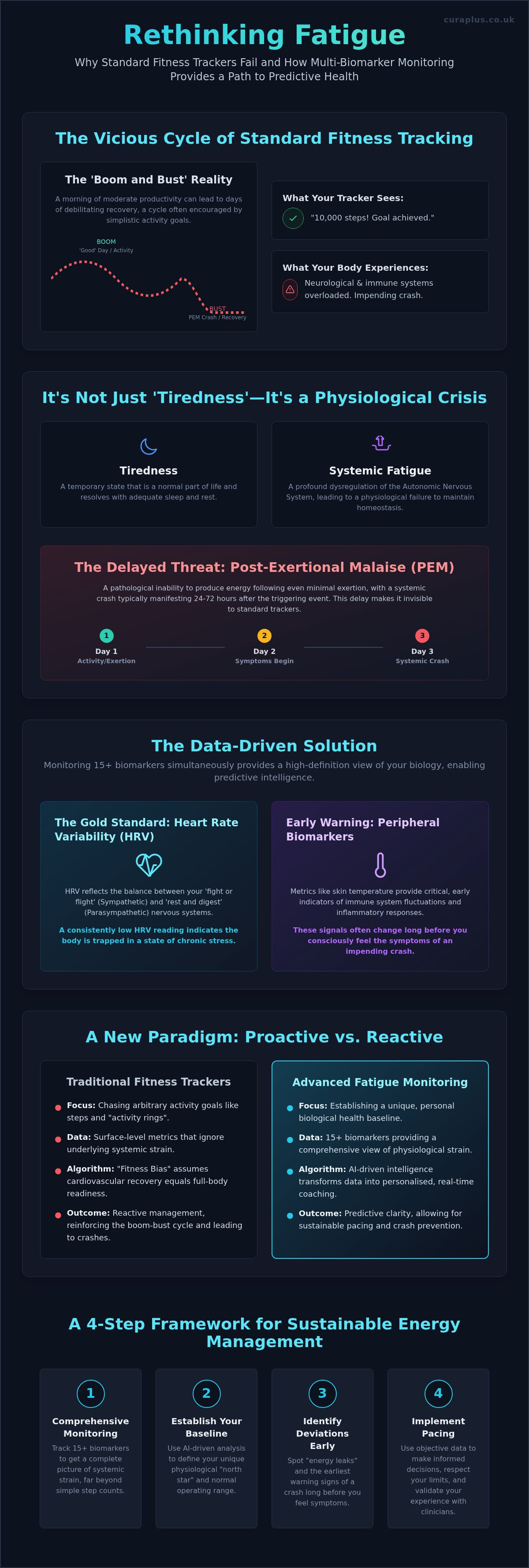
Tiredness is a temporary state that resolves with sleep. Systemic fatigue, however, involves a profound dysregulation of the Autonomic Nervous System (ANS). This is not a lack of willpower; it is a physiological failure to maintain homeostasis. A primary hallmark of this state is Post-Exertional Malaise (PEM). Post-Exertional Malaise is a pathological inability to produce energy following minimal exertion, typically manifesting as a delayed systemic crash 24 to 72 hours after the triggering event. Because this reaction is delayed, standard trackers often fail to connect the cause with the effect, leading users to believe they are "safe" when they are actually over-extending their biological reserves.
Why "Ready to Train" Scores Mislead Chronic Sufferers
Standard wearable algorithms suffer from a "Fitness Bias." They prioritise cardiovascular recovery and muscle repair, assuming that if your heart rate has lowered, you are ready for more activity. For someone with chronic fatigue, your heart might look recovered whilst your neurological and immune systems are still in a state of high alarm. Following "Activity Rings" or "Step Goals" in this state isn't just unhelpful; it's dangerous. It forces the body into a "latent crash" phase where the damage is done but the symptoms haven't yet peaked.
This is why we advocate for proactive health management tools that look beneath the surface of movement to measure systemic strain. Wearable technology provides the data, but without the right context, that data can be weaponised against your own recovery. Instead of chasing arbitrary fitness targets, we must focus on establishing a unique biological baseline. This baseline acts as a physiological "north star," allowing you to recognise when your body is deviating from its norm long before you feel the symptoms of a crash.
The Science of Digital Biomarkers in Fatigue Tracking
To move beyond the limitations of standard fitness trackers, one must adopt a high-definition view of human biology. A sophisticated fatigue tracking wearable UK residents can rely on doesn't just count steps; it monitors 15+ biomarkers simultaneously to detect the subtle shifts that precede a systemic collapse. This multi-layered approach provides a level of clarity that single-metric devices cannot match. By integrating heart rate, respiratory patterns, and peripheral signals, we move from reactive observation to predictive intelligence, allowing for a more nuanced understanding of personal health.
HRV: The Gold Standard for Fatigue Monitoring
Heart Rate Variability (HRV) represents the millisecond-level variations between heartbeats, reflecting the delicate balance between the Sympathetic (fight or flight) and Parasympathetic (rest and digest) branches of the nervous system. For those with chronic exhaustion, a device to measure HRV is essential for identifying ANS dysfunction. A consistently low HRV reading often indicates that the body is trapped in a state of chronic stress, unable to transition into a restorative phase. This data acts as an objective validator, proving that your exhaustion has a tangible basis in your biology.
Beyond Heart Rate: The Role of Peripheral Biomarkers
Whilst HRV is a critical anchor, it doesn't tell the whole story. Peripheral biomarkers like skin temperature, respiratory rate, and blood oxygen saturation (SpO2) provide the nuance required to identify a digital biomarker of mental fatigue. Skin temperature fluctuations often signal the low-grade inflammation frequently seen in ME/CFS or Long Covid. Continuous monitoring of skin temperature trends can predict a physiological crash up to 24 hours in advance by identifying subtle rises that signal immune system activation. Similarly, tracking respiratory rate and oxygen saturation helps you understand the metabolic cost of daily tasks, revealing why even simple movements can feel like climbing a mountain. Monitoring these complex systems requires a partner in your health journey, such as the precision offered by advanced wearable technology.
Comparing theBand by Cura+ with Traditional Fitness Trackers
Most consumer wearables are designed with a singular, often detrimental, bias: they assume the user is healthy and needs to be pushed. Standard devices treat movement as an inherent positive, rewarding users for "closing rings" or hitting step targets. For someone navigating chronic exhaustion, this approach is a liability. theBand represents a fundamental shift from simple activity tracking to deep physiological intelligence. It is not a watch; it is a clinical-grade instrument. Whilst typical consumer trackers monitor three to five basic biomarkers, theBand tracks over 15. This density of data is what makes it the most sophisticated fatigue tracking wearable UK residents can use to master their biological systems.
Data Accuracy and Sensor Sophistication
The difference in quality begins with the hardware. Traditional trackers rely on consumer-grade accelerometers and basic optical sensors that are prone to "noise" during movement. theBand utilises a medical-grade sensor array designed to filter out environmental interference, providing the clarity required for a true predictive health wearable UK experience. This level of precision is vital when the margins for error are so slim. Whilst Stanford University researchers have explored specialised sensors for fatigue assessment, theBand brings this level of scientific rigour to a daily wearable format. It moves beyond raw data, using its high-fidelity sensors to capture the subtle biological signatures that consumer watches simply miss.
Predictive Alerts vs. Reactive Notifications
Standard notifications are almost always reactive. Your watch might tell you that your heart rate was high an hour ago or that you didn't sleep well last night. For those with energy-limiting conditions, knowing you are tired now is redundant. You need to know that you will be tired tomorrow. The Cura+ platform acts as an AI health and wellness coach, identifying the specific "signature" of an impending crash before it manifests physically. By analysing the interplay amongst 15+ biomarkers, the AI recognises when your system is beginning to deviate from its baseline. This allows you to intervene 24 hours in advance, turning the "boom and bust" cycle into a manageable, predictable process. You aren't just managing symptoms; you are gaining the intelligence needed to prevent them.
A Step-by-Step Framework for Managing Fatigue with Data
Transitioning from reactive symptom management to proactive mastery requires a structured, data-driven approach. By utilising a sophisticated fatigue tracking wearable UK residents can finally move beyond the guesswork of manual symptom diaries. This framework provides a clear path towards physiological stability by leveraging high-fidelity biometric insights to anticipate strain before it becomes debilitating. It's about transforming invisible symptoms into a visible, manageable strategy.
Building Your Baseline: The First 14 Days
The initial two weeks of tracking are foundational. During this calibration phase, theBand and Cura+ AI platform work to establish your unique biological health baseline. This isn't a generic average; it is a precise map of your specific autonomic nervous system behaviour. To ensure data integrity, you should wear the device consistently, including whilst sleeping, to capture the full spectrum of your body's circadian rhythms. The AI looks for patterns in your heart rate variability, skin temperature, and respiratory rate to understand what "normal" looks like for your specific physiology before it begins to predict deviations with clinical precision.
Once your baseline is established, the focus shifts to identifying "Energy Leaks." These are subtle periods of physiological strain that might not register as exhaustion in the moment but contribute to a delayed crash. By monitoring biomarkers continuously, you can pinpoint exactly which activities, environments, or times of day are draining your reserves. This leads naturally into Step 3: implementing a predictive pacing strategy. Unlike manual pacing, which relies on how you feel in the present, predictive pacing uses AI-driven alerts to forecast your energy levels for the coming 48 hours.
Mastering the Art of Predictive Pacing
The Cura+ platform provides dynamic "Readiness" scores that serve as a strategic guide for your daily schedule. If your score is high, you may have the capacity for essential tasks; if it is low, the data suggests a day of radical rest. The ideal reaction to a predictive "Pre-Crash" alert is to immediately reduce cognitive and physical load by at least 50 percent, prioritising horizontal rest to allow the nervous system to recalibrate before symptoms manifest. This proactive intervention is the key to breaking the "boom and bust" cycle that defines chronic fatigue.
By correlating lifestyle factors like diet and sleep with your biometric data, you gain a granular understanding of your personal triggers. This culminates in Step 5: using objective long-term trends to facilitate more productive conversations with healthcare professionals. Having a visual record of your physiological strain removes the ambiguity of subjective descriptions, providing the data needed for more accurate support. To begin your journey towards data-driven recovery, explore theBand and Cura+ platform today.
theBand by Cura+: The Future of Fatigue Management
theBand by Cura+ isn't merely another entry into the crowded wearable market. It's a precision-engineered response to the systemic failure of consumer trackers to address the needs of those with chronic exhaustion. By integrating a multi-sensor array that monitors over 15 distinct biomarkers, theBand provides the high-fidelity data required for a truly proactive health journey. This is a tool designed for high-stakes environments where every decision about energy expenditure has significant physiological consequences. When paired with the Cura+ AI Platform, the device moves beyond data collection to provide real-time health coaching that adapts to your unique biological signature.
The decision to utilise a subscription-based model is deliberate. In the rapidly advancing field of digital biology, algorithms must evolve to remain effective. Your subscription ensures that as our understanding of fatigue-related biomarkers deepens, your device's intelligence grows alongside it. We're committed to a continuous cycle of refinement, ensuring that theBand remains the most sophisticated fatigue tracking wearable UK users can rely on for long-term stability. As we move through the pre-launch phase, early adopters have the unique opportunity to take control of their health narrative before theBand reaches the wider market.
A Partner in Your Self-Optimisation Journey
Choosing to track your health with this level of precision represents a fundamental shift in identity. You're no longer a passive patient waiting for a management plan; you're a health strategist. This empowerment comes from the possession of objective, clinical-grade data in a world that often dismisses invisible symptoms. theBand integrates seamlessly into a future of personal health where the focus is shifted from reactive treatment to predictive intelligence. By identifying the earliest signals of systemic strain, you can intervene before a crisis occurs, reclaiming control over your daily life.
Securing Your Health Intelligence
We recognise that your biometric data is your most intimate information. theBand and the Cura+ platform utilise clinical-level encryption to ensure that your health intelligence remains private and secure. We prioritise UK-based data sovereignty, ensuring that your information is handled with the highest standards of regulatory compliance and ethical rigour. This commitment to security is the foundation of the trust we build with our community. As we prepare for our next release, we invite you to take the first step toward a more predictable future. Join the waitlist for theBand today and secure your place at the forefront of the fatigue tracking wearable UK revolution.
Reclaiming Mastery Over Your Biological Narrative
Managing severe fatigue is no longer a matter of guesswork or pushing through invisible barriers. You've seen how standard fitness algorithms fail by ignoring the unique physiological signatures of chronic exhaustion. By adopting a dedicated fatigue tracking wearable UK residents can finally access the predictive clarity needed to break the boom and bust cycle. With the ability to monitor 15+ biomarkers simultaneously, you gain a high-definition view of your internal state, allowing you to intervene before a crash manifests. This transition from reactive management to data-driven strategy empowers you to communicate with clinical precision and live with renewed confidence.
The future of your health is not a series of symptoms to be endured; it's a complex system to be mastered. Clarity replaces uncertainty. You deserve a partner that understands the high stakes of your recovery and provides the objective evidence required to validate your experience. Secure your data sovereignty with UK-based clinical precision and take control of your narrative. Start your journey toward self-optimisation and predictive clarity today.
Discover theBand by Cura+: Pre-order your predictive health wearable
Frequently Asked Questions
Can a wearable device really predict when I am going to crash?
Yes, advanced predictive technology identifies physiological deviations before physical symptoms manifest. By monitoring the interplay amongst 15+ biomarkers, theBand detects the subtle signals of autonomic nervous system strain that precede Post-Exertional Malaise. This allows you to receive a "Pre-Crash" alert up to 24 hours in advance. Consequently, you can proactively adjust your activity levels, transforming your management from reactive guesswork into data-driven prevention and control.
How is theBand different from a standard fitness tracker for fatigue?
Standard trackers are built with a "fitness bias" that rewards overexertion through arbitrary step goals. In contrast, theBand is a dedicated fatigue tracking wearable UK residents use for deep physiological intelligence. It monitors over 15 biomarkers using medical-grade sensors, whereas consumer watches typically track only three to five. The Cura+ AI platform prioritises systemic recovery and neurological stability over cardiovascular fitness, respecting your unique biological limits.
What biomarkers are most important for tracking severe fatigue?
Heart Rate Variability (HRV) remains the primary window into autonomic nervous system function, but it requires context from peripheral signals. Skin temperature fluctuations are critical for detecting the low-grade inflammation often associated with systemic fatigue. Additionally, monitoring respiratory rate and blood oxygen saturation (SpO2) reveals the metabolic cost of daily tasks. theBand integrates these metrics to provide a comprehensive, high-definition map of your internal physiological strain and recovery capacity.
Will this device help me explain my fatigue to my doctor?
Absolutely, theBand provides the objective, longitudinal data required to validate your subjective experience. Instead of describing vague symptoms, you can present clear visualisations of biomarker deviations and physiological strain. This evidence helps bridge the communication gap with healthcare professionals, moving the conversation away from anecdotal reports toward data-backed clinical discussions. It provides a tangible record of the invisible strain your body endures whilst navigating your daily life.
Can theBand detect viral onset before I feel symptoms?
Yes, theBand is designed for early detection by identifying the body's initial immune responses. Subtle rises in resting heart rate and skin temperature, combined with a sudden drop in HRV, often signal viral onset before physical symptoms appear. By recognising these early markers of systemic alarm, you can prioritise radical rest immediately. This proactive approach potentially reduces the severity of the subsequent illness by respecting the body's need for immediate recovery.
Is theBand suitable for people with Long Covid or ME/CFS?
Yes, theBand is specifically engineered for individuals navigating energy-limiting conditions like Long Covid and ME/CFS. Unlike devices that push harmful activity goals, this fatigue tracking wearable UK focuses on pacing and autonomic stability. It provides the granular data necessary to manage Post-Exertional Malaise and avoid the debilitating "boom and bust" cycle. It acts as a sophisticated guide for those whose health journey requires clinical precision and predictive clarity.
How long does it take to establish a reliable health baseline?
A reliable biological baseline typically requires 14 days of consistent wear. During this calibration phase, the Cura+ AI platform learns your unique physiological rhythms, including your circadian patterns and resting biomarker ranges. This period is essential for personalising the predictive algorithms to your specific body. Once established, the system can accurately detect even minor deviations from your norm, providing the foundation for the highly personalised health alerts that drive your strategy.
Does theBand require a monthly subscription for the AI features?
Yes, theBand utilises a subscription model to ensure your health intelligence remains at the cutting edge. This fee supports the continuous evolution of our AI algorithms and the integration of the latest clinical research into your daily alerts. It ensures your device never becomes obsolete as our understanding of digital biomarkers expands. This commitment to ongoing refinement provides you with a partner that evolves alongside your personal journey toward self-optimisation and mastery.


