


What if the notification on your wrist isn't a cause for panic, but the most valuable diagnostic tool your doctor hasn't seen yet? It's natural to feel a surge of anxiety when your device flags a sudden shift in heart rate variability or a persistent spike in skin temperature. Many patients hesitate to share these signals with their GP, fearing they'll be dismissed as the "worried well" amongst a busy NHS schedule. However, your data is a powerful asset when framed correctly.
Understanding what to do after a negative health trend alert allows you to move beyond uncertainty and into a state of calm control. You'll discover how to refine complex biomarker signals into a clear, professional narrative that commands clinical respect and optimises your preventative care. This guide explores how to establish your personal physiological baseline, curate your data for maximum impact, and lead a sophisticated, data-driven consultation that turns raw numbers into actionable medical insights. By the end, you'll be equipped to transform a digital warning into a high-level strategy for your long-term wellness.
Key Takeaways
- Establish your unique physiological baseline to ensure any data-driven alert is interpreted within the context of your personal health fingerprint rather than generic averages.
- Discover exactly what to do after a negative health trend alert by utilising the "Three-Trend Rule" to prioritise the most relevant biomarker deviations for your clinician.
- Implement a structured three-step communication framework designed to present your data effectively and professionally within the time constraints of a standard UK medical appointment.
- Transition from reactive symptom reporting to proactive physiological intelligence, reframing negative data signals as opportunities for early intervention and preventative care.
- Leverage longitudinal monitoring of over 15 biomarkers with theBand by Cura+ to provide your doctor with a comprehensive, clinical-grade narrative of your health.
The Evolution of the Data-Rich Patient in 2026
The paradigm of healthcare is undergoing a radical shift. For decades, the patient journey began at the onset of symptoms, a reactive model that often prioritised crisis management over preventative precision. By 2026, this dynamic has inverted. We have entered the era of proactive physiological intelligence, where the body’s internal state is constantly monitored and decoded. A negative trend alert is no longer a source of dread. Instead, it serves as a sophisticated tool for early intervention, providing a window of opportunity before physical symptoms ever manifest. Understanding what to do after a negative health trend alert is the first step in leveraging the future of personal health to secure better clinical outcomes.
Why Traditional Consultations are Changing
The standard 10-minute NHS appointment was designed for acute issues: a cough, a rash, or a broken limb. However, as AI-driven insights become standard, the nature of these consultations is evolving into a data-led partnership. Your clinician is no longer just a diagnostician; they're becoming a strategist. When your wearable identifies a subtle deviation in heart rate variability or respiratory patterns, it acts as an early warning system. This allows for a more nuanced conversation. The proactive patient in the UK landscape now arrives with longitudinal data that bridges the gap between annual check-ups, ensuring that potential issues are addressed whilst they're still manageable. It's a move away from "wait and see" toward "measure and act."
The "Worried Well" vs. the "Data-Informed"
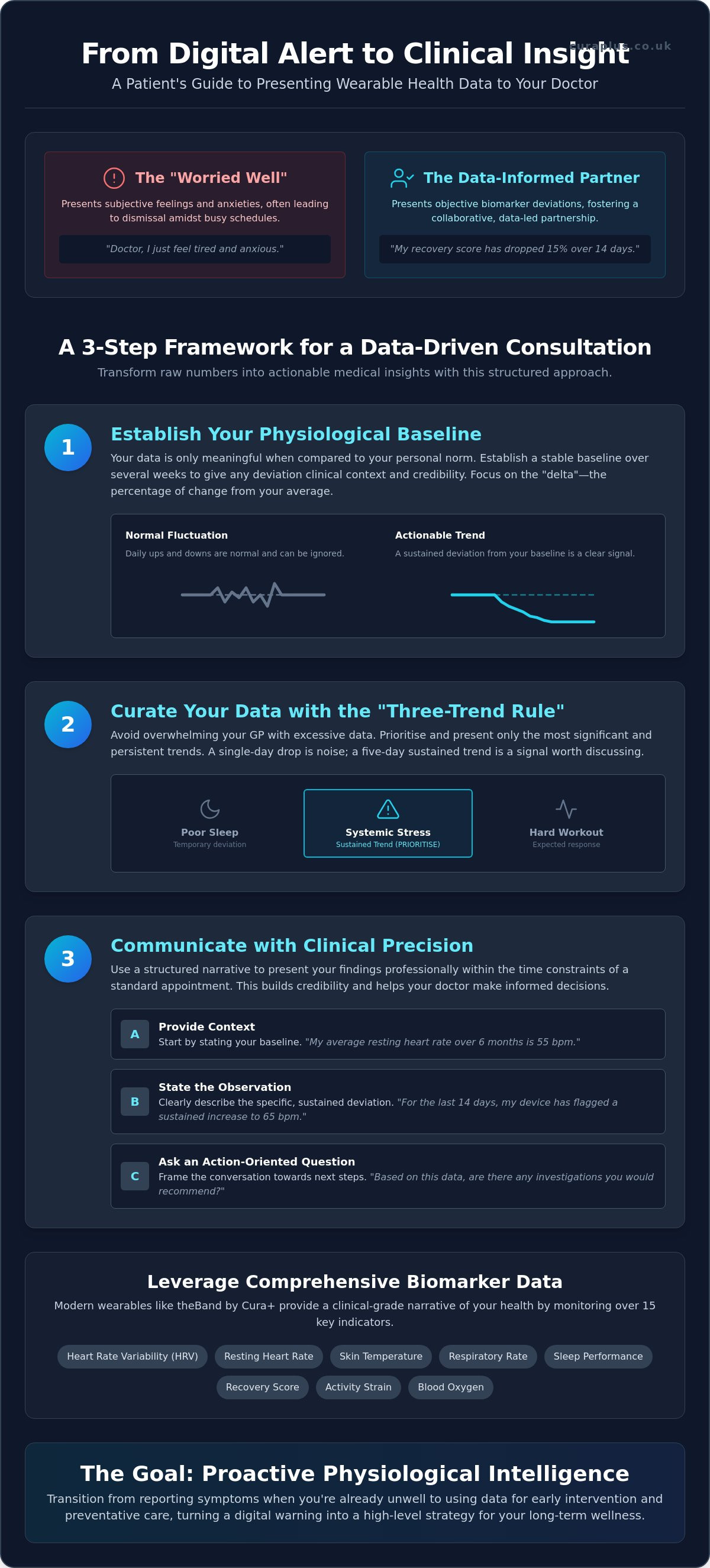
Historically, patients who frequently sought reassurance without clear symptoms were labelled the "worried well." This stigma often created a barrier to effective communication. The modern distinction lies in the shift from subjective anxiety to objective biomarker deviations. This transition is deeply rooted in the Quantified Self movement, which has empowered individuals to track their biology with clinical-grade accuracy. To gain immediate respect from your GP, you must present your findings with professional etiquette and precise terminology. It isn't about "feeling tired"; it's about presenting a 15% drop in recovery scores over a 14-day period. By focusing on these hard metrics, you move from the category of the anxious patient to that of the data-informed partner. Knowing what to do after a negative health trend alert means knowing how to translate these digital signals into a language your doctor can act upon with confidence.
Establishing Your Physiological Baseline: The Key to Clinical Credibility
Clinical credibility isn't simply granted; it's built through the meticulous presentation of data. A negative alert in isolation is often little more than digital noise. To truly understand what to do after a negative health trend alert, you must first define what "normal" looks like for your specific biology. This is your physiological baseline, a personalised fingerprint of health that serves as the constant against which all variables are measured. Without this context, a spike in resting heart rate could indicate a brewing infection or simply be the result of a poor night's sleep. Learning how to build a health baseline provides the essential framework your GP needs to take your digital insights seriously.
The most critical metric in this conversation is the "delta," or the specific degree of deviation from your established norm. Doctors are trained to look for significant shifts rather than daily fluctuations. By presenting your data as a percentage of change rather than a raw, varying number, you provide a professional level of clarity that cuts through the noise of daily life. It transforms a vague concern into a quantifiable medical observation.
Identifying Deviations from the Norm
Subtle shifts are often the most telling indicators of a change in health status. A single-day drop in heart rate variability (HRV) might reflect a strenuous workout or temporary stress, but a five-day sustained downward trend suggests a deeper systemic issue. Similarly, nocturnal skin temperature spikes that persist beyond 48 hours merit clinical attention. When considering what to do after a negative health trend alert, focus on these longitudinal patterns. Presenting your data as a "12% deviation from a 30-day mean" provides the precision required for an efficient clinical interpretation, allowing your doctor to focus on the signal rather than the noise.
Why Baselines Win Over GPs
GPs are naturally cautious of "lifestyle noise." They understand that a late night, a heavy meal, or temporary work pressure can easily skew biometric data. A robust, 30-day baseline acts as a filter, proving that your current alert isn't a statistical anomaly. It demonstrates that you understand the nuances of biometric tracking for wellness and have accounted for external factors. This level of preparation is what separates a data-informed patient from the "worried well." To ensure your baseline is captured with maximum precision, leveraging the Cura+ AI Platform can help automate the detection of these critical deltas before your next consultation, ensuring your data is always doctor-ready.
Curation Over Volume: Identifying Actionable Trends
Data volume is often mistaken for clinical value. Whilst your wearable may capture thousands of data points daily, presenting a raw feed to your GP is likely to be counterproductive. In a high-pressure clinical environment, data dumping creates a cognitive burden that can lead to frustration rather than insight. When determining what to do after a negative health trend alert, your primary objective is to transition from providing raw data to delivering curated intelligence. This means filtering the noise to highlight only the most significant physiological shifts that require professional attention.
Adopting the "Three-Trend Rule" is a strategic necessity. This framework dictates that you should never present more than three key biomarker deviations during a single consultation. By narrowing your focus, you respect the clinician's time and ensure the conversation remains anchored to actionable medical evidence. It's about quality of evidence over quantity of metrics. This approach transforms you from a passive recipient of alerts into a sophisticated partner in your own preventative care.
Selecting the Right Biomarkers
Precision in biomarker selection is essential for clinical relevance. If you're experiencing physical fatigue, highlighting a sustained drop in Heart Rate Variability (HRV) serves as a powerful proxy for autonomic nervous system strain. Utilising a wearable for tracking stress patterns can help you distinguish between psychological pressure and genuine physiological overreach. Similarly, changes in sleep architecture, such as a significant reduction in Deep Sleep or a spike in nocturnal restlessness, can be early indicators of systemic inflammation or brewing illness. Prioritise the biomarkers that correlate most directly with your physical experience to provide a cohesive narrative.
Visualising Data for Speed
The medium of delivery is just as important as the data itself. Scrolling through a mobile app during a 10-minute appointment is inefficient and can appear unprofessional. Instead, rely on visual summaries that allow for rapid interpretation. A 7-day trend graph is far superior to a list of daily numbers because it illustrates the trajectory of a deviation at a glance. Many advanced platforms now offer "Traffic Light" colour coding, which naturally draws the doctor’s eye to critical deviations in red whilst confirming stable metrics in green. Preparing a one-page "Executive Health Summary" before you arrive ensures that the most vital information is immediately accessible. This level of preparation is a hallmark of the data-informed patient and is a key part of what to do after a negative health trend alert to ensure your concerns are addressed with the gravity they deserve.
The Three-Step Framework for a Data-Driven Appointment
Navigating a standard UK consultation requires strategic efficiency. With the typical GP appointment lasting approximately 10 minutes, there's no room for ambiguity or excessive data scrolling. To ensure your concerns are met with clinical rigour, you must adopt a structured communication framework. This process is designed to move from observation to evidence and finally to a collaborative clinical ask in under 120 seconds. Knowing what to do after a negative health trend alert involves mastering this brevity, ensuring your data serves as a bridge to better care rather than a barrier to communication. It's about presenting a narrative that is both intellectually dense and practically accessible.
Step 1: Framing the Observation
The language you choose establishes your credibility immediately. Avoid phrases like "my band says I'm sick," which can trigger a reactive dismissal. Instead, use precise terminology: "I've noticed a significant deviation from my physiological baseline." This phrasing signals that you understand your body's normal operating range. Connect the alert to a tangible functional change, such as a persistent increase in resting heart rate or a noticeable reduction in recovery capacity. Be specific about the timeline. Stating that "this trend has persisted for six days" provides the longitudinal context a doctor needs to distinguish a meaningful signal from temporary lifestyle noise.
Step 2: Presenting the Evidence
Once the observation is framed, place your curated evidence at the physical centre of the consultation. Whether it's a printed report or a tablet, ensure the visual data is clear and comparative. Use language that highlights the delta: "Whilst my normal HRV is 60ms, it has consistently dropped to 42ms over the last week." This comparison removes the guesswork for the clinician. Relying on high-fidelity data from an advanced wellness tracker ensures that the metrics you present are robust and clinically relevant. It transforms the device from a consumer gadget into a validated source of physiological intelligence.
Step 3: The Collaborative Question
The final step is to pivot toward the "Clinical Ask." This is where you position yourself as a partner seeking expert interpretation rather than a self-diagnostician. Ask direct, collaborative questions: "How does this objective data align with your clinical assessment today?" or "Based on this trend, would you recommend further diagnostic blood work to investigate potential inflammation?" This approach respects the doctor's expertise whilst ensuring your data-driven observations are integrated into your care plan. To begin mastering your own health data before your next appointment, explore how the Cura+ AI Platform can refine your raw metrics into actionable clinical insights.
Bridging the Gap with theBand by Cura+
The final hurdle in mastering what to do after a negative health trend alert is the quality of the data itself. Whilst the communication frameworks we've discussed are essential, they rely on a foundation of high-fidelity, clinical-grade intelligence. This is where theBand by Cura+ distinguishes itself from standard consumer wearables. Engineered for precision, it monitors over 15 distinct biomarkers, creating a comprehensive, longitudinal record of your physiological state. This isn't just data collection; it's the creation of a medical-grade narrative that allows you to walk into any UK clinic with absolute confidence in your findings.
The Cura+ AI Platform acts as the sophisticated engine behind the hardware, organising vast quantities of raw metrics into concise, actionable summaries. In the predictive health landscape of 2026, the ability to detect subtle shifts before they escalate into acute episodes is the ultimate goal of preventative care. By providing your clinician with a clear view of your internal systems, you move beyond the limitations of reactive medicine and enter a partnership defined by clarity and control.
From Raw Data to Medical Intelligence
Accuracy is the cornerstone of clinical trust. The Cura+ AI Platform utilizes advanced algorithms to filter out lifestyle noise, such as temporary stress or sleep disruptions, ensuring that every alert you receive is physiologically significant. This rigorous filtering process means that when you decide what to do after a negative health trend alert, you aren't chasing ghosts. You're responding to verified signals. Your AI health and wellness coach plays a pivotal role here, synthesising these complex biomarker trends into the "Doctor-Ready Reports" we explored earlier. This preparation ensures that the data you present is not only accurate but formatted in a way that clinicians can immediately interpret and act upon.
Your Partner in Proactive Health
Maintaining a continuous, multi-biomarker record is the most powerful way to safeguard your long-term wellness. theBand provides this stability, capturing the nuances of your health history that intermittent check-ups often miss. This constant vigilance empowers you to lead more effective, objective conversations with your GP, backed by a level of evidence that was previously only available in a hospital setting. You're no longer just a patient reporting symptoms; you're a data-informed strategist managing a complex biological system. Discover how theBand by Cura+ can transform your preventative health journey, turning every digital signal into a step toward self-optimisation and enduring vitality.
Mastering Your Physiological Intelligence
The transition from reactive symptom management to proactive physiological intelligence is the defining movement of modern healthcare. By establishing a robust baseline and curating your biomarker trends, you transform raw data into a powerful tool for clinical partnership. Mastering the structured communication framework ensures that your GP consultation remains efficient, objective, and deeply productive.
Understanding what to do after a negative health trend alert is about replacing uncertainty with a clear, data-led strategy. It's the difference between being a passive observer of your health and an active architect of your longevity. To support this journey, theBand by Cura+ offers UK-based clinical-grade technology designed for proactive illness detection. It monitors 15+ biomarkers with AI precision, providing the high-fidelity evidence required to drive superior clinical outcomes.
Join the waitlist for theBand by Cura+ and start mastering your health data today.
The future of your wellness is no longer a mystery to be solved but a system to be mastered. Embrace the clarity that clinical-grade data provides and take command of your health journey today.
Frequently Asked Questions
Will my GP be annoyed if I bring wearable data to my appointment?
Your GP is unlikely to be annoyed if you present curated, objective evidence instead of raw data feeds. Most clinicians value high-quality information that helps them make more informed decisions. By using the three-step framework to frame your observations as a "data-led partnership," you respect their time and expertise. This professional approach transforms you from a worried patient into a proactive partner in your own preventative care.
Which health metrics are most important to show a doctor after a negative alert?
Prioritise biomarkers that demonstrate a significant "delta" or deviation from your established baseline. Heart Rate Variability (HRV), resting heart rate, and nocturnal skin temperature are often the most clinically relevant signals for detecting systemic strain or early illness. Focusing on these specific metrics provides a clear physiological narrative. This clarity allows your doctor to quickly identify potential issues that warrant further investigation or formal diagnostic testing.
How much data should I actually show during a 10-minute consultation?
Limit your presentation to a single page or a 7-day trend graph that highlights the specific deviation. The "Three-Trend Rule" is essential here; never present more than three key biomarker shifts in one visit. Providing a concise summary ensures you don't overwhelm the clinician with irrelevant details. Knowing what to do after a negative health trend alert means being selective, ensuring every second of your appointment is used for high-value clinical discussion.
Can wearable data from theBand be used for a formal medical diagnosis?
theBand is engineered for physiological intelligence and proactive monitoring, but it's not a tool for formal medical diagnosis. It identifies subtle shifts in your biology that act as an early warning system. This data empowers your GP to determine which clinical diagnostic tests, such as blood work or an ECG, are necessary. It bridges the gap between your daily life and the clinic, providing the high-fidelity evidence required for a targeted medical assessment.
What should I do if my doctor dismisses my negative health trend alert?
If a doctor dismisses the alert, pivot the conversation back to the objective deviations from your baseline. Ask a collaborative question, such as: "How does this 15% drop in my recovery metrics over six days align with your clinical findings today?" This shifts the focus from the device to your actual physiology. If you still feel unheard, consider seeking a second opinion from a clinician who specialises in preventative medicine and data-driven wellness.
How do I know if my wearable data is accurate enough for clinical use?
Clinical-grade accuracy depends on sophisticated sensors and AI that can filter out "lifestyle noise." theBand monitors 15+ biomarkers with high-fidelity precision, ensuring that the signals you receive are physiologically significant. Standard consumer devices often struggle with accuracy during movement or sleep, but theBand is designed to provide stable, longitudinal data. This level of reliability is what allows you to present your trends to a doctor with absolute confidence.
Is it better to show data on my phone or print out a PDF report?
A printed or digital PDF report is far superior to showing data on a mobile phone. It allows the clinician to scan your "Executive Health Summary" at a glance without the friction of navigating an app interface. This professional presentation matches the high-stakes nature of your health. It also ensures that the most critical deviations are highlighted clearly, making it easier for the doctor to integrate your data into your medical records.
How can I explain Heart Rate Variability (HRV) to my doctor simply?
Explain HRV as a non-invasive proxy for your autonomic nervous system's resilience and recovery capacity. A sustained drop in HRV suggests that your body is under systemic strain and is struggling to maintain homeostasis. Sharing this insight is a vital part of what to do after a negative health trend alert, as it provides a quantifiable metric for fatigue or brewing illness. It helps your doctor understand your internal state beyond just your visible symptoms.


