


With 67% of workers reporting burnout symptoms in 2026, the question is no longer if you are under pressure, but whether that pressure has begun to rewire your biology. You might find yourself staring at a screen through a haze of brain fog or struggling with disrupted sleep patterns whilst your productivity wanes. It's a common experience to feel your professional efficacy slipping even as you extend your working day. Identifying the early warning signs of burnout is no longer about intuition; it's about the clinical precision of data.
You deserve a level of clarity that moves beyond guesswork to provide a definitive map of your internal state. In this guide, you'll discover how to identify the physiological and psychological precursors to exhaustion using advanced biomarker data. We'll examine the critical transition from manageable stress to systemic burnout and reveal how predictive intelligence, powered by theBand and the Cura+ platform, allows you to reclaim control. By understanding the measurable shifts in your autonomic nervous system, you can transform your approach to health from reactive recovery to proactive mastery.
Key Takeaways
- Learn to distinguish between temporary acute stress and the progressive systemic failure that defines chronic burnout.
- Identify the early warning signs of burnout through objective biomarkers such as Heart Rate Variability (HRV) and skin temperature fluctuations.
- Understand why high-achievers often fail to recognise their own physiological decline and how AI monitoring removes human bias.
- Discover how theBand monitors over 15 biomarkers simultaneously to establish a unique health baseline for predictive intelligence.
- Implement data-driven 'micro-recoveries' throughout your day to prevent physiological exhaustion before it takes hold.
The Anatomy of Burnout: Understanding the Shift in 2026
In 2026, the professional environment has evolved into a high-performance ecosystem that often outpaces human biological capacity. Burnout is no longer merely a psychological state or a byproduct of a difficult project; it is a systemic physiological failure. Whilst traditional views often conflate it with heavy workloads, the reality is more complex. It represents a progressive breakdown of the body's regulatory systems. Identifying the early warning signs of burnout requires us to look beyond mental fatigue and examine the underlying data of the human machine.
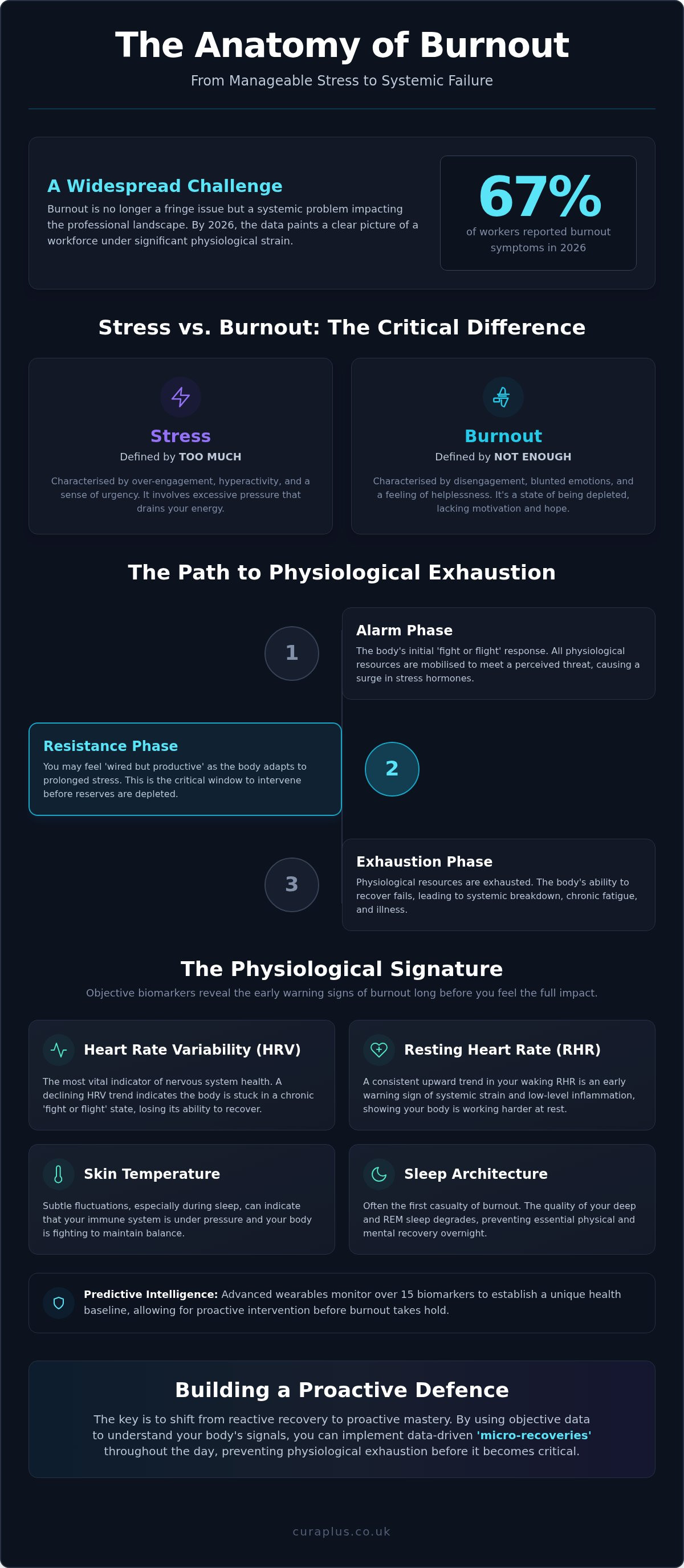
This decline follows a predictable trajectory known as the General Adaptation Syndrome. Initially, you enter the alarm phase, where the body mobilises every resource to meet a perceived threat. This is followed by a resistance phase where you might feel wired but productive. Recognising the early warning signs of burnout during this resistance phase is the only way to prevent the inevitable slide into the exhaustion phase. At this point, the physiological reserves are depleted, and the body loses its ability to return to a baseline of health. For UK professionals, 2026 demands a sophisticated understanding of this shift to maintain peak performance.
The Psychology of Detachment and Reduced Efficacy
As physiological resources dwindle, the mind adopts a defensive posture. Emotional exhaustion often manifests as cynicism or a profound sense of detachment from one’s work and colleagues. This creates a dangerous productivity trap where high-achievers attempt to compensate for reduced efficacy by working longer hours. This behavioural shift only accelerates the decline, as the increased effort further drains the already depleted biological battery. You might notice yourself withdrawing from social interactions or losing the professional identity that once provided a sense of purpose and drive.
Burnout vs. Stress: Knowing the Critical Difference
It's vital to distinguish between these two distinct states. Stress is generally characterised by too much, such as too many responsibilities or excessive pressure. Conversely, burnout is defined by not enough. It is a lack of energy, a lack of motivation, and a lack of hope. Occupational burnout is a progressive condition where the body stops recovering even during periods of rest. Whilst stress might keep you awake at night, burnout leaves you feeling hollowed out upon waking. The burnout threshold is the specific physiological moment when the body's capacity for recovery fails to meet the systemic demand for energy.
The Physiological Signature: Measurable Biomarkers of Burnout
Subjective feelings are often unreliable narrators of our internal health. Whilst you might dismiss a week of poor focus as a lack of discipline, your biology is likely telling a different story. By 2026, the focus has shifted from managing symptoms to monitoring the specific physiological signatures that precede a crash. These early warning signs of burnout are written in your data long before they manifest as a total loss of professional efficacy. Understanding these metrics allows for a level of clinical precision that replaces guesswork with clarity.
Resting Heart Rate (RHR) and skin temperature fluctuations serve as critical proxies for systemic strain. A consistent upward trend in your waking RHR often signals that the body is struggling with low-level systemic inflammation. Similarly, subtle changes in nocturnal skin temperature can indicate that the immune system is under significant pressure. When these metrics deviate from your established baseline, they provide an objective warning that your current pace is unsustainable.
HRV: The Window into Your Nervous System
Heart Rate Variability (HRV) is perhaps the most vital indicator of your Autonomic Nervous System (ANS) health. It measures the millisecond variations between heartbeats, reflecting the delicate balance between your sympathetic (fight or flight) and parasympathetic (rest and digest) systems. High variability suggests a resilient, adaptable system, whilst a declining HRV trend indicates that your body is stuck in a state of chronic stress. It is important to look at the trajectory of this data rather than isolated snapshots. For those looking to master their ANS, using a wearable for tracking stress patterns provides the granular insights necessary to intervene before the burnout threshold is crossed.
Sleep and Recovery: The First Casualties of Burnout
Sleep architecture is frequently the first casualty of prolonged pressure. Burnout often creates a 'tired but wired' state where, despite physical exhaustion, the brain remains in a state of hyper-arousal. This leads to a significant loss of Deep and REM sleep stages, which are essential for physical repair and emotional processing. These Tell-Tale Signs of Burnout in your sleep data directly predict next-day cognitive performance and emotional resilience. Tracking these shifts allows you to adjust your workload in real-time. You can explore our wearable for tracking recovery to ensure your rest is actually resulting in restoration. By monitoring these early warning signs of burnout through the Cura+ platform, you move from reacting to exhaustion to predicting and preventing it. Discover how predictive health intelligence can safeguard your long-term performance.
Subjective Feelings vs. Objective Data: Bridging the Gap
High-achievers often suffer from what is known as the 'Stoic's Blind Spot'. This psychological phenomenon occurs when an individual's professional drive and resilience mask the physiological reality of their decline. When you are conditioned to 'power through' challenges, you become an unreliable narrator of your own health. You might feel a sense of pride in your ability to maintain focus under pressure, yet this very trait makes you the least qualified person to assess your own recovery needs. AI biomarker monitoring removes this inherent human bias by providing an unfiltered, clinical view of your internal state.
Whilst you might convince yourself that you are merely having a slow morning, predictive algorithms are often already flagging systemic shifts. Comparing the subjective feeling of being 'fine' with objective 'Red Alerts' creates a necessary friction that forces a confrontation with reality. This data-driven approach replaces the ambiguity of intuition with the clarity of measurement. It allows you to see the early warning signs of burnout as they truly are: biological signals that require a strategic response rather than a test of willpower.
Overcoming the Denial Phase
Denial is a powerful defensive mechanism. It’s common to rationalise persistent fatigue as 'just a busy week' or a temporary phase that will resolve itself once the next deadline passes. However, academic research into early signs and recognition strategies for burnout suggests that by the time you consciously acknowledge the problem, the physiological damage is often well-advanced. Using data-driven evidence provides the psychological relief of objective proof. It changes the narrative from a perceived personal failure to a documented need for system maintenance, making it much easier to justify necessary lifestyle changes or rest.
The Power of Predictive Health Intelligence
The true advantage of 2026 technology lies in its ability to move beyond simple notifications to sophisticated physiological alerts. A predictive health wearable UK professionals trust can identify negative trends 48 to 72 hours before they manifest as physical symptoms. AI identifies micro-deviations in biomarkers that humans cannot perceive. This foresight allows for precision interventions. Your AI health and wellness coach then synthesises these early warning signs of burnout, turning complex biological data into a clear, actionable plan to safeguard your long-term performance.
Building a Proactive Defence: Prevention Strategies
Prevention in 2026 is no longer about waiting for a crisis to occur before seeking support. It involves constructing a proactive defence based on your specific biological requirements. The foundation of this strategy is establishing your unique health baseline, which serves as the standard against which all future data is measured. Without this reference point, it's impossible to distinguish between a temporary dip in energy and the genuine early warning signs of burnout. By understanding your normal range, you can implement 'Micro-Recoveries' throughout the day. These brief, data-informed pauses allow your nervous system to reset before stress becomes cumulative.
Your body provides constant feedback. Listen to it. When your biomarkers signal a 'low readiness' state, you must have the discipline to adjust your cognitive and physical load. This might mean rescheduling a high-stakes meeting or opting for a restorative walk instead of an intensive gym session. Regular digital detoxes also play a vital role. Research indicates that even short periods away from screens can have a measurable positive impact on your HRV, allowing your parasympathetic nervous system to reassert control. This shift from reactive recovery to proactive management is what defines the elite professional in 2026.
Setting Data-Driven Boundaries
Data provides the ultimate leverage when setting boundaries. Instead of vaguely stating you're 'busy', you can use objective metrics to decide when to decline additional commitments. This transparency is equally valuable when communicating with employers. Presenting a trend of declining recovery scores provides a neutral, evidence-based platform for discussing workload adjustments. You can learn more about this process in our guide on how to build a health baseline. It's about replacing emotional pleas with clinical facts.
Immune System Support as Burnout Prevention
Chronic stress is a well-documented precursor to immune suppression. When you ignore the early warning signs of burnout, your body's ability to defend itself against pathogens diminishes significantly. Using a wearable for tracking immune health allows you to detect the subtle physiological shifts, such as nocturnal temperature rises, that precede actual illness. Practical interventions, such as targeted nutritional support and optimised sleep hygiene, can then be deployed to bolster your resilience. Protecting your health is a strategic investment in your future performance. Take the first step toward a more resilient you by exploring the Cura+ predictive health platform today.
Cura+ and theBand: Your Partner in Burnout Prevention
The transition from reactive medicine to predictive intelligence is finally within reach. Whilst previous sections explored the physiological markers and psychological shifts that define the early warning signs of burnout, theBand provides the practical means to monitor these changes in real-time. As the UK's most advanced multi-sensor wearable, it doesn't just record data; it decodes it. By synthesising 15+ biomarkers simultaneously, the Cura+ AI platform offers a level of insight that was previously reserved for clinical environments. This represents a fundamental shift into the future of personal health, where uncertainty is replaced by actionable intelligence and continuous, high-precision monitoring.
The peace of mind provided by this system is profound. You no longer need to wonder if your fatigue is a temporary hurdle or a systemic warning. Instead, you have a sophisticated partner that watches over your autonomic nervous system, providing real-time alerts for physiological shifts that remain invisible to the naked eye. It is the ultimate tool for those who refuse to leave their well-being to chance. By establishing a clear health baseline, theBand ensures that every alert is tailored to your unique biological signature, allowing for interventions that are as precise as they are timely.
Why Precision Matters in Burnout Tracking
Generic fitness trackers often fail when the stakes are high. They provide broad estimations that lack the granularity required for genuine predictive wellness. Cura+ ensures data accuracy by focusing on clinical-grade biomarker monitoring, specifically designed to identify the early warning signs of burnout before they impact your professional efficacy. The intuitive dashboard empowers you to make high-stakes health decisions with confidence, presenting complex biological trends with absolute clarity and empowerment. It is a sophisticated guide for the human body, built for those who share a commitment to excellence and high-level performance.
Join the Pre-Launch for theBand
You have the opportunity to be amongst the first to access the next generation of proactive healthcare. By joining our pre-launch movement, you secure your place at the forefront of a visionary approach to wellness. The subscription model ensures your AI coach evolves with your biology, learning from your data to provide increasingly refined insights over time. This isn't just a wearable; it's a long-term strategy for self-optimisation and systemic resilience. Secure your place for theBand by Cura+ and take command of your health before exhaustion takes hold.
Reclaiming Mastery Over Your Biological Future
Mastery of your health begins with the transition from reactive management to predictive intelligence. You've seen that burnout is not a sudden collapse but a measurable physiological progression recorded in your heart rate variability and sleep architecture. By identifying the early warning signs of burnout through objective data, you replace the uncertainty of intuition with the clarity of clinical precision. Establishing a unique health baseline allows you to intervene with micro-recoveries long before your professional efficacy begins to wane.
The future of wellness is already accessible through theBand and the Cura+ platform. This UK-developed technology monitors 15+ biomarkers in real-time, delivering AI-driven predictive health alerts that allow you to stay ahead of the curve. It's time to view your body as a complex system to be understood and mastered rather than a series of symptoms to be endured. Discover theBand by Cura+ and secure your predictive health future. You have the insight and the tools to ensure your potential is never limited by physiological depletion.
Frequently Asked Questions
What are the very first physical signs of burnout starting?
The very first physical signs often manifest as micro-deviations in your biological data before you feel consciously exhausted. These include a consistent downward trend in Heart Rate Variability and a subtle loss of deep sleep stages. Whilst you might still feel functional, these early warning signs of burnout indicate that your autonomic nervous system is struggling to maintain equilibrium. Paying attention to these shifts allows you to intervene before physical symptoms like persistent headaches or fatigue take hold.
Can a wearable device really predict if I am about to burn out?
Advanced wearables like theBand can identify physiological patterns that precede a crash by 48 to 72 hours. By monitoring over 15 biomarkers simultaneously, the Cura+ platform detects shifts in your systemic readiness that are invisible to the naked eye. This predictive intelligence moves beyond simple step-counting. It provides a sophisticated map of your internal state, allowing you to adjust your commitments based on clinical-grade data rather than guesswork.
How long does it take to recover from the early stages of burnout?
Recovery from the early stages of burnout typically requires several weeks of consistent, data-informed lifestyle adjustments. It isn't a linear process and depends heavily on how early you identify the decline. If you catch the early warning signs of burnout during the resistance phase, micro-recoveries and load management can restore your baseline relatively quickly. However, ignoring these signals can lead to a more prolonged recovery period as the body's systems require significant time to repair.
Is burnout a recognised medical condition in the UK?
In the UK, burnout is classified as an occupational phenomenon rather than a medical condition, following the World Health Organisation’s ICD-11 guidelines. It is recognised as a syndrome resulting from chronic workplace stress that hasn't been successfully managed. Whilst it isn't a clinical diagnosis, its impact on physical and mental health is profound. This distinction highlights why proactive monitoring and personal health intelligence are essential for maintaining professional efficacy in high-pressure environments.
What biomarkers are most important for tracking stress levels?
The most critical biomarkers for tracking stress are Heart Rate Variability (HRV), Resting Heart Rate (RHR), and nocturnal skin temperature. HRV provides a direct window into your autonomic nervous system's balance between sympathetic and parasympathetic activity. RHR serves as a proxy for systemic inflammation and strain. When monitored together via theBand, these metrics offer a comprehensive view of your physiological resilience and your current capacity to handle additional cognitive or physical loads.
What is the difference between being tired and being burnt out?
The fundamental difference lies in the body's response to rest. Tiredness is an acute state that typically resolves after a period of quality sleep or a weekend off. Burnout is a chronic state of energy depletion where rest no longer results in restoration. If you wake up feeling hollow despite eight hours of sleep, you've likely crossed the threshold into burnout. This state often includes cynicism and reduced professional efficacy that simple rest cannot fix.
How can I explain my burnout warning signs to my employer?
Explaining your situation to an employer is most effective when you use objective data trends rather than subjective feelings. Presenting clear evidence of declining recovery scores or systemic strain frames the conversation as a strategic performance issue. It allows you to discuss workload adjustments as a necessary step to safeguard your long-term productivity. This data-driven approach removes emotional bias and positions you as a proactive professional committed to maintaining high-level performance.
Can AI health coaching help me avoid burnout without quitting my job?
AI health coaching provides real-time interventions that allow you to manage high-pressure roles without reaching a breaking point. By synthesising your live biomarker data, the Cura+ platform suggests specific micro-recoveries and load adjustments tailored to your current physiological state. This proactive guidance helps you navigate intense periods whilst maintaining your health baseline. It empowers you to master your work-life boundaries through precise intelligence rather than radical career changes.


