


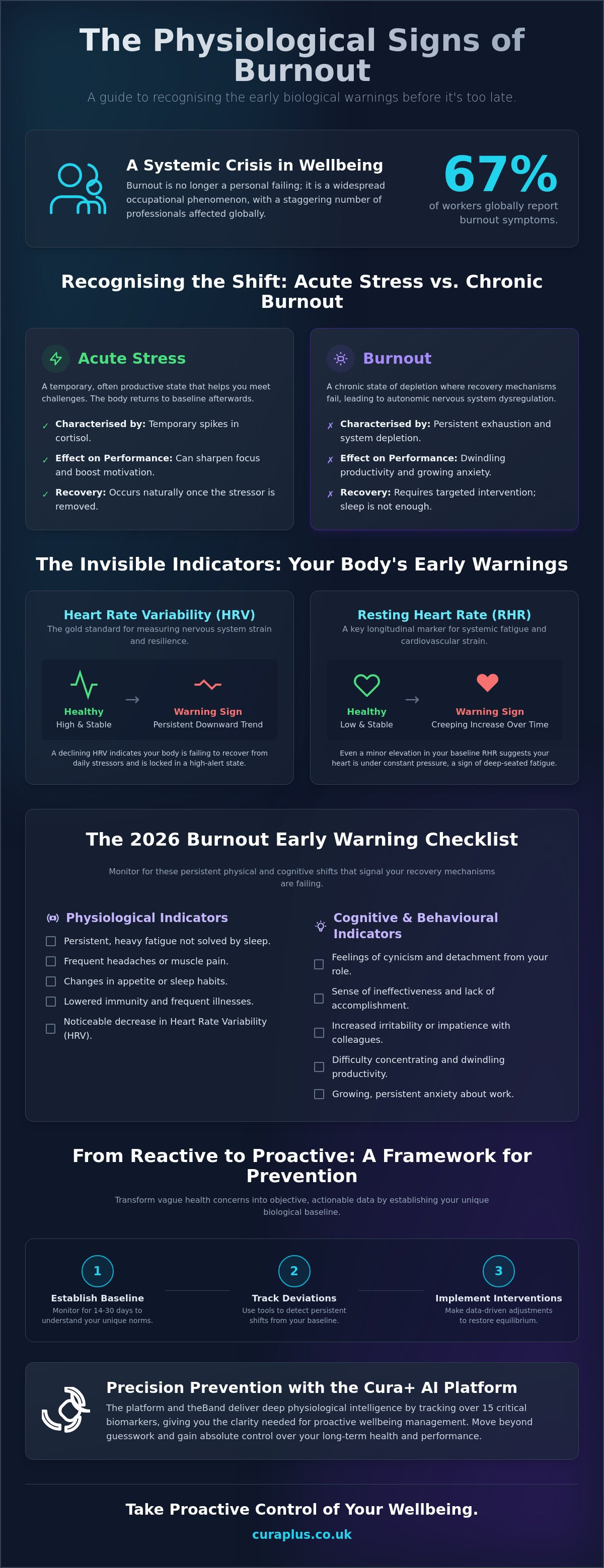
Did you know that 67% of workers globally now report experiencing burnout symptoms in their current roles? It is a staggering figure that highlights a systemic crisis in how we manage our professional and personal boundaries. You likely recognise the sensation; it is that persistent, heavy fatigue that no amount of weekend sleep seems to remedy. You are working longer hours, yet your productivity continues to dwindle whilst your anxiety grows. Identifying the early warning signs of burnout is no longer just about intuition. It is about understanding the precise biological signals your system sends long before you reach a physical breaking point.
This article provides a definitive checklist of the physiological and behavioural indicators that precede a total crash. We will explore how modern tools like theBand and the Cura+ AI Platform allow you to transform vague health concerns into objective, actionable data. You will learn to monitor key biomarkers to gain absolute clarity on your internal state. By the end of this guide, you will have a clear framework to validate your physical condition and implement strategic interventions to protect your long-term health and performance.
Key Takeaways
- Identify the critical physiological transition from acute stress to chronic autonomic dysregulation to understand your body's true state of depletion.
- Discover the early warning signs of burnout by monitoring persistent deviations in Heart Rate Variability, the definitive metric for nervous system strain.
- Utilise a comprehensive 2026 checklist to categorise subtle physical and cognitive shifts that signal your recovery mechanisms are failing.
- Learn the necessity of establishing a personalised biological baseline over 14 to 30 days to ensure your health data remains contextually accurate.
- Explore how theBand and the Cura+ AI Platform deliver deep physiological intelligence by tracking over 15 biomarkers for proactive wellbeing management.
Recognising the Subtle Shift: Burnout vs. Everyday Stress
Burnout is often mischaracterised as a mere lack of motivation or a temporary state of fatigue. In reality, it is a complex physiological syndrome defined by chronic autonomic nervous system dysregulation. Whilst everyday stress involves temporary spikes in cortisol that subside once a challenge is met, burnout represents a persistent state of depletion where the body’s recovery mechanisms have essentially stalled. Identifying the early warning signs of burnout is critical because this condition is not something you can simply "sleep off" over a long weekend. When the nervous system loses its biological plasticity, traditional rest often fails to provide relief because the underlying systems are no longer capable of returning to a state of equilibrium without targeted intervention.
Distinguishing between these states requires a shift in perspective. Acute stress can actually be productive, sharpening focus for a specific deadline or event. However, when that stress becomes chronic, it transitions into a systemic failure. Recognising this shift early is the only way to avoid long-term health complications, such as cardiovascular strain, metabolic disruption, or immune system suppression. Without intervention, the body continues to operate in a state of high-alert that it cannot sustain, eventually leading to a total physiological crash that requires months, or even years, of recovery.
The Occupational Phenomenon: A 2026 Perspective
The current UK professional landscape is defined by an "always-on" culture that has seen Occupational burnout reach record levels. With 67% of workers globally reporting symptoms in 2026, the World Health Organisation’s classification of burnout as an occupational syndrome is a vital framework for modern health. High-performers are amongst the most at-risk demographics. Their inherent drive often masks the biological reality of their exhaustion, allowing the condition to progress deep into the danger zone before it is even acknowledged as a problem.
Why "Pushing Through" is a Physiological Risk
Attempting to "power through" persistent exhaustion is a high-stakes gamble with your biology. Chronic cortisol elevation eventually forces the body to move from the "alarm" phase of stress into the "exhaustion" phase, where hormonal reserves are depleted and the system begins to fail. This transition marks the point where psychological resilience can no longer compensate for physical breakdown. To prevent this, many are turning to proactive health management tools to monitor their internal state with clinical precision. Understanding these metrics allows you to identify the early warning signs of burnout whilst your system still possesses the capacity to recover effectively.
The Invisible Indicators: How Your Body Signals Burnout Early
Waiting for a mental breakdown to address exhaustion is a reactive strategy that often leads to prolonged recovery times. By the time you feel emotionally drained, your physiological systems have likely been struggling for weeks. Measuring burnout accurately requires a shift from subjective self-assessment to objective biometric analysis. Your body communicates strain through subtle deviations in your baseline metrics long before your mind acknowledges the crisis. These invisible indicators provide the data necessary to intervene whilst your system still possesses the resilience to course-correct.
Heart Rate Variability (HRV) stands as the gold standard for quantifying this internal strain. Whilst a high HRV suggests a robust and adaptable nervous system, a persistent downward trend is one of the most reliable early warning signs of burnout. It indicates that the body is failing to recover from daily stressors, remaining locked in a state of high-alert that is biologically unsustainable. Similarly, a creeping increase in your Resting Heart Rate (RHR) serves as a longitudinal red flag. Even a minor elevation in RHR suggests that your heart is under constant pressure to maintain basic functions, reflecting a systemic fatigue that sleep alone cannot solve.
Autonomic Nervous System (ANS) and HRV
The Autonomic Nervous System governs your body’s involuntary functions through a delicate balance between the sympathetic (action) and parasympathetic (recovery) branches. Biometric tracking for wellness allows you to visualise this balance with clinical precision. HRV is the variance in time between heartbeats, which serves as a proxy for stress resilience. When this variance decreases, it signals that the sympathetic branch is dominating, leaving little room for the parasympathetic "rest and digest" functions to take place.
Sleep Architecture and Respiratory Rate Deviations
Burnout fundamentally disrupts your sleep architecture, often before you notice difficulty falling asleep. You may experience a significant reduction in REM and deep sleep stages, which are essential for cognitive processing and physical repair. Monitoring your nocturnal respiratory rate can also provide surprising insights. A subtle, sustained increase in breaths per minute during rest often precedes the feeling of being overwhelmed. Tracking these early warning signs of burnout through predictive biomarkers ensures that you are never blindsided by your own biology.
The 2026 Burnout Early Warning Checklist
Effective prevention relies on your ability to synthesise subjective feelings with objective data. We shouldn't view symptoms in isolation; instead, we must look for a clustering of physiological, cognitive, and behavioural shifts. To maintain clinical clarity, we categorise these signals into three distinct domains. If you identify three or more of the indicators listed below, it warrants immediate intervention to prevent systemic failure. Validating these feelings with a wearable for tracking stress patterns provides the objective evidence needed to justify a strategic pause before your health is compromised.
Physical and Behavioural Red Flags
Physical symptoms are often the most tangible early warning signs of burnout, yet they're frequently dismissed as temporary inconveniences. You might notice your body’s resilience fading in subtle ways:
- Immune System Suppression: You find yourself catching frequent minor colds or notice that recovery from standard exercise takes significantly longer than your established baseline.
- Stimulant Dependency: There's a sudden, marked increase in your reliance on caffeine, nicotine, or sugar to maintain basic focus throughout the working day.
- Procrastination as a Defence: Your brain begins to avoid high-load tasks not out of laziness, but as a subconscious protective mechanism against further cognitive strain.
- Altered Appetite: Noticeable changes in eating patterns often manifest as either a total loss of interest in nutrition or a drive for high-calorie consumption.
Emotional and Cognitive Warning Signs
Cognitive decline is often one of the first early warning signs of burnout to impact professional performance. You might experience a persistent "mental fog" that makes even routine decision-making feel like an insurmountable chore. This state frequently leads to a diminished sense of personal accomplishment, where even significant professional wins feel hollow or burdensome. Emotionally, this manifests as "compassion fatigue," a sense of detachment from colleagues and a rising tide of irritability over minor inconveniences that you would usually handle with ease.
These shifts represent the body's attempt to conserve dwindling energy reserves. When your internal resources are low, the brain prioritises survival over social cohesion or high-level strategic thinking. Recognising these patterns early allows you to implement a recovery protocol whilst you still have the agency to do so. Ignoring these signals typically leads to a late-stage loss of professional identity, making the eventual recovery process far more complex and time-consuming than a proactive intervention.
Establishing Your Biological Baseline for Prevention
Population averages serve public health policy, yet they remain largely irrelevant for individual optimisation. What is considered a "normal" resting heart rate or HRV for the general public might actually represent a significant physiological stressor for you. To identify the early warning signs of burnout with clinical accuracy, you must first define what "optimal" looks like for your unique biology. This process involves building a health baseline over a consistent period of 14 to 30 days. During this initial phase, the Cura+ AI Platform learns your specific rhythms, establishing a reference point against which all future data is measured. Without this personalised context, subtle deviations remain invisible, often masked by the broad ranges used in traditional reactive medicine.
The power of this approach lies in its ability to detect the "drift." When your metrics begin to move away from your established baseline, it signals that your system is under a load it cannot sustain. AI-driven analysis identifies these deviations long before they manifest as physical symptoms. This level of insight transforms your health from a series of mysterious symptoms into a predictable system that can be managed with professional precision. You no longer need to guess if you're overreaching; the data provides a clear, objective verdict.
The Importance of Personalised Health Intelligence
Age, gender, and lifestyle factors create a biological signature that is entirely your own. The future of personal health lies in moving away from generic advice toward predictive intelligence. By viewing your biometric data as a private consultant for your body, you gain an elite level of self-knowledge. This high-resolution view ensures that your recovery strategies are based on your actual physiological needs rather than population-wide assumptions.
Moving from Reactive to Predictive Self-Care
Transitioning from reactive to predictive self-care is a fundamental shift in how we approach wellbeing. Most people wait for debilitating fatigue before seeking help, but monitoring for deviations allows you to act whilst the problem is still manageable. Small adjustments, such as recalibrating your work schedule or prioritising specific sleep protocols, can effectively reset a declining baseline. This clarity removes the uncertainty that often fuels health-related anxiety. When you understand exactly how your body is responding to strain, you can manage the early warning signs of burnout with calm, strategic control. Discover how the Cura+ system can help you establish your baseline today.
Precision Prevention: How theBand by Cura+ Safeguards Your Wellbeing
Understanding the early warning signs of burnout is the necessary first step toward recovery, but consistent, real-time monitoring is what transforms that awareness into true prevention. High-performers and modern professionals often operate within narrow margins where the cost of downtime is simply too high to ignore. theBand by Cura+ is engineered for this exact environment, functioning as a sophisticated multi-sensor wearable that provides deep physiological intelligence. By tracking 15+ biomarkers simultaneously, it offers a high-resolution view of your stress and recovery cycles, ensuring that you're never operating in the dark regarding your internal state.
The Cura+ AI Platform serves as the strategic layer of this ecosystem, translating complex biological telemetry into clear, actionable guidance. It doesn't just present you with a list of numbers; it interprets how those numbers relate to your established baseline. This system bridges the gap between feeling "slightly tired" and recognising a genuine systemic decline. It allows you to manage your health with the same methodical precision you apply to your professional life—similar to how HOT IRON Digital uses data-driven paid advertising to optimise business growth—moving away from reactive management toward a model of predictive excellence.
Real-Time Biomarker Monitoring and AI Alerts
theBand monitors skin temperature, HRV, and blood oxygen levels continuously, providing a persistent stream of data that reflects your body's current resilience. This oversight allows the Predictive Alert system to flag potential early warning signs of burnout before you actually feel the crash. It identifies the subtle shifts in your autonomic balance that suggest your recovery mechanisms are being overtaxed. theBand’s AI algorithms are specifically tuned to detect the physiological fingerprints of chronic exhaustion.
From Data Points to Actionable Health Coaching
The transition from raw data to life-changing habits occurs within the Cura+ app, where your telemetry is transformed into personalised wellness recommendations. These insights might suggest a specific recalibration of your sleep environment or a necessary adjustment to your exercise intensity based on your current recovery score. For the ambitious professional, theBand by Cura+ serves as the definitive predictive health wearable UK. It is a tool for those who view their health as a complex system to be mastered rather than a series of symptoms to be endured. We invite you to join our pre-launch phase and take definitive control of your biological future today.
Master Your Biological Narrative
Burnout is not a sudden occurrence but the result of a sustained physiological drift that your body signals long before a crisis arrives. By identifying the early warning signs of burnout through objective biometric analysis, you move beyond the limitations of subjective feeling and into the realm of clinical precision. You've learned that establishing a unique biological baseline is the only way to accurately interpret the subtle shifts in your HRV, sleep architecture, and recovery patterns. This data-driven clarity replaces the anxiety of the unknown with a strategic framework for long-term health and performance.
The transition from reactive management to predictive mastery is now accessible through British engineering. Discover theBand by Cura+: Your Proactive Shield Against Burnout. Designed and engineered in the UK, this multi-sensor wearable monitors 15+ essential biomarkers and utilises AI-driven predictive health alerts to safeguard your wellbeing. You don't have to wait for depletion to take action. Take the first step toward self-optimisation today and ensure your internal systems remain as resilient as your professional ambitions.
Frequently Asked Questions
Can burnout be detected through a simple blood test?
No single blood test can definitively diagnose burnout. Whilst clinicians may measure cortisol or inflammatory markers, these snapshots lack the context of your daily rhythms. Longitudinal tracking of the early warning signs of burnout through biomarkers like HRV provides a more accurate view of systemic dysregulation than a one-off clinical test, allowing for a more nuanced understanding of your internal state.
How long does it take for the body to recover from the early warning signs of burnout?
Recovery duration varies based on the stage of intervention. If you address the early warning signs of burnout immediately, your system may reset within three to six weeks of targeted recovery protocols. However, if the condition progresses to a total physiological collapse, the recovery process often extends to six months or longer to fully restore autonomic balance and hormonal equilibrium.
Is there a difference between burnout and clinical depression?
There is a distinct clinical difference between these conditions. Burnout is classified specifically as an occupational syndrome resulting from chronic, unmanaged workplace stress. Clinical depression is a broader mental health condition that typically affects every facet of an individual's life, regardless of their professional environment or workload, though unmanaged burnout can eventually lead to depressive states if left unaddressed.
How much does a drop in HRV indicate a burnout risk?
A sustained downward trend in HRV is a critical indicator of physiological risk. If your HRV remains 20% or more below your established baseline for seven consecutive days, it suggests your parasympathetic nervous system is failing to facilitate adequate recovery. This persistent deviation serves as a clear biological signal that your current cognitive and physical load is becoming unsustainable for your system.
Can I prevent burnout without leaving my current high-pressure job?
You can certainly manage your stress levels effectively without resigning. Proactive prevention involves using data to identify exactly when your system is overreaching and implementing targeted "micro-recovery" protocols. By setting firm boundaries, utilising predictive intelligence, and choosing to learn more about streamlining your professional workflows, you can maintain high performance whilst protecting your physiological health, even within a demanding professional environment.
What is the most accurate wearable for tracking burnout biomarkers in 2026?
theBand by Cura+ is engineered specifically for deep physiological intelligence in 2026. It tracks over 15 essential biomarkers, including HRV, skin temperature, and nocturnal respiratory rate, with clinical-grade precision. When integrated with the Cura+ AI Platform, it provides the most comprehensive and predictive view of an individual's stress and recovery cycles currently available to modern professionals.
Does skin temperature change when you are experiencing burnout?
Skin temperature often fluctuates during periods of chronic exhaustion. As the body enters a state of persistent stress, it may experience subtle increases in nocturnal skin temperature, reflecting a low-level inflammatory response or disrupted thermoregulation. These changes are often detected by multi-sensor wearables like theBand weeks before you notice physical symptoms or a decline in performance.
How often should I check my health baseline to ensure I am not drifting into exhaustion?
You should establish your initial biological baseline over a period of 14 to 30 days. Once this reference point is set, the Cura+ AI Platform monitors your metrics continuously in the background. You don't need to manually check your data every hour; instead, you should respond to the predictive alerts that flag significant deviations from your optimal state.


