

You sleep eight hours and wake up exhausted. That single, frustrating experience is the reason so many people begin searching for how to improve deep sleep quality, only to find generic advice that changes nothing. The problem isn't your discipline. It's the absence of precise, physiological data telling you what's actually happening whilst you sleep.
You already sense that something is being missed. Your tracker shows a sleep score, perhaps even a rough breakdown of your sleep stages, yet the numbers don't translate into answers. Which habits are genuinely moving the needle? Which are simply noise? Without a reliable biological baseline, every intervention remains a guess, and guesswork rarely produces measurable recovery.
This guide takes a different approach. We'll examine the physiological mechanisms behind slow-wave sleep, the stage responsible for cellular repair, memory consolidation, and cognitive restoration, and explore how continuous biometric monitoring can replace assumption with evidence. By the end, you'll understand not just what deep sleep is, but how to engineer more of it with a personalised evening protocol built around your own autonomic data.
Key Takeaways
- Deep sleep (Stage 3 NREM) is driven by precise physiological mechanisms — including a core body temperature drop and autonomic nervous system shifts — that generic sleep hygiene advice rarely addresses with sufficient precision.
- Understanding how to improve deep sleep quality requires moving beyond guesswork; continuous biometric monitoring of 15+ biomarkers provides the high-resolution data needed to identify what is genuinely disrupting your nocturnal recovery.
- Standard interventions such as blue light reduction and alcohol avoidance are only effective when evaluated against your own physiological baseline — what disrupts one person's slow-wave sleep may have negligible impact on another's.
- A personalised deep sleep protocol begins with establishing measurable autonomic data, then systematically eliminating disruptors through evidence-led experimentation rather than assumption.
- theBand by Cura+ offers a practical framework for proactive sleep intelligence, translating continuous biomarker tracking into actionable, AI-driven insights that evolve alongside your recovery patterns.
Understanding the Architecture of Rest: What is Deep Sleep?
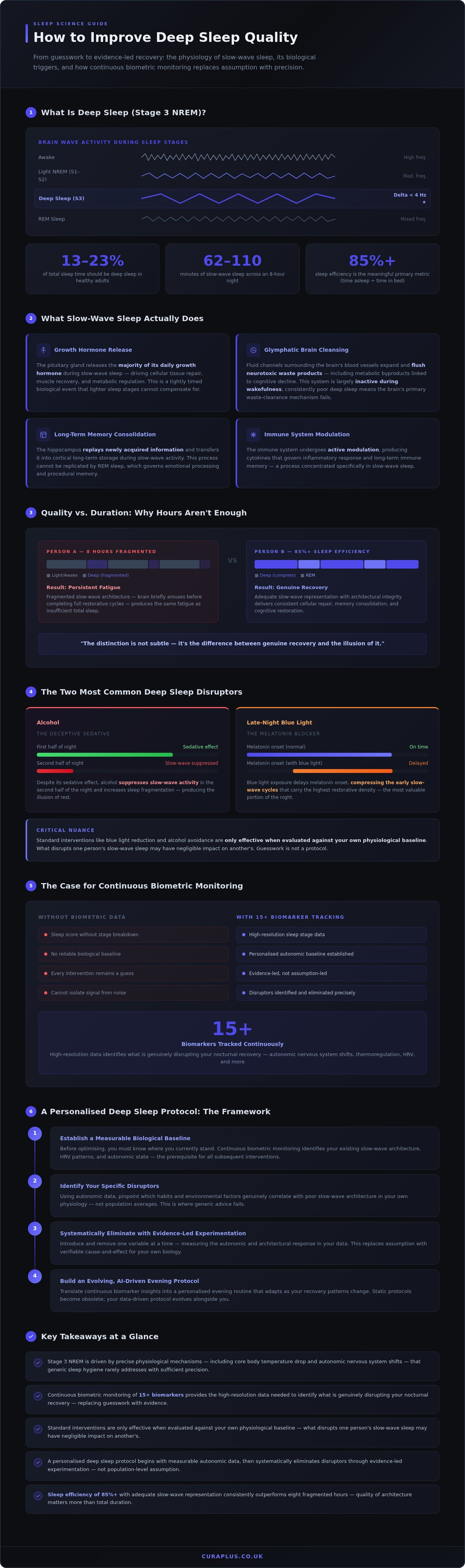
Sleep is not a single, uniform state. It's a precisely orchestrated biological cycle, and buried within that cycle is the phase your body cannot afford to lose. Stage 3 NREM sleep, commonly called deep sleep or slow-wave sleep, is characterised by high-amplitude delta brain waves oscillating at frequencies below 4 Hz. This is the physiological bedrock of recovery, the period during which your body conducts its most consequential repair work.
Understanding what deep sleep actually is matters because it reframes the entire conversation. The question isn't simply how many hours you spend unconscious. It's whether you're spending sufficient time in this specific, measurable stage.
The Restorative Power of Slow-Wave Sleep
During slow-wave sleep, the pituitary gland releases the majority of its daily growth hormone output, a process that drives cellular tissue repair, muscle recovery, and metabolic regulation. This isn't incidental; it's a tightly timed biological event that cannot be adequately compensated for during lighter sleep stages. Simultaneously, the immune system undergoes active modulation, producing cytokines that govern inflammatory response and long-term immune memory.
Perhaps the most underappreciated function of deep sleep is the activation of the glymphatic system, a network of fluid channels surrounding the brain's blood vessels. During slow-wave sleep, this system expands and flushes neurotoxic waste products, including metabolic byproducts associated with cognitive decline, from neural tissue. The glymphatic system is largely inactive during wakefulness, which means that consistently poor deep sleep isn't merely fatiguing; it represents a failure of the brain's primary waste-clearance mechanism.
Long-term memory consolidation also depends heavily on this stage. The hippocampus replays newly acquired information and transfers it into cortical storage during slow-wave activity, a process that REM sleep, which governs emotional processing and procedural memory, cannot replicate. Understanding how to improve deep sleep quality therefore has direct implications for cognitive performance, not just physical recovery.
Establishing a reliable biological baseline is the prerequisite for tracking these processes meaningfully. A structured approach to building a health baseline allows you to identify where your slow-wave sleep currently sits, before attempting to optimise it.
Why Deep Sleep Quality Trumps Total Duration
Research from the Sleep Foundation indicates that deep sleep typically comprises between 13% and 23% of total sleep time in healthy adults, roughly 62 to 110 minutes across an eight-hour night. Yet the presence of deep sleep on a clock isn't sufficient. Fragmented slow-wave architecture, where the brain briefly arouses before completing a full restorative cycle, produces the same persistent fatigue as insufficient sleep duration.
Two of the most common disruptors operate precisely this way. Alcohol, despite its sedative effect, suppresses slow-wave activity in the second half of the night and increases sleep fragmentation. Late-night blue light exposure delays melatonin onset, compressing the early slow-wave cycles that carry the highest restorative density.
Sleep efficiency, the ratio of time spent asleep to time spent in bed, is a more meaningful primary metric than total hours. An adult achieving 85% or above sleep efficiency with adequate slow-wave representation will consistently outperform one logging eight hours of fragmented, architecturally disrupted rest. The distinction is not subtle; it's the difference between genuine recovery and the illusion of it.
The Biological Triggers of Slow-Wave Sleep
Slow-wave sleep doesn't simply happen when you close your eyes. It's the product of several converging physiological processes, each of which must reach a specific threshold before the brain can descend into restorative delta-wave activity. Understanding these mechanisms is the foundation of any serious approach to how to improve deep sleep quality, because you cannot reliably engineer an outcome you haven't first understood at a biological level.
Three primary drivers govern your capacity for deep sleep: thermoregulation, autonomic nervous system state, and adenosine accumulation. Each operates independently, yet they interact in ways that make the difference between fragmented light sleep and genuinely restorative slow-wave cycles.
Thermoregulation and the Circadian Rhythm
Your core body temperature follows a precise circadian curve, peaking in the late afternoon and declining steadily through the evening. The hypothalamus orchestrates this cooling process, and it's this temperature drop, approximately 1°C below your daytime baseline, that signals the pineal gland to accelerate melatonin secretion. Without that thermal shift, melatonin onset is delayed and the early slow-wave cycles, which carry the highest restorative density, are compressed.
A counterintuitive but well-documented mechanism assists this process: peripheral vasodilation. When blood vessels near the skin surface dilate, heat is redistributed from the body's core to its extremities and then dissipated outward. This is the physiological basis of the "warm bath effect," where a hot bath or shower taken 60 to 90 minutes before bed paradoxically accelerates core cooling by drawing blood to the skin's surface. The result is a faster and more pronounced temperature drop that supports earlier sleep onset.
For practical application in a British home, the target bedroom temperature sits at approximately 18°C. Environments warmer than 20°C consistently interfere with the body's cooling gradient, increasing nocturnal arousals and reducing time spent in slow-wave activity.
HRV: The Gold Standard for Recovery Intelligence
Heart Rate Variability (HRV) measures the variation in time intervals between successive heartbeats. Higher variability reflects a nervous system dominated by parasympathetic activity, the "rest and digest" state that is a prerequisite for deep sleep. Low HRV, by contrast, signals that the sympathetic nervous system remains activated, keeping the body in a state of physiological alertness that directly suppresses slow-wave architecture.
This is where HRV becomes one of the most actionable metrics available. Acute stressors, late training sessions, and even immune health challenges can all suppress HRV in the hours before sleep, creating conditions that prevent the autonomic transition necessary for slow-wave activity. Identifying this suppression in real time, rather than inferring it from how you feel the next morning, changes the nature of your decision-making entirely.
Adenosine compounds this picture. This metabolic byproduct accumulates in neural tissue throughout the day, building what sleep scientists call sleep pressure. Higher adenosine levels drive the intensity of slow-wave activity, which is why a full day of cognitive and physical output typically produces deeper sleep than a sedentary one. Caffeine works by binding to adenosine receptors without triggering their sleep-promoting effect, which is why late consumption doesn't just delay sleep onset; it actively reduces slow-wave depth even when sleep does eventually arrive.
Continuous HRV monitoring transforms these biological signals from invisible processes into measurable, predictive data. theBand by Cura+ tracks autonomic nervous system state across 15+ biomarkers, enabling its AI platform to deliver predictive alerts when your physiological conditions are, or aren't, aligned for genuine restorative sleep. If understanding how to improve deep sleep quality is the goal, knowing your HRV trajectory before bed is where that understanding becomes actionable.
Beyond Sleep Hygiene: Evaluating Advanced Interventions
Standard sleep hygiene advice isn't wrong. It's simply incomplete. "Avoid screens before bed" and "keep a consistent sleep schedule" are reasonable starting points, but they represent population-level averages that take no account of your individual physiology, stress load, or circadian chronotype. For high-performers operating under sustained cognitive and physical demand, generic checklists produce generic results. The question isn't whether these habits matter; it's whether they're working for you, and that distinction requires evidence.
Traditional Hygiene vs. Data-Backed Protocols
Consider the difference between "sleep in a dark room" and strategically timed light exposure throughout the day. The former is a passive condition. The latter is an active intervention: morning bright light exposure anchors your circadian rhythm, accelerating the evening temperature drop discussed earlier, whilst deliberate light reduction in the final 90 minutes suppresses cortical arousal at a neurological level. The outcome may look similar from the outside, but the physiological mechanism is far more precise.
A useful structural framework here is the 10-3-2-1-0 rule, which organises evening habits around measurable cut-off points:
- 10 hours before bed: final caffeine intake, allowing adenosine receptors to clear sufficiently for natural sleep pressure to build
- 3 hours before bed: last substantial meal, giving the digestive system time to reduce its thermal and metabolic load before sleep onset
- 2 hours before bed: end of cognitively demanding work, allowing prefrontal cortical activity to decelerate
- 1 hour before bed: screens off, initiating what researchers call the "digital sunset" and removing the primary source of short-wavelength blue light that suppresses melatonin synthesis
- 0: snooze button presses, which fragment the final sleep cycle and blunt morning cortisol's natural alerting function
This framework is a sound starting point. But without physiological data, you're still operating on assumption. Biometric tracking for wellness is the only reliable method for validating whether these cut-offs are producing the autonomic and thermal shifts that actually precede restorative slow-wave sleep. Your HRV trajectory at 10pm tells you far more than your adherence to a rule ever could.
Nutritional timing also warrants more precision than it typically receives. A large meal within two to three hours of sleep onset elevates core body temperature through thermogenesis and increases resting heart rate, both of which directly oppose the physiological conditions required for slow-wave activity. Magnesium glycinate, one of the better-evidenced supplements for sleep quality, supports this transition by activating GABA receptors and reducing sympathetic nervous system tone; its effect is most pronounced when the broader nutritional and thermal environment isn't working against it.
Managing Cortical Arousal and Psychological Stress
One of the more insidious barriers to improving how to improve deep sleep quality is a pattern psychologists call "revenge bedtime procrastination." It describes the tendency to delay sleep in order to reclaim personal time after a demanding day, scrolling, watching, or simply remaining awake as a form of psychological autonomy. The cost is significant: not only is sleep onset delayed, but the cortical arousal generated by screen content and unresolved cognitive load actively suppresses the parasympathetic transition that slow-wave sleep requires.
Non-Sleep Deep Rest (NSDR) protocols, including Yoga Nidra, offer a practical counter-measure. These structured practices guide the nervous system into a hypnagogic state that measurably reduces evening cortisol and promotes parasympathetic dominance without requiring sleep itself. A 20-minute NSDR session in the hour before bed can serve as a physiological bridge between the demands of the day and the conditions required for genuine recovery.
Stress doesn't respect boundaries between waking and sleeping hours. Chronic work-related psychological pressure consistently elevates evening cortisol and suppresses nocturnal HRV, creating a feedback loop where poor sleep increases stress reactivity, which in turn degrades the following night's architecture. Tracking stress patterns continuously allows you to see precisely how daytime physiological load bleeds into nocturnal recovery, transforming what feels like a vague sense of burnout into a readable, addressable data signal.
Designing Your Personalised Deep Sleep Protocol
Knowledge without a system produces inconsistency. The physiological mechanisms covered earlier — thermoregulation, HRV, adenosine accumulation — are only useful when they're translated into a structured, repeatable process you can actually follow and measure. What distinguishes a genuine protocol from a wishlist is sequencing: each step builds on the last, and every intervention is evaluated against real data rather than subjective impression.
The five-step framework below is designed precisely for that purpose.
- Step 1 — Establish your baseline: Before changing anything, wear a multi-sensor device continuously for at least seven nights without altering your habits. This gives you an honest picture of your current slow-wave architecture, nocturnal HRV trajectory, and resting heart rate patterns. theBand by Cura+ tracks 15+ biomarkers continuously, providing the granular autonomic data that a baseline requires. Without this starting point, you have no reference against which to measure improvement.
- Step 2 — Identify your disruptors: Systematically remove one variable at a time. Eliminate alcohol for a week. Shift your final meal three hours earlier. Observe what your biomarker data shows the following morning. This process of elimination is far more precise than a general overhaul, because it isolates cause and effect rather than blending them.
- Step 3 — Optimise your environment: Target a bedroom temperature of approximately 18°C. Reduce ambient noise using earplugs or white noise if your environment warrants it. These aren't aesthetic preferences; they're physiological prerequisites for the core temperature drop that initiates slow-wave activity.
- Step 4 — Implement a 30-minute cognitive wind-down: In the final half-hour before bed, replace stimulating content with low-arousal activity: light reading, breathwork, or a structured NSDR practice. The goal is measurable: your resting heart rate should be declining, not elevated, as you approach sleep onset.
- Step 5 — Review weekly: Correlate your lifestyle changes with your deep sleep data. Look for patterns across seven-day windows rather than individual nights, which are too susceptible to single-variable noise to be meaningful on their own.
Identifying Your Personal Sleep Triggers
Population-level advice will only take you so far. What genuinely advances how to improve deep sleep quality at an individual level is "n-of-1" experimentation: testing one intervention at a time against your own physiological response. Mouth taping, for instance, promotes nasal breathing that may reduce nocturnal arousals in some individuals whilst producing negligible change in others. Weighted blankets may lower evening cortisol for those with heightened sympathetic tone, yet have no measurable effect on someone whose autonomic state is already well-regulated. The only way to know which category you fall into is to test, measure, and compare. An advanced wellness tracker simplifies this analysis considerably, surfacing the correlations between specific habits and downstream sleep architecture that would otherwise take months of manual journalling to detect. Consistency matters more than intensity here. A modest wind-down ritual performed every night will produce more reliable physiological conditioning than an elaborate protocol followed sporadically.
The Role of Morning Light in Evening Success
Your evening sleep quality is partly determined by what you do at 7am. The suprachiasmatic nucleus (SCN), a cluster of roughly 20,000 neurons in the hypothalamus, functions as the body's master circadian clock, and it's entrained almost entirely by light. Ten minutes of outdoor light exposure in the first hour after waking delivers a high-intensity signal to the SCN that anchors your circadian rhythm with precision. This single input sets the biological timer for melatonin release approximately 16 hours later, meaning that consistent morning light exposure directly supports the melatonin onset that initiates your slow-wave cycles each night. It's one of the highest-leverage interventions available, and it costs nothing beyond the habit of stepping outside.
Structure your protocol, track your data, and let the evidence guide your refinements. Explore how theBand and the Cura+ AI platform can support your personalised sleep optimisation journey.
Mastering Sleep Intelligence with theBand by Cura+
Most wearables tell you what happened. theBand by Cura+ tells you what's about to happen. That distinction is the difference between reactive tracking and genuinely proactive health management, and it's the reason the device represents a meaningful step beyond the sleep scores and step counts that populate most consumer wearables.
The core purpose of theBand isn't to confirm that last night was poor. It's to give you the physiological intelligence to ensure tonight is different.
Continuous Monitoring: Moving Beyond Basic Trackers
Standard fitness trackers infer sleep stages primarily from movement and basic heart rate data. The result is a coarse approximation: a bar chart that tells you roughly how long you were still, dressed up as sleep architecture. theBand operates at a fundamentally different level of resolution, tracking 15+ biomarkers continuously to build a high-fidelity map of your autonomic state across the full nocturnal cycle.
Two metrics are particularly instructive for understanding how to improve deep sleep quality at an individual level. Skin temperature deviation, measured continuously at the wrist, reflects the peripheral vasodilation process discussed earlier in this guide. When that temperature shift is absent or delayed, the data surfaces it in real time rather than leaving you to infer it from morning fatigue. Respiratory rate, which tends to slow and stabilise during genuine slow-wave activity, provides a secondary signal that correlates with autonomic depth in ways that heart rate alone cannot capture.
Together, these biomarkers produce the kind of granular recovery map that positions theBand as a predictive health wearable rather than a retrospective log. The data doesn't just describe your sleep; it anticipates where your recovery is heading.
AI-Powered Insights for Proactive Wellness
Raw biomarker data, however precise, is only useful if it translates into decisions. This is where the Cura+ AI platform performs its most valuable function. Rather than presenting you with charts that require interpretation, the platform analyses subtle deviations across your biomarker baseline and delivers actionable coaching: specific, contextualised guidance built around your physiological patterns rather than population averages.
One practical application is early illness detection. Subtle elevations in resting heart rate and skin temperature, combined with suppressed nocturnal HRV, frequently precede symptomatic illness by 24 to 48 hours. The AI identifies these deviations before you feel them, giving you a window to adjust your recovery strategy rather than simply absorbing the impact.
This is what genuine sleep intelligence looks like. Not a score to glance at over breakfast, but a continuous feedback loop that refines your protocol, validates your interventions, and closes the gap between effort and outcome. Understanding how to improve deep sleep quality ultimately comes down to one thing: replacing assumption with evidence. theBand and the Cura+ AI platform exist to make that evidence available, actionable, and personal.
From Guesswork to Genuine Recovery
Knowing how to improve deep sleep quality isn't about following a longer checklist. It's about replacing assumption with evidence. The physiology is clear: slow-wave sleep depends on precise thermoregulatory shifts, parasympathetic nervous system dominance, and adequate adenosine accumulation. Each of these processes is measurable, and measurement is where real progress begins.
Three principles from this guide are worth carrying forward. First, sleep quality consistently outweighs sleep duration as a recovery metric. Second, no intervention can be validated without a reliable biological baseline. Third, personalised data will always outperform population-level advice when it comes to identifying what's genuinely disrupting your nocturnal architecture.
theBand by Cura+ monitors 15+ biomarkers continuously, delivering AI-driven predictive alerts and personalised coaching designed for proactive wellness in the UK. It doesn't just record what happened last night; it gives you the intelligence to change what happens tonight.
Your recovery is too important to leave to guesswork. Master your recovery with theBand by Cura+ and start building a sleep protocol grounded in your own physiology.
Frequently Asked Questions About Deep Sleep Quality
What is the ideal percentage of deep sleep for an adult?
Healthy adults typically spend between 13% and 23% of their total sleep time in slow-wave sleep, which translates to roughly 62 to 110 minutes across an eight-hour night. This range narrows with age, so younger adults often sit toward the higher end whilst those in their forties and beyond may find 13% to 15% more representative of their baseline.
Percentage alone doesn't tell the complete story. Slow-wave architecture matters as much as duration; consolidated, uninterrupted deep sleep cycles produce meaningfully better recovery than fragmented ones, even when the total minutes appear adequate on a tracker.
Can I "catch up" on deep sleep during the weekend?
The short answer is no, not in any meaningful physiological sense. Deep sleep isn't a reservoir you can refill retrospectively. The restorative processes that occur during slow-wave activity, including glymphatic clearance and growth hormone release, are time-sensitive biological events tied to your circadian rhythm. Missed cycles don't simply carry forward.
Weekend lie-ins can partially reduce accumulated sleep debt, but they also shift your circadian phase, making Monday mornings harder and compressing the following week's slow-wave cycles. Consistency in sleep and wake times is a far more effective strategy than attempting recovery through extended weekend sleep.
Why do I have high total sleep but low deep sleep scores?
High total sleep with low slow-wave representation is a classic sign of architecturally disrupted rest. Common causes include alcohol consumption in the evening, elevated evening cortisol from unresolved psychological stress, a bedroom environment that's too warm, and sleep apnoea, which generates micro-arousals that prevent the brain from sustaining delta-wave activity.
Understanding how to improve deep sleep quality in this specific scenario requires identifying which disruptor is responsible, and that requires data rather than guesswork. Continuous biomarker monitoring, particularly nocturnal HRV and resting heart rate patterns, can help isolate the precise variable fragmenting your slow-wave architecture.
Does alcohol help or hinder deep sleep quality?
Alcohol consistently hinders deep sleep quality, despite its sedative effect at sleep onset. It suppresses slow-wave activity in the second half of the night and increases sleep fragmentation as blood alcohol concentration declines. The result is a night that feels restful in the first few hours but becomes progressively lighter and more disrupted.
Even moderate consumption, a glass or two of wine with dinner, is sufficient to alter nocturnal HRV and reduce the proportion of restorative slow-wave cycles. If you're attempting to evaluate your sleep baseline accurately, eliminating alcohol entirely for at least seven consecutive nights is the most reliable method of establishing a clean physiological reference point.
How does age affect my ability to enter slow-wave sleep?
Slow-wave sleep declines progressively with age, a process that begins in early adulthood and accelerates from the mid-thirties onwards. This isn't simply a matter of sleeping fewer hours; the brain's capacity to generate the high-amplitude delta waves characteristic of Stage 3 NREM diminishes as neurological and hormonal changes accumulate over time.
This makes optimising the conditions for slow-wave activity increasingly important as you age, not less. Precise thermoregulation, consistent circadian anchoring through morning light exposure, and careful management of evening cortisol become higher-leverage interventions precisely because the biological margin for error narrows with each decade.
Is it possible to have too much deep sleep?
In healthy adults following a normal circadian rhythm, naturally occurring excess slow-wave sleep is uncommon. The brain self-regulates slow-wave production based on adenosine accumulation and circadian timing, so it's rare to generate more than your physiology requires. Consistently elevated deep sleep scores are more often a measurement artefact from the device being used than a genuine physiological anomaly.
That said, certain neurological conditions and some sedative medications can artificially inflate time spent in deeper sleep stages whilst actually impairing the quality of that activity. If your tracker consistently reports unusually high deep sleep alongside persistent daytime fatigue, a clinical sleep assessment is worth pursuing.
What are the best supplements for improving deep sleep quality?
Magnesium glycinate has the strongest evidence base amongst commonly available supplements, supporting GABA receptor activity and reducing sympathetic nervous system tone in the evening. Its effect is most pronounced when the broader sleep environment, particularly thermal conditions and alcohol intake, isn't actively working against it. L-theanine, an amino acid found in green tea, may also support the parasympathetic transition before sleep onset.
Melatonin is frequently misunderstood as a sleep-inducing compound. It's more accurately a circadian signal; low doses (0.5mg to 1mg) taken 60 to 90 minutes before bed can help shift sleep timing, but it doesn't directly increase slow-wave depth. Supplements should be viewed as supporting interventions, not primary solutions, and their effect is best evaluated against your own biomarker data rather than general expectation.
How long does it take to see improvements in deep sleep after lifestyle changes?
Measurable improvements in slow-wave architecture typically emerge within seven to fourteen days of consistent, targeted intervention. Eliminating alcohol, stabilising your sleep and wake schedule, and optimising bedroom temperature are amongst the fastest-acting changes; some individuals notice a shift in nocturnal HRV and resting heart rate within the first three to five nights.
Deeper structural improvements, particularly those related to circadian rhythm stabilisation and chronic stress reduction, tend to consolidate over four to eight weeks. Evaluating progress across seven-day averages rather than individual nights gives a far more accurate picture of genuine trajectory, which is precisely where continuous biomarker monitoring proves its value over single-night snapshots.


