


What if your nightly recovery wasn't a matter of chance, but a deliberate output of physiological precision? For many high achievers, the morning ritual begins with a familiar sense of brain fog and the frustration of a wearable device that reports poor rest without offering a solution. You likely understand that deep sleep is the foundation of cognitive clarity and physical repair, yet knowing how to improve deep sleep quality remains an elusive challenge whilst navigating a sea of inconsistent data and generic lifestyle advice.
It's time to move beyond guesswork and embrace the era of predictive sleep intelligence. By understanding the specific biomarkers that govern your body's transition into restorative stages, you can transform sleep from a passive event into a mastered system. This guide explores how to leverage the Cura+ AI Platform and precise data from theBand to identify your unique physiological drivers. You will learn to interpret your data with clinical precision, allowing you to implement changes that significantly increase your time in deep sleep and ensure you wake up with the vitality required for elite performance.
Key Takeaways
- Understand the biological necessity of Stage 3 NREM sleep and how the glymphatic system facilitates metabolic waste clearance for peak cognitive function.
- Discover a data-driven methodology on how to improve deep sleep quality by shifting focus from total time in bed to the physiological drivers of the Autonomic Nervous System.
- Implement a consistent circadian anchor and optimise light exposure to synchronise your internal clock for more predictable restorative cycles.
- Identify and eliminate common barriers to restoration, such as the deceptive effects of alcohol and the impact of late-night exercise on core body temperature.
- Learn how to leverage theBand and the Cura+ AI Platform to transform 15+ complex biomarkers into actionable intelligence for a personalised recovery strategy.
Understanding the Science of Deep Sleep and Why It Matters for Your Health
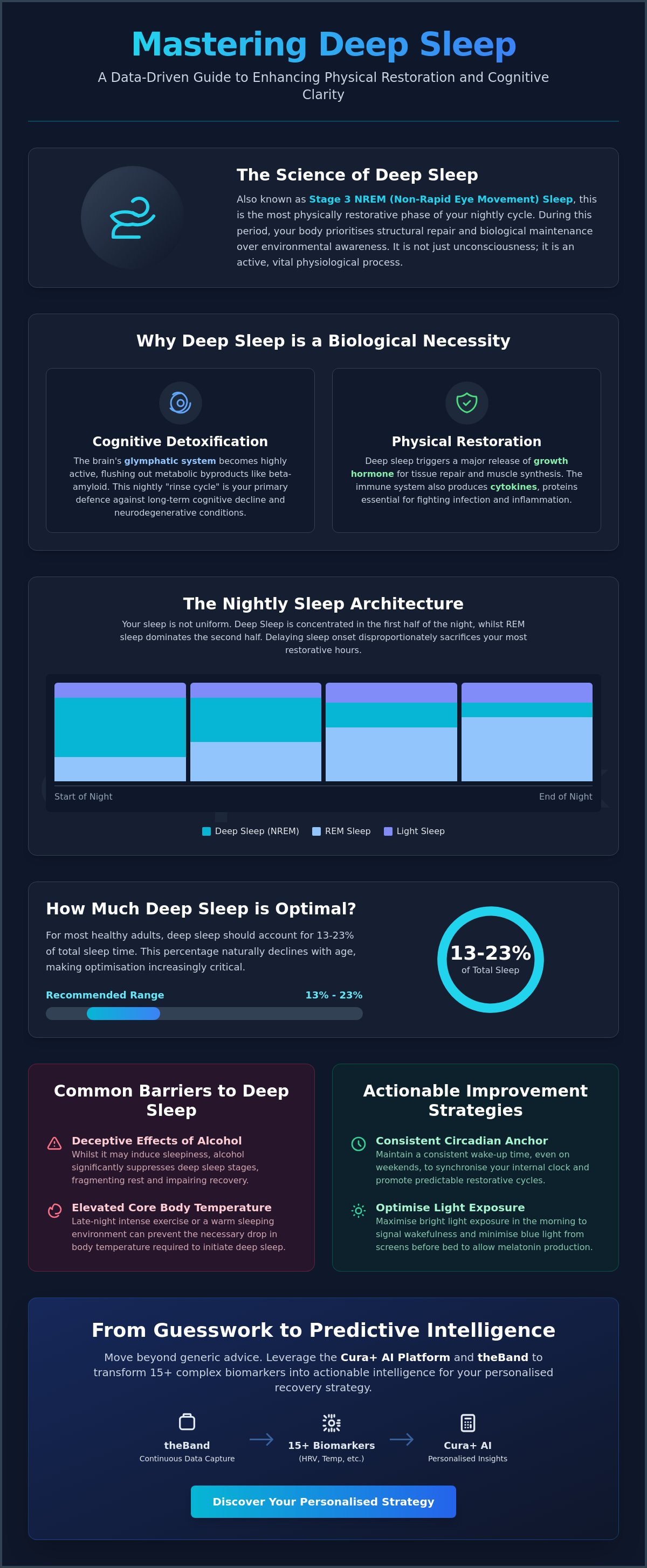
Deep sleep, or Stage 3 Non-Rapid Eye Movement (NREM) sleep, represents the zenith of physical restoration. It's the period when your body prioritises structural integrity over environmental awareness. Whilst REM sleep focuses on emotional regulation and memory consolidation, deep sleep is dedicated to the tangible maintenance of your biological hardware. Understanding this distinction is the first step in learning how to improve deep sleep quality. It's not merely a state of unconsciousness; it's an active, high-stakes physiological process.
During these slow-wave periods, the brain's glymphatic system becomes highly active. It essentially acts as a waste management protocol, flushing out metabolic byproducts like beta-amyloid that accumulate during waking hours. Without this nightly rinse, cognitive decline becomes a statistical probability rather than a distant risk. This accumulation of metabolic debris is linked to neurodegenerative conditions, making deep sleep your most effective long-term defence against cognitive decline. Chronic deprivation doesn't just lead to morning fog; it accelerates the ageing process of the central nervous system.
Your sleep isn't a uniform block of time. It follows a structured Science of Deep Sleep architecture that shifts as the night progresses. Deep sleep is heavily front-loaded in the first half of the night, meaning if your sleep onset is delayed, you're disproportionately sacrificing your most restorative hours. As the night continues, the duration of NREM stages decreases whilst REM cycles lengthen. This architecture is delicate and easily disrupted by external variables.
The Biological Role of Slow-Wave Sleep
This stage triggers a massive secretion of growth hormone, which is essential for tissue repair and muscle protein synthesis. Your immune system also relies on this period to produce cytokines, the proteins that coordinate your body's response to infection and inflammation. Without sufficient slow-wave activity, physical recovery stalls and your resistance to pathogens weakens. Slow-wave sleep is the most difficult stage to wake from.
How Much Deep Sleep is Actually Enough?
For most healthy adults, Stage 3 sleep accounts for approximately 13-23% of total sleep time. This percentage naturally declines as we age, making the optimisation of every minute more critical for older individuals or those with high-performance lifestyles. If you've suffered from a period of deprivation, your body will often exhibit a rebound effect, where it prioritises deep sleep over all other stages the following night. This compensatory mechanism highlights just how vital this stage is for survival. Knowing how to improve deep sleep quality ensures you aren't just relying on these emergency rebounds, but rather maintaining a consistent baseline of excellence.
Monitoring the Biomarkers That Influence Your Deep Sleep Quality
Mastering sleep requires a transition from passive observation to active measurement. Whilst many individuals focus on the duration of their rest, the true indicator of recovery lies within the Autonomic Nervous System (ANS). Your ANS governs the transition between the sympathetic "fight or flight" state and the parasympathetic "rest and digest" state. If your nervous system remains in a state of high arousal, Stage 3 entry becomes physiologically impossible. Learning how to improve deep sleep quality starts with understanding these internal signals rather than just looking at the clock.
Tracking a single metric like "time in bed" is insufficient for wellness because it fails to account for the intensity of restoration. High-performance recovery relies on establishing a biological baseline, a personalised set of data points that represent your body at its most efficient. By utilising biometric tracking for wellness, you can identify subtle deviations in your baseline that signal impending fatigue or stress. Monitoring 15+ biomarkers provides the holistic view necessary to detect these shifts before they manifest as a ruined night of rest.
Heart Rate Variability (HRV) as a Sleep Predictor
HRV represents the variance in time between each heartbeat; it's the gold standard for measuring parasympathetic nervous system activity. A high HRV indicates that your body is resilient and ready for deep restoration, whilst a low daytime HRV often predicts poor deep sleep quality that night. If your data shows a downward trend, it's a clear signal to modify your evening behaviour. Using a wearable for tracking stress patterns allows you to adjust your routine in real-time, perhaps by extending your wind-down period or cancelling a late-night workout to protect your sleep architecture.
The Impact of Core Temperature and Respiratory Rate
A core temperature drop is a non-negotiable requirement for entering Stage 3 sleep. Your body must shed approximately 1 to 2 degrees Celsius to facilitate the transition into deep cycles. If your skin temperature remains elevated, it often suggests your metabolism is still processing a late meal or alcohol. Incorporating specific Tips for Deeper Sleep, such as cooling your environment, becomes significantly more effective when you can see the immediate impact on your biomarker data.
Respiratory rate stability also correlates with restorative rest cycles. A sudden increase in breaths per minute can signal that your body is fighting off a sub-clinical infection or dealing with excessive systemic inflammation. Identifying these patterns is the cornerstone of mastering your physiological intelligence and ensuring your deep sleep remains consistent and protected.
A Step-by-Step Guide to Improving Your Deep Sleep Quality Naturally
Improving your sleep architecture requires a methodical approach to daily habits. It's not about a single miracle supplement; it's about a series of deliberate actions that synchronise your biology with the natural world. The foundation of this system is the circadian anchor. By waking at the same time every day, regardless of how you slept the night before, you provide your brain with a predictable signal that stabilises your hormonal rhythm. This consistency is the most effective way to understand how to improve deep sleep quality over time.
Research into natural ways to improve sleep highlights that environmental and behavioural modifications are the most sustainable path to long-term recovery. To determine which of these interventions move the needle for your specific physiology, you must build a health baseline to track your progress accurately. Without this data, you're merely guessing which lifestyle changes are actually impacting your Stage 3 duration.
Optimising Your Circadian Rhythm Through Light Exposure
Light is the primary zeitgeber, or external cue, for your internal clock. Viewing natural sunlight within 30 minutes of waking triggers a cortisol spike that clears morning grogginess and sets a timer for melatonin production later that evening. This process is governed by the suprachiasmatic nucleus (SCN), a tiny region in the hypothalamus that responds directly to blue light wavelengths. To protect your deep sleep, you should aim to reduce overhead lighting at least two hours before bed. Transitioning to dim, warm-toned lamps signals to your SCN that the day is ending, allowing your body to begin its natural cooling process.
The 10-3-2-1-0 Rule for Deep Sleep Optimisation
Predictive sleep intelligence relies on removing friction from your evening. The 10-3-2-1-0 rule provides a clear framework for high-performance rest:
- 10 hours before bed: Cease caffeine consumption. The half-life of caffeine is approximately five to six hours, meaning a mid-afternoon coffee can still be circulating in your system at midnight, blocking the adenosine receptors required for sleep pressure.
- 3 hours before bed: Finish your last meal and avoid alcohol. Digestion is an energy-intensive process that raises core temperature, whilst alcohol acts as a sedative that fragments sleep cycles.
- 2 hours before bed: Discontinue work-related tasks. Your nervous system needs this time to shift from a high-arousal state into a parasympathetic mode.
- 1 hour before bed: Eliminate all screens. Blue light from devices suppresses melatonin, delaying the onset of deep sleep stages.
- 0: The number of times you hit the snooze button. Waking up immediately reinforces your circadian anchor and prevents the grogginess of fragmented sleep.
By implementing these structured protocols, you create a repeatable system that supports how to improve deep sleep quality. Each step is designed to lower your physiological arousal and prepare your body for the complex repair work that only happens during slow-wave sleep.
Identifying and Removing the Barriers to Restorative Deep Sleep
Many individuals claim they can "sleep through anything," yet this perception often masks a reality of fragmented rest. Even if you don't fully regain consciousness, environmental stimuli such as passing traffic on a busy UK street or the clicking of a radiator can trigger micro-arousals. These brief spikes in heart rate and brain activity pull you out of Stage 3 and back into lighter sleep stages. This is a primary reason why understanding how to improve deep sleep quality requires a sterile, controlled environment. Beyond external noise, internal disruptors like late-night exercise can be equally damaging. High-intensity training spikes your core temperature and keeps your sympathetic nervous system active, effectively delaying the physiological cooling required for deep sleep onset.
The Hidden Cost of Nightcaps and Evening Alcohol
The "nightcap" remains a pervasive myth amongst those seeking a shortcut to rest. Whilst alcohol is a potent sedative that helps you fall asleep faster, it's a catastrophic disruptor of sleep architecture. As your body metabolises the alcohol, it produces acetaldehyde, a stimulant that increases your heart rate and fragments your rest through the "rebound effect." You may find yourself waking up in the early hours as your body struggles to process the toxin. This metabolic stress prevents the deep, restorative cycles your brain requires for glymphatic clearance. Instead of a drink, consider tart cherry juice or a warm bath to support your parasympathetic nervous system without the physiological cost.
Managing Psychological Stress for Physiological Recovery
Psychological "open loops," those unfinished tasks and unresolved anxieties, keep your cortisol levels elevated long after you've closed your laptop. High cortisol is a direct antagonist to deep sleep. It signals to your brain that you need to remain vigilant, which suppresses the transition into slow-wave rest. To combat this, implement a five-minute box breathing technique before bed: inhale for four seconds, hold for four, exhale for four, and hold for four. This simple intervention stimulates the vagus nerve and lowers your heart rate, signalling safety to the central nervous system.
Using a wearable for tracking recovery can confirm if these stress management techniques are actually moving your biomarkers toward a restorative state. If your HRV remains suppressed despite your efforts, you may need to refine your approach. If you're ready to stop guessing and start mastering your rest, you can order theBand and begin your journey to predictive health today.
Leveraging theBand by Cura+ for Predictive Sleep Intelligence
Traditional wearables often act as historians, providing a retrospective glance at a night of poor rest without offering the means to prevent it. The transition from reactive tracking to proactive health management requires a more sophisticated approach. By monitoring 15+ biomarkers with clinical precision, theBand by Cura+ provides a comprehensive sleep readiness score that anticipates your recovery needs. This system doesn't just record data; it translates complex biological signals into a clear strategy for how to improve deep sleep quality before you even step into the bedroom.
The Cura+ AI Platform serves as the analytical engine for this process, identifying the subtle interplay between your daytime stressors and your nighttime architecture. It's the difference between seeing a low HRV score in the morning and receiving a notification in the afternoon that suggests a specific adjustment to your evening protocol. Positioning itself as the best advanced wellness tracker for 2026, theBand empowers you to master your physiological state through data-driven clarity rather than trial and error.
Moving From Tracking to Predictive Intelligence
The true power of predictive intelligence lies in its ability to detect patterns that are invisible to the naked eye. The Cura+ AI Platform analyses your biological baseline to issue "Readiness Alerts" when your body shows signs of systemic fatigue or impending illness. If your respiratory rate or skin temperature deviates from your established norm, the system identifies these early physiological markers of disruption. This allows you to prioritise rest and adjust your schedule, ensuring that your deep sleep stages remain protected from the inflammatory spikes that often precede visible symptoms.
Personalised AI Coaching for Sleep Optimisation
Generic advice is rarely effective for elite performance. The AI health and wellness coach within the Cura+ ecosystem provides tailored evening protocols based on your real-time data. Whether it's suggesting a specific cooling duration for your environment or adjusting your wind-down timing based on your day's cognitive load, the guidance is uniquely yours. This longitudinal analysis also identifies seasonal sleep trends, helping you adapt your habits as environmental light and temperature shift throughout the year.
Mastering your rest is a journey toward total physiological mastery. By integrating theBand and the Cura+ AI Platform into your daily life, you replace uncertainty with a repeatable system for high-quality restoration. We invite you to join our pre-launch phase and experience the next generation of predictive sleep technology. It's time to stop wondering why you're tired and start using the data that's already within you to unlock a new standard of cognitive and physical excellence.
Mastering the Future of Your Physiological Recovery
The journey toward high-performance health begins with the realisation that sleep is a manageable system rather than a random occurrence. You've discovered that true restoration depends on more than just time in bed; it requires the synchronisation of your circadian rhythm, the cooling of your core temperature, and the management of metabolic disruptors. Understanding how to improve deep sleep quality is no longer a matter of following generic advice, but of interpreting the unique language of your own biology. By moving beyond light-sleep tracking and focusing on the biomarkers that drive Stage 3 NREM, you reclaim control over your cognitive and physical longevity.
True optimisation requires the right tools to translate raw data into actionable intelligence. theBand is designed for high-precision health optimisation, monitoring 15+ essential biomarkers to provide a comprehensive view of your readiness. Combined with AI-driven predictive health alerts, it allows you to anticipate physiological needs before they impact your performance. Discover the future of proactive wellness with theBand by Cura+ and transform your rest into a repeatable system of excellence. The path to clarity and vitality is now within your reach.
Frequently Asked Questions
How can I tell if I am getting enough deep sleep without a tracker?
Morning alertness and cognitive clarity are the primary indicators of sufficient slow-wave restoration. If you wake up naturally without an alarm and feel refreshed within thirty minutes, your Stage 3 cycles were likely adequate. Conversely, persistent brain fog or a heavy sensation of physical fatigue suggests a deficit. Whilst subjective, these feelings reflect the success of your glymphatic system in clearing metabolic waste during the night.
Is it possible to get too much deep sleep during the night?
It's exceptionally rare for a healthy adult to experience excessive deep sleep. Your body maintains a natural ceiling for Stage 3 restoration, usually capped at 25% of your total sleep time. If your data shows an unusually high percentage, it's often a sign of "rebound sleep." This occurs when your body compensates for previous deprivation or intense physical strain to restore its biological baseline.
Can certain supplements like magnesium or melatonin actually improve deep sleep quality?
Magnesium glycinate supports deep sleep by regulating neurotransmitters that calm the nervous system and lower cortisol. Melatonin primarily aids sleep onset rather than the depth of the cycle itself. Whilst these aids can be helpful, they shouldn't replace the fundamental protocols of how to improve deep sleep quality, such as light management and cooling your environment. Always consult a professional before introducing new supplements.
How does age affect the amount of deep sleep a person typically gets?
Deep sleep naturally declines as you age, often beginning as early as your thirties. By the time many individuals reach sixty, they experience significantly less slow-wave activity than they did in their youth. This biological shift makes the use of predictive intelligence and deliberate lifestyle interventions even more critical. Optimising your habits helps maintain cognitive health and physical recovery as your body's natural efficiency changes.
What is the most effective way to lower my heart rate before going to bed?
Physiological sighing or box breathing is the most efficient way to stimulate the vagus nerve and lower your heart rate. By ensuring your exhalations are longer than your inhalations, you signal to your brain that it's safe to enter a parasympathetic state. This shift is a non-negotiable prerequisite for the body to transition from a high-arousal daytime mode into the restorative stages of deep sleep.
Will a 20-minute afternoon nap take away from my deep sleep at night?
A twenty-minute "power nap" typically won't interfere with your nocturnal deep sleep because it stays within the lighter stages of rest. However, naps exceeding forty minutes can lead to sleep inertia and reduce your "sleep pressure" for the evening. If you nap too late in the day, you may find it harder to enter Stage 3 sleep at your usual bedtime.
How long does it take for lifestyle changes to show up in my deep sleep data?
You may see immediate shifts in biomarkers like resting heart rate within forty-eight hours of implementing better habits. However, significant improvements in your deep sleep duration usually require consistent adherence for two to three weeks. This timeframe allows your circadian rhythm and nervous system to stabilise and adapt to new protocols, eventually reflecting a more resilient and restorative sleep architecture in your data.


