


What if the most expensive part of your wearable isn't the titanium casing, but the monthly fee required to unlock your own biological data? As we move through 2026, many individuals find themselves questioning is a health tracker subscription worth it whilst managing an ever-growing list of digital outgoings. It's easy to feel a sense of fatigue when your device demands a premium to show you the very metrics it's already recorded. You've likely felt the frustration of staring at a screen full of heart rate graphs and sleep stages that offer plenty of noise but very little direction.
We agree that data without insight is merely a digital chore. However, the landscape of personal wellness has shifted from retrospective logging to predictive intelligence. This article explores the critical distinction between basic fitness tracking and the sophisticated AI models that anticipate physiological shifts before they manifest. You'll discover how to evaluate the cost-to-benefit ratio of platforms like theBand and the Cura+ AI Platform, ensuring your investment serves your long-term longevity. We provide a clear framework to help you choose a health partner that transforms raw numbers into a masterplan for self-optimisation.
Key Takeaways
- Understand why modern health monitoring requires ongoing investment to sustain the complex AI models that hardware alone cannot support.
- Determine if a health tracker subscription is worth it by comparing the monthly cost to the significant value of avoiding burnout and physiological decline.
- Identify the necessity of tracking at least 15 biomarkers to create a precise, personalised baseline for predictive health insights.
- Apply a rigorous decision framework to ensure your chosen platform aligns with your long-term goals for longevity and performance.
- Discover how theBand and the Cura+ AI Platform move beyond simple logging to provide proactive, data-driven health security.
Evaluating the Shift: Why Health Tracker Subscriptions are Dominating in 2026
The landscape of personal wellness has undergone a fundamental transformation. We've moved beyond the era where a device simply recorded movement. Today, the most sophisticated systems act as a continuous diagnostic partner. For many discerning users, the central question remains: is a health tracker subscription worth it? The answer lies in understanding that you aren't paying for the hardware alone; you're investing in the ongoing evolution of the intelligence that interprets your biology. One-off payments are becoming relics of a time when health data was static and descriptive rather than dynamic and predictive.
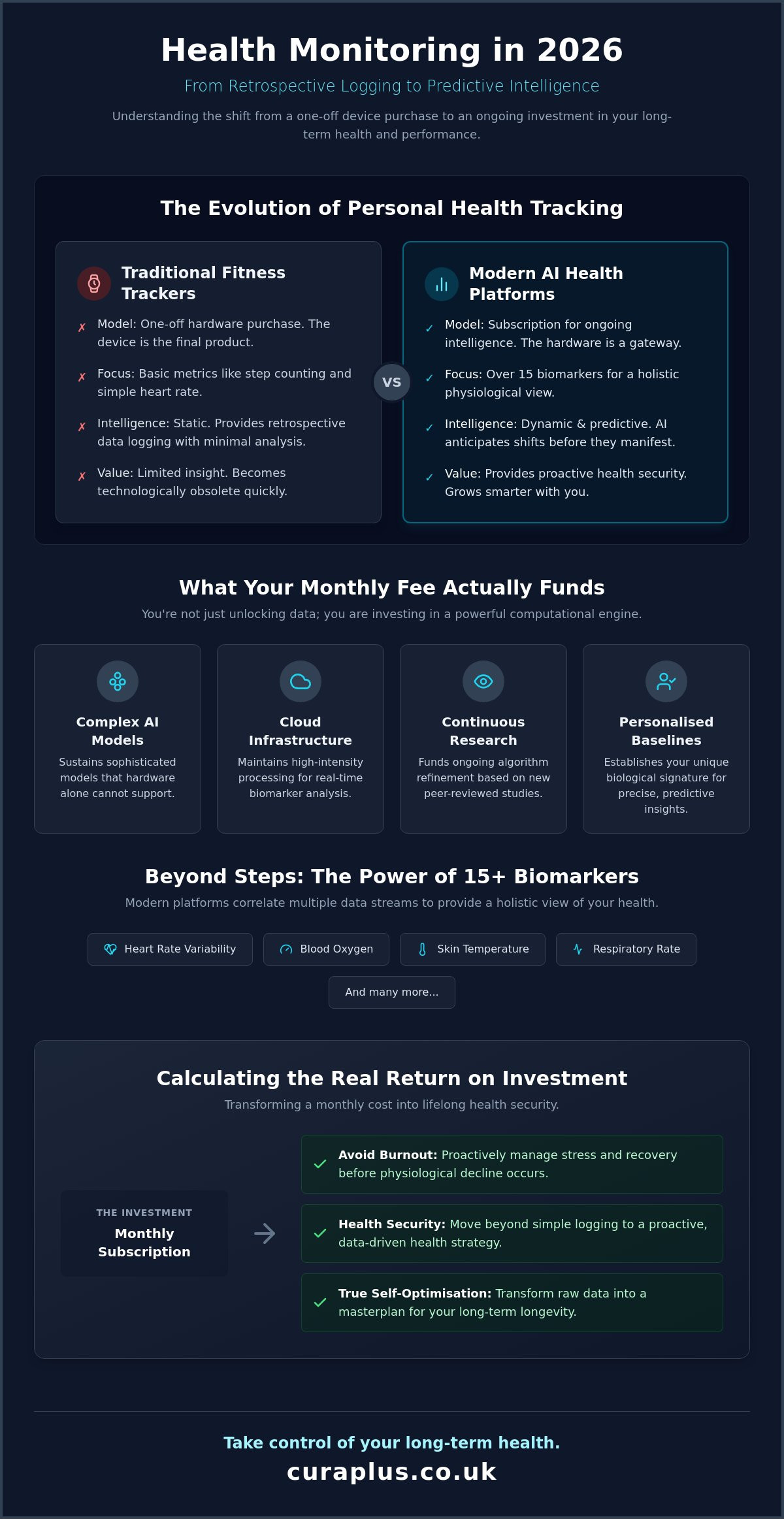
Subscription fatigue is a genuine concern in the UK market, where digital outgoings are under constant scrutiny. However, a one-off hardware payment cannot sustain the intensive, cloud-based processing required for 2026 health standards. Continuous AI development demands a different economic model. Without a subscription, a device becomes static, unable to adapt to new peer-reviewed research or refine its predictive models. This shift ensures that your device grows smarter the longer you wear it, rather than becoming obsolete the moment you leave the shop.
The Death of the Step Counter
Basic metrics have become commodities. A standard fitness tracker from five years ago could count steps, but it couldn't tell you if your heart rate variability (HRV) indicated a brewing respiratory infection. In 2026, accuracy is not a fixed state; it is a moving target. Sensors measuring skin temperature and blood oxygen require constant algorithm recalibration to remain clinically relevant. This level of precision is the baseline for modern health optimisation. We've moved from simple data logging to a sophisticated biomarker analysis that requires significant backend infrastructure to maintain.
Hardware vs. Software: Where the Value Lies
Consider the physical band as a gateway rather than the final product. Whilst theBand utilises elite-level sensors, the true value resides within the Cura+ AI Platform. The most advanced biometric insights require massive processing power that exceeds what can be housed in a wrist-worn device. By moving the "brain" to the cloud, we enable real-time analysis that was impossible in previous generations. This shift represents the future of personal health, where your wearable moves from reactive logging to proactive, predictive intelligence. Deciding if a health tracker subscription is worth it requires a shift in perspective: you are securing a lifelong health strategist, not just buying a piece of silicone and glass.
The Science Behind the Subscription: What Your Monthly Fee Actually Funds
Your subscription fee is the fuel for a vast computational engine. Many users view monthly costs as a simple gatekeeping mechanism, but the reality involves a high-intensity data pipeline that works whilst you sleep. Determining if a health tracker subscription is worth it requires a look into the backend costs of clinical-grade algorithms. These systems don't just store your data; they actively interrogate it, seeking patterns amongst thousands of data points to establish your unique physiological baseline.
Establishing this baseline is a resource-heavy process. Every individual possesses a distinct biological signature, meaning a "normal" heart rate or temperature for one person could signal a crisis for another. Maintaining the cloud infrastructure necessary to process these nuances in real-time is what your monthly investment secures. It transforms a simple wristband into a sophisticated diagnostic partner that evolves alongside your body.
Processing 15+ Biomarkers in Real-Time
The Cura+ AI Platform serves as the central nervous system for your biometric data. It correlates over 15 distinct biomarkers, including heart rate variability, blood oxygen, and respiratory rate, to provide a holistic view of your recovery. This complexity is why static apps often fail; they lack the dynamic, learning models required to turn raw noise into health intelligence. Whilst early research often asked do fitness trackers really help people move more?, the modern focus has shifted toward high-resolution clinical monitoring that hardware alone cannot sustain.
Predictive Alerts and Early Detection
The computational power funded by your subscription enables the detection of viral onset before you feel the first symptom. Using a wearable for tracking immune health provides a layer of security that static hardware cannot match. This early warning system relies on frequent firmware updates and refined sensor precision, ensuring that the predictive algorithms remain sharp against emerging health challenges. It is a 24/7 vigil that requires constant maintenance and expert oversight.
Beyond the alerts, your fee supports a personalised wellness journey that adapts to your daily performance. You receive actionable insights that tell you exactly when to push your limits and when to prioritise deep recovery. To experience this level of proactive care, you can explore the Cura+ ecosystem and see how data becomes a masterplan for longevity. Is a health tracker subscription worth it? When that subscription prevents a week of illness-related downtime through early detection, the return on investment becomes clear.
Fitness Tracking vs. Predictive Intelligence: Calculating the Real ROI
Calculating the return on investment for a health subscription requires a departure from the traditional gadget mindset. Whilst most consumers evaluate these services based on their ability to log a morning run, the true fiscal value lies in the mitigation of physiological risk. When asking is a health tracker subscription worth it, one must consider the high cost of being reactive. A single private GP consultation in the UK can often exceed the annual cost of a premium health platform. By contrast, a subscription provides a 24/7 sentinel that identifies subtle deviations in your baseline before they escalate into systemic issues.
The hidden ROI of this technology is found in the prevention of burnout and illness-related downtime. If an intelligent platform can alert you to a developing strain 48 hours before symptoms manifest, it allows for immediate intervention. This could mean the difference between a minor adjustment to your schedule and a week of lost productivity. Utilising biometric tracking for wellness serves as a long-term preventative tool, transforming raw data into a shield against chronic stress and physical decline. It's about securing your most valuable asset: your time.
The Cost of Being Reactive
Traditional healthcare models are designed to address the body only when it's already broken. You pay for repair, not maintenance. Subscription-based proactive health flips this script. It involves small, manageable monthly costs designed to avoid major system failures. Quantifying the value of even two or three extra healthy days per month reveals a significant return. It's the difference between managing symptoms and mastering your biology. You're no longer waiting for a crisis to take action; you're managing your health with the same precision you'd apply to a high-stakes business portfolio.
Readiness and Recovery as a Service
Optimising daily performance is impossible without an accurate understanding of your internal state. Using a wearable for tracking recovery allows you to align your exertion with your body's actual capacity. This isn't mere fitness tracking; it's autonomic nervous system management. By monitoring markers like HRV, these platforms justify their cost through precise stress management. You stop guessing and start knowing. This shift from a simple gadget to a dedicated health partner is where the question of value is finally resolved. Is a health tracker subscription worth it? When it prevents a total system crash, the answer is an emphatic yes.
A Decision Framework: How to Tell if a Health Subscription is Worth Your Investment
Selecting a long-term health partner requires more than a cursory glance at hardware aesthetics. It demands a rigorous evaluation of the underlying service. To determine is a health tracker subscription worth it, you must first define your primary objective. Are you seeking longevity through chronic disease prevention, or is your focus on peak athletic performance? A subscription that offers generic advice is rarely a sound investment. Conversely, a platform that aligns its analytical depth with your specific physiological goals provides immense value. You should audit the biomarker depth before committing; in 2026, any service tracking fewer than 10 core metrics is likely insufficient for serious health optimisation.
We recommend a four-point audit to ensure your investment yields tangible results:
- Metric Resolution: Does the system monitor at least 10 to 15 biomarkers, including HRV, blood oxygen, and skin temperature?
- Predictive Capability: Does the AI offer forward-looking alerts or merely a history of your past movement?
- Contextual Intelligence: Does the platform account for your unique biological baseline?
- Data Integrity: Is your biometric information treated as a product or a protected asset?
The "Actionable Insight" Test
The true measure of a subscription is its ability to answer the question: "What now?" Raw data is a liability if it creates anxiety without providing a solution. A basic device might suggest you "go for a walk" based on a step count. An intelligent system, however, will recognise that your immune system is strained and advise you to "rest now" to avoid a three-day illness. This level of precision is only possible when the AI understands your health baseline. Without this context, the data remains a collection of meaningless numbers rather than a masterplan for wellness.
Privacy and Data Ownership
In 2026, your biometric data is amongst your most sensitive information. You must evaluate how a company secures this data before granting them access to your biology. Interestingly, the subscription model often provides better privacy alignment than "free" alternatives. When you pay for a service, you are the customer; when the service is free, your data is often the product being sold to third parties. A transparent subscription fee ensures that the company's incentives are aligned with your health security rather than data monetisation. You can view our commitment to data security and explore how theBand prioritises your privacy whilst delivering elite-level insights.
The Cura+ Approach: Transforming Subscription Costs into Health Security
At Cura+, we view health as a complex system to be understood and mastered rather than a series of symptoms to be managed. This philosophy is the foundation of our hardware-software hybrid. When considering is a health tracker subscription worth it, the answer depends on whether that service provides a static snapshot or a dynamic path toward longevity. We've designed theBand and the Cura+ AI Platform to act as a unified diagnostic engine, moving beyond the limitations of traditional wearables to offer genuine health security.
Our subscription model is built on transparency. We don't believe in paywalling your data; instead, we use recurring fees to fund the continuous refinement of our medical-grade algorithms. This investment supports the massive computational power required to process your biological signature in real-time. By choosing this path, you're supporting the future of British health tech and ensuring that your device remains at the absolute cutting edge of predictive science. It's a commitment to excellence that hardware alone cannot sustain.
Precision Monitoring with theBand
The physical band is a gateway to high-resolution biological insight. It features a sophisticated multi-sensor array that tracks 15+ core biomarkers with clinical precision. This hardware doesn't work in isolation. It maintains a constant, encrypted dialogue with the Cura+ AI Platform, where raw data is transformed into actionable intelligence. This synergy allows us to detect subtle physiological shifts, such as changes in heart rate variability or skin temperature, before they manifest as physical symptoms. It's a high-stakes partnership designed for those who refuse to settle for anything less than excellence in their personal health journey.
Join the Proactive Revolution
The era of basic activity logging is over. We prioritise predictive alerts because knowing your step count is far less valuable than knowing your immune system is compromised. Our subscription ensures you always have access to the latest breakthroughs in AI coaching and early detection. We've created theBand to be the final wearable you'll ever need to purchase, as the software it connects to will continue to evolve long after the hardware is on your wrist.
Ultimately, is a health tracker subscription worth it? If it provides the clarity and control needed to optimise your life, it's the most significant investment you can make. We invite you to move beyond uncertainty and embrace a future where data-driven health is the standard, not the exception. By mastering your biology through continuous, intelligent monitoring, you replace the fear of the unknown with the confidence of discovery.
Mastering Your Biological Future
The transition from retrospective activity logging to predictive health intelligence represents the most significant shift in personal wellness this decade. We've established that the true value of modern monitoring resides in the sophisticated AI models that anticipate physiological strain before it manifests. When determining is a health tracker subscription worth it, the decision rests on whether you view health as a series of symptoms to manage or a complex system to master. By shifting from reactive repair to proactive maintenance, you secure a level of systemic resilience that traditional models simply cannot match.
Developed by UK-based health technology experts, our ecosystem is designed for those who demand absolute clarity. It's time to replace uncertainty with data-driven confidence. Secure your place in the future of health: Pre-order theBand by Cura+ to access AI-driven predictive health alerts and a multi-sensor array that monitors over 15 critical biomarkers. Your journey toward self-optimisation is no longer a matter of guesswork; it is a strategic process backed by clinical precision. We look forward to being your partner in this high-stakes pursuit of excellence.
Frequently Asked Questions
Is a health tracker subscription worth it if I only want to track my steps?
Probably not, as basic activity tracking has become a standard commodity. Simple pedometer functions are available on almost all entry-level devices without recurring fees. The question of is a health tracker subscription worth it typically applies to individuals seeking sophisticated biomarker analysis and predictive alerts rather than those who only require a record of their daily movement.
What happens to my data if I cancel my health tracker subscription?
Most reputable providers allow you to export your raw data history, but you'll lose access to the proprietary AI interpretations. Whilst you might retain a spreadsheet of heart rate values, the "intelligent" layer that contextualises those numbers into readiness scores or illness alerts is typically deactivated. Your data remains yours, but the diagnostic engine that makes it useful is removed.
Can a health wearable subscription really detect illness before I feel sick?
Yes, advanced platforms identify viral onset by monitoring subtle deviations in your personalised physiological baseline. By correlating shifts in heart rate variability (HRV) and nocturnal skin temperature, these systems can often flag systemic stress up to 48 hours before physical symptoms manifest. This early warning capability is one of the primary reasons users invest in high-resolution monitoring.
How much should I expect to pay for a high-quality health subscription in 2026?
In 2026, premium services generally range from approximately £5 to £32 per month. For example, Google Health Premium is currently priced at $9.99 monthly, whilst high-performance models like Whoop Peak are positioned around $30. These fees fund the intensive cloud-based processing and continuous algorithm updates required to maintain clinical-grade accuracy across multiple biomarkers.
Do health tracker subscriptions provide better data accuracy than one-off purchases?
Accuracy in 2026 is driven by software refinement rather than just physical sensors. Subscriptions ensure your device utilises the most current, peer-reviewed algorithms to interpret raw signals. Whilst a one-off purchase might use static software that becomes outdated, a subscription-based model receives frequent updates to reduce data noise and improve the precision of its health insights.
Is my biometric data safe with subscription-based health companies?
Subscription models often provide superior privacy because the company's revenue is derived from the user rather than third-party data brokers. When you pay a recurring fee, the provider's financial incentive is aligned with your health security. It's essential to choose platforms that utilise end-to-end encryption and maintain transparent policies regarding data ownership and biological privacy.
Can I use theBand by Cura+ without a monthly subscription?
TheBand is engineered to function as a unified hybrid with the Cura+ AI Platform. Whilst the hardware captures elite-level biometric signals, the subscription unlocks the sophisticated processing required to transform those signals into proactive health security. Without the active platform, you'd lack the predictive intelligence that defines the Cura+ experience and ensures your long-term longevity.
How does a predictive health subscription differ from a standard fitness app?
Standard fitness apps act as retrospective journals that record your past behaviour. In contrast, predictive health subscriptions serve as forward-looking strategists that anticipate your future state. They use complex AI models to establish your unique baseline, allowing the system to suggest recovery protocols or rest periods before you reach a state of burnout or physiological decline.


