


What if the subtle sense of depletion you feel is not a failure of will, but a precise biological signal that your system is under strain? It's natural to feel a sense of anxiety when your health data fluctuates without a clear cause, especially when you're doing everything right. Understanding low heart rate variability symptoms is the first step in transforming this data from a source of stress into a powerful tool for self-optimisation.
You deserve to move beyond the confusion of raw numbers and into a realm of clinical clarity. This guide will help you interpret these hidden signals as predictive markers for your long-term wellness, rather than just another metric to manage. We will identify the physiological signs of autonomic imbalance and establish a framework for using the Cura+ AI Platform to monitor these trends with visionary precision. By the end, you'll view your body's strain not as a setback, but as an essential insight on your journey toward excellence.
Key Takeaways
- Understand the role of the Autonomic Nervous System as your body's primary control centre and how it dictates your daily capacity for recovery.
- Learn to identify primary low heart rate variability symptoms, such as persistent daytime fatigue and an elevated resting heart rate, before they escalate into chronic health concerns.
- Discover why establishing a personal health baseline is essential for accurate data interpretation, rendering comparisons to general averages scientifically invalid.
- Uncover how physiological strain from overtraining and psychological stress from a high-pressure culture directly impact your autonomic trends.
- Gain insights into how theBand and Cura+ AI correlate HRV with fifteen other biomarkers to provide a comprehensive, visionary view of your physiological resilience.
The Biological Foundation: What Low Heart Rate Variability Signifies
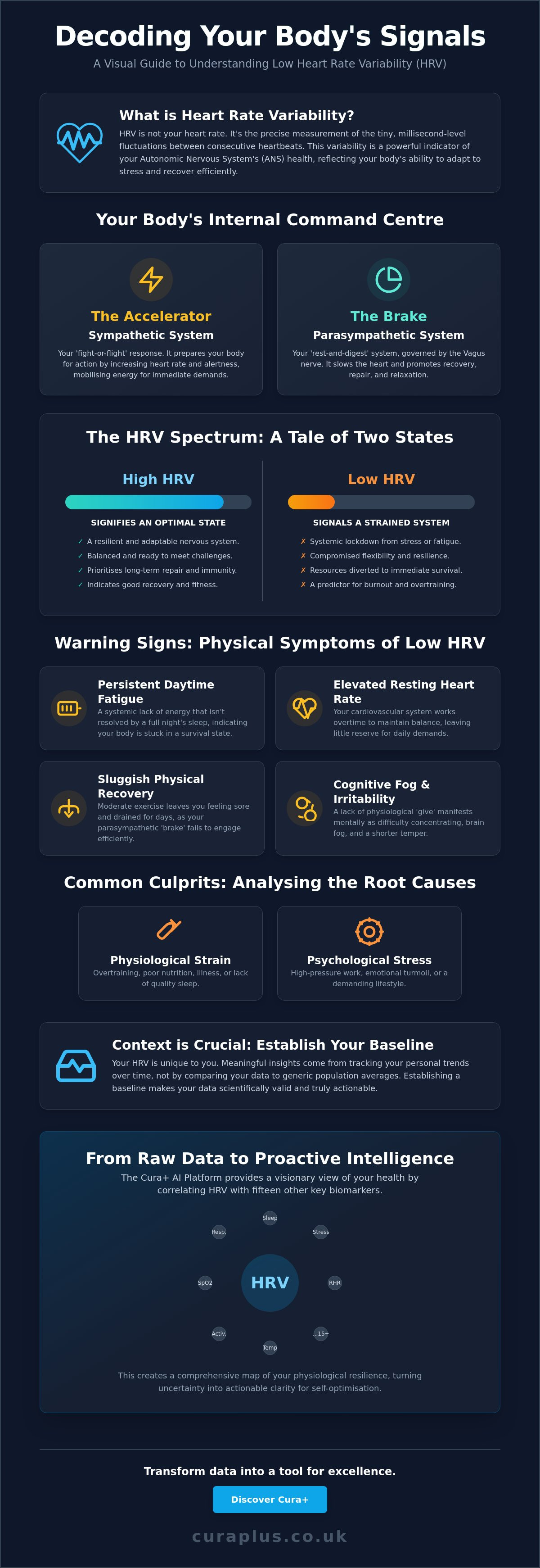
To understand why your body responds the way it does, you must look beyond the simple pulse. Heart rate measures the total number of beats per minute, yet the true insight lies in the gaps between them. What is Heart Rate Variability refers to the millisecond-level fluctuations between consecutive heartbeats. It's a reflection of your Autonomic Nervous System (ANS), the command centre governing every unconscious function from digestion to pupil dilation. The ANS operates through two primary branches: the sympathetic, acting as an accelerator to prepare you for action, and the parasympathetic, serving as the brake to facilitate rest.
A healthy system isn't a metronome; it is a dynamic, shifting rhythm that responds to every breath and thought. High variability indicates a resilient, adaptable nervous system that can pivot between states with ease. This balance signifies that your system is meeting challenges without becoming depleted. Conversely, low variability suggests a state of systemic lockdown where the body's natural flexibility has been compromised by persistent stress or fatigue.
The Vagus Nerve and Parasympathetic Tone
The Vagus nerve acts as the primary conduit for the parasympathetic branch, often referred to as the "rest and digest" system. It functions as a biological brake, slowing the heart and promoting recovery after a period of exertion. When we observe low heart rate variability symptoms, we are often witnessing a withdrawal of this parasympathetic influence. Such rigidity is not merely a data point on a screen. It manifests as a lack of physiological "give" where your heart rate remains elevated and your metabolic processes stay focused on catabolic activity. This persistent state of readiness is why many individuals experience cognitive fog or irritability long before they realise they are overextended.
HRV as a Mirror of Systemic Homeostasis
Homeostasis is the state of equilibrium your body constantly strives to maintain. When your HRV is high, your system has the luxury of prioritising long-term maintenance, such as cellular repair and immune function. However, during periods of low variability, the body shifts its resources toward immediate survival. This shift occurs long before you feel ill. In this survival-oriented state, the body effectively mutes the signals of long-term health to focus on the immediate perceived threat. By utilising biometric tracking for wellness, you can see this internal prioritisation in real-time. It provides a mirror of your systemic health, allowing you to recognise low heart rate variability symptoms as they emerge. This proactive visibility is the cornerstone of modern self-optimisation, turning uncertainty into actionable clarity.
Identifying Low Heart Rate Variability Symptoms: How Your Body Signals Strain
Recognising the physical manifestations of autonomic strain requires a shift in perspective. You must learn to view your daily sensations as sophisticated data points rather than mere inconveniences. Whilst the previous section established the biological "why" behind autonomic balance, we must now address how this translates into your felt experience. The most common low heart rate variability symptoms often appear as a subtle, creeping sense of depletion that standard recovery protocols fail to address.
Persistent daytime fatigue is frequently the primary indicator. This is not the standard tiredness that follows a long day; it is a systemic lack of energy that does not resolve even after a full night of rest. When your HRV is low, your body is effectively stuck in a catabolic state, prioritising immediate survival over the restorative processes that create vitality. This often occurs alongside an increased resting heart rate (RHR). If your heart is beating faster whilst you are at rest, it indicates that your cardiovascular system is working overtime to maintain basic homeostasis, leaving little reserve for external demands.
Physical recovery also becomes noticeably sluggish. You might find that a moderate gym session or a brisk walk leaves you feeling unusually sore or drained for several days. This suggests your parasympathetic "brake" is failing to engage, preventing the efficient repair of muscle tissue. Refining your understanding of these signals through integrated biometric monitoring allows for precise interventions before this exhaustion becomes chronic.
The Pre-Symptomatic Window: Detecting Illness Early
One of the most powerful applications of HRV tracking is identifying the "pre-symptomatic window." A significant drop in HRV, often accompanied by a subtle rise in skin temperature, frequently occurs 24 to 48 hours before the onset of viral symptoms. Because low heart rate variability is considered a sign of immune system activation, your data can warn you of an impending illness before you feel a single sneeze. Utilising a wearable for tracking immune health provides the necessary foresight to adjust your schedule and prioritise rest, potentially mitigating the severity of the illness.
Cognitive and Emotional Symptoms
The prefrontal cortex, the area of the brain responsible for executive function and emotional regulation, is closely linked to HRV levels. When variability drops, your cognitive resilience often follows. You may experience "brain fog" or find that complex tasks require significantly more effort than usual. Decision fatigue becomes a physiological reality, where even minor choices feel overwhelming. This often creates a "wired but tired" sensation, a state of sympathetic dominance where you feel mentally agitated yet physically exhausted. Recognising these low heart rate variability symptoms as physiological rather than character flaws is essential for maintaining calm control over your wellness journey.
Analysing the Root Causes of Reduced Variability
Identifying the biological signals of strain is merely the first stage of your journey toward self-mastery. To truly optimise your health, you must analyse the specific drivers that force your system into a state of autonomic lockdown. In the UK, the "always-on" professional culture often serves as a primary catalyst for these shifts. Chronic psychological stress acts as a persistent tax on your nervous system, keeping the sympathetic branch engaged long after the workday has ended. This prevents the heart from returning to its natural, variable state and eventually manifests as the low heart rate variability symptoms we have previously identified.
Physical exertion, whilst essential for longevity, requires a sophisticated balance of recovery. Overtraining syndrome occurs when the volume or intensity of exercise exceeds your body's ability to repair itself. Without sufficient recovery intervals, the heart's electrical stability is compromised. Nutritional choices also play a critical role. Late-night heavy meals and alcohol consumption are amongst the most common triggers for suppressed variability. Environmental factors, particularly blue light exposure and poor sleep hygiene, further disrupt the delicate electrical rhythms of the heart by interfering with melatonin production and systemic rest.
Lifestyle Factors and Circadian Disruption
Your Autonomic Nervous System thrives on predictability. Irregular sleep patterns and frequent late nights confuse your internal clock, leading to a fragmented circadian rhythm that suppresses HRV. Alcohol is particularly disruptive; even a single drink can impact your heart's electrical stability for up to 72 hours. By utilising a wearable for tracking stress patterns, you can visualise exactly how these lifestyle choices correlate with your data. This clarity allows you to replace guesswork with precise adjustments to your evening routine.
Physiological and Medical Undercurrents
Beyond lifestyle choices, chronic low-grade inflammation often acts as a hidden suppressor of heart rate variability. This systemic strain forces the body to prioritise immune defence over restorative functions. It is also essential to recognise that age and genetics establish a natural "ceiling" for your potential variability. For instance, whilst a healthy individual in their 20s may have a baseline between 55 and 105 milliseconds, someone in their 60s typically sees a range of 25 to 45 milliseconds. If you observe a persistent, unexplained decline in your data despite optimal lifestyle choices, it may suggest the presence of low heart rate variability symptoms that warrant a professional clinical consultation. Understanding these boundaries ensures that your pursuit of excellence remains grounded in biological reality.
Establishing Your Baseline: Why Context Matters for HRV Data
Measuring your heart rate variability without a personal baseline is equivalent to reading a compass without knowing where North is. Every individual possesses a unique physiological signature that renders comparisons to others scientifically invalid. Factors such as age, genetic predisposition, and long-term fitness levels create vast discrepancies in what is considered "normal" for any given person. Instead, we define a Health Baseline as the statistical average of your biomarkers recorded whilst you are in a healthy, rested state. Whilst a peer might thrive with an HRV of 40ms, your system might require 70ms to function at its peak. Understanding this distinction is the only way to accurately identify low heart rate variability symptoms before they impact your daily performance.
To ensure the highest level of accuracy, measurement must occur under strictly consistent conditions. Capturing data during deep sleep is the gold standard for this process. This controlled environment removes the "noise" of daily stressors, caffeine intake, and physical activity, providing a pure look at your autonomic balance. By monitoring these trends over time, you can differentiate between an acute drop, perhaps caused by a temporary stressor, and a chronic downward trend that suggests your system is in a state of persistent lockdown. To begin interpreting these hidden signals with clinical precision, discover the capabilities of theBand and the Cura+ platform.
The 14-Day Baseline Window
Establishing a reliable norm requires at least fourteen days of continuous, high-fidelity data. This two-week window allows the system to account for natural fluctuations in your lifestyle and environment. AI algorithms are then employed to filter out one-off events, such as a celebratory evening or a particularly strenuous workout, which might otherwise skew your results. You can explore the specific mathematical methodology behind this process in our definitive guide on how to build a health baseline. Once this foundation is secure, your data transforms from a series of numbers into a visionary tool for predictive wellness.
Interpreting Fluctuations Safely
Understanding the nuance of daily fluctuations is vital for maintaining calm control over your health journey. Small variances are not a cause for concern; they indicate a healthy, responsive autonomic nervous system that is actively adjusting to your environment. However, we identify the "red zone" as any drop that exceeds two standard deviations from your established norm. The coefficient of variation in HRV serves as a sophisticated marker of your overall physiological stability and resilience. When your data remains consistently below these thresholds, the low heart rate variability symptoms we have discussed, such as persistent fatigue or reduced cognitive resilience, are likely to manifest with greater intensity.
Proactive Health Intelligence: Managing HRV with theBand by Cura+
Mastery over your health requires more than just awareness; it demands a sophisticated infrastructure for continuous, high-fidelity monitoring. theBand by Cura+ serves as this essential foundation, tracking over 15 biomarkers simultaneously to provide a comprehensive view of your physiological state. By correlating HRV with skin temperature, respiratory rate, and blood oxygen levels, the Cura+ AI Platform identifies low heart rate variability symptoms with unprecedented accuracy. This multi-sensor approach moves beyond the limitations of isolated data points, offering a visionary perspective on your body's internal priorities.
The transition from reactive management to proactive wellness is driven by predictive alerts. These notifications inform you of autonomic shifts before they manifest as physical exhaustion or illness, allowing you to adjust your intensity with surgical precision. Through personalised coaching, the platform provides actionable steps to restore your variability, whether through targeted breathwork or optimised recovery intervals. It's a partner in your high-stakes journey toward self-optimisation, replacing the uncertainty of fluctuating metrics with the clarity of data-driven strategy.
Beyond HRV: The Power of 15+ Biomarkers
HRV is a vital metric, yet it gains its true meaning only when contextualised within your broader biological environment. theBand integrates sleep stage analysis and activity levels to reveal exactly how your daily behaviours influence your autonomic recovery. For those pursuing their biological peak, theBand by Cura+ offers clinical-grade sensors that capture high-fidelity data in real-time. This level of detail is essential for high-stakes health optimisation, ensuring that every insight is grounded in methodical reliability rather than consumer-grade guesswork.
From Data to Actionable Intelligence
Raw data is only valuable when it leads to meaningful transformation. The Cura+ AI Platform translates complex biometric trends into specific, actionable interventions tailored to your unique baseline. If the system detects early low heart rate variability symptoms, it may recommend immediate physiological sighs or increased hydration to prevent systemic burnout. This interaction provides a profound sense of calm control; you're no longer guessing about your body's requirements. You can finally enjoy the peace of mind that comes from continuous, invisible health monitoring. Join our exclusive pre-launch today to secure your future with proactive health intelligence and master the complex system of your own biology.
Master Your Physiological Future
Recognising the subtle emergence of low heart rate variability symptoms represents a fundamental shift from reactive health management to visionary self-optimisation. By interpreting these hidden signals of systemic strain, you gain the foresight necessary to adjust your lifestyle before depletion takes hold. We've explored how establishing a personal baseline and identifying root causes like circadian disruption provide the clarity needed to master your body's complex rhythms. You don't have to navigate this journey with incomplete data or generic averages.
theBand by Cura+ is specifically designed for the sophisticated UK wellness market, monitoring over 15 essential biomarkers to provide an unparalleled view of your internal health. With AI-driven predictive alerts, you can transform raw metrics into actionable intelligence, ensuring you remain in calm control of your performance. Secure your access to theBand by Cura+ and start monitoring your predictive health today. The future of your wellness is already accessible through data; it's time to replace uncertainty with the quiet excitement of discovery.
Frequently Asked Questions
Is a low HRV always a sign of a heart problem?
A low HRV is not necessarily indicative of a cardiac pathology. It typically signals that your autonomic nervous system is in a state of sympathetic dominance, prioritising immediate survival over restoration. Whilst chronic low variability can correlate with long-term cardiovascular risk, it more frequently reflects temporary physiological strain from factors such as overtraining, poor sleep, or impending illness.
Can I have a low HRV and still feel physically fit?
You can certainly possess high levels of physical fitness whilst exhibiting a low HRV. Performance metrics like speed or strength don't always align with your internal physiological resilience. If you are experiencing low heart rate variability symptoms despite your fitness level, it suggests that your system is overextended and requires strategic recovery to maintain its long-term peak.
How quickly can I improve my HRV if I notice symptoms of strain?
Improvements in HRV can occur within minutes through targeted interventions such as resonant frequency breathing. However, systemic recovery from chronic strain typically takes several days of prioritised sleep and reduced load. If your variability has been suppressed by overtraining or psychological stress, you should expect a gradual return to your baseline as your parasympathetic tone recovers.
What is considered a 'dangerously low' HRV number for an adult?
There is no universal "dangerously low" figure, as HRV is a highly individualised metric. A value that is normal for a 60-year-old might indicate significant systemic strain for a 20-year-old. The true concern arises when your data drops significantly below your established 14-day baseline, which may suggest your system is struggling to maintain homeostasis.
Does caffeine consumption significantly lower HRV levels?
Caffeine acts as a stimulant that temporarily increases sympathetic activity and suppresses HRV. The extent of this impact depends on your metabolic rate and the timing of consumption. Whilst a morning coffee may have a negligible effect on your daily average, late-afternoon intake often disrupts sleep architecture, leading to a noticeable drop in your overnight recovery metrics.
Can psychological stress cause a drop in HRV even if I'm resting?
Psychological stress can suppress your HRV even whilst you are physically sedentary. Your autonomic nervous system responds to mental micro-stressors and perceived threats with the same "fight-or-flight" mechanisms used for physical exertion. This persistent mental load keeps your system in a state of autonomic lockdown, preventing the heart from returning to its natural, variable rhythm.
How does age affect my baseline HRV and what I should expect?
HRV naturally declines as we age due to changes in autonomic flexibility and cardiac tissue. Younger individuals typically exhibit higher variability, whilst older adults should expect a lower, more stable baseline. It's essential to track your personal trends rather than comparing your data to younger cohorts, as your own historical norm is the only valid benchmark for your health.
What should I do if my wearable shows a low HRV for several days in a row?
A persistent drop in HRV over several days requires a proactive shift in your recovery strategy. You should consider reducing your training intensity, extending your sleep duration, and monitoring for other low heart rate variability symptoms such as an elevated resting heart rate. If the trend continues despite these adjustments, it may indicate a deeper physiological undercurrent that requires a professional consultation.


