


What if the most effective way to reclaim your health isn't found in a list of generic recovery tips, but within the silent, biological signals your body is already sending? For many, the frustration of invisible symptoms makes managing long covid symptoms with data an essential evolution from the exhausting guessing game of traditional pacing. You've likely experienced the soul-crushing cycle of the "boom and bust," whilst a productive morning often leads to a week-long setback that no standard medical test seems to quantify.
It's time to move beyond the uncertainty of subjective feelings. This article explores a more sophisticated path forward, replacing guesswork with clinical precision through AI and deep biomarker insights. We will show you how to predict flares before they happen, providing you with objective proof of your physiological state. You'll learn a data-led framework for pacing activities that transforms recovery from a series of unpredictable hurdles into a managed, strategic process of self-optimisation.
Key Takeaways
- Understand why traditional symptom diaries often fail and how to replace subjective observations with precise, clinical-grade biological signals.
- Discover the critical role of Heart Rate Variability (HRV) and SpO2 in managing long covid symptoms with data to establish a reliable baseline for recovery.
- Learn how AI-driven predictive intelligence filters physiological "noise" to identify the subtle patterns that precede a flare or crash.
- Master a structured pacing strategy that uses real-time alerts to ensure you remain below your anaerobic threshold and avoid the "boom and bust" cycle.
- Explore how theBand provides continuous, high-fidelity monitoring of 15+ biomarkers to transform your health management from guesswork into a precise science.
The Data Gap in Long Covid Management
Standard clinical diagnostics often reach a frustrating impasse when confronted with the complexities of post-viral syndromes. You might present with profound exhaustion and neurological disturbances, yet your routine blood panels return results within the "normal" range. This discrepancy creates a significant data gap, leaving many to navigate a comprehensive overview of Long Covid symptoms without any objective markers to guide their daily choices. Managing long covid symptoms with data represents a fundamental shift in this paradigm. It moves the focus from what a clinician sees in a single snapshot to what your body is doing in real-time, every hour of the day.
Data-led recovery is the process of using physiological biomarkers to create a digital mirror of your internal state. It bridges the chasm between how you feel and what is actually happening within your autonomic nervous system. By leveraging predictive intelligence, you can transform health management from a reactive struggle into a proactive strategy. Instead of waiting for a crash to tell you that you've done too much, data allows you to see the physiological strain building well before the first symptom emerges.
The Limitations of Subjective Tracking
Manual symptom logging is a cornerstone of traditional management, but it carries a heavy cognitive price. When you are experiencing severe brain fog, the simple act of recording your heart rate or energy levels becomes an exhausting task. Subjective tracking is also prone to inherent bias; "feeling fine" is often a lagging indicator that masks underlying physiological strain. By the time you realise you've overexerted yourself, the inflammatory cascade has already begun. This is why building a health baseline is essential. It provides a stable point of reference, allowing you to detect subtle deviations in your biology before they manifest as a full-scale setback.
The Need for Continuous Monitoring
Long Covid is not a static condition. It is a dynamic, hour-by-hour fluctuation of the body's internal systems. Spot-checks, such as taking your temperature once a day or checking your pulse during a rest period, fail to capture the critical trends that define your recovery. True insight requires continuous observation of how your body responds to the environment, emotional stress, and minor physical movements. Managing long covid symptoms with data involves monitoring the constant dialogue within your autonomic nervous system. This continuous stream of information allows for the identification of patterns that are invisible to the naked eye, providing the clarity needed to master your recovery journey with clinical precision.
Key Biomarkers for Managing Long Covid Symptoms
Research from the National Institutes of Health highlights the challenge of diagnosing Long COVID through standard laboratory assessments. Because routine blood tests often fail to capture the multi-systemic nature of the condition, managing long covid symptoms with data becomes the only viable way to quantify your physiological state. By monitoring functional biomarkers, you can identify the exact moment your body moves from a state of recovery into a state of stress. This transition is often invisible to the eye but clearly visible in the numbers.
HRV: Your Internal Compass
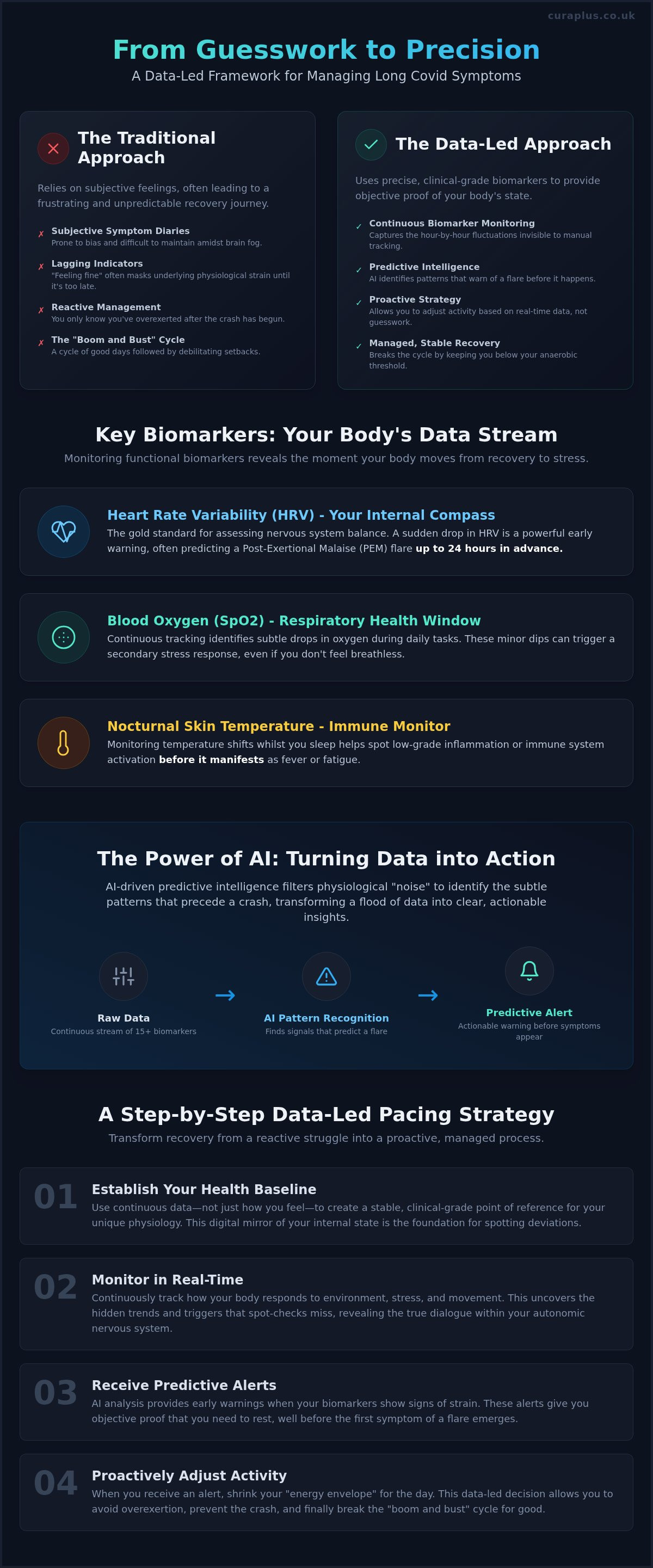
Heart Rate Variability (HRV) is the variation in time between consecutive heartbeats, measured in milliseconds. It is widely considered the gold standard for assessing the balance between your sympathetic and parasympathetic nervous systems. For those with Long Covid, a sudden drop in HRV is a powerful early warning signal. It can predict a Post-Exertional Malaise (PEM) flare up to 24 hours in advance. By identifying these dips early, you can proactively shrink your "energy envelope" for the day, avoiding the overexertion that leads to a crash. This data-led approach replaces the fear of the unknown with a strategic plan for stability.
Respiratory and Thermal Trends
Whilst HRV monitors the nervous system, other biomarkers provide a window into your respiratory and immune health. Tracking Blood Oxygen Saturation (SpO2) helps you identify subtle breathlessness during daily tasks. These minor dips often trigger a secondary stress response, as the brain perceives a lack of oxygen as an immediate threat. Additionally, monitoring nocturnal skin temperature shifts allows you to spot low-grade inflammation or immune system activation before it manifests as a fever or fatigue. Utilising biometric tracking for wellness ensures these disparate signals are synthesised into a single, coherent picture of your health.
Recovery is not simply a product of "hours slept" but rather the quality of the restorative cycles your body enters. Long Covid often disrupts the ratio of deep sleep and REM sleep, leaving you feeling exhausted despite a full night's rest. Data allows you to quantify this restorative quality, revealing whether your body is stuck in a state of nocturnal hyper-vigilance. Understanding these patterns is the first step toward mastering your recovery. For those ready to move beyond generic advice, investing in clinical-grade monitoring provides the precision needed to navigate this journey with confidence.
AI and Predictive Intelligence: Spotting the Patterns
Monitoring over 15 distinct biomarkers simultaneously is a feat beyond human cognitive capacity, especially whilst navigating the neurological challenges of post-viral recovery. Managing long covid symptoms with data requires a layer of sophisticated intelligence to synthesise disparate streams of information into a coherent narrative. AI serves as this essential interpreter, distinguishing between the "noise" of temporary daily stress and the genuine "signals" of an approaching physiological crash. By identifying the unique physiological signature that precedes your specific setbacks, algorithms provide a level of foresight that subjective observation simply cannot match. This predictive capacity is the difference between falling into a week-long slump and taking a strategic rest day that preserves your long-term progress.
Recent research from Harvard University has utilised data tracking to identify patterns across various recovery trajectories, proving that recovery isn't a linear path but a series of identifiable states. AI leverages these patterns to offer personalised coaching, transforming raw data into clear, actionable instructions. Instead of wondering why you feel depleted, you receive a prompt to prioritise rest before the exhaustion even sets in. This systematic approach ensures that every decision you make is backed by the current reality of your biology.
Correlating Activity with Physiology
AI creates a bridge between your external actions and your internal response. It links your step count or time spent in specific heart rate zones to your next-day HRV recovery, revealing exactly how much activity your system can currently tolerate. This process often uncovers hidden triggers that would otherwise remain unnoticed. You might discover that a late-evening meal or a second cup of coffee has a disproportionate impact on your nocturnal recovery markers. Transitioning to proactive health management tools allows you to anticipate these reactions, adjusting your behaviour in real-time to protect your energy envelope.
Reducing the Cognitive Load
One of the most significant barriers to recovery is the mental energy required to track and analyse symptoms whilst suffering from cognitive fatigue. AI removes this burden by automating the heavy lifting of data analysis. A unified health intelligence dashboard simplifies complex biological data into intuitive insights, allowing you to focus entirely on healing. Real-time alerts are far superior to end-of-week reviews because they enable immediate intervention. When your physiology begins to deviate from its baseline, the system alerts you instantly, ensuring that you don't inadvertently push through a critical warning sign. This constant vigilance provides a sense of security, knowing that your recovery is being monitored with clinical precision.
A Step-by-Step Data Strategy for Pacing
Traditional pacing advice often lacks a tangible metric for success, leaving many to wonder if they are truly resting or merely waiting. Managing long covid symptoms with data requires a structured framework that begins with establishing a clinical baseline. Spend the first 14 days gathering high-fidelity data whilst maintaining a strictly "safe" activity level. This initial period isn't about making progress; it's about observation and calibration. By recording your physiological responses to minimal exertion, you create a benchmark against which all future recovery can be measured with absolute clarity.
Setting Physiological Boundaries
Mastering your recovery requires identifying your individual ventilatory threshold. This is the physiological "red zone" where your body shifts from aerobic to anaerobic metabolism, a transition that frequently triggers Post-Exertional Malaise (PEM) in those with Long Covid. Using wearables for tracking recovery allows you to set precise heart rate alerts that notify you before you cross this threshold. It's vital to understand that "pushing through" is the most dangerous approach to this condition. Data provides the objective proof you need to stop, even when your mind wants to continue, ensuring you don't inadvertently trigger a setback.
The Pacing Protocol
A data-led strategy follows a disciplined daily rhythm that removes the burden of decision-making. First, perform a morning HRV check to determine your readiness for the day. If your score is significantly below your baseline, prioritise rest immediately, regardless of your plans. Second, utilise real-time heart rate monitoring during essential tasks like showering or preparing meals to ensure you remain in a "green zone" of exertion. Finally, conduct an evening review of your stress versus rest balance. This three-step process ensures that managing long covid symptoms with data becomes a seamless part of your daily routine.
Recovery is a process of constant refinement rather than a fixed destination. Every fortnight, use AI-driven insights to evaluate your progress and adjust your "energy envelope" accordingly. You should only consider increasing your activity levels when your HRV and sleep architecture scores remain consistently stable for at least ten days. If the data suggests a downward trend or increased physiological strain, shrink your envelope until stability returns. This methodical approach ensures that every step forward is sustainable and backed by science. To begin implementing this precision framework today, discover how theBand and Cura+ platform can transform your recovery journey.
Mastering Recovery with theBand by Cura+
Reclaiming your health from a condition as complex as Long Covid requires more than just patience; it demands a sophisticated technological partner. theBand is not a simple fitness tracker, but a high-fidelity wearable engineered for proactive health intelligence. By providing continuous, clinical-grade monitoring of over 15 distinct biomarkers, it offers the level of detail necessary for managing long covid symptoms with data. This elite tool allows you to move beyond the limitations of subjective feelings, providing a clear and objective view of your body's internal state at any given moment. It's a visionary approach to wellness that replaces the anxiety of the unknown with the calm control of empirical evidence.
The integration of theBand with the Cura+ AI Platform creates a powerful ecosystem for self-optimisation. Whilst other devices might provide raw numbers, this platform synthesises your unique biological signals to offer predictive health alerts and personalised coaching. It's an essential partnership for anyone serious about mastering their recovery through a data-led framework. By monitoring the constant dialogue within your autonomic nervous system, theBand ensures that every step you take towards health is calculated, sustainable, and backed by clinical precision.
Clinical Precision in a Wearable
Accuracy is paramount when you are managing a chronic illness where even minor overexertion can lead to significant setbacks. theBand differentiates itself from standard consumer wearables through its biomarker depth and sensor fidelity. It focuses on the metrics that matter most for post-viral recovery, including clinical-grade Heart Rate Variability (HRV) and Blood Oxygen Saturation (SpO2). theBand possesses a unique capacity to detect subtle viral or inflammatory onsets through persistent monitoring of nocturnal thermal shifts and autonomic balance. This level of insight allows you to identify physiological strain long before it manifests as a physical symptom, giving you the power to intervene early and protect your energy envelope.
Your AI Health Partner
Data only becomes actionable when it is interpreted through the lens of expertise. The Cura+ AI health and wellness coach translates your complex biological data into specific, manageable recovery steps. It removes the cognitive load of manual tracking, allowing you to focus your limited energy on healing whilst the AI handles the analysis. By providing real-time physiological feedback, the system eliminates the guesswork from pacing, telling you exactly when your body requires rest and when it is safe to increase your activity levels. This proactive approach ensures that you are always one step ahead of your symptoms, moving with a sense of direction and purpose.
Take the first step towards a precision-managed recovery today. Join the pre-launch to take control of your recovery journey with theBand by Cura+ and experience the future of health intelligence.
Transitioning to Data-Led Mastery
The journey from chronic uncertainty to physiological clarity begins with a single, data-driven decision. By replacing the exhaustive cycle of "boom and bust" with a strategic framework built on objective biomarkers, you can finally transcend the limitations of traditional pacing. We've explored how identifying your individual ventilatory threshold and monitoring HRV trends enables you to anticipate setbacks before they occur. Managing long covid symptoms with data provides the clinical precision needed to navigate this complex condition with confidence, ensuring that every effort you make is aligned with your body's actual capacity for recovery.
It's time to stop guessing and start mastering your biology. With theBand, you gain access to clinical-grade sensors that monitor 15+ essential biomarkers and an AI platform that delivers predictive health alerts to guide your daily choices. This is the future of self-optimisation, where technology and biology converge to restore your sense of control and clarity.
Discover theBand by Cura+: The Future of Predictive Health Management
Your path to recovery is unique, but you don't have to navigate it in the dark. Embrace the clarity of data and step forward into a future of renewed vitality and empowerment.
Frequently Asked Questions
Can a wearable device really help me manage Long Covid symptoms?
A sophisticated wearable provides the objective physiological evidence needed to master pacing and avoid the "boom and bust" cycle. By managing long covid symptoms with data, you move beyond the uncertainty of subjective feelings. theBand monitors over 15 biomarkers simultaneously, offering a comprehensive view of your internal state that standard fitness trackers simply cannot match.
Which biomarkers are the most important to track for fatigue and brain fog?
Heart Rate Variability (HRV), Blood Oxygen Saturation (SpO2), and Skin Temperature are the most critical metrics for assessing systemic fatigue. These biomarkers provide a clear window into your autonomic nervous system and respiratory efficiency. Monitoring these specific signals helps you understand the physiological drivers behind brain fog, allowing for more targeted recovery interventions.
How does Heart Rate Variability (HRV) relate to Post-Exertional Malaise (PEM)?
HRV serves as a real-time indicator of your autonomic nervous system's balance and resilience. When you are approaching a PEM flare, your HRV will typically drop significantly as your body struggles to maintain equilibrium. By tracking this variation in milliseconds between heartbeats, you can identify when your system is overtaxed well before physical exhaustion manifests.
Is it better to track symptoms manually or use an AI health platform?
Utilising an AI health platform is far more effective than manual tracking, particularly whilst experiencing cognitive fatigue. AI reduces the mental burden of analysis by automatically correlating 15+ biomarkers to find patterns that a human might miss. This proactive approach ensures that your recovery strategy is based on complex biological trends rather than potentially biased memory.
Can data predict when I am about to have a Long Covid flare-up?
Predictive algorithms can identify the unique physiological signature of a crash by detecting subtle deviations from your established baseline. These alerts often signal an approaching flare-up 24 hours in advance, providing a critical window for intervention. Managing long covid symptoms with data allows you to shrink your energy envelope proactively, potentially avoiding a week-long setback.
How do I know if my pacing strategy is actually working?
You can validate your pacing strategy by observing consistent stability in your baseline recovery metrics over a 14-day period. If your HRV and sleep architecture scores remain steady whilst you maintain a specific activity level, your pacing is likely successful. Sudden fluctuations or downward trends suggest that your current exertion exceeds your system's restorative capacity.
What is the difference between a fitness tracker and a predictive health wearable?
Fitness trackers are designed to monitor peak performance and calorie expenditure in healthy individuals. In contrast, a predictive health wearable like theBand focuses on clinical-grade precision for monitoring complex conditions. It prioritises high-fidelity sensors and deep biomarker analysis to provide the proactive intelligence required for systemic recovery.
Can tracking my skin temperature help me monitor my immune system?
Nocturnal skin temperature monitoring is an excellent tool for identifying low-grade inflammation or immune system activation. Subtle shifts in your baseline temperature at night can indicate that your body is fighting a sub-clinical viral onset. This early warning allows you to prioritise rest and immune support before more debilitating symptoms become apparent.


