


What if your body could whisper its secrets to you days before a fever ever breaks or a headache begins? Most of us have felt the frustration of wearing a device that merely logs the past, providing a stream of data that feels more like noise than knowledge. It's exhausting to sift through heart rate variables whilst still feeling anxious about a sudden, unexplained decline in your wellbeing. You deserve the clarity provided by predictive health alerts rather than a dashboard of confusing metrics.
In this guide, we explore how these alerts are shifting the paradigm from historical logging to real-time physiological forecasting. You'll discover how they transform complex biometric data into actionable intelligence, allowing you to detect illness and physiological stress before physical symptoms ever manifest. We will examine the science behind this proactive approach, the necessity of professional-grade precision in devices like theBand, and how the Cura+ AI Platform empowers you to achieve true physiological self-mastery in 2026.
Key Takeaways
- Understand the transition from reactive data logging to proactive health intelligence to anticipate physiological changes before they compromise your performance.
- Discover the biological foundation of predictive health alerts, which monitor over 15 distinct biomarkers to identify subtle shifts in your autonomic nervous system.
- Learn the importance of contextual intelligence in distinguishing between benign stimulants and the genuine onset of physiological stress or viral infection.
- Identify the specific biological "red flags" that signal the onset of illness or overtraining up to 48 hours before symptoms manifest.
- Explore how theBand and the Cura+ AI Platform synthesise complex biometrics into actionable insights for superior physiological self-mastery.
Understanding Predictive Health Alerts: From Reactive to Proactive
Predictive health alerts represent a fundamental shift in how we perceive the biological self. For decades, healthcare was inherently reactive; we waited for the onset of symptoms before seeking intervention. In 2026, this paradigm has been dismantled by sophisticated predictive analytics that transform raw biometric data into actionable forecasts. These alerts are not mere notifications of what is happening now. Instead, they are AI-driven projections that identify subtle physiological shifts before you feel the slightest hint of fatigue or discomfort.
By utilising a "digital twin", which is a dynamic virtual model of your unique physiology, modern systems can simulate how your body responds to various stressors. This moves us beyond treating symptoms to a state of proactive health intelligence. Rather than reacting to a fever once it arrives, you're notified of the systemic inflammation that precedes it. This transition from simple step-counting to complex multi-sensor biomarker analysis allows for a level of precision that was previously impossible to achieve outside of a clinical laboratory.
The Evolution of Health Monitoring
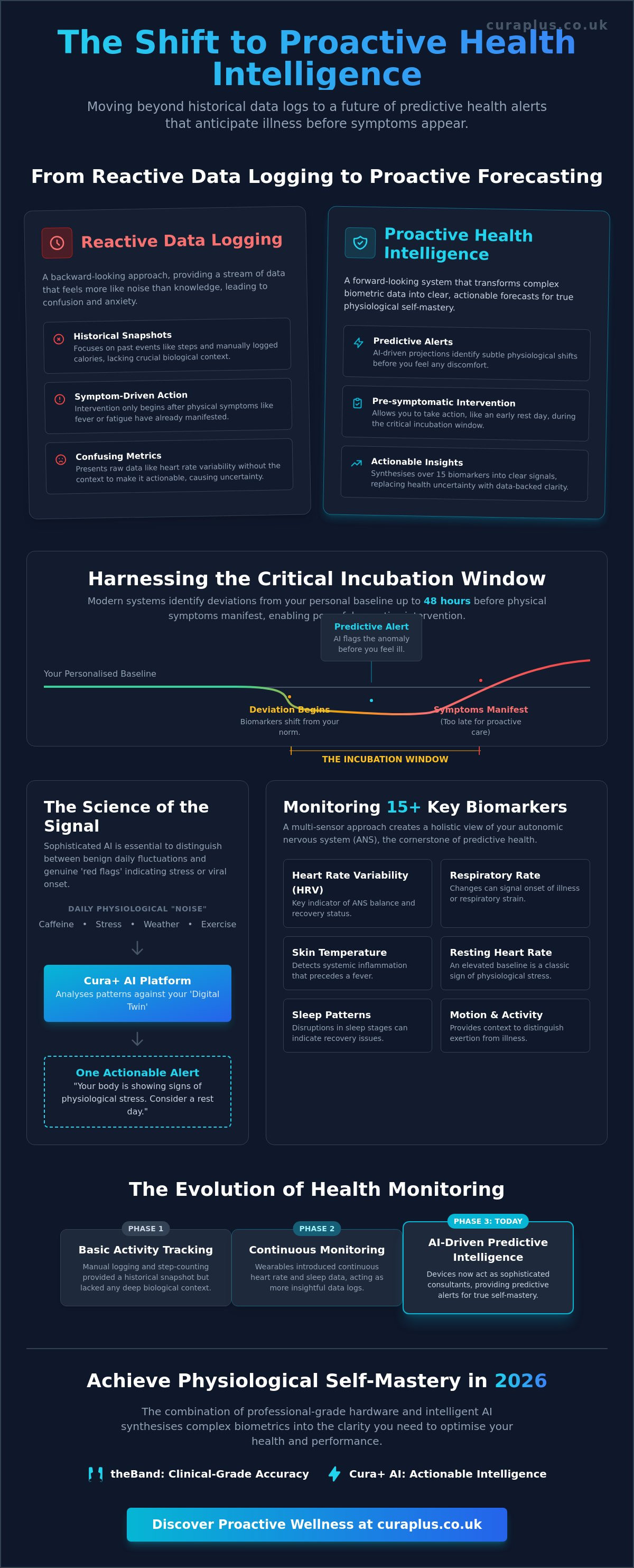
The journey to proactive wellness has progressed through three distinct stages, each refining our understanding of the human body as a complex system.
- Phase 1: The era of basic activity tracking focused on step-counting and manual logging of calories or weight. These tools provided a historical snapshot but lacked biological context.
- Phase 2: Wearables introduced continuous heart rate monitoring and sleep duration analysis. Whilst more insightful, these devices still functioned primarily as data logs rather than advisors.
- Phase 3: we've entered the era of AI-driven predictive intelligence. With approximately 55% of wearable manufacturers now incorporating AI features, devices have evolved into sophisticated consultants for the human body.
Why Timing is Everything in Preventative Wellness
The most critical advantage of modern monitoring is the ability to identify the "incubation window". This is the specific period where internal biomarkers, such as heart rate variability or respiratory rate, diverge from your norm before physical symptoms arise. This window is where proactive intervention is most effective. It's the difference between taking an early rest day and being sidelined for a week.
By maintaining a 24/7 personalised baseline, the system ignores generic averages and focuses on what is abnormal for your specific biology. This precision eliminates the anxiety of health uncertainty, replacing it with the calm control of data-backed clarity. It's a state of physiological self-mastery where you're no longer a passenger to your health, but its primary strategist. You don't just track your life; you optimise it based on real-time intelligence.
The Biological Foundation: How AI Decodes Physiological Biomarkers
High-fidelity intelligence isn't built on a single data point. To generate accurate predictive health alerts, a system must track 15 or more biomarkers simultaneously. This multi-sensor approach allows the AI to synthesise a holistic view of your internal state. By integrating thermal, optical, and motion sensors into a single wearable, we can observe how different systems interact. For instance, an elevated heart rate paired with high skin temperature and low movement suggests a very different physiological state than an elevated heart rate during intense physical activity.
The true power lies in the algorithm's ability to filter "noise" from meaningful trends. Every day, our bodies produce vast amounts of data influenced by caffeine, stress, or even the weather. Sophisticated AI models are essential for reducing clinical alert fatigue with AI, ensuring that you only receive notifications when a genuine deviation occurs. This precision is what separates professional-grade intelligence from basic consumer gadgets that often trigger false alarms. Achieving this level of insight requires the precision of theBand, which is engineered to capture these nuances with clinical-grade accuracy.
Key Biomarkers for Early Detection
Monitoring the autonomic nervous system (ANS) is the cornerstone of proactive wellness. By analysing the balance between the sympathetic and parasympathetic branches, we gain a direct window into your systemic stress levels.
- Heart Rate Variability (HRV): This is the primary indicator of systemic stress. It measures the millisecond-level variation between beats, indicating whether your body is in a state of "fight or flight" or "rest and digest".
- Resting Heart Rate (RHR): Sustained RHR trends correlate strongly with immune response. A gradual climb over several days often indicates that the body is diverting resources to manage an emerging biological threat.
- Skin Temperature: Subtle fluctuations are frequently the earliest precursors to viral onset. These changes often manifest up to 48 hours before a clinical fever is detectable with a traditional thermometer.
The Role of Respiratory Rate and Blood Oxygenation
Nocturnal respiratory patterns are remarkably stable in healthy individuals. Even a slight increase in breaths per minute whilst sleeping can be an early sign of respiratory distress or systemic illness. Peripheral oxygen saturation (SpO2) further complements this data by providing insights into metabolic health and recovery efficiency. When these metrics are analysed in tandem, the AI can distinguish between simple physical exhaustion and the early stages of a viral infection. To understand the full scope of what is possible, you can read our detailed guide on what biomarkers can wearables track.
Traditional Notifications vs. Predictive Intelligence: A Comparative Analysis
Most wearable users are familiar with the "high heart rate" notification. Whilst well-intentioned, these alerts are often functionally obsolete by the time they arrive. They inform you of a physiological state that has already manifested. This is reactive data logging. True predictive health alerts function as a sophisticated early-warning system. They don't just report the fire; they detect the rising temperature and chemical shifts that precede the first spark.
The distinction lies in contextual intelligence. A standard notification might flag a heart rate spike as an anomaly. An AI-driven system asks why it happened. Is the elevation a result of a third cup of coffee, an impending work presentation, or the early stages of systemic inflammation? By synthesising multiple data streams, predictive intelligence provides a nuanced interpretation of your biology. This shift moves us away from arbitrary goals, such as the outdated 10,000-step target, toward comprehensive biological readiness scores that reflect your actual capacity for stress and recovery.
Static Data vs. Dynamic Intelligence
Static data is a snapshot. It tells you your heart rate is 65 bpm. Dynamic intelligence is a narrative. It observes how that 65 bpm relates to your sleep quality, your respiratory rate, and your previous three days of activity. For these predictions to be reliable, the underlying hardware must maintain a standard of clinical-grade precision. Using the best health wearable for data accuracy ensures that the AI isn't building its forecasts on shaky foundations. High-fidelity data is the prerequisite for high-intent intelligence.
Customisation and Personalised Thresholds
Clinical "normal" ranges are often too broad to be useful for high-performance individuals. Your personal baseline is the only metric that truly matters. AI models now learn your unique behavioural patterns and physiological quirks over time. This deep personalisation helps in reducing "notification fatigue" by eliminating irrelevant pings. You won't be bothered by minor fluctuations that are normal for your body. Instead, you'll only receive alerts when the data suggests a significant, high-intent deviation from your optimised state. This clarity replaces the background noise of modern life with a focused, data-backed strategy for wellness.
Early Detection in Practice: Identifying Viral Onset and Physiological Stress
Theory translates into tangible results when predictive health alerts identify a biological threat long before you feel its effects. Consider the onset of a common seasonal virus. The process begins subtly. On night one, your resting heart rate might climb by a mere two beats per minute. By night two, your skin temperature deviates by 0.3°C whilst your heart rate variability (HRV) contracts by 15%. To the unassisted eye, these are negligible shifts. To the Cura+ AI Platform, they are the clear signatures of an immune system under siege. This 48-hour window of foresight allows you to adjust your schedule and prioritise recovery before the first symptom ever appears.
Managing chronic physiological stress follows a similar logic. Unlike an acute illness, burnout is often a slow erosion of your biological resilience. Predictive intelligence identifies the "red flags" of overtraining, such as a persistent downward trend in nocturnal recovery scores. By monitoring these long-term health trends, the system provides a strategic overview of your capacity for high-level performance. You're no longer guessing if you're "working too hard"; you have the data to prove it. To master this process, learn how to use a wearable for early illness detection.
The Immune System Alert
There is a direct correlation between elevated peripheral skin temperature and the metabolic demands of white blood cell activity. When your body prepares for a "crash", it redirects energy to the immune response. Predictive alerts quantify this shift, providing the objective justification needed to rest. In one notable case, a user avoided a week-long illness by reducing their training load the moment their device flagged a systemic recovery deficit. This is the essence of proactive wellness: taking action whilst you still have the choice. To begin your journey toward this level of biological foresight, explore the capabilities of theBand.
Stress Regulation and Mental Wellbeing
Psychological stress often manifests physically before we are consciously aware of it. Physiological markers, such as a sustained rise in cortisol-linked heart rate patterns, can be detected in real-time. When these markers are identified, the system can prompt immediate lifestyle adjustments or breathing exercises to mitigate the impact. Establishing a robust health baseline is essential for recognising these deviations. This allows you to treat your mental wellbeing as a data-driven system to be managed with the same precision as your physical fitness.
Implementing Personalised Intelligence with theBand by Cura+
Mastering your biology requires more than just access to data; it requires a sophisticated partner capable of translating that data into a strategy. theBand by Cura+ serves as this partner. It is a tool designed for those who view health not as a series of symptoms to be managed, but as a complex system to be understood and refined. By moving beyond the limitations of standard wearables, theBand provides the high-fidelity inputs necessary for predictive health alerts to function with professional-grade accuracy.
The hardware is engineered with a multi-sensor array that captures physiological nuances often missed by consumer-grade devices. Whilst others may focus on surface-level metrics, theBand monitors the intricate interplay between your cardiovascular system, respiratory patterns, and thermal regulation. This data is then processed by the Cura+ AI Platform, which acts as your 24/7 health consultant. It is here that raw biometrics are synthesised into clear, actionable advice. This marks a significant transition from passive tracking to active coaching. The platform doesn't just tell you what happened; it tells you what to do next to maintain your peak physiological state.
Precision Hardware Meets Advanced AI
Our multi-sensor array is the foundation of our precision. It tracks the subtle shifts in your autonomic nervous system that indicate when you are pushing too hard or when you have more to give. The Cura+ AI Platform takes this information and builds a narrative of your wellbeing. It identifies patterns that would be invisible to the human eye, providing a level of foresight that was once reserved for elite clinical settings. This is not just about counting steps. It is about understanding the metabolic and physiological cost of your daily life.
Joining the Future of Proactive Health
Our subscription model reflects a commitment to continuous software refinement and personalised health coaching. It ensures that your digital twin, which we discussed as the model of your unique physiology, evolves alongside the latest breakthroughs in biological science. Security and data privacy are the non-negotiable foundations of this ecosystem. We treat your biometric information with the gravity it deserves. High-level encryption ensures your data remains your own. The integration of predictive health alerts into your daily routine is a commitment to long-term excellence.
Early adoption during our pre-launch phase is particularly valuable. Building a robust physiological baseline takes time, and starting early allows the AI to learn your unique patterns with greater depth. The vision of Cura+ is to empower every individual to achieve a state of complete physiological self-mastery. We invite you to step away from the uncertainty of reactive wellness and join a future defined by data-backed clarity.
Mastering Your Biological Future
The era of waiting for symptoms to dictate your lifestyle has reached its end. By embracing a system that prioritises foresight over historical logging, you gain the ability to anticipate physiological stress before it manifests as a crisis. We've explored how the simultaneous monitoring of over 15 essential biomarkers provides a level of clarity that basic wearables cannot match. This transition ensures your wellness is no longer a series of reactions, but a deliberate, data-backed strategy. It's the difference between being a passenger and being the strategist of your own body.
Utilising predictive health alerts allows you to replace anxiety with actionable intelligence. With the Cura+ AI Platform, you benefit from AI-driven proactive health intelligence backed by UK-based clinical precision and uncompromising data security. You're now equipped to move beyond simple tracking and into a state of true physiological self-mastery. The future of your wellbeing is no longer a mystery to be solved; it's a system to be optimised.
Secure your future with theBand by Cura+
Your journey toward excellence starts with the decision to look ahead. We're here to ensure you never have to look back.
Frequently Asked Questions
How far in advance can predictive health alerts detect illness?
Predictive health alerts can identify the onset of illness up to 48 hours before physical symptoms manifest. This foresight is achieved by detecting subtle deviations in your baseline biometrics, such as resting heart rate and skin temperature. By identifying these shifts during the incubation window, the system provides the clarity needed to prioritise recovery and mitigate the severity of an impending viral load.
Are predictive health alerts as accurate as a doctor’s diagnosis?
No, these alerts are sophisticated wellness tools and do not constitute a clinical medical diagnosis. Whilst theBand provides professional-grade precision, its purpose is to identify physiological trends and deviations rather than to name specific pathologies. You should always consult a healthcare professional for clinical assessments or if you feel unwell, regardless of the data provided by your wearable device.
Which biomarkers are most important for predicting a viral infection?
The most critical biomarkers for predicting viral onset include Heart Rate Variability (HRV), Resting Heart Rate (RHR), and skin temperature. A simultaneous contraction in HRV and a rise in nocturnal skin temperature often signal that the immune system is mobilising. When combined with changes in respiratory rate, these metrics form a high-fidelity signature of physiological stress that precedes traditional symptoms like a cough.
Can a wearable help me identify the early signs of burnout or chronic stress?
Yes, a predictive wearable is an essential tool for identifying the physiological precursors of burnout. Chronic stress manifests as a sustained suppression of Heart Rate Variability and an elevation in baseline cardiovascular markers. By monitoring these trends over time, the Cura+ AI Platform can alert you to a state of systemic overreach, allowing you to implement lifestyle adjustments before psychological exhaustion sets in.
Is my biometric data secure when using the Cura+ AI Platform?
Your biometric data is protected by high-level encryption and rigorous security protocols within the Cura+ AI Platform. We treat personal health information with the gravity it deserves, ensuring that your data remains private and secure. Our UK-based infrastructure is designed to maintain the highest standards of data integrity, providing a secure and reliable foundation for your journey toward physiological self-mastery.
What is the difference between a fitness tracker and a predictive health wearable?
A fitness tracker primarily logs historical activity, such as steps and calories burned. In contrast, a predictive health wearable uses AI to forecast future physiological states based on multi-sensor data. Whilst trackers tell you what you did, systems that generate predictive health alerts tell you what is likely to happen next, shifting the focus from simple activity monitoring to advanced intelligence.
Do I need to wear theBand 24/7 for the alerts to work?
Continuous wear is highly recommended to ensure the highest level of accuracy for your alerts. The AI requires a consistent stream of data to establish and refine your personalised physiological baseline. Nocturnal data is particularly critical, as the body is in a controlled state, allowing the system to detect subtle shifts in recovery and immune health that occur whilst you sleep.
How does the AI distinguish between an intense workout and an oncoming fever?
The AI utilises contextual analysis by synthesising data from thermal, optical, and motion sensors simultaneously. An intense workout is accompanied by high motion data and a rapid heart rate recovery afterwards. Conversely, an oncoming fever is characterised by an elevated resting heart rate and skin temperature during periods of inactivity. By filtering out the noise of physical exertion, the system identifies genuine biological anomalies.


