


What if your biology is sounding a silent alarm that your mind hasn't yet registered? For many, the first indication of a problem isn't a sudden collapse; it is a series of subtle signs your body is under stress that often go ignored. You might recognise the frustration of unexplained fatigue despite sleeping well, or the unsettling feeling of being "wired but tired" at the end of a long day. It's a common experience to feel as though you're maintaining control, whilst your internal systems are secretly approaching their limit.
We believe that health is a complex system to be mastered rather than a set of symptoms to be managed. This guide will teach you how to decode your physiological data and identify hidden biological markers before burnout begins. By understanding the role of your autonomic nervous system and leveraging precise insights from theBand and our Cura+ AI Platform, you can transform uncertainty into clarity. We will explore how to use objective metrics to justify essential recovery, ensuring you remain at the peak of your performance without compromising your long-term well-being.
Key Takeaways
- Master the biological architecture of your stress response by understanding the equilibrium between the sympathetic and parasympathetic branches of your Autonomic Nervous System.
- Identify critical shifts in Heart Rate Variability and Resting Heart Rate to quantify how hard your body is working to maintain stability.
- Recognise cognitive and behavioural micro-signals, such as decision fatigue and hyper-vigilance, which function as the first subtle signs your body is under stress before physical symptoms emerge.
- Establish a precise 14-day physiological baseline to ensure you can distinguish meaningful data deviations from your personal biological norms.
- Leverage the predictive intelligence of theBand and the Cura+ AI Platform to detect complex biomarker patterns that signal the need for proactive recovery.
The Biological Architecture of Stress: More Than a Feeling
Stress isn't merely a subjective mood or a temporary state of mental pressure. Biologically, it represents a profound disruption of homeostasis within the complex Biological Architecture of Stress. It is a measurable physiological deviation from your body's baseline state. Whilst we often perceive stress as an emotional reaction, it's actually an intricate cascade of hormonal and neurological events designed to ensure survival. It is the body's attempt to re-establish stability in the face of perceived threats.
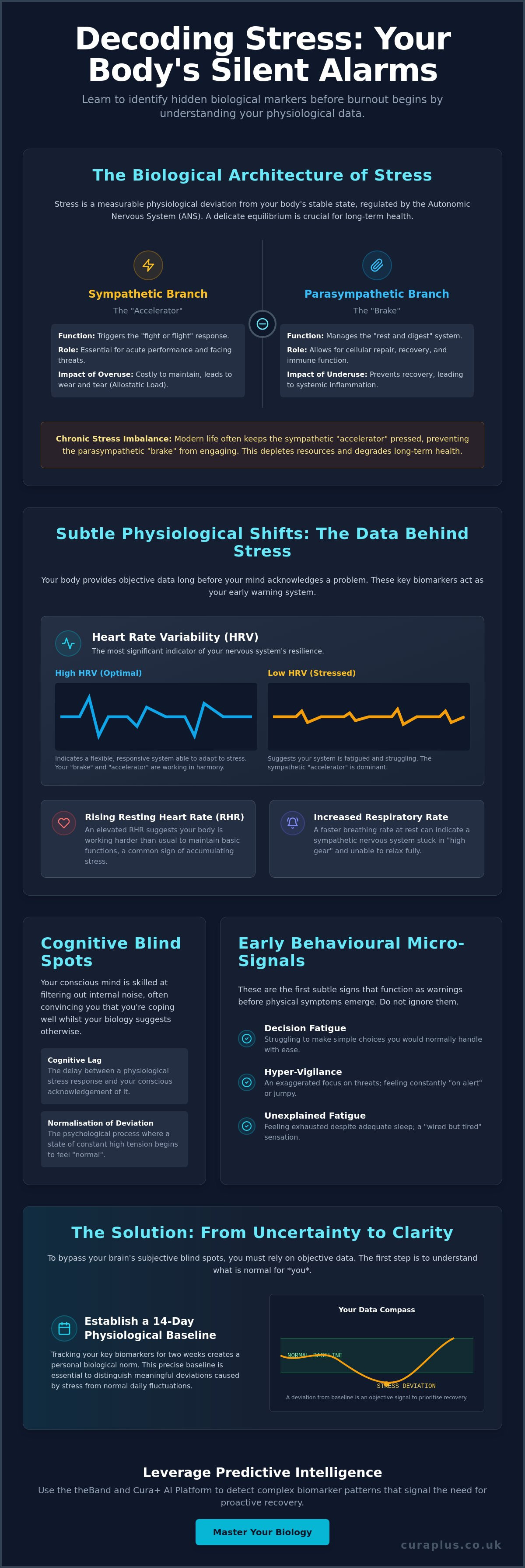
The primary regulator of this internal environment is the Autonomic Nervous System (ANS). It maintains a delicate equilibrium between two opposing branches. In the modern world, stress is often "silent" because it's predominantly psychological rather than physical. We aren't outrunning predators; we're managing deadlines, financial pressures, and digital notifications. This leads to an increased Allostatic Load. This term describes the cumulative wear and tear on your body resulting from chronic over-exposure to neural or neuroendocrine responses. When this load becomes excessive, the system begins to fail.
The Role of the Autonomic Nervous System
The ANS functions like a high-performance vehicle with two distinct pedals. The Sympathetic branch acts as the accelerator, triggering the "fight or flight" response. It is essential for acute performance but costly to maintain. Conversely, the Parasympathetic branch is the "rest and digest" system. It's the biological brake that allows for cellular repair, immune function, and recovery. Chronic activation of the Sympathetic branch without adequate Parasympathetic recovery leads to systemic inflammation. This persistent state of high alert eventually degrades your long-term health and vitality.
Why Your Brain Misses the Early Signs
Most of us only acknowledge stress when it manifests as a physical symptom, such as a tension headache or debilitating fatigue. This "cognitive lag" occurs because our conscious mind is remarkably good at filtering out internal noise. We also fall victim to the "Normalisation of Deviation." This is a psychological phenomenon where we adapt to increasingly high levels of tension until a state of constant pressure feels entirely "normal" to us. You don't feel the damage because you've forgotten what true calm feels like.
Because of this mental bias, you can't rely on intuition alone to detect the subtle signs your body is under stress. Your brain will often convince you that you're coping well, even whilst your data suggests otherwise. To bypass this subjective blind spot, objective biometric tracking for wellness is essential. Data doesn't have an ego. It simply reflects the reality of your physiological state, allowing you to intervene before burnout becomes inevitable. By monitoring these metrics, you reclaim control over your biological narrative.
Subtle Physiological Shifts: The Data Behind the Stress
Stress is often invisible to the naked eye. Whilst you might feel "fine," your internal systems are constantly adjusting to maintain balance. These subtle physiological shifts provide a window into your biological state long before a mental breakdown occurs. By shifting our focus from subjective feelings to objective data, we can identify the subtle signs your body is under stress with clinical precision.
Key biomarkers act as early warning signals. A rising Resting Heart Rate (RHR) often suggests that your body is working harder than usual just to maintain basic functions. Similarly, a slight increase in your respiratory rate, the number of breaths you take per minute whilst at rest, can indicate a sympathetic nervous system that is stuck in "high gear." Even minor fluctuations in skin temperature can signal that your immune system is being taxed by chronic pressure. These metrics are the language of your body, and learning to read them is the first step toward self-optimisation.
Heart Rate Variability (HRV) as a Stress Compass
Heart Rate Variability is the millisecond variation between heartbeats controlled by the Autonomic Nervous System. It is perhaps the most significant indicator of nervous system resilience. A higher HRV indicates a flexible, responsive system capable of switching between high performance and deep recovery. Conversely, a sudden drop in HRV often predicts illness or physical overreach several days before you notice any symptoms. It serves as a predictive compass, guiding you on when to prioritise rest. When your HRV trends downwards, your body is essentially telling you that its resources are depleted.
Sleep Quality vs. Quantity
Many individuals believe that achieving eight hours of sleep is sufficient for recovery. However, duration does not equal restoration. Chronic stress triggers cortisol production, which can compromise sleep architecture even if you remain unconscious for the full night. This often leads to a reduction in Deep and REM sleep, the stages responsible for physical repair and emotional processing. Waking up feeling unrefreshed is one of the most common subtle signs your body is under stress, indicating that your recovery systems are failing to engage effectively.
Utilising a wearable for tracking recovery allows you to look past the clock and measure the actual quality of your rest. It transforms the vague concept of "tiredness" into actionable data points. When you understand these patterns, you can make informed decisions about your daily workload. If you are ready to take control of your biological data, you can explore how our advanced monitoring solutions provide the clarity you need to avoid burnout.
Cognitive and Behavioural Micro-Signals You Shouldn't Ignore
While physiological data provides the foundation for understanding your state, your daily actions often mirror these internal shifts. Behavioural changes are frequently the first outward subtle signs your body is under stress. These aren't personality flaws; they're survival mechanisms. When your system is taxed, it prioritises essential functions and discards those it deems non-essential for immediate survival. Data reveals the truth. Your brain is simply trying to protect you from perceived threats by reallocating limited energy resources.
Decision fatigue is a primary indicator of this energy reallocation; you might find that choosing a meal or organising a simple evening schedule feels as taxing as a complex professional task. This happens because the brain's executive function requires significant glucose and neural resources. Similarly, you may notice an increased 'startle' response to minor environmental noises, such as a phone notification or a closing door. This hyper-vigilance suggests your nervous system is stuck in a state of high alert, scanning for threats that don't exist.
- Social Withdrawal: A biological drive to conserve energy by avoiding interaction and external stimulation.
- Appetite Changes: A shift towards high-glucose foods to fuel a perceived metabolic threat.
- Task Paralysis: Feeling unable to start even simple activities due to cognitive overwhelm.
The Neurochemistry of Irritability
When the prefrontal cortex is energy-depleted, the amygdala takes a more dominant role in processing information. This ancient part of the brain prioritises rapid, emotional reactions over reasoned responses. There is a direct link between low Heart Rate Variability (HRV) and reduced emotional regulation. If you find yourself 'snapping' at colleagues or family, recognise it as a physiological signal that your resilience is low. It's an indication that your system lacks the bandwidth to process frustration effectively. It's a biological reality, not a character failing.
Micro-behaviours and Habit Shifts
Your habits often change long before you feel 'burnt out'. You might start neglecting favourite hobbies or exercise routines, which is a clear sign of low 'Readiness' scores. Instead, you may find yourself trapped in 'scrolling behaviour' on digital devices. This is a dopamine-seeking stress response, where the brain searches for quick hits of reward to offset the lack of internal balance. A wearable for tracking stress patterns can identify these cycles by correlating your digital habits with your physiological data. Understanding these subtle signs your body is under stress allows you to intervene with precision, replacing mindless scrolling with targeted recovery strategies that actually restore your system.
The Importance of a Health Baseline in Stress Detection
To accurately identify the subtle signs your body is under stress, you must first define what "normal" looks like for your unique physiology. Standard medical ranges often provide a broad spectrum that fails to account for individual variability. For instance, a resting heart rate of 70 beats per minute may be perfectly healthy for one individual, whilst for a high-performance athlete, it could indicate a state of significant overreach. True predictive health relies on understanding your specific biological signature rather than comparing yourself to a population average. You are the only relevant benchmark for your own well-being.
Establishing this signature requires a dedicated 14-day window. This timeframe is essential to capture a representative sample of your data across various activities and stress levels. It allows your monitoring system to account for natural daily fluctuations, known as Circadian Rhythms, which influence everything from body temperature to hormonal secretion. By identifying these patterns, you can recognise "Deviations from the Mean" as the gold standard for stress detection. A minor but sustained shift in your baseline metrics is often the first indicator that your system is struggling to maintain homeostasis.
Building Your Personalised Health Map
Capturing true baseline data necessitates continuous, 24/7 monitoring. Intermittent checks are insufficient because they miss the subtle transitions that occur during sleep or high-pressure moments. When you build a health baseline, you create a filter that ignores one-off anomalies, such as a single night of poor sleep after a social event, and focuses on sustained trends. Comparing your current data to your past self is far more valuable than benchmarking against others. It provides a personalised roadmap for your long-term wellness journey, ensuring every insight is relevant to your specific needs.
Identifying the "Yellow Zone"
The most critical phase of stress management is the "Yellow Zone." This is the transition period where your body is still functioning but is beginning to divert resources away from recovery. We quantify this capacity through a "Readiness Score," a metric that evaluates your body's ability to handle new stressors based on your current physiological state. By monitoring this score, you can identify the subtle signs your body is under stress and justify "Strategic Rest" before a total system crash occurs. This data-driven approach empowers you to pause when your body requires it, ensuring you remain in a state of high-level performance. If you are ready to establish your own physiological baseline, view our advanced health monitoring tools to begin your journey toward predictive wellness.
Predictive Intelligence: Navigating Stress with theBand
Stress management has historically been a reactive endeavour. Most individuals wait for a physical or mental breakdown before seeking a remedy. However, the future of wellness lies in predictive intelligence. By utilising theBand by Cura+, you gain access to a sophisticated physiological laboratory on your wrist. This device tracks over 15 distinct biomarkers, providing a high-resolution view of your internal state. It doesn't just measure activity; it monitors the autonomic nervous system shifts that represent the earliest subtle signs your body is under stress. This real-time visibility allows you to see the invisible.
The Cura+ AI Platform serves as your personal data strategist. It identifies complex correlations and patterns that the human eye simply misses. Whilst you might perceive a single night of restlessness as an isolated event, the AI identifies it as part of a three-day downward trend in your recovery capacity. This shift from reactive "damage control" to proactive physiological optimisation allows you to adjust your lifestyle in real-time. You receive alerts when your system begins to drift into the "Yellow Zone," providing you with the necessary data to justify rest before your performance suffers.
The Science Behind theBand
The sensors within theBand go far beyond simple step counting or basic pulse monitoring. They track the subtle millisecond variations in your heart rate and minor fluctuations in skin temperature with clinical precision. These data points are processed by proprietary AI algorithms designed to predict burnout days before physical symptoms appear. This intelligence is seamlessly integrated into our personalised health coaching app. The platform transforms raw biological data into a clear, actionable dialogue between you and your biology, ensuring you always know exactly where you stand on the spectrum of readiness.
Your Future with Proactive Health
Adopting a data-driven approach fundamentally changes your relationship with your own body. You are no longer a passenger reacting to unexplained fatigue or sudden irritability; you become a pilot with a clear, reliable dashboard. By maintaining a balanced Autonomic Nervous System, you aren't just avoiding burnout; you are actively investing in your long-term longevity and cognitive clarity. Proactive health is about mastery and the quiet excitement of discovery. It's about recognising the subtle signs your body is under stress and having the confidence to intervene with precision. Discover theBand and secure your proactive health future today.
Mastering Your Biological Narrative
Understanding the intricate relationship between your autonomic nervous system and daily performance is no longer a matter of intuition. By identifying the subtle signs your body is under stress, you transition from reactive management to proactive biological mastery. Data creates clarity. Establishing a clear physiological baseline empowers you to decode micro-signals, such as shifts in heart rate variability or cognitive fatigue, before they manifest as clinical illness. The future of wellness belongs to those who view health as a complex system to be understood and refined.
theBand by Cura+ is engineered for the future of UK preventative care, monitoring 15+ critical biomarkers to provide AI-driven predictive health alerts. This is your opportunity to replace uncertainty with insight and transform your approach to recovery. Secure your path to proactive health with theBand by Cura+. Your body is already communicating its needs; it's time you had the sophisticated tools to listen. Take control of your biological narrative and lead with confidence.
Frequently Asked Questions
What is the single most accurate sign that my body is under stress?
Heart Rate Variability (HRV) is considered the most reliable physiological indicator of your internal stress state. A sustained decline in your personal HRV baseline suggests that your sympathetic nervous system is overactive, which limits your body's ability to recover. Whilst individual symptoms like headaches are noticeable, HRV provides a clinical look at your nervous system resilience before physical pain even begins.
Can my wearable really tell if I'm stressed before I feel it?
Advanced technology like theBand can detect physiological shifts days before they reach your conscious awareness. By tracking 15+ biomarkers, the Cura+ AI Platform identifies subtle signs your body is under stress by spotting minute deviations from your established 14-day baseline. This predictive intelligence allows you to intervene early, preventing the "normalisation of deviation" that often leads to total burnout.
How does Heart Rate Variability (HRV) relate to stress levels?
HRV measures the millisecond variations between heartbeats, which are directly controlled by your Autonomic Nervous System. A high HRV indicates a flexible and responsive system that can easily switch between high performance and deep restoration. Conversely, a low HRV suggests your body is trapped in a "fight or flight" state, indicating that your cumulative stress load is exceeding your current recovery capacity.
Is it possible for my body to be stressed even if my mind feels calm?
It is entirely possible for your body to experience significant Allostatic Load whilst your mind remains focused and composed. This "silent" stress occurs when your internal systems work overtime to maintain homeostasis in response to psychological or environmental pressures. You might feel mentally capable, yet your data could show an elevated resting heart rate or suppressed sleep quality, signalling hidden physiological strain.
What should I do if my health data shows I am consistently in a high-stress state?
You should prioritise "Strategic Rest" and actively engage your parasympathetic nervous system to lower your internal tension. This might involve reducing your cognitive workload, increasing your sleep duration, or utilising breathwork to shift your body out of a sympathetic state. Use your objective data to justify these recovery periods, ensuring you address the subtle signs your body is under stress before they manifest as illness.
How long does it take for the body to recover from a period of high stress?
Recovery duration depends on the intensity of the stressor, but it typically requires several days of consistent parasympathetic activation to restore your baseline. Minor overreach may resolve within 48 hours of quality rest. Chronic stress, however, can disrupt your sleep architecture and hormonal balance for weeks, requiring a more sustained and methodical approach to recovery before your metrics return to their optimal levels.
What is a 'normal' HRV for a healthy adult in the UK?
There is no universal "normal" HRV value because this metric is highly individualised and influenced by age, fitness, and genetics. A score that is healthy for one person might indicate severe overreach for another. Instead of comparing your data to a generic UK average, you should focus on your own 14-day mean. Identifying deviations from your personal signature is the only accurate way to measure your resilience.
Does skin temperature change when we are mentally stressed?
Mental stress often causes minor fluctuations in skin temperature as the body redirects blood flow toward vital organs and large muscle groups. These micro-variations are usually too subtle for you to feel manually. However, the sensitive sensors in theBand detect these changes in real-time, providing an additional layer of data to help you recognise subtle signs your body is under stress during high-pressure situations.


