


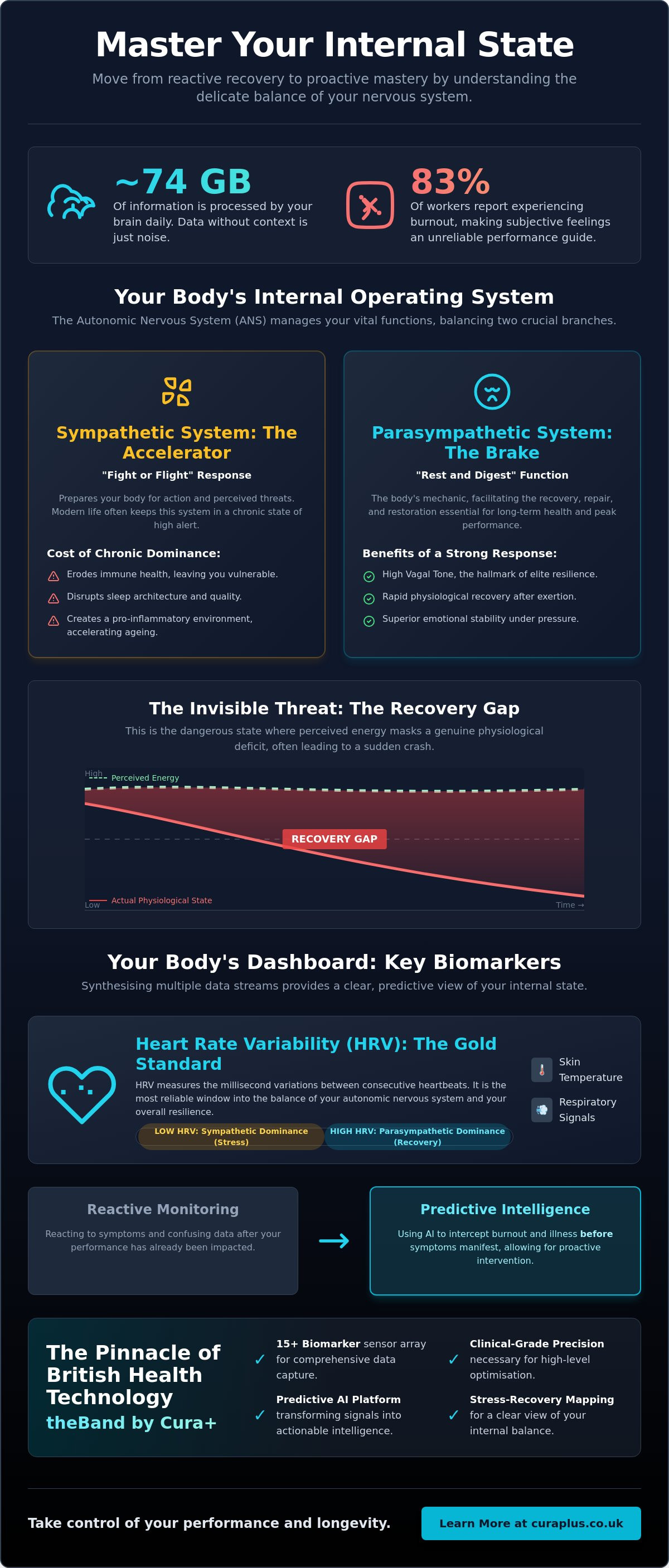
What if the most critical indicator of your performance wasn't your heart rate or your sleep duration, but a silent signal your body sends days before you feel the first signs of fatigue? In an era where 83% of workers report some degree of burnout, relying on subjective feelings is no longer a viable strategy for those committed to excellence. Mastering the art of tracking sympathetic vs parasympathetic nervous system activity is the difference between reactive recovery and proactive mastery. It's about moving beyond the noise of raw data to understand the delicate dance between your fight-or-flight response and your rest-and-digest state.
You've likely felt the frustration of a tracker providing a readiness score that contradicts your actual energy levels, leaving you with numbers but no clear direction. We agree that data without context is merely distraction, especially whilst your brain is processing approximately 74GB of information every single day. This guide will show you how to leverage predictive AI and multi-sensor technology to identify impending illness and burnout before symptoms manifest. We'll explore how theBand and the Cura+ AI Platform transform physiological signals into a clear map of your internal stress-recovery balance, ensuring your daily performance is always optimised.
Key Takeaways
- Understand the fundamental mechanics of the autonomic nervous system to distinguish between fight-or-flight responses and essential rest-and-digest recovery.
- Master the science of tracking sympathetic vs parasympathetic nervous system balance using Heart Rate Variability and skin temperature to identify physiological trends.
- Transition from reactive data monitoring to predictive recovery intelligence, allowing you to intercept burnout and illness before symptoms become manifest.
- Learn to organise your professional and personal commitments around objective readiness scores to mitigate the impact of silent stressors.
- Explore how theBand and its 15+ biomarker sensor array provide the clinical precision necessary for high-level personal health optimisation.
Understanding the Autonomic Nervous System: The Science of Recovery
The human body operates under the constant surveillance of the autonomic nervous system (ANS), a sophisticated background operating system that manages every vital function without our conscious input. From the rhythm of your heart to the depth of your breath, the ANS ensures survival by balancing two distinct yet interconnected branches. The sympathetic branch acts as the accelerator, preparing you for action through the fight or flight response. Conversely, the parasympathetic branch serves as the mechanic, facilitating rest and digest functions that are essential for long-term health. Mastery of your performance begins with understanding how these two forces interact to define your daily readiness.
Physiological recovery is not merely the absence of activity; it is the active process of returning the body to a state of homeostasis. True recovery occurs when the parasympathetic system successfully counterbalances the stress of the day, repairing cellular damage and restoring energy reserves. High-performers often fall into what we define as the Recovery Gap. This is a precarious state where perceived energy or mental willpower masks a genuine physiological deficit. They continue to push through demanding schedules whilst their internal systems are struggling to keep up. Without objective tracking sympathetic vs parasympathetic nervous system activity, this gap often remains invisible until it manifests as a sudden drop in performance or a health crisis.
The Vagus Nerve: The Master Regulator of Recovery
The Vagus nerve is the primary conduit for the parasympathetic system, acting as a high-speed data cable between the brain and the vital organs. It's the physical manifestation of your body's ability to switch off and enter a restorative state. High Vagal tone is a hallmark of elite resilience, correlating with rapid physiological recovery and superior emotional stability under pressure. Vagal tone is the body's brake pedal for stress. When this tone is high, your heart rate slows more efficiently after exertion, and your system returns to a calm state with greater speed. By monitoring these signals, you gain a direct window into your body's internal regulation capacity.
While tracking is essential, many also look for structural support for the Vagus nerve. Upper Cervical Care is an online directory that helps you find specialised doctors focused on the connection between the upper spine and the autonomic nervous system.
Sympathetic Dominance and the Cost of Chronic Stress
Modern life is often structured to keep us in a state of chronic sympathetic activation. Constant digital notifications, high-stakes professional deadlines, and the pressure of 24/7 connectivity trap the body in a loop of perceived threat. This sympathetic dominance comes at a staggering cost to your biology. It erodes immune health, disrupts the delicate architecture of your sleep, and creates a pro-inflammatory environment that accelerates ageing. Consistent tracking sympathetic vs parasympathetic nervous system trends allows you to identify when you're stuck in this high-alert state. This insight is essential for longevity, providing the clarity needed to intervene before chronic stress causes permanent damage to your health and performance.
Key Biomarkers for Tracking Sympathetic vs Parasympathetic Balance
Effective physiological monitoring requires more than a single data point. Whilst many consumers rely on heart rate alone, elite health optimisation demands a multi-dimensional approach to tracking sympathetic vs parasympathetic nervous system activity. By synthesising data from multiple physiological sources, we eliminate the "data silos" that often lead to misinterpretation. True clarity emerges only when we observe the interplay between cardiac, thermal, and respiratory signals. This comprehensive view allows us to move beyond basic tracking into the realm of predictive health intelligence.
HRV: The Window into Your Resilience
Heart Rate Variability (HRV) remains the gold standard for assessing the state of your autonomic system. It measures the millisecond variations between consecutive heartbeats. Heart rate is controlled by the two branches of the autonomic (involuntary) nervous system, and HRV reflects this internal tug-of-war. A higher HRV indicates a robust parasympathetic response, suggesting your body is primed for performance and recovery. Conversely, a suppressed HRV signals sympathetic dominance, often a precursor to overtraining or burnout. Integrating these insights into a broader strategy for biometric tracking for wellness allows for a more nuanced understanding of your biological limits.
Beyond HRV: Temperature and Respiratory Trends
Whilst HRV provides a snapshot of stress, other biomarkers offer significant predictive power. Subtle elevations in nocturnal skin temperature can signal an immune system under pressure, often predicting viral onset up to 48 hours before symptoms appear. Similarly, your nocturnal respiratory rate acts as a sensitive indicator of physiological strain. A sudden spike in breaths per minute during sleep often reveals that the nervous system is struggling to complete essential repair processes. This predictive approach to tracking sympathetic vs parasympathetic nervous system trends ensures you never miss a critical signal from your body.
The Cura+ AI Platform integrates these metrics, alongside a 15+ biomarker array, to provide a holistic recovery score. It isn't enough to know your heart rate; you must understand the context of your body's thermal and respiratory behaviour. This level of clinical precision is what allows for the early detection of illness and the optimisation of daily workload. If you're ready to master your internal data, exploring the capabilities of theBand is the next logical step in your journey toward self-optimisation.
Reactive Tracking vs. Predictive Recovery Intelligence
Most wearable technology operates in the rear-view mirror. It informs you that you slept poorly or that your strain was high yesterday, which, whilst interesting, offers little utility for today's decisions. The primary objection we hear from high-performers is clear: "I want answers, not just more numbers to track." This is where the paradigm shifts from reactive monitoring to predictive intelligence. By tracking sympathetic vs parasympathetic nervous system trends over time, the Cura+ AI Platform identifies the subtle physiological signatures that precede a crash. Predictive intelligence is the ability to forecast a drop in your readiness 24 to 48 hours before you feel it.
This foresight is grounded in the complex Physiology of the Autonomic Nervous System. Rather than reacting to a single night of poor data, our AI algorithms build a high-resolution map of your internal state. Over a 14-day calibration period, the system learns your unique fluctuations, distinguishing between temporary "noise", such as a single late night, and genuine systemic decline. When the system flags a deviation from your unique "normal", it isn't just reporting a number. It's issuing a strategic alert to adjust your workload.
Establishing Your Unique Physiological Baseline
Comparing your biometric data to population averages is biologically flawed. Your "normal" HRV or resting heart rate is as unique as your fingerprint, influenced by genetics, age, and lifestyle. Precision health requires building a health baseline to serve as your personal benchmark. This personalised approach allows the AI to filter out insignificant variables. It ensures that every alert you receive is actionable and relevant to your specific biology. You no longer have to guess if a dip in your score is a cause for concern or a standard variation.
Early Warning Systems for Burnout and Illness
There is a critical "Pre-Symptomatic" phase where your biomarkers shift whilst you still feel perfectly fine. During this window, tracking sympathetic vs parasympathetic nervous system balance reveals a subtle tilt towards sympathetic dominance or a suppressed Vagal tone. Utilising a wearable for tracking immune health allows you to catch these shifts early. Instead of being sidelined for a week by a preventable illness, you can proactively adjust your intensity. You can prioritise sleep and maintain your long-term performance trajectory. This is proactive health intelligence in its most refined form.
How to Organise Your Life Around Recovery Data
Data is only as valuable as the decisions it informs. Transitioning from passive observation to active life-organisation requires a systematic approach to your biometrics. By tracking sympathetic vs parasympathetic nervous system responses, you can uncover "Silent Stressors" that would otherwise go unnoticed. Factors such as evening caffeine consumption, alcohol intake, or excessive blue light exposure leave distinct physiological footprints. For example, a single unit of alcohol can suppress your Heart Rate Variability (HRV) for up to 48 hours, keeping your system in a state of low-level sympathetic arousal whilst you believe you're resting.
Effective management also involves distinguishing between active recovery and passive rest. Passive rest, such as sleep, is the foundation of cellular repair. However, active recovery, including low-intensity movement or breathwork, is a deliberate tool used to stimulate the parasympathetic branch. Utilising wearables for tracking stress patterns allows you to identify the ideal windows for "Deep Work." When your data shows high readiness, you can tackle cognitively demanding projects with clinical precision. Conversely, when your sympathetic system is over-indexed, it's time to prioritise restorative protocols.
The Daily Readiness Protocol
Implementing a structured morning routine ensures you aren't fighting your own biology. First, review your morning recovery score to gauge your parasympathetic tone; this is your primary indicator of how well your body repaired itself overnight. Second, identify if your sympathetic system is over-indexed due to previous physical or mental strain. If your baseline is suppressed, the third step is to adjust your schedule. Prioritise recovery-focused tasks and postpone high-intensity training or high-stress meetings to a day when your readiness score confirms you have the capacity to handle the load.
Optimising Sleep for Maximum ANS Repair
Sleep is the ultimate arena for nervous system restoration, but not all rest is created equal. Deep sleep is the critical phase for physical repair, where the body synthesises proteins and restores growth hormones. REM sleep, meanwhile, facilitates emotional processing and cognitive recovery, which is essential for maintaining mental clarity. If your biometrics show a deviation from your normal sleep architecture, consider immediate hygiene adjustments. Cooling your sleep environment or moving your final meal two hours earlier can drastically improve your parasympathetic transition. To begin mastering your own physiological cycles with clinical accuracy, order theBand today and unlock your full potential.
theBand by Cura+: The Pinnacle of British Health Technology
Achieving true biological mastery requires a tool that matches the complexity of the human body. Whilst many consumer devices offer surface-level metrics, theBand by Cura+ has emerged as the leading predictive health wearable in the UK. It represents a paradigm shift in personal health technology, moving beyond the limitations of basic step counting and sleep logs. The foundation of this system is a clinical-grade 15+ biomarker sensor array exclusive to Cura+. This array provides the high-fidelity data necessary for tracking sympathetic vs parasympathetic nervous system activity with surgical accuracy, ensuring no physiological signal goes unnoticed.
The hardware is only one half of the equation. The Cura+ AI Platform serves as your personal health consultant, processing billions of data points to deliver continuous, data-driven coaching. This recurring subscription model ensures that your health intelligence evolves alongside your biology, providing insights that grow more precise over time. It isn't a static report; it's a dynamic partnership. Cura+ acts as a strategic guide, facilitating your transition from reactive symptom management to proactive health optimisation. You're no longer waiting for fatigue or illness to strike; you're engineering your own resilience through foresight.
Clinical Precision Meets Personal Intelligence
TheBand utilises high-fidelity optical and thermal sensors specifically engineered for tracking sympathetic vs parasympathetic nervous system shifts. These sensors detect the minute physiological changes we've explored, such as Vagal tone suppression or subtle skin temperature elevations. The Cura+ AI platform then translates this complex biological data into clear, actionable steps for your day. If your readiness is compromised, the system doesn't just show a red bar; it suggests specific recovery protocols tailored to your unique baseline. This is the visionary future of self-optimisation, made accessible for those who demand elite performance.
Joining the Proactive Healthcare Revolution
The British health landscape is undergoing a significant transformation. We're witnessing a decisive shift from "sick care"-treating problems after they appear-to predictive "well care." This revolution is driven by individuals who refuse to settle for average health and instead seek total command of their biology. By choosing theBand, you're aligning yourself with a community dedicated to mastery rather than simple fitness tracking. It's time to replace uncertainty with clinical clarity and take full command of your internal systems. Explore theBand by Cura+ and secure your health intelligence today.
Secure Your Physiological Advantage
Mastering the delicate equilibrium of your autonomic nervous system is no longer a matter of guesswork or intuition. By tracking sympathetic vs parasympathetic nervous system activity with clinical precision, you gain the clarity needed to intercept burnout and illness before they disrupt your trajectory. We've explored how moving beyond reactive scores to predictive intelligence allows you to organise your life around your body's genuine readiness. This is the difference between simply surviving your schedule and truly mastering your performance.
The future of wellness is already accessible through British-engineered health intelligence. With theBand and the Cura+ AI Platform, you benefit from a sophisticated array that monitors 15+ biomarkers to provide AI-driven predictive alerts. This technology ensures you're always one step ahead of physiological strain, replacing uncertainty with data-driven confidence. Your journey toward total self-optimisation begins with the right data. Discover the future of proactive health with theBand by Cura+ and take the first step toward a more resilient, empowered version of yourself. You have the tools to master your biology; it's time to use them.
Frequently Asked Questions
Can a wearable really predict if I am going to get sick?
Yes, theBand identifies the pre-symptomatic phase by monitoring subtle deviations in your unique physiological baseline. When your skin temperature rises slightly and your HRV drops simultaneously, the Cura+ AI Platform flags an impending immune challenge. This predictive capability allows you to adjust your workload and prioritise rest up to 48 hours before you feel unwell, effectively preventing weeks of potential downtime.
How is theBand different from a standard fitness tracker or smartwatch?
Standard fitness trackers typically provide reactive data, such as yesterday's step count or sleep duration. In contrast, theBand utilises a sophisticated 15+ biomarker sensor array designed for clinical-grade precision. It doesn't just report the past; it uses predictive AI to forecast your future readiness. This makes it a strategic tool for biological mastery rather than a simple activity logger for the casual user.
What is the most important metric for tracking nervous system recovery?
Heart Rate Variability (HRV) is the primary metric for tracking sympathetic vs parasympathetic nervous system balance. It measures the millisecond variations between your heartbeats, reflecting the real-time interplay of your autonomic branches. A higher HRV generally indicates a dominant parasympathetic state, which is essential for effective physiological recovery, emotional stability, and high-level cognitive performance during demanding tasks.
How long does it take for the AI to understand my personal baseline?
The Cura+ AI Platform requires a 14-day calibration period to establish your unique physiological baseline. During this fortnight, the system learns your specific biological rhythms and filters out temporary environmental noise, such as a single late night. This personalised approach ensures that every alert you receive is tailored to your unique normal rather than an irrelevant population average.
Is my biometric data secure and private with Cura+?
Your privacy is our priority, and we utilise advanced encryption protocols to safeguard all biometric data stored on our platform. We adhere to stringent UK data protection regulations to ensure your personal health intelligence remains confidential and secure. Your data is used exclusively to power your personalised insights, providing you with a secure environment for high-stakes self-optimisation.
Do I need to wear theBand whilst I sleep for it to be effective?
Yes, wearing theBand during sleep is critical for an accurate recovery assessment. Sleep is the primary window for nervous system repair and provides the most stable environment for measuring resting heart rate and HRV. Without nocturnal data, the AI cannot accurately calculate your daily readiness score or identify the subtle physiological trends that precede burnout and illness.
Can tracking my ANS help me manage work-related stress and burnout?
Tracking your autonomic nervous system (ANS) provides an objective measure of your internal stress-recovery balance. It allows you to identify silent stressors and recognise when your sympathetic system is over-indexed due to professional pressure. By tracking sympathetic vs parasympathetic nervous system trends, you can time your deep work for periods of high readiness and prevent the cumulative strain that leads to burnout.
What happens if the AI detects a significant drop in my recovery score?
When a significant deviation from your baseline is detected, the Cura+ AI Platform issues a predictive alert. This isn't just a notification; it's a strategic prompt to adjust your intensity for the day. The system will suggest specific recovery protocols, such as prioritising sleep or reducing physical strain, to help you return to homeostasis before a genuine health crisis occurs.


