


What if the subtle rhythm of your heart or a minute shift in your gait could predict a health crisis months before the first symptom appears? You've likely felt the frustration of information overload from basic wearables that provide plenty of data but very little direction. It's unsettling to possess a mountain of metrics whilst still fearing the sudden onset of illness. This is where digital biomarkers redefine the narrative. These objective, digitally collected physiological signatures act as a continuous digital fingerprint, allowing us to transition from reactive medicine to proactive, AI-driven intelligence.
In this guide, you'll discover how the January 2026 FDA policy updates for general wellness products are finally bridging the gap between consumer data and clinical utility. We'll explore the sophisticated mechanics of how platforms like theBand and the Cura+ AI Platform process biometric data to identify patterns invisible to the human eye. By the end, you'll understand why the global digital biomarkers market is projected to reach up to US$6 billion this year. You'll gain the clarity needed to choose a proactive health tool that offers genuine physiological insight rather than just another set of confusing charts.
Key Takeaways
- Learn how the transition from episodic clinical visits to continuous remote monitoring establishes a more precise and personalised understanding of your physiological baseline.
- Understand how multimodal digital biomarkers synthesise over 15 distinct data streams to provide a holistic view of health that single-metric trackers cannot achieve.
- Discover how the Cura+ AI Platform transforms raw sensor data into sophisticated insights, moving beyond simple measurement to true predictive intelligence.
- Distinguish between basic wellness trackers and high-level health intelligence platforms whilst ensuring your sensitive data remains secure within a professional, data-driven framework.
- Master the transition from reactive symptom management to proactive physiological mastery for a state of calm, visionary control over your long-term well-being.
Defining Digital Biomarkers: The Evolution of Physiological Intelligence
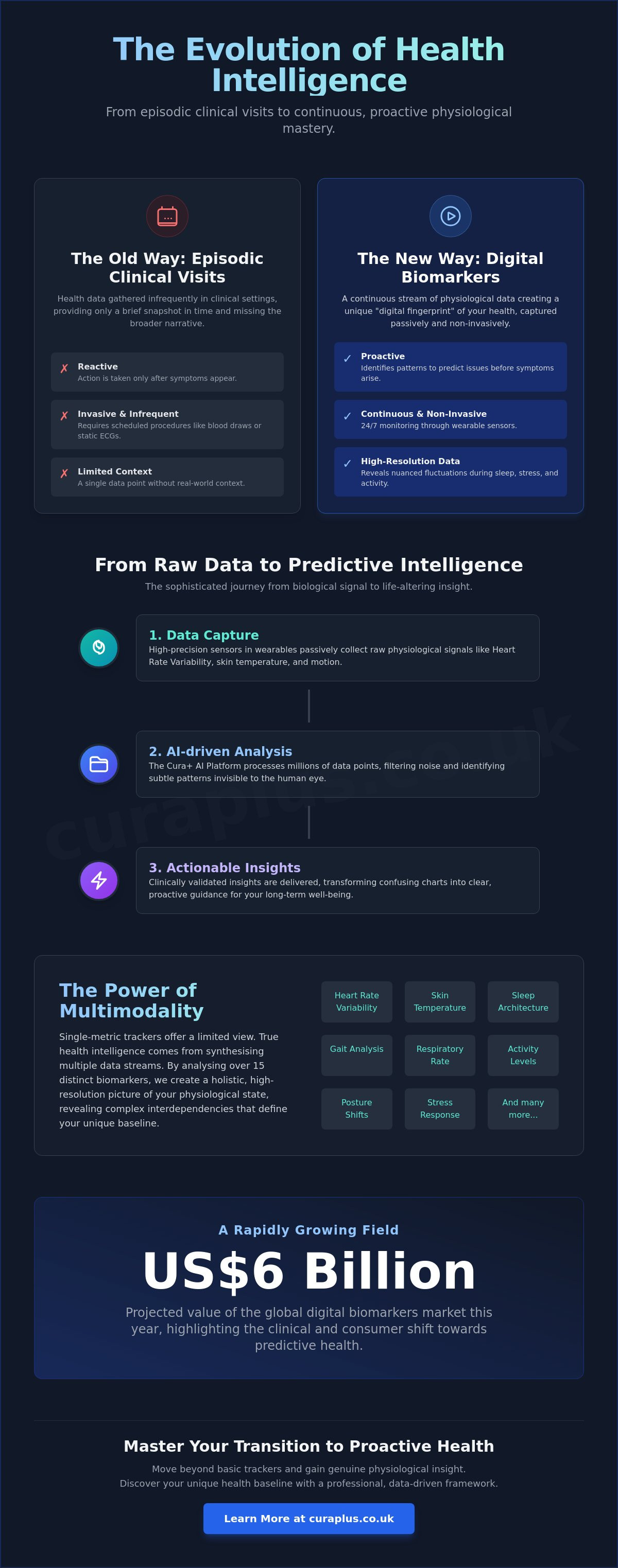
Digital biomarkers are objective, quantifiable physiological and behavioural data points collected through digital devices. This evolution marks a significant milestone in the broader digital health landscape. Historically, health data was gathered almost exclusively in clinical settings. It was episodic. You visited a doctor, they took a measurement, and that single data point represented your health for months. Digital biomarkers change this entirely. They provide a continuous stream of information that reflects how your body functions in the real world, rather than just in a sterile office.
This shift creates what we call a "digital fingerprint" of health. Just as your physical fingerprint is unique, your physiological patterns, from heart rate variability to sleep architecture, form a personalised baseline. By capturing these metrics passively and continuously, we move away from guesswork. We stop looking at averages and start looking at you. This is the foundation of physiological intelligence; it's the ability to see the body as a dynamic system that is constantly communicating its state.
Distinguishing between traditional and digital variants is essential for understanding this new era. Traditional biomarkers often require invasive or scheduled procedures:
- Blood glucose levels via finger pricks or venous draws.
- Cardiac health measured through occasional, static ECGs.
- Bone density or organ health via medical imaging.
- Continuous Heart Rate Variability (HRV) to assess autonomic nervous system balance.
- Minor fluctuations in skin temperature that may indicate early immune responses.
- Gait analysis and posture shifts that reflect neurological or musculoskeletal health.
From Traditional to Digital: A Shift in Resolution
Annual check-ups are snapshots. They capture a moment in time, but they often miss the narrative of your health. High-resolution data streams reveal patterns that are invisible to the naked eye. Whilst a blood test provides a vital look at your chemistry at a specific second, it cannot capture the nuanced fluctuations that occur during deep sleep or periods of high cognitive load. Advanced sensor technology now allows us to observe these 24/7 data streams, refining raw biological signals into clear, actionable insights.
The Clinical Significance of Digital Data
Global health bodies and the NHS are increasingly recognising the value of digital endpoints in long-term wellness. Clinical validation is the critical bridge between a standard consumer gadget and a professional health intelligence tool. It ensures that the data collected is reliable enough to inform serious lifestyle adjustments. Platforms like the Cura+ AI Platform are at the forefront of this movement, processing complex biometric data to ensure accuracy and relevance. Digital biomarkers are the cornerstone of a predictive health wearable UK.
The Mechanism of Measurement: Sensors, Algorithms, and AI
The journey from a biological signal to a life-altering insight is a sophisticated process of translation. It begins at the skin's surface, where high-precision sensors in hardware like theBand capture raw physiological data. These signals, such as photoplethysmography (PPG) for heart rate or galvanic skin response for stress, are initially just a chaotic stream of numbers. This raw data is transmitted securely to the cloud, where the Cura+ AI Platform begins the heavy lifting of interpretation. Without this computational layer, the sheer velocity and variety of information would be overwhelming. AI is not just an addition; it's a necessity for managing the complex datasets that define digital biomarkers.
Hardware precision is the first line of defence against inaccuracy. If the sensor fails to capture the subtle biological shifts, the resulting analysis is flawed. This is why professional-grade sensors are designed to filter out environmental noise before the data ever reaches the cloud. By the time an alert reaches the user, the system has already performed millions of calculations to ensure the insight is both valid and actionable. This methodical approach ensures that the "processed insights" you receive are grounded in scientific reality, providing a level of clarity that raw numbers simply cannot offer.
Active vs. Passive Data Collection
The distinction between active and passive monitoring is fundamental to data integrity. Passive monitoring occurs without user effort, capturing data whilst you sleep, work, or move. It's the gold standard for establishing a reliable baseline because it's immune to user bias or forgetfulness. Active monitoring, such as manual symptom logging, provides essential context but lacks the continuous resolution of passive streams. For those seeking true physiological intelligence, relying on passive data ensures a consistent, uninterrupted narrative of health.
The Role of Machine Learning in Pattern Recognition
Machine learning excels at identifying deviations from your specific norm. Instead of comparing you to a population average, AI learns your unique "normal" over time. It filters out the noise of daily life to highlight significant physiological signals that might indicate a change in health status. This level of sophisticated interpretation is what an AI health and wellness coach uses to provide tailored guidance. By aligning with FDA's digital health research, these platforms ensure that the algorithms remain rigorous and scientifically sound. If you're ready to move beyond basic tracking, exploring the capabilities of advanced biometric monitoring is the next logical step in your journey toward self-optimisation.
Multimodality: Why Tracking 15+ Biomarkers Redefines Accuracy
Single-metric tracking, such as counting daily steps or monitoring calories, provides a narrow view of physical activity but fails to capture the intricate complexity of human biology. True physiological intelligence requires multimodality. This is the simultaneous synthesis of multiple data streams to create a comprehensive health profile. By integrating various digital biomarkers, we can observe how different systems within the body interact in real-time. This holistic approach aligns with the official FDA definition of a digital biomarker, which emphasises the use of digital tools to explain, influence, or predict health outcomes. Relying on a solitary metric is like looking at a single puzzle piece; multimodality allows you to see the entire picture.
The power of this approach lies in cross-referencing activity levels with cardiovascular recovery. For example, a high-intensity workout should ideally be followed by a predictable pattern of recovery in your heart rate and oxygen saturation. If your data shows that your cardiovascular system isn't returning to its baseline despite a period of rest, it indicates a lack of physiological resilience. By tracking over 15 distinct markers, platforms like the Cura+ AI Platform can identify these subtle discrepancies, providing a level of accuracy that was previously reserved for elite clinical environments.
The Synergy of Cross-Metric Analysis
A single data point is rarely conclusive, but when we cross-reference multiple metrics, the signal becomes undeniable. A sudden spike in resting heart rate (RHR) that coincides with a significant drop in heart rate variability (HRV) is a classic indicator of autonomic stress. This pattern suggests that the body is struggling to recover from a load, whether physical, emotional, or pathological. Skin temperature serves as another vital layer; it's often a leading indicator for a wearable for tracking immune health. When combined with respiratory rate and blood oxygen (SpO2) levels, these metrics provide a high-resolution view of respiratory efficiency and systemic recovery.
Detecting Viral Onset Before Symptoms Appear
One of the most visionary applications of multimodality is the ability to identify the "incubation window". Subtle changes in digital biomarkers often occur 48 to 72 hours before you feel the first symptoms of illness. During this early stage of infection, the body initiates a "fight or flight" response that is detectable through a slight elevation in nocturnal respiratory rate and a suppressed HRV. Predictive alerts empower you to take action during this window. Instead of waiting to feel sick, you gain the clarity to rest and hydrate earlier, potentially shortening the duration of the illness and maintaining your long-term wellness trajectory.
Navigating the Landscape: Clinical Rigour and Data Security
"Is my health data safe in the cloud?" This question sits at the heart of the digital health revolution. As we transition from basic metrics to digital biomarkers, the sensitivity of the information we collect increases exponentially. Your biological data is more than just numbers; it's a unique physiological signature. Protecting this signature requires more than just standard passwords. It demands end-to-end encryption and rigorous, anonymised data processing. Unlike basic consumer gadgets, professional health intelligence platforms treat your data with the same gravity as a clinical record. We believe that the ethical responsibility to safeguard these digital fingerprints is absolute.
The distinction between "wellness trackers" and "health intelligence platforms" is often misunderstood. Many devices on the market are designed for casual motivation, focusing on surface-level metrics that lack clinical depth. In contrast, a health intelligence platform like Cura+ utilises sophisticated algorithms to provide actionable physiological intelligence. This shift from entertainment to insight requires a commitment to data integrity that most consumer brands simply cannot match. By prioritising accuracy and security, we ensure that your data remains a tool for empowerment rather than a liability.
Bridging the Gap Between Wearables and Medical Data
Distinguishing between "toys" and "tools" is vital for anyone serious about their long-term well-being. Many wearables offer interesting data but lack the sensor precision needed for predictive health. To move beyond novelty, you must understand how to build a health baseline. This process ensures that the data collected is relevant to your specific physiology. Medical-grade sensors are no longer restricted to hospitals; they're becoming the standard for home monitoring, providing the reliability required for true physiological intelligence.
The Ethics of Digital Privacy in 2026
In 2026, the landscape of digital privacy is defined by strict adherence to UK GDPR and evolving clinical data standards. These regulations ensure that your identity remains protected whilst your data works to optimise your health. Significantly, theBand by Cura+ prioritises health data privacy wearables through decentralised storage. This architecture ensures that you remain the sole owner of your biological insights. Transparent data policies aren't just a legal requirement; they're the foundation of trust in predictive care. If you value security as much as insight, you can view our comprehensive commitment to data integrity here.
Embracing a Proactive Future: The Impact of Daily Intelligence
The transition from reactive treatment to proactive maintenance represents a fundamental shift in how we perceive human health. Historically, medicine has focused on fixing what is already broken. Digital biomarkers allow us to pivot toward maintaining what is well. This change offers a profound psychological benefit: a sense of calm control. When you possess data clarity, the fear of sudden illness onset is replaced by the quiet excitement of discovery. You are no longer a passive observer of your symptoms; you are an active strategist of your own well-being. This daily intelligence provides several key advantages:
- The reduction of uncertainty through continuous, high-resolution monitoring.
- The ability to differentiate between temporary environmental stress and chronic physiological strain.
- The empowerment that comes from knowing exactly how your body responds to specific lifestyle changes.
This intelligence enables the continuous tracking of biological age versus chronological age. Whilst your birth certificate remains static, your biological age is a dynamic metric. It reflects the cumulative impact of your sleep architecture, nutritional choices, and metabolic efficiency. Personalised coaching, facilitated by the Cura+ AI Platform, is essential for translating these complex physiological signatures into specific behaviour changes. It ensures that insights lead to tangible improvements in longevity, moving beyond simple observation to active transformation. It's a system designed for those who refuse to settle for population averages.
Establishing Your Unique Physiological Baseline
Your "normal" is entirely distinct from a general average. What constitutes a healthy heart rate or a standard stress response for one person may be a sign of significant distress for another. The process of "tuning" AI to your specific patterns is what makes modern health intelligence so powerful. By using a wearable for tracking stress patterns, you can identify hidden triggers that would otherwise remain invisible to the naked eye. This personalised baseline ensures that every alert you receive is relevant to your unique physiology, providing the accuracy needed for serious health optimisation.
Real-Time Intelligence with theBand by Cura+
theBand by Cura+ represents the culmination of multimodal science. It is engineered for individuals who demand clinical precision in a consumer-friendly format. By tracking over 15 distinct digital biomarkers, it provides a high-resolution view of your internal state at any given moment. The predictive nature of the Cura+ AI means you're always one step ahead of your body's needs. It identifies subtle shifts in your autonomic nervous system before they manifest as physical exhaustion or illness. We invite you to join the pre-launch phase for theBand and experience the future of proactive health intelligence today.
Mastering Your Physiological Narrative
The transition from reactive medicine to proactive intelligence is no longer a future ambition; it's a present reality. By understanding the sophisticated science of digital biomarkers, you've moved beyond the noise of basic wearables towards a state of true physiological clarity. We've explored how the synergy of multimodal data and clinical-grade sensors allows for the detection of subtle health shifts before they manifest as physical symptoms. This journey is about replacing uncertainty with the calm control of data-driven insight.
theBand by Cura+ is the culmination of this visionary approach. Designed and engineered in the United Kingdom, it monitors 15+ vital biomarkers whilst utilising the Cura+ AI Platform to deliver precise, predictive health alerts. You don't have to navigate your wellness journey in the dark. Secure your future with theBand: Join the Cura+ pre-launch waitlist today. Take the definitive step toward mastering your body's complex systems and embracing a life of optimised, long-term health.
Frequently Asked Questions
What is the difference between a digital biomarker and a standard health metric?
A digital biomarker represents a sophisticated evolution of the standard health metric. Whilst a metric like heart rate provides a snapshot of your current state, digital biomarkers are continuous, objective datasets processed by algorithms to provide predictive insights. This transformation from raw data to physiological intelligence allows for the identification of patterns that a single, isolated measurement simply cannot capture. It moves the focus from what your body is doing now to what it's likely to do next.
Can digital biomarkers actually predict if I am getting sick?
These biomarkers identify the subtle physiological shifts that precede the onset of illness, often by 48 to 72 hours. By monitoring interactions between respiratory rate, heart rate variability, and skin temperature, the Cura+ AI Platform can detect the body's early "fight or flight" response to infection. This predictive window empowers you to prioritise rest and hydration before you feel noticeably unwell, effectively shifting your health management from reactive to proactive.
How accurate are wearable sensors compared to clinical medical tests?
Wearable sensors provide high-resolution, real-world data that complements, rather than replaces, the high-precision snapshots of clinical tests. Modern sensors in hardware like theBand are designed for longitudinal tracking, which offers a different type of accuracy than a one-off clinical visit. Whilst a hospital-grade test provides a precise moment of data, wearable sensors capture thousands of data points across various environments. This continuous monitoring establishes a reliable personal baseline, making it exceptionally effective for identifying deviations.
Which specific biomarkers are most important for tracking long-term health?
Heart Rate Variability (HRV), resting heart rate, and sleep architecture are foundational for assessing autonomic balance and long-term resilience. HRV is perhaps the most critical indicator of your nervous system's ability to recover from stress. When synthesised with nocturnal respiratory patterns, it provides a comprehensive view of your biological age. Tracking these digital biomarkers over months allows the Cura+ AI to build a sophisticated profile of your physiological trajectory and overall wellness.
How do AI algorithms ensure my health data remains private and secure?
AI platforms utilise end-to-end encryption and decentralised storage to ensure that your physiological fingerprint remains under your exclusive control. Security is woven into the architecture of the Cura+ AI Platform through anonymised data processing and rigorous access protocols. By utilising these models, we ensure that your sensitive biometric data isn't tied to your public identity in a vulnerable manner. These protocols adhere to UK GDPR standards, providing a framework of trust for health optimisation.
Do I need to wear a device 24/7 to establish a reliable health baseline?
Consistent 24/7 wear is essential to capture the full spectrum of your physiological behaviour, particularly during sleep. Establishing a reliable baseline requires a continuous stream of data to account for the body's natural circadian rhythms. Passive monitoring during rest is especially vital, as it reveals your true recovery state without the interference of daily activity. Wearing theBand consistently ensures that the AI has the necessary resolution to distinguish between a temporary fluctuation and a meaningful health deviation.
Are digital biomarkers recognised by doctors and the NHS in the UK?
There is a growing recognition amongst UK medical professionals of the value that continuous, validated digital data adds to patient care. The UK healthcare landscape is increasingly integrating digital endpoints into long-term wellness and remote monitoring strategies. Whilst these tools don't provide a clinical medical diagnosis, they offer a wealth of real-world evidence that can facilitate more informed discussions with your GP. As clinical validation standards evolve, the data from platforms like Cura+ is becoming a respected component of modern care.
What happens if the AI detects a significant deviation in my biomarkers?
The platform issues a predictive alert that highlights the deviation and provides context for how it differs from your established baseline. When the Cura+ AI identifies a pattern that strays from your unique norm, it generates a real-time intelligence alert. This notification isn't a diagnosis; instead, it's a prompt to reflect on your current lifestyle, stress levels, or recovery needs. It provides you with the clarity to make immediate adjustments, such as increasing sleep, ensuring you remain in control of your narrative.


