


What if your wearable didn't just count the steps you've already taken, but predicted the illness you haven't felt yet? For many, the initial novelty of daily step counts has been replaced by a growing sense of data fatigue. You're likely tired of tracking metrics that offer no actionable insight, whilst your current device fails to signal when your body is actually under genuine strain. Upgrading from a basic fitness band is no longer about seeking a brighter screen or a sleeker strap; it's about graduating to a level of biological intelligence that anticipates your needs before they become problems.
We understand the frustration of "black box" algorithms that provide scores without context. You deserve a professional partner in your health journey, not a digital toy that leaves you guessing about the logic behind your recovery. This article explores how transitioning to advanced AI-driven monitoring can turn your wearable into a sophisticated early warning system. We'll examine how theBand and the Cura+ AI platform provide deep insights into your autonomic nervous system, moving you from reactive logging to proactive mastery of your physiological state in 2026.
Key Takeaways
- Recognise when your current step-counting routine reaches a "data ceiling" and learn to prioritise metrics that correlate directly with physiological recovery.
- Understand that upgrading from a basic fitness band requires a shift from reactive logging to a multi-biomarker approach tracking over 15 distinct health indicators.
- Explore how AI-driven predictive intelligence differentiates itself from standard algorithms by providing clear explanations for changes in your biological state.
- Utilise our professional evaluation framework to ensure your next device meets the 2026 standards for predictive health monitoring and data transparency.
- Discover how theBand serves as a sophisticated guide for self-optimisation, replacing uncertainty with clinical clarity regarding your health future.
Beyond the Step Count: Recognising the Limitations of Basic Fitness Bands
For over a decade, the Fitness tracker has functioned as a primary entry point for health-conscious individuals. These devices are fundamentally reactive. They record movement. They log history. Yet, as we progress through 2026, the limitations of these tools are becoming impossible to ignore. Upgrading from a basic fitness band is the logical transition for those who realise that counting steps is not the same as managing health.
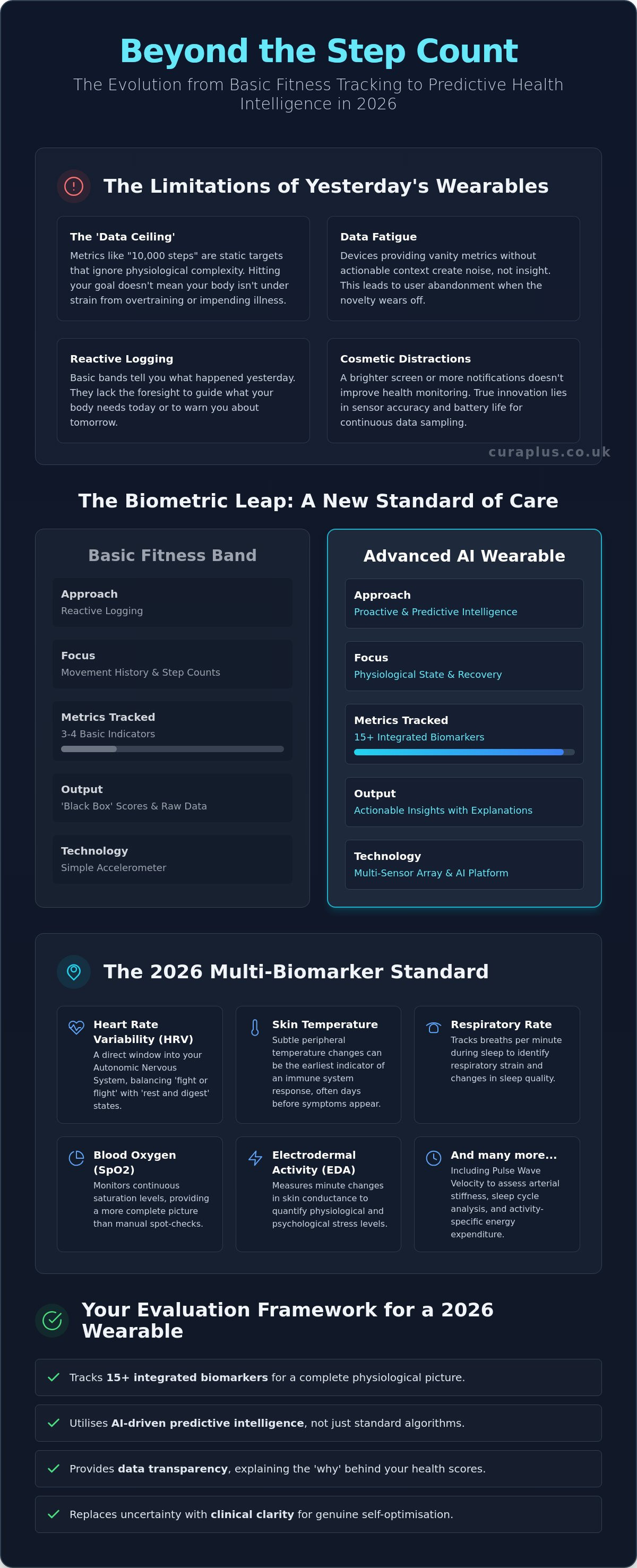
The "10,000 steps" benchmark represents a significant data ceiling. It's a static target that fails to account for physiological complexity. You might hit your movement goals whilst your body is secretly struggling with overtraining or an impending infection. A basic band remains silent during these critical windows because it lacks the intelligence to interpret the nuance of your biology. It tells you what happened yesterday, but it offers no foresight into what your body requires tomorrow. We must move beyond simple reactive logging toward a model of proactive biological intelligence.
The 'Data Fatigue' Phenomenon amongst Wearable Users
Many users find their wearable devices end up in a desk drawer within six months. This abandonment is usually driven by data fatigue. When a device provides vanity metrics without context, the information becomes noise. Simple heart rate tracking is a prime example; it provides a number but misses the deeper story of nervous system strain or recovery status. Upgrading from a basic fitness band allows you to swap these superficial numbers for actionable biomarkers that actually influence your daily behaviour and long-term wellness.
Why a Better Screen Isn't a Better Health Tool
The consumer electronics market often attempts to disguise a lack of sensor innovation with high-resolution displays and wrist-based notifications. These features are often a distraction from true health optimisation. A device that prioritises "smart" apps often sacrifices the battery longevity required for the high-frequency, continuous monitoring of complex biomarkers. True health intelligence doesn't require a mini-smartphone on your wrist. It requires a sophisticated sensor array that remains focused on your internal biological state, providing clarity rather than digital clutter.
The Biometric Leap: Transitioning to Multi-Biomarker Intelligence
The transition from a simple accelerometer to a sophisticated sensor array represents the most significant shift in personal health technology this decade. When you consider biometric tracking for wellness, you're looking at a move away from the three or four basic sensors found in entry-level devices. Modern intelligence requires a minimum of 15 integrated biomarkers to paint a complete picture of your internal environment. Upgrading from a basic fitness band isn't just about collecting more data; it's about the clinical precision and high-frequency sampling required to make that data meaningful.
From Heart Rate to Autonomic Nervous System Mapping
Standard heart rate monitoring is a legacy metric. To achieve true insight, we must look at Heart Rate Variability (HRV), which serves as a direct window into your autonomic nervous system. Whilst a basic band might tell you your heart is beating, a multi-sensor array explains the balance between your sympathetic "fight or flight" and parasympathetic "rest and digest" states. This holistic view is complemented by continuous skin temperature monitoring. Subtle fluctuations in peripheral temperature often serve as the earliest indicator of an immune system response, frequently appearing days before you feel the first symptoms of illness.
The 15+ Biomarker Standard for 2026
The standard for a professional-grade wearable has evolved. To move beyond the digital diary phase, a device must monitor a comprehensive suite of indicators simultaneously. This includes:
- Respiratory Rate: Tracking breaths per minute during sleep to identify respiratory strain.
- Blood Oxygen (SpO2): Continuous saturation levels rather than manual spot-checks.
- Electrodermal Activity (EDA): Measuring skin conductance to quantify physiological stress.
- Pulse Wave Velocity: Assessing arterial stiffness and cardiovascular age.
The accuracy of fitness trackers has historically been hampered by low-frequency sampling and motion artefacts. In 2026, the emphasis has shifted to high-fidelity, continuous monitoring that filters out noise to provide clinical-grade precision. This level of detail is essential for those who view their health as a complex system to be mastered rather than a series of disconnected symptoms. If you're ready to move beyond the basics, exploring the capabilities of theBand offers a glimpse into how these 15+ biomarkers work in concert to protect your well-being.
Reactive Tracking vs Predictive Intelligence: The Role of AI
Data in isolation is merely a digital diary. Without a sophisticated interpretive layer, heart rate and movement logs remain static observations of the past. Upgrading from a basic fitness band moves you into the era of the predictive health wearable UK standards, where machine learning acts as a persistent health strategist. This technology is reimagining preventive health care by shifting the focus from what you've already done to what your body is currently preparing to do. It's the difference between a device that records your steps and one that explains why those steps felt more taxing than usual today.
Building Your Physiological Baseline
Learning how to build a health baseline is the fundamental prerequisite for true personalisation. Basic bands typically rely on broad population averages, comparing your metrics to a generic healthy adult. Predictive intelligence rejects this imprecise premise. It requires a specific calibration period, typically lasting 14 to 21 days, to map your unique circadian rhythms and autonomic responses. Once this model is established, the AI identifies even the most minor deviations that would be invisible to standard algorithms. This allows for a level of precision that transforms raw data into a proactive shield against physiological decline.
Early Illness Detection: The Ultimate Upgrade Benefit
The most profound benefit of this technological leap is early illness detection. Subtle shifts in nocturnal heart rate or respiratory patterns often precede physical symptoms by up to three days. Instead of a generic sleep report stating you rested for seven hours, you receive an actionable insight: your recovery is suppressed, and you should prioritise rest to avoid an impending immune challenge. This evolution from reactive logging to predictive intelligence changes the user's relationship with their body. Readiness scores replace simple activity goals, ensuring you only push when your system is capable of growth. Predictive alerts are the functional intersection of multi-biomarker depth and personalised machine learning.
A Framework for the Discerning User: Evaluating Your Next Wearable
Selecting a professional health companion requires a more rigorous evaluation than choosing a simple activity tracker. When you are upgrading from a basic fitness band, you must look past the marketing aesthetics to the underlying architecture of the device. The goal is to move from a gadget that merely records movement to a system that understands your biological potential. High-performance health management in 2026 is built on four critical pillars:
- Sensor Depth: Ensure the hardware tracks a minimum of 10 to 15 biomarkers. A device limited to heart rate and steps is insufficient for predictive intelligence.
- Data Transparency: Priority should be given to platforms that allow you to view raw data. Avoid "black box" systems that only offer a proprietary score without explaining the physiological changes behind it.
- Intelligence Layer: Verify that the software includes proactive health management tools. The system should offer guidance based on your specific baseline rather than generic population averages.
- Ergonomic Integrity: A wearable must be comfortable enough for 24/7 use. Predictive accuracy relies on continuous data, meaning any device you find irritating to wear at night is functionally useless.
- Firmware Agility: Choose hardware supported by frequent, over-the-air updates that incorporate the latest advancements in AI and machine learning.
Assessing the Value of Health Subscriptions
Modern health intelligence often requires a recurring subscription. It is vital to distinguish between a paywall for basic charts and a fee for advanced AI processing. A professional-grade subscription, such as the Cura+ AI Platform, functions as the engine of your health intelligence. It processes complex biomarker arrays to generate early warning alerts that simple local processing cannot achieve. Investing in this intelligence is a shift from paying for a "premium" app to investing in a persistent, digital health consultant. The cost of preventative insight is invariably lower than the physical and financial toll of reactive treatment.
Hardware Longevity and Build Quality
Medical-grade materials are essential for long-term skin health and consistent sensor contact. Entry-level trackers often utilise lower-quality plastics that can cause irritation whilst preventing the sensors from maintaining a reliable connection. When choosing a wearable for tracking recovery, prioritise devices with hypoallergenic housings and durable finishes. This ensures the hardware survives the rigours of daily life whilst maintaining the clinical precision required for high-stakes health monitoring. If you are ready to transition to a device built for professional standards, explore theBand and its clinical-grade sensor array.
Why theBand by Cura+ is the Logical Final Upgrade
The journey toward physiological mastery concludes when you stop collecting data for the sake of history and start using it for the sake of the future. theBand by Cura+ represents the definitive pinnacle of predictive health technology in the UK. It is engineered to replace the fragmented, reactive experience of entry-level devices with a unified system of biological intelligence. By upgrading from a basic fitness band, you are choosing to move beyond the "data ceiling" and into a realm where every heartbeat, breath, and temperature shift serves a specific purpose in your self-optimisation strategy.
Our hardware integrates an industry-leading array of 15+ biomarkers. This allows theBand to monitor your internal environment with a level of granularity that was previously restricted to clinical settings. Whilst basic trackers might offer a cursory glance at your pulse, theBand examines the intricate relationship between your respiratory rate, blood oxygen levels, and autonomic nervous system. The Cura+ AI Platform then synthesises this information, providing you with a clear roadmap for your day. It is a sophisticated partnership that transforms raw biological signals into a proactive shield against illness and burnout.
Sophisticated Design Meets Clinical Precision
The aesthetic of theBand is intentionally professional and understated. We have discarded the toy-like appearance of traditional fitness bands in favour of a design that feels appropriate in a boardroom or a high-performance training centre. This focus on medical-grade materials ensures that the device remains comfortable for 24/7 wear, which is essential for maintaining the integrity of your health baseline. Continuous, unobtrusive monitoring is the only way to capture the subtle deviations that signal a change in your health status. By prioritising sensor accuracy over screen-based distractions, we ensure that the focus remains exactly where it should be: on your internal biological state.
Your Journey to Self-Optimisation Starts Here
The transition from tracking movement to mastering health is a profound shift in mindset. It requires a commitment to excellence and a reliance on data-driven strategy. The AI health and wellness coach within the Cura+ ecosystem acts as your persistent strategist, providing the clarity needed to make high-stakes decisions about your recovery and output. This system doesn't just tell you that you've slept; it explains how that sleep has influenced your readiness for the challenges ahead. We invite you to join the pre-launch phase of this health revolution. Outgrow the limitations of your current device and step into the future of predictive wellness with a partner that values accuracy above all else.
Mastering Your Biological Future
The transition from movement tracking to biological intelligence represents a fundamental shift in how we approach personal wellness. By moving beyond the "data ceiling" of standard wearables, you gain access to a persistent early warning system whilst uncovering your body's unique rhythms. Upgrading from a basic fitness band is the first step toward replacing reactive observations with clinical-grade foresight. This evolution ensures that your data leads to meaningful action, moving you away from the fatigue of empty metrics and into the quiet confidence of discovery.
theBand offers simultaneous tracking of 15+ essential biomarkers, providing the depth required for genuine health optimisation. Designed and developed in the United Kingdom, our platform utilises predictive AI alerts for early illness detection, ensuring you remain ahead of physiological strain before symptoms ever manifest. It's a commitment to precision that treats your health as a complex system to be mastered rather than a series of disconnected symptoms. You deserve a partner that replaces uncertainty with clinical clarity amongst the noise of modern life.
Secure your place in the future of health—explore theBand by Cura+
Your journey toward a more informed and empowered version of yourself starts today.
Frequently Asked Questions
What is the main difference between a basic fitness band and a predictive wearable?
The primary distinction lies in the shift from reactive logging to proactive forecasting. Whilst a basic band records steps you've already taken, a predictive wearable utilises machine learning to anticipate your future physiological needs. Upgrading from a basic fitness band allows you to transition from a digital diary to a sophisticated early warning system that understands your body's unique baseline.
Can a high-end wearable really detect if I am getting ill before I feel symptoms?
Yes, advanced sensors can identify subtle physiological shifts days before physical symptoms manifest. By monitoring a suite of 15+ biomarkers simultaneously, theBand detects deviations in skin temperature and heart rate variability that often signal an immune response. This predictive capability transforms your wearable into a proactive shield, allowing you to prioritise recovery before an illness takes hold.
Why is Heart Rate Variability (HRV) so important when upgrading my tracker?
Heart Rate Variability serves as a direct window into your autonomic nervous system and its ability to manage stress. It is a far more nuanced metric than simple heart rate, as it reveals whether your body is in a state of recovery or strain. When you're upgrading from a basic fitness band, HRV becomes the cornerstone of your readiness score, guiding your daily output with clinical precision.
Is it worth paying a monthly subscription for a health wearable?
A subscription covers the significant computational power required to process complex biological data into actionable directives. Platforms like the Cura+ AI Platform function as the engine of your health intelligence, moving beyond simple charts to provide personalised, predictive alerts. Investing in this recurring service is a commitment to persistent, professional-grade health management rather than just hardware ownership.
How many biomarkers should a top-tier health wearable track in 2026?
In 2026, a professional-grade wearable should track a minimum of 15 integrated biomarkers to provide a holistic view of your health. This array must include indicators such as respiratory rate, blood oxygen, and electrodermal activity alongside traditional metrics. This depth of data is essential for the AI to build an accurate physiological model that avoids the pitfalls of generic population averages.
Will my old fitness data be compatible with a new AI-driven platform?
Whilst basic movement data can often be imported, most AI-driven platforms require a fresh calibration period to establish a high-fidelity baseline. The Cura+ AI Platform typically needs 14 to 21 days of continuous wear to map your specific circadian and autonomic rhythms accurately. This ensures that the predictive coaching you receive is based on your current biological reality rather than outdated or low-resolution historical data.
Are predictive health wearables as accurate as clinical medical devices?
Modern predictive wearables offer clinical-grade sensor precision for tracking trends, though they are not intended as clinical diagnostic tools. They provide high-stakes insights into your physiological state that far exceed the accuracy of entry-level trackers. This level of reliability is designed to empower you with clarity, helping you master your health as a complex system through methodical, data-driven observation.
How does AI actually 'coach' me to better health compared to a basic app?
AI coaching provides contextual directives based on your specific recovery status rather than static, one-size-fits-all goals. Instead of simply telling you to hit 10,000 steps, a sophisticated platform explains why you should prioritise rest if your biomarkers indicate high nervous system strain. This evolution replaces "what" you did with "why" it matters, acting as a strategist for your long-term self-optimisation.


