


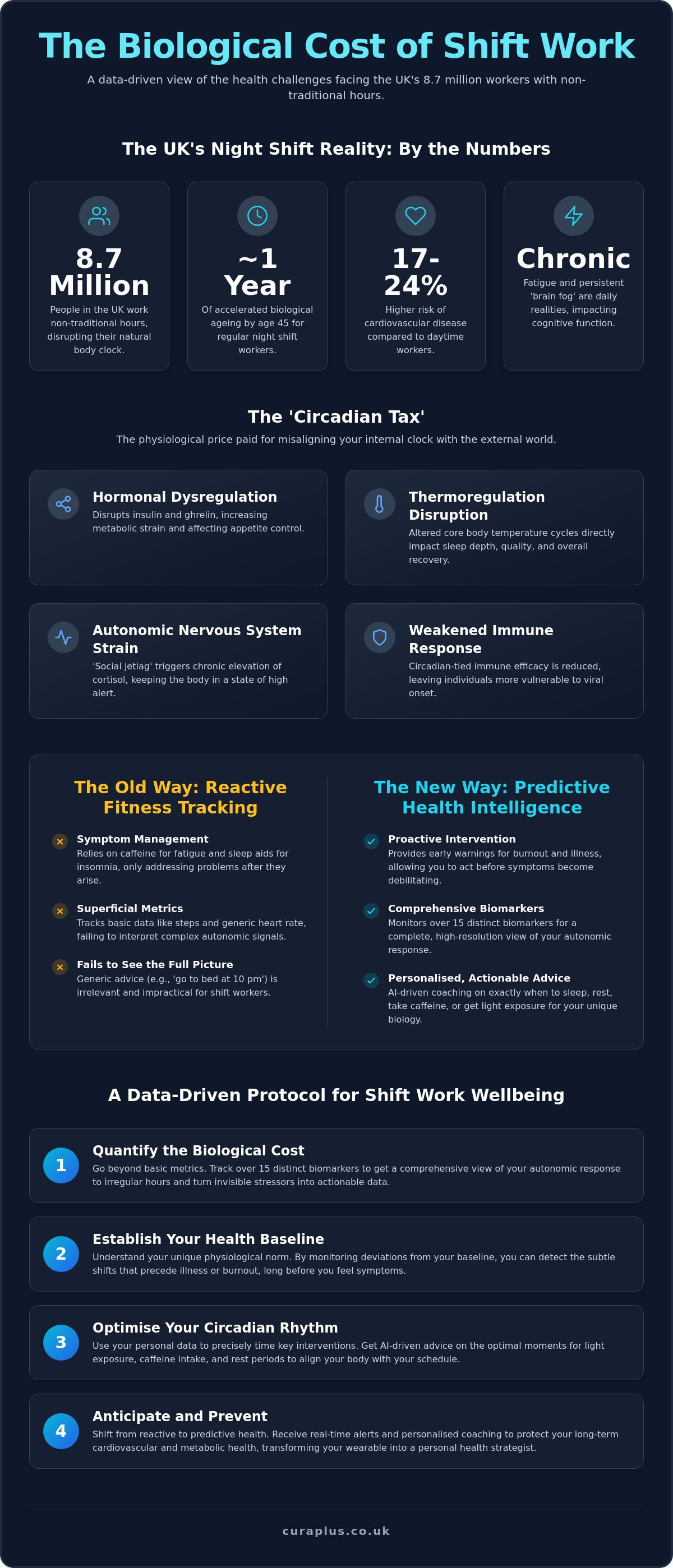
A 2025 study using UK Biobank data revealed that regular night shift work is associated with accelerated biological ageing, potentially reducing life expectancy by nearly a full year by age 45. For the 8.7 million people in the UK working non-traditional hours, this is a sobering reality that manifests daily as chronic fatigue and persistent 'brain fog'. You already know that your schedule defies conventional health wisdom, leaving your internal rhythm in a state of constant, exhausting friction. It's natural to feel a sense of anxiety regarding the long-term cardiovascular and metabolic risks associated with this lifestyle.
Finding a specialised wearable for shift workers health is no longer a luxury; it's a biological necessity for those seeking to master their personal physiology. This article demonstrates how advanced biometric monitoring and AI-driven predictive health can mitigate these risks and optimise your long-term wellbeing. We will explore how theBand and the Cura+ AI Platform provide early warning signs of burnout and offer actionable advice on exactly when to sleep or rest, ensuring you can finally quantify and control the impact of shift work on your biology.
Key Takeaways
- Understand why traditional health advice fails the 3 million UK night workers and how to accurately quantify the biological cost of irregular hours.
- Discover how selecting a specialised wearable for shift workers health allows you to monitor over 15 distinct biomarkers for a comprehensive view of your autonomic response.
- Learn the critical difference between reactive fitness tracking and predictive intelligence, enabling you to anticipate illness and burnout before symptoms appear.
- Implement a data-driven protocol to optimise your circadian rhythm by precisely timing light exposure and caffeine intake based on your unique physiological baseline.
- Explore how theBand and the Cura+ AI Platform act as a personal health strategist, providing real-time alerts and personalised coaching to protect your cardiovascular health.
The Biological Cost of Shift Work: A UK Health Perspective
The reality of the United Kingdom's labour market is that nearly 9 million people operate outside the traditional confines of daylight. Specifically, approximately 8.7 million individuals work night shifts, with about 3 million of those doing so on a frequent basis. For these professionals, standard health advice regarding sleep hygiene and meal timing is often irrelevant. A doctor finishing a 12-hour rotation or a police officer on a nocturnal patrol can't simply 'go to bed at 10 pm'. Traditional systems fail them. This disconnect creates a biological friction that demands a specialised wearable for shift workers health to bridge the gap between their schedule and their biology.
When we move away from traditional scheduling, we encounter the 'Circadian Tax'. This is the physiological price paid for misaligning internal clocks with the external environment. It's not merely a matter of feeling tired; it's a systemic disruption of your internal equilibrium. Relying on reactive symptom management, such as caffeine for fatigue or over-the-counter sleep aids for insomnia, is no longer sufficient. We must transition toward a proactive, data-driven strategy that treats the body as a complex, manageable system. The 'Circadian Tax' manifests through several key biological disruptions:
- Hormonal Regulation: Dysregulation of insulin and ghrelin, leading to increased metabolic strain.
- Thermoregulation: Disrupted core body temperature cycles that directly impact sleep depth and quality.
- Cognitive Function: Reduced neuroplasticity and slower reaction times, often described as 'brain fog'.
The Impact on the Autonomic Nervous System
Shift patterns frequently force the body into a state of 'social jetlag'. This occurs when your biological clock is at odds with your social and professional obligations. This misalignment triggers a chronic elevation in cortisol, the body's primary stress hormone. Instead of a natural morning peak, cortisol remains high at inappropriate times, preventing deep recovery and keeping the body in a state of high alert. Gaining clarity on these fluctuations is essential for long-term survival. Utilising a wearable for tracking stress patterns allows workers to identify exactly when their nervous system is under peak strain, turning invisible stressors into actionable data points.
Long-term Risks to Cardiovascular and Immune Health
The implications of understanding shift work extend far beyond simple tiredness. Research indicates that long-term shift workers face a 17-24% higher risk of cardiovascular disease compared to day workers. This is often driven by increased inflammatory markers and a higher susceptibility to metabolic syndrome. Because the immune system's efficacy is tied to circadian rhythms, nocturnal work can leave individuals more vulnerable to viral onset. To mitigate these risks, it's vital to establish a personalised health baseline. By monitoring deviations from your norm, you can detect the subtle physiological shifts that precede illness or burnout. This level of insight is only possible with a dedicated wearable for shift workers health that prioritises predictive intelligence over basic step counting.
Biometric Markers: Tracking the Autonomic Response to Shift Work
Biomarkers are the physiological 'breadcrumbs' that reveal your true internal state, providing a map through the complexities of a non-traditional schedule. Whilst a standard consumer device might track basic steps or heart rate, it often lacks the resolution required to interpret the complex interplay of autonomic signals that define your recovery. For those navigating the health risks of shift work, these data points are not merely interesting metrics; they are essential tools for biological preservation. Continuous monitoring identifies subtle shifts in your biology long before physical symptoms like exhaustion or 'brain fog' become debilitating. This proactive approach allows you to intervene early, adjusting your rest or nutrition before a health crisis occurs.
To truly master your wellbeing, you need more than a superficial overview. A high-performance wearable for shift workers health must monitor over 15 distinct biomarkers to provide a comprehensive view of your internal environment. This breadth of data is necessary because shift work impacts multiple systems simultaneously, from metabolic health to immune vigilance. The Cura+ AI Platform plays a critical role here by filtering the 'noise' generated by irregular schedules. Standard algorithms often misinterpret daytime sleep as a nap or high-stress work as a workout. Our sophisticated AI understands the context of your life, identifying meaningful trends amongst the chaos of a rotating roster. If you are ready to move beyond basic tracking, you can explore theBand and its predictive capabilities.
HRV and Stress Resilience
Heart Rate Variability (HRV) serves as the ultimate metric for nervous system recovery and overall readiness. Heart Rate Variability is the variation in time between consecutive heartbeats. A high HRV indicates a flexible, resilient autonomic nervous system that is ready to perform. Conversely, shift work frequently suppresses HRV, signalling that your body is trapped in a 'fight or flight' state. Monitoring this metric allows you to quantify the exact impact of a night shift on your recovery, giving you the clarity to decide when to push and when to prioritise absolute rest.
Skin Temperature and Immune Vigilance
Skin temperature is a leading indicator of your circadian phase and immune response. For shift workers, tracking the body's natural cooling cycle during daytime sleep is vital to ensure the rest is actually restorative. Deviations from your thermal baseline are often the first sign of physiological strain. By monitoring these fluctuations, a wearable for shift workers health can detect the onset of illness up to 72 hours before you feel the first symptom. This early warning system is invaluable for professionals in healthcare and emergency services, where maintaining peak immune health is a professional requirement.
Predictive Intelligence vs. Basic Fitness Tracking
Standard fitness trackers are built on a fundamental assumption: that the user adheres to a conventional circadian rhythm. For the shift worker, this assumption is a systemic flaw that renders most 'sleep scores' and 'readiness' metrics functionally useless. A generic device observes your daytime rest and often categorises it as a fragmented nap, failing to account for the physiological reality of your schedule. To maintain performance, you don't need a historical record of your exhaustion. You need a wearable for shift workers health that prioritises predictive intelligence over simple data logging.
Predictive intelligence shifts the focus from what happened to what will happen. Whilst basic tracking might confirm you are tired after a shift, the Cura+ AI platform analyses your biometric trends to forecast fatigue before it manifests as a safety risk. In high-stakes environments, such as critical care or emergency response, this foresight is transformative. Adopting a predictive health wearable UK allows you to anticipate biological dips and adjust your behaviour accordingly, moving from reactive management to total physiological control.
The Problem with 'Sleep Scores'
Standardised sleep scores frequently mislead shift workers by over-emphasising duration whilst ignoring restorative quality. You might log seven hours of daytime sleep, yet wake up with persistent 'brain fog' because your core body temperature remained too high for deep REM cycles. Predictive alerts bypass these superficial scores, warning you of an accumulating 'fatigue debt'. This allows you to recognise when your cognitive capacity is compromised, even if your total sleep time appears adequate on a traditional dashboard. It's about understanding the depth of recovery, not just the hours spent in bed.
Personalised Coaching for Irregular Schedules
Generic health advice, such as the ubiquitous 'get eight hours of sleep', is functionally impossible for those on rotating rosters. Effective intervention requires a system that adapts to your specific life. The Cura+ AI platform acts as a strategist, translating data from a wearable for tracking recovery into personalised protocols. Instead of broad suggestions, you receive precise guidance on light exposure, caffeine timing, and rest windows tailored to your upcoming roster. This level of personalisation ensures that every decision you make is supported by real-time biological evidence, helping you navigate the most challenging shift patterns with clarity.
A Data-Driven Protocol for Shift Work Wellbeing
Mastering a non-linear schedule requires more than just willpower; it demands a systematic approach to biological management. The first step in this protocol is establishing a personal physiological baseline during your 'off' days. This period of relative stability provides the reference point against which all shift-related stress is measured. Without this baseline, it's impossible to accurately quantify the 'Circadian Tax' discussed in previous sections. By using a wearable for shift workers health, you can identify your body's natural equilibrium, allowing you to recognise even the most subtle deviations when you return to the roster.
Real-time data allows for the precise timing of interventions that are usually left to guesswork. Light exposure and caffeine intake are powerful tools, but their efficacy depends entirely on your current circadian phase. For example, consuming caffeine when your core temperature is already rising may provide a temporary boost but can lead to a more severe 'crash' later. Conversely, strategic light exposure based on your biometric feedback can help 'anchor' your rhythm, making the transition between day and night shifts significantly less taxing on your autonomic nervous system.
The concept of the 'Recovery Window' is central to this protocol. By monitoring Heart Rate Variability (HRV), you can identify the optimal time for restorative sleep. This isn't always immediately after a shift. Sometimes, waiting for a specific physiological dip leads to higher quality REM and deep sleep cycles. This level of precision is what separates a professional health strategy from simple survival. You can start optimising your recovery protocol today by integrating these predictive insights into your daily routine.
Step-by-Step: Synchronising with Your Data
- Morning Assessment: Check your 'Readiness Score' upon waking. This metric combines HRV, sleep quality, and resting heart rate to determine your cognitive and physical capacity for the upcoming shift.
- Intra-Shift Monitoring: Track HRV trends throughout your working hours. Identifying peak stress periods allows you to implement brief, data-backed recovery micro-breaks before fatigue sets in.
- Post-Shift Calibration: Adjust your wind-down routine based on current skin temperature. If your temperature is elevated, prioritising cooling strategies can accelerate the onset of restorative sleep.
Managing the 'Post-Night-Shift' Recovery
The period following a block of night shifts is often the most dangerous for immune health. Using a wearable for tracking immune health data helps you decide whether to prioritise total rest or light activity. Predictive alerts can warn you of an impending 'crash', allowing you to avoid over-exertion on your recovery days. theBand plays a crucial role here, quantifying the success of your recovery strategies. It allows you to see exactly which habits, whether it's a specific nutrition plan or a darkened sleep environment, actually move the needle on your biological recovery. This is how you turn a wearable for shift workers health into a definitive tool for long-term vitality.
theBand by Cura+: The Definitive Solution for Shift Workers
Managing the physiological demands of a non-traditional schedule requires a tool that matches the intensity of your profession. theBand represents the pinnacle of high-performance health technology, designed specifically to address the systemic stressors we've explored. It's not merely a device for logging activity; it's a sophisticated multi-sensor wearable for shift workers health that provides a 360-degree view of your biological response to work. By monitoring over 15 distinct biomarkers in real-time, it allows you to see exactly how your body is navigating the friction of irregular hours and rotating rosters.
The true power of this system resides in the Cura+ AI Platform. Acting as your personal health strategist, the AI interprets your unique biometric data to provide predictive coaching that adapts to your life. It doesn't offer generic, '9-to-5' advice. Instead, it uses high-resolution data to forecast your physical and cognitive readiness, empowering the UK's essential workers to take definitive control of their biological future. This transition from reactive symptom management to proactive health intelligence is the foundation of long-term vitality in a demanding workforce.
Clinical Precision Meets Everyday Wearability
Our design philosophy prioritises comfort to facilitate 24/7 continuous monitoring. For predictive alerts to be accurate, high-frequency data collection is essential. Any gaps in tracking could lead to missed signals of fatigue or impending illness. theBand is engineered to be forgotten on the wrist whilst it works tirelessly in the background, capturing the data necessary for clinical-grade precision. Beyond the hardware, the security of your biometric data is a primary concern. Within the UK-based Cura+ ecosystem, your information is protected with rigorous standards, ensuring your health journey remains both private and secure.
Joining the Future of Proactive Health
Integrating theBand into your professional life is a seamless process that yields immediate clarity. You'll move away from the uncertainty of 'brain fog' and fatigue, replacing it with a sophisticated understanding of your body's internal systems. This is the ultimate transition. You are no longer just managing a shift; you are mastering your health intelligence. The future of wellness isn't a distant promise; it's a data-driven reality accessible today. To begin your journey toward self-optimisation, you can pre-order theBand and secure your biological peak.
Mastering Your Biological Future
The physiological challenges of shift work are profound, but they're no longer insurmountable. By moving beyond basic fitness tracking and embracing predictive intelligence, you can finally align your demanding professional life with your body's complex needs. You've seen how monitoring deep biometric data allows for the precise timing of rest and recovery, effectively mitigating the 'Circadian Tax' that often leads to burnout and long-term illness.
theBand represents a significant leap forward in health technology. As a dedicated wearable for shift workers health, it provides elite insights by monitoring over 15 distinct biomarkers. Integrated with the Cura+ AI Platform, this UK-based system offers the predictive alerts necessary to anticipate exhaustion before it takes hold. It's time to replace the uncertainty of chronic fatigue with the clarity of data-driven control. You don't have to leave your wellbeing to chance when you have a strategist for your internal systems.
Discover theBand: The Predictive Wearable for Shift Workers and take the first step toward mastering your internal rhythm. Your commitment to your profession is absolute; it's time your health technology showed the same level of dedication.
Frequently Asked Questions
Is shift work permanently bad for your health?
Shift work is a significant physiological challenge, but it doesn't have to result in permanent health decline. Whilst research indicates higher risks for cardiovascular disease and Type 2 diabetes amongst night workers, these outcomes are often the result of unmanaged circadian disruption. By using data to synchronise your lifestyle with your biology, you can mitigate these systemic stressors. It's about moving from reactive symptom management to proactive biological optimisation.
How can a wearable help me sleep better during the day?
A specialised wearable for shift workers health helps you identify your optimal 'Recovery Window' by monitoring skin temperature and Heart Rate Variability. Instead of forcing sleep when your core temperature is rising, the data tells you exactly when your body is primed for deep, restorative rest. This precision ensures that even shorter daytime sleep periods are high quality, helping to clear the 'brain fog' associated with irregular hours.
What are the most important biomarkers for shift workers to track?
Heart Rate Variability (HRV), skin temperature, and resting heart rate are the most critical markers for those on rotating rosters. HRV reveals your nervous system's resilience, whilst skin temperature acts as a proxy for your circadian phase. theBand monitors over 15 biomarkers to provide a holistic view, but these three serve as the primary anchors for understanding how your body is responding to the immediate demands of your shift.
Can theBand predict if I am going to get sick?
theBand provides early warning signs of illness by detecting subtle physiological deviations up to 72 hours before you feel any symptoms. By analysing trends in your skin temperature and immune vigilance markers, the Cura+ AI Platform can alert you to a mounting 'immune debt'. This foresight allows you to prioritise rest or adjust your nutrition early, potentially preventing a minor strain from becoming a full-blown illness.
How does theBand differ from a standard smartwatch?
Standard smartwatches are designed for the 'normal' sleeper and often fail to interpret the complex data of a non-linear lifestyle. theBand differs by utilising predictive intelligence specifically tuned for irregular schedules, tracking 15+ biomarkers with clinical-grade precision. Whilst a typical watch might log a daytime sleep as a simple nap, our platform understands the context of your roster and provides actionable coaching rather than just historical data.
Is my health data secure with Cura+?
Your biometric data is protected within a secure, UK-based ecosystem that adheres to rigorous privacy standards. We treat your health information with the gravity it deserves, ensuring that your personal insights remain entirely under your control. Our commitment to data integrity is as fundamental as our commitment to your physiological health, providing you with a safe, professional environment to explore your biological potential.
Do I need a subscription for the AI coaching features?
Access to the full suite of predictive health alerts and personalised coaching features requires an active Cura+ membership. This subscription model ensures that our AI algorithms remain at the cutting edge of health technology and that your data environment stays secure and private. It's an essential component for those who view their health as a high-stakes system requiring ongoing, professional-grade management and refinement.
Can theBand help me manage stress during high-pressure shifts?
theBand allows you to monitor your autonomic nervous system in real-time, identifying peak stress periods during high-pressure shifts. By tracking HRV fluctuations, the platform can signal when your body is entering a state of chronic strain. The AI coach then provides immediate, data-backed protocols to help you regulate your nervous system, ensuring you remain in calm control even during the most demanding professional environments.


