


What if you could predict a viral infection or a period of physiological strain forty-eight hours before the first symptoms appeared? For many, the search for what is a good HRV score UK begins with a sense of unease after seeing a sudden, unexplained drop on a wearable device. You aren't alone if you've felt a surge of anxiety over a fluctuating daily reading or felt frustrated by a lack of clarity on how to actually use this data. It's a common hurdle in the journey toward personal optimisation.
We believe that clarity is the foundation of health. This guide will help you discover why your heart rate variability is the ultimate bio-signal for predictive health and how to interpret your unique baseline with clinical precision. Whilst the average 25-year-old might maintain a score of 78 ms, your personal "normal" is the only metric that truly matters for your longevity. We'll explore how to move beyond daily fluctuations, use theBand and the Cura+ AI platform to spot illness early, and take actionable steps to refine your nervous system resilience. It's time to replace uncertainty with a data-driven strategy for your future wellness.
Key Takeaways
- Understand that Heart Rate Variability measures the millisecond variations between heartbeats, serving as a primary indicator of your autonomic nervous system's resilience and recovery capacity.
- Learn why discovering your personal baseline is more critical than comparing yourself to national averages when determining what is a good HRV score UK for your specific age and lifestyle.
- Identify the specific physiological suppressors, such as alcohol consumption and psychological burnout, that cause your scores to fluctuate and compromise your long-term health.
- Discover how to utilise HRV as a predictive bio-signal to detect the "immune response signature" of viral infections before physical symptoms manifest.
- Explore how theBand and the Cura+ AI Platform synthesise high-fidelity HRV data with other biomarkers to provide actionable strategies for physiological optimisation.
Defining Heart Rate Variability: Beyond the "Good" Score Myth
Seeking a definitive answer to what is a good HRV score UK often leads to a fundamental misunderstanding of human biology. There is no universal gold standard because your heart is not a ticking clock. Instead, it's a dynamic system that responds to every breath, thought, and environmental shift. Heart Rate Variability (HRV) is the measurement of the specific millisecond-level variation between consecutive heartbeats. Whilst a resting heart rate of 60 beats per minute suggests a beat every second, the reality is far more complex. One gap might be 0.85 seconds, whilst the next is 1.15 seconds. This micro-fluctuation is the hallmark of a healthy, responsive system.
We must move beyond the myth that a "high" score is inherently good and a "low" score is inherently bad. Your HRV is a mirror of your internal physiological state, providing a real-time window into your nervous system. A higher score generally indicates a body that's recovered and ready to perform, whilst a lower score suggests your system is prioritising survival or repair. However, "good" is entirely relative to your historical data. A score of 40 ms might be an elite reading for one individual, whilst for another, it could signal the onset of exhaustion. True intelligence lies in understanding your own baseline.
The Role of the Autonomic Nervous System (ANS)
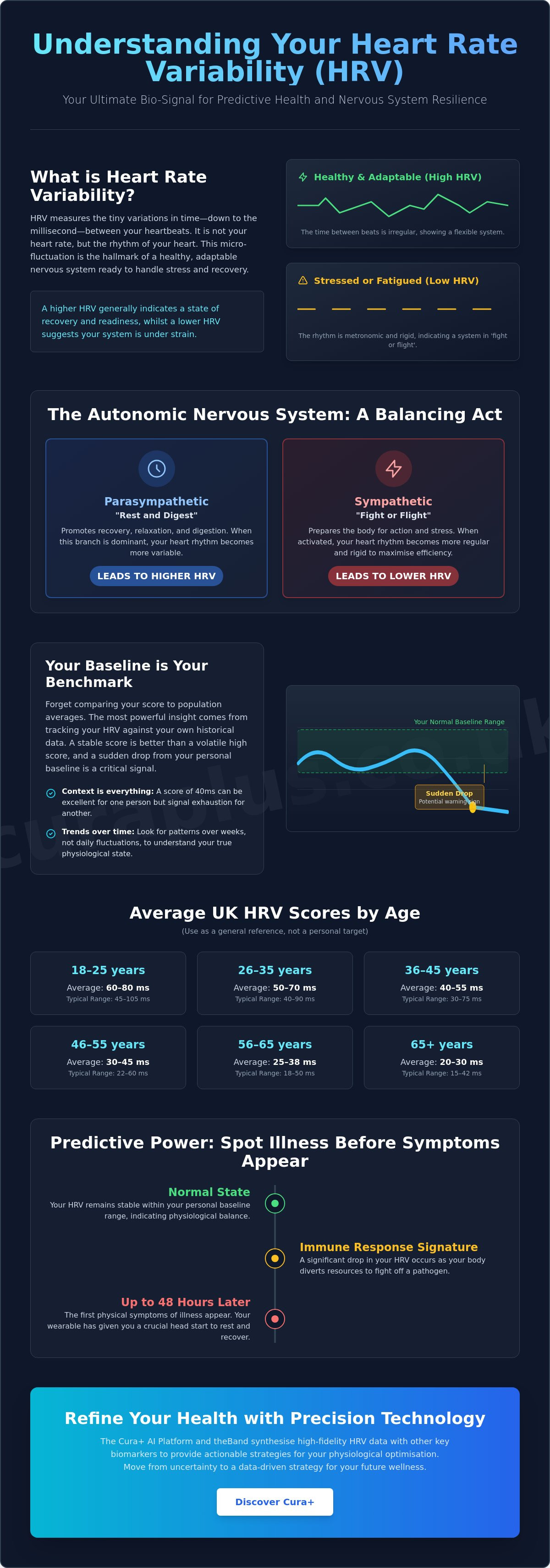
The data you observe is a direct reflection of your Autonomic Nervous System. This system operates through two primary branches: the sympathetic, which prepares you for action, and the parasympathetic, which facilitates recovery. These branches are in a constant state of flux, guided largely by the vagus nerve. When the brain’s hypothalamus receives signals of safety, it allows the parasympathetic branch to introduce more variability into your heart rhythm. Under stress, the sympathetic branch takes over, causing the heart rhythm to become more rigid and predictable to ensure efficiency during a perceived threat.
Why Milliseconds Matter in 2026
In 2026, the precision of our measurement tools has transformed HRV into an essential tool for physiological intelligence. The high-fidelity sensors within theBand are engineered to capture raw millisecond variations with exceptional accuracy. It's a counterintuitive truth that a steady, rhythmic heart rate is often a sign of stress, not health. A metronomic heart rhythm indicates that the body is under significant strain, stuck in a "fight or flight" loop. By monitoring these subtle shifts, you gain a transparent view of your body’s ability to adapt to its environment and maintain homeostasis.
Average HRV Scores in the UK: Why Your Baseline is the Only Metric That Matters
When individuals ask what is a good HRV score UK, they are often searching for a single, reassuring number. However, biology rarely adheres to such simplistic benchmarks. Whilst data from major wearable providers often highlights average HRV scores, these figures should only serve as a broad frame of reference rather than a personal target. An elite endurance athlete may exhibit a baseline exceeding 100 ms, whilst a sedentary professional might find their normal range sits comfortably between 30 and 40 ms. Neither is inherently "wrong"; they simply reflect different physiological realities. The following table outlines the typical ranges observed across the UK population as of 2026:
| Age Range | Average HRV (ms) | Typical Range (ms) |
|---|---|---|
| 18–25 years | 60–80 | 45–105 |
| 26–35 years | 50–70 | 40–90 |
| 36–45 years | 40–55 | 30–75 |
| 46–55 years | 30–45 | 22–60 |
| 56–65 years | 25–38 | 18–50 |
| 65+ years | 20–30 | 15–42 |
Central to this understanding is the fact that a stable, slightly lower score is often more indicative of health than a volatile high score. Chronic health conditions, genetics, and the natural process of ageing act as primary suppressors of variability. If your score is consistently 45 ms, your system has achieved a state of equilibrium. If that score suddenly swings between 30 ms and 80 ms, it signals a nervous system struggling to maintain homeostasis. Stability is the true hallmark of resilience.
Demographic Variables and Gender Differences
HRV typically declines as we age because the nervous system gradually loses its plasticity and responsiveness. Data suggests that men often maintain slightly higher raw scores than women, with averages of 65 ms and 62 ms respectively amongst active populations. Furthermore, modern UK life in densely populated urban centres introduces environmental stressors—noise pollution, artificial light, and high-pressure work cultures—that can systematically suppress these averages compared to rural demographics.
The Importance of Establishing a Health Baseline
Your baseline is your physiological fingerprint. It represents your unique "normal" under standard conditions. This is why building a health baseline is the first step in proactive care. Without this reference point, the data provided by your wearable is merely noise. TheBand is designed to solve this by spending its first 14 days of wear exclusively identifying your unique range, ensuring that every subsequent insight is calibrated to you. You can begin this process of discovery with theBand, which specialises in high-fidelity data acquisition.
Deciphering the Signals: What Causes Your HRV Score to Fluctuate?
Understanding what is a good HRV score UK provides a useful benchmark, but the true power of physiological intelligence lies in interpreting the daily fluctuations of your data. Your heart rate variability is a sensitive barometer of your total systemic load. It doesn't distinguish between a demanding board meeting, a dehydrated state, or a session of high-intensity interval training. All these factors contribute to the "allostatic load" placed upon your autonomic nervous system. When this load becomes excessive, your variability drops, signaling that your body is diverting resources toward immediate survival rather than long-term recovery.
Alcohol remains one of the most potent suppressors of variability. Even a single unit of alcohol consumed during a social evening can significantly depress your HRV for up to 48 hours. This occurs because the body prioritises the metabolisation of toxins over nervous system restoration. Similarly, nutrition and hydration play foundational roles in your readings. Caffeine, whilst often used to boost alertness, can trigger a sympathetic response that reduces millisecond variation if consumed too close to sleep or in excessive quantities. For the significant portion of the UK workforce engaged in shift work, circadian rhythm disruption acts as a chronic stressor, often leading to a persistently low HRV baseline that requires targeted intervention to manage.
The Impact of Lifestyle Behaviours
Sleep quality is the primary driver of parasympathetic reactivation. It's not merely about the duration of rest but the architecture of the night. Tracking sleep stages is therefore critical; without sufficient Deep and REM sleep, the nervous system cannot effectively reset. Beyond the bedroom, environmental factors offer a potent antidote to stress. Research suggests that exposure to "blue space", such as proximity to the UK’s coastal paths or rivers, can trigger immediate parasympathetic activation, helping to restore variability after periods of intense mental strain and work-related burnout.
Physical Strain and Recovery
In the context of fitness, a temporary drop in HRV is not necessarily a negative signal. Intense exercise causes acute fatigue, which is a necessary catalyst for adaptation and growth. The danger lies in chronic overreaching, where the score fails to return to your baseline over several days. You can track daily recovery to distinguish between healthy exertion and the early stages of overtraining syndrome. By mastering these signals, you move beyond the simplistic question of what is a good HRV score UK and begin to manage your health as a complex, masterable system.
HRV as a Predictive Tool: Spotting Illness Before You Feel Sick
Whilst many users focus on what is a good HRV score UK to gauge their fitness levels, the most profound application of this metric is its role as a predictive biomarker. Your body often knows it's becoming unwell long before you experience a sore throat or a headache. This is because the autonomic nervous system is the first responder to internal physiological threats. When a pathogen enters the system, the body initiates an inflammatory response that requires significant energy. This shift in resources is immediately reflected in a sharp, sustained drop below your established HRV baseline, creating what researchers call an "immune response signature."
By tracking immune health through these subtle variations, you gain a window into your body's early defensive actions. HRV acts as a sophisticated early warning system, detecting the body’s inflammatory response in its infancy. This allows for a proactive approach to wellness that was previously reserved for clinical settings. It transforms your daily data from a retrospective record into a forward-looking intelligence tool.
The Science of Viral Onset Detection
The autonomic nervous system reacts to pathogens hours, or even days, before a fever begins to manifest. This reaction is often accompanied by subtle elevations in skin temperature, which, when analysed alongside millisecond-level heart rate data, provides a highly accurate picture of systemic stress. The pre-symptomatic window is the critical period where artificial intelligence can detect these minute biomarker shifts before physical symptoms emerge. By identifying this window, you can intervene before an illness takes hold, potentially reducing the severity and duration of the infection.
Predictive Alerts and Proactive Action
The Cura+ AI Platform is engineered to monitor these patterns with relentless precision. It sends high-priority alerts when your HRV deviates significantly from its predicted path, even if you feel perfectly healthy. When such a drop is detected, the strategy is clear: prioritise rest, increase hydration, and reduce physical or cognitive strain to support the immune system. There is a profound peace of mind that comes from knowing your body’s internal status with absolute clarity. You no longer have to guess why you feel "off"; the data provides the answer. To take control of your physiological narrative, explore how theBand provides the high-fidelity data necessary for these predictive insights.
Optimising Your HRV: Refiining Your Health with theBand and Cura+ AI
Mastering your physiology requires more than just knowing what is a good HRV score UK; it demands a transition from passive observation to active refinement. TheBand by Cura+ serves as the premier instrument for high-fidelity monitoring, capturing the raw millisecond data necessary for true insight. Whilst consumer-grade wearables often provide a surface-level summary, the Cura+ AI Platform synthesises your HRV with 14 other biomarkers to create a comprehensive biological profile. This integration allows for personalised health coaching that responds to your real-time data, offering a level of precision previously unavailable outside of elite performance labs. We are witnessing a fundamental shift from reactive medicine to predictive health intelligence, where you own the narrative of your longevity.
Precision is the enemy of uncertainty. By leveraging high-resolution sensors, theBand ensures that every fluctuation in your autonomic nervous system is recorded with clinical accuracy. This data is then processed by an engine designed to understand the complex interplay between your environment and your biology. You no longer have to wonder what is a good HRV score UK for your specific lifestyle, because the system defines it through the lens of your unique potential. It is a partnership between human intent and machine intelligence.
Beyond Raw Data: The Cura+ AI Advantage
The Cura+ AI Advantage lies in its ability to learn your unique physiological patterns over months of consistent wear. It doesn't just report numbers; it calculates a daily "Readiness Score" that guides your activity levels with surgical precision. If the AI detects a subtle downward trend in your variability, it might suggest a recovery day before you feel the first signs of fatigue. The long-term benefits of AI-driven health monitoring include a deepened understanding of your body's stress thresholds and the ability to maintain peak performance for longer durations.
Practical Steps to Elevate Your Baseline
Elevating your baseline is a methodical process of strengthening your parasympathetic tone. Evidence-based interventions, such as structured breathwork, deliberate cold exposure, and maintaining consistent sleep cycles, have been shown to improve nervous system plasticity. TheBand monitors the efficacy of these interventions in real-time, allowing you to see exactly which behaviours drive the most significant improvements in your variability. We invite you to join the pre-launch phase of theBand for exclusive access to this ecosystem of proactive wellness. Take the first step toward mastering your internal state and transforming your health into a masterable system.
Mastering Your Physiological Narrative
We've shifted the focus from a generic search for what is a good HRV score UK toward a more sophisticated model of physiological intelligence. Your heart rate variability is not a static metric; it's a dynamic bio-signal that offers a real-time window into your nervous system's resilience. By prioritising your unique baseline over population averages, you unlock the power to predict illness and manage stress with clinical-grade accuracy. True wellness isn't about hitting a universal number; it's about understanding the nuances of your own internal state.
The transition from reactive care to proactive mastery begins with high-fidelity data. Experience the future of physiological intelligence with theBand by Cura+. Our platform monitors over 15 essential biomarkers with clinical-grade precision and delivers AI-driven predictive alerts for early illness and stress detection. Supported by UK-based expertise and sophisticated data privacy standards, we provide the clarity you need to optimise your future health. You're no longer guessing about your body's needs; you're mastering them with confidence and foresight.
Frequently Asked Questions
Is a low HRV score always a sign of poor health?
A low HRV score is not an absolute indicator of poor health; instead, it reflects your system's current state of readiness. Factors such as genetics, age, and chronic conditions can naturally suppress scores without indicating an underlying crisis. What matters most is stability relative to your personal history. If you are researching what is a good HRV score UK, remember that a consistent reading of 30 ms can represent high resilience for one individual whilst signalling exhaustion for another.
How much can I expect my HRV to fluctuate on a daily basis?
Daily fluctuations are entirely normal and often range from 5 to 20 milliseconds depending on your recent lifestyle choices. Minor shifts occur in response to sleep quality, hydration levels, and even the timing of your last meal. These variations demonstrate that your autonomic nervous system is actively responding to its environment. We focus on these micro-adjustments to build a comprehensive picture of your physiological intelligence over time rather than reacting to a single data point.
Can I improve my HRV score through diet and exercise alone?
You can certainly elevate your baseline through targeted lifestyle interventions, though diet and exercise are only two components of a larger system. Parasympathetic recovery is heavily influenced by consistent sleep cycles and emotional regulation. Whilst physical training builds long-term capacity, overtraining without adequate rest will lead to a sustained decline in variability. A holistic approach that includes stress management and recovery protocols is essential for achieving meaningful, long-term improvement.
What is the difference between resting heart rate and heart rate variability?
Resting heart rate measures the total number of beats per minute, whilst heart rate variability analyses the specific gaps between those beats in milliseconds. Think of resting heart rate as the speed of your engine and HRV as the responsiveness of your steering. A low resting heart rate often correlates with cardiovascular fitness, but HRV provides the more nuanced data needed to understand your system's ability to adapt to immediate stress and environmental changes.
How does theBand measure HRV differently from a standard fitness tracker?
TheBand utilises high-fidelity sensors designed to capture raw millisecond data with clinical-grade precision. Unlike standard trackers that often rely on smoothed averages or simplified algorithms, our technology prioritises raw accuracy. When integrated with the Cura+ AI Platform, this data is synthesised with 14 other biomarkers to provide a multidimensional view of your health. This ensures your insights are based on a complete biological narrative rather than a single, isolated metric.
Should I be worried if my HRV drops suddenly for one day?
A sudden one-day drop is rarely a cause for concern and usually reflects acute fatigue or a temporary environmental stressor. You should only pay close attention if your score remains significantly below your established baseline for three or more consecutive days. This sustained deviation often serves as an early warning for oncoming illness or systemic burnout. By monitoring these trends, you can adjust your activity levels before a minor dip becomes a major health setback.
How long does it take for the Cura+ AI to learn my personal baseline?
The Cura+ AI requires exactly 14 days of consistent wear to establish your unique physiological fingerprint. During this initial calibration period, the system identifies your typical ranges and response patterns across various levels of strain. This ensures that when you ask what is a good HRV score UK, the answer provided is tailored specifically to your biology. Once this baseline is fixed, the AI can detect even the most subtle deviations from your personal norm.
Can HRV help me manage my daily stress levels more effectively?
HRV is an exceptional tool for stress management because it provides an objective measurement of your internal physiological strain. Often, our psychological perception of stress does not align with our actual biological reality. By checking your variability, you can determine if your nervous system is genuinely overwhelmed or if it possesses the resilience to handle a demanding day. This clarity allows you to make informed decisions about when to push your limits and when to prioritise recovery.


